
Texas Medical Billing Services: A Payer-Readiness and Credentialing Checklist for Multi-State Practices
Texas practices billing across state lines need a revalidation and payer-roster system. Here is the checklist that stops billing-privilege deactivations.
Texas medical billing services carry a specific risk: a Medicare revalidation you missed in one state can deactivate billing privileges that touch your revenue in every state. There are no exemptions, no extensions, and no reinstatement path that preserves the gap.
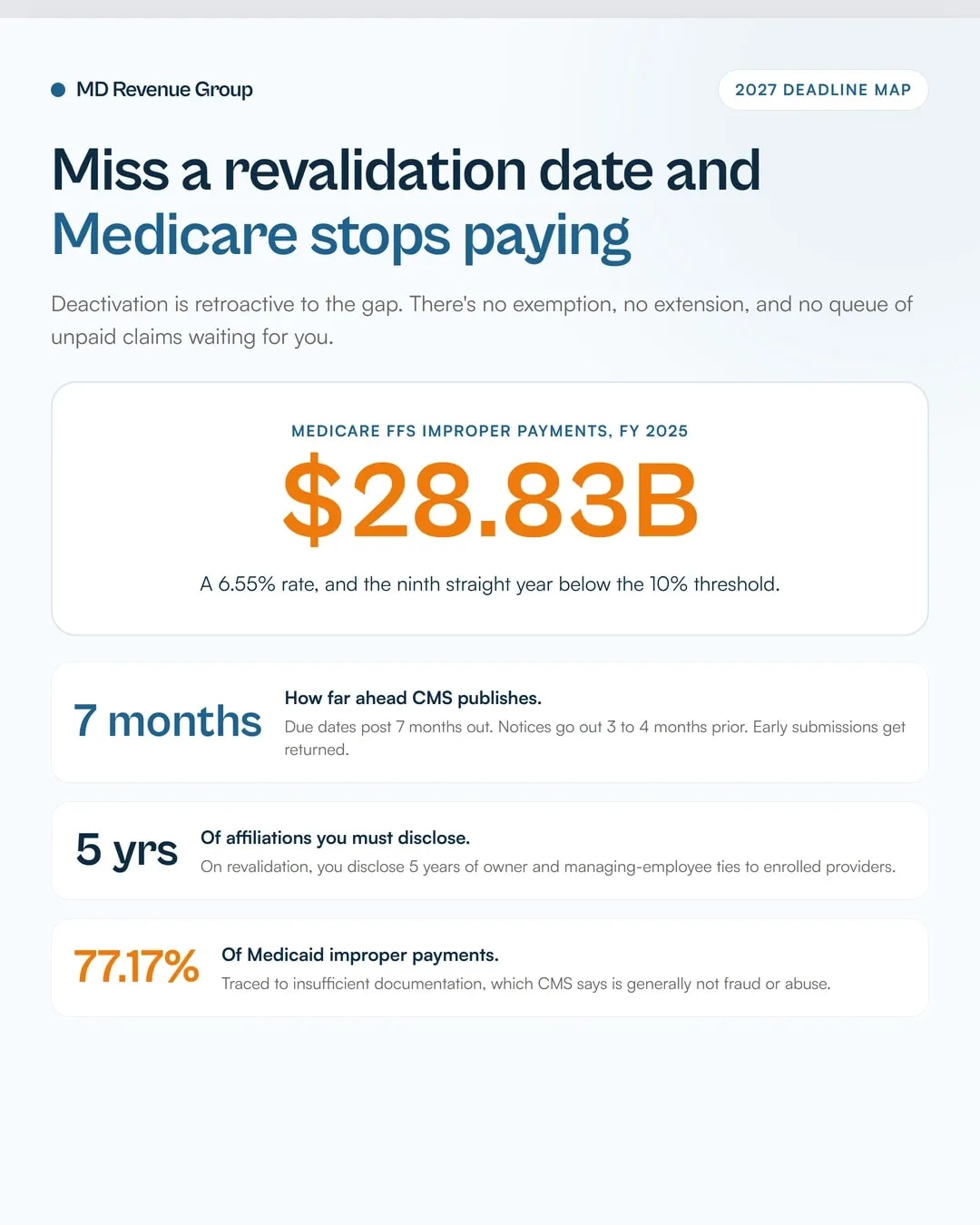
The mechanics are unforgiving. CMS requires providers and suppliers to revalidate every 5 years, and DMEPOS suppliers every 3 years. Miss the date and you get a reimbursement hold or a deactivation. If you are deactivated, Medicare will not reimburse you for services during the deactivation period, and reactivating means submitting a complete Medicare enrollment application from scratch.
For a Texas practice that also bills in California, Florida, or New York, the exposure multiplies. Each state adds its own payer enrollment obligations on top of the federal cycle. This is the control system that keeps a multi-state practice billing clean.
Key takeaways
- Revalidation is mandatory and has no escape hatch. CMS states there are no exemptions and it does not grant extensions.
- Due dates publish 7 months ahead. Notices go out 3 to 4 months prior. CMS tells you to revalidate within 3 months of your due date "even if you haven't received a notification."
- Deactivation is retroactive to the gap. Medicare does not pay for services furnished during deactivation.
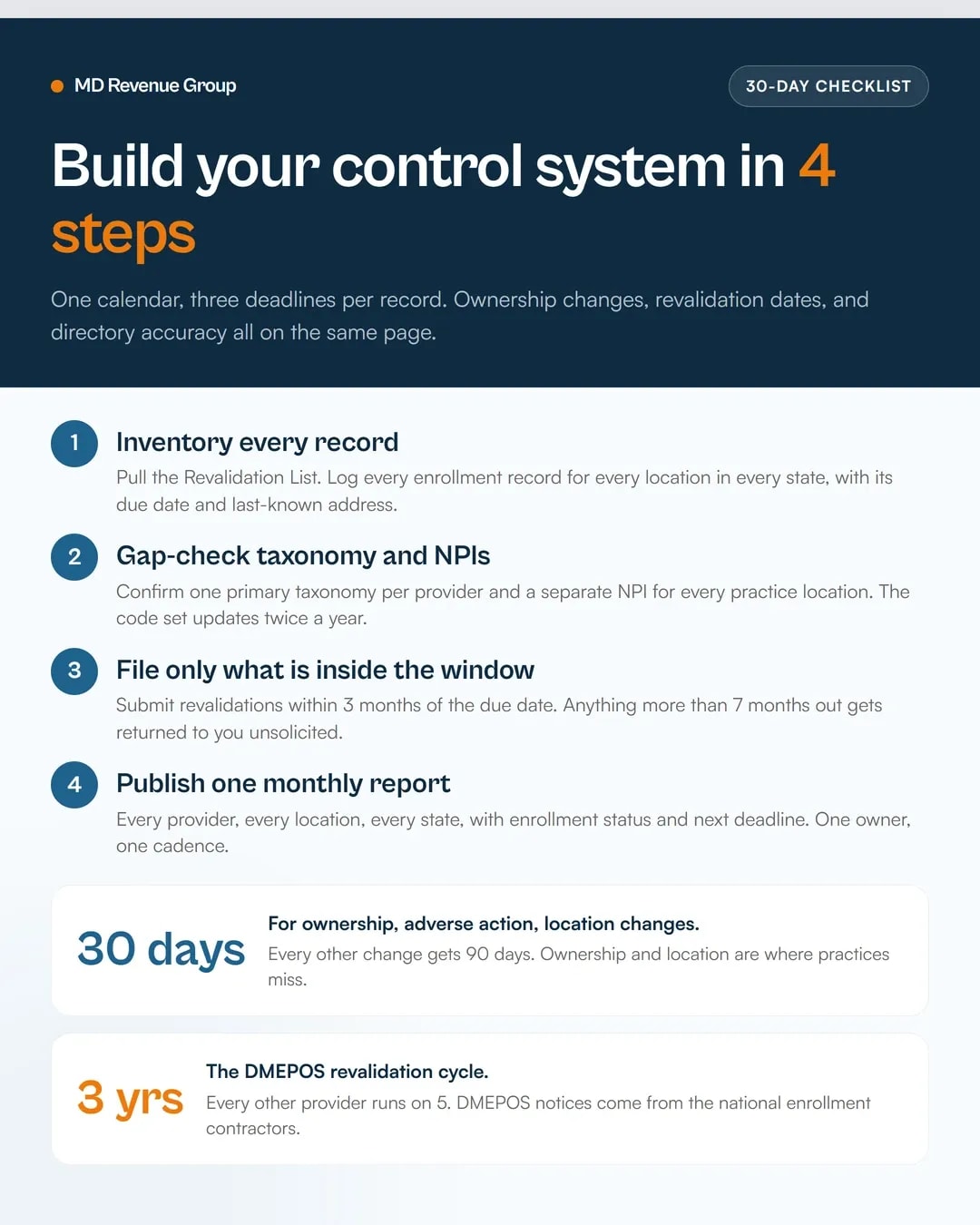
- Ownership, adverse legal action, and practice location changes have a 30-day clock. Everything else gets 90 days.
- A revalidating provider must disclose 5 years of owner and managing-employee affiliations. CMS can deny or revoke on undisclosed risk.
What happens if you miss a Medicare revalidation date
The consequence is stated plainly on CMS's revalidation page: failing to revalidate on time "could result in a hold on your Medicare reimbursement or deactivation of your Medicare billing privileges."
Deactivation is the severe end, and recovery is slow. If your privileges are deactivated, you have to resubmit a complete Medicare enrollment application to reactivate. Medicare does not reimburse you for services during the deactivation period. There is no retroactive payment queue waiting for you.
Two details in CMS's guidance get missed:
Unsolicited revalidations get thrown out. CMS says revalidate when you are within three months of your due date, even without a notification. It also says don't revalidate when your due date is more than seven months away unless you received a notice, because "these unsolicited revalidations will be returned." Sending a file early wastes the submission and resets nothing.
CMS reserves the right to ask off-cycle. The 5-year cycle is the floor, not the ceiling. CMS can request revalidation outside the normal window, which means your calendar needs a trigger for notices, not just a date lookup.
The regulatory hooks are specific enough to matter in a dispute: 42 CFR 424.515 for revalidation, 424.540 for reactivation, 424.516 for change of information, and 424.535 for revocation.
Our Medicare revalidation control calendar covers the recurring calendar mechanics. This article is about what breaks when a practice operates across state lines, which is a different failure mode.
The revalidation calendar CMS actually publishes
Here is the sequence CMS built, with the dates it commits to.
Timing | What happens |
|---|---|
7 months before due date | CMS posts the due date on the Medicare Revalidation List |
3 to 4 months before due date | Enrollment contractor emails or mails the notice |
Within 3 months of due date | Revalidate, even without a notice received |
More than 7 months out | Do not submit. Unsolicited files are returned |
Due date passes | Reimbursement hold or deactivation |
DMEPOS suppliers operate on a different clock. They revalidate every 3 years rather than 5, and their notices come from the National Provider Enrollment DMEPOS East and West contractors rather than the Medicare Administrative Contractor.
The structural point for a Texas practice: your revenue cycle calendar has to be per-enrollment, per-location, and per-state. A single spreadsheet date for "the practice" fails the moment you have a second location or a second state.
CMS also flags that a PECOS application can be automatically deleted due to inactivity. Start a revalidation, abandon it, and you may have to rebuild the file. Save partial work somewhere that survives.
What a multi-state practice has to track that a single-state one does not
Running medical billing services in Texas while billing in other states adds a layer that single-state practices never build: the taxonomy and location matrix.
Each of these is a separate record with a separate lifecycle:
- NPI per location. CMS requires an NPI for each practice location, and DMEPOS suppliers need an NPI per location with a surety bond per NPI.
- Taxonomy code per provider, with one designated primary. You may select more than one taxonomy when applying for an NPI, but one must be marked primary. The primary designation drives how payers match your records.
- Medicare enrollment per state. Initial enrollment covers enrolling for the first time, enrolling in another Medicare contractor's jurisdiction, or re-enrolling after prior enrollment.
- Change reporting per record. A new location in Austin and a new location in Houston are separate events with separate clocks.
- Payer enrollment per state per tax ID. A Texas Blue Cross Blue Shield enrollment does nothing for a California patient.
The taxonomy code set is the quiet risk here. CMS publishes and releases it twice a year, in January and July. That is a built-in trigger, and most practices never wire it into anything. Add both release dates to your calendar and diff your provider records against the current set.
Where our medical billing services team sees the most multi-state leakage is the same place every time: a provider adds a location, the front desk starts scheduling there, and the record still points at the old address. Claims go out, get denied for address mismatch or wrong rendering provider, and the fix is administrative rather than clinical.
Practices in Florida or California face the same record-hygiene problem under a different payer set. Our California medical billing and Florida medical billing services pages cover the state-specific payer enrollment side, and the state coverage list has every state we track. The federal revalidation rules in this article apply identically in all of them.
The 30-day and 90-day change reporting clocks
Most credentialing denials trace back to a missed change report, not a missed revalidation.
CMS's rule from the provider enrollment guide is specific:
Change | Reporting deadline |
|---|---|
Change in ownership | 30 days |
Adverse legal action | 30 days |
Change in practice location | 30 days |
All other changes | 90 days |
CMS frames the consequence as avoiding revoked billing privileges. In practice, a stale practice-location record is the mechanism behind a broad family of claim denials: rendering provider not found, taxonomy mismatch, service location outside the enrolled footprint.
For a practice adding Texas locations, the practice-location clock is the one that bites. Ownership changes trip it too, and a practice that transitions from sole proprietorship to an LLC or S-corp has more than one ownership event to report.
Put both clocks on the same calendar as the revalidation date, with different colors. One calendar, three deadlines.
Why affiliations are the risk nobody tracks
This one is new in the CY 2027 Home Health PPS and provider enrollment proposed rule, and it deserves more attention than it is getting.
Under 42 CFR 424.519, when CMS requests it, an initially enrolling or revalidating provider must disclose all affiliations that it, or any of its owning or managing employees or organizations, has or had within the previous 5 years with a currently or formerly enrolled Medicare, Medicaid, or CHIP provider that carries a disclosable event.
If CMS determines an affiliation poses undue risk of fraud, waste, or abuse, it may deny or revoke enrollment under 424.530(a)(13).
Practically: revalidation is now a background check on your ownership history, not a data refresh. Any physician who left a practice that later had an adverse event, any employed clinician who came from a facility under scrutiny, any management company with a history, falls inside the 5-year window.
CMS is also proposing to broaden 424.535(a)(4), which currently revokes for false or misleading enrollment data. The expansion would apply to every provider and would reach documentation submitted alongside an application. CMS's reasoning: the submission need not be intended to gain enrollment, and the information need not have been certified true, because "correctness is the salient point."
Assemble the affiliation history before your revalidation window opens, not during it. A five-year ownership and employment timeline is a two-day exercise if you start early and a month-long scramble if you do not.
The provider directory audit covers the NPI and payer directory side of this, and how long provider credentialing takes covers realistic payer-by-payer timelines. Both matter more in a multi-state setup where the same provider holds records in several states at once.
What the payer-side deadline means for your front end
Payer requirements shape how quickly you can get an answer back, which determines whether you can bill first time.
CMS-0057-F, released January 17, 2024, required impacted payers to implement certain provisions by January 1, 2026, with API requirements extending to primarily January 1, 2027. In February 2024, the National Standards Group granted enforcement discretion for covered entities using FHIR-based prior authorization APIs without the X12 278 standard.
CMS-0062-P, published April 14, 2026, extends many of those requirements to drug prior authorization and adds small-group QHP issuers on the FF-SHOP Exchanges as impacted payers. It proposes NCPDP SCRIPT, Formulary and Benefit, and Real-Time Prescription Benefit standards beginning October 1, 2027 for pharmacy-benefit electronic prior authorization.
The practical read for a Texas practice: payer-side prior authorization plumbing keeps tightening, and your front-end staff should expect faster structured responses, not slower ones. Practices that build their own structured request workflow get denial reasons in a usable format. Practices that fax and phone get the same nonpayment.
The prior authorization automation guide covers where these automations break in practice. If your payer mix includes a plan with a January 1, 2027 API deadline, confirm your vendor is actually connected rather than assuming it.
Texas-specific readiness items
We keep Article 2 anchored on federal enrollment mechanics, because those are the rules that deactivate billing privileges, and they apply identically in Texas. Texas-specific state billing requirements sit with the state Medicaid agency and the Texas Department of Insurance, and they move on their own cycle.
Practically, for a Texas practice billing across state lines:
Build the state matrix now. For each state you bill in, name the owner of: Medicare revalidation, state Medicaid enrollment, commercial payer enrollment, and the NPI/taxonomy record. One name per line. Practices with no named owner on a line fail that line.
Keep Texas commercial payer rosters current. Payer directory accuracy drives patient routing and, with it, your claim volume. A provider-directory audit is a recurring task, not a one-time fix.
Check multi-state timely filing rules. Deadlines vary by state and by payer. A practice billing in four states is managing four filing calendars. Our guide to timely filing denials covers the mechanism.
Watch the DMEPOS accreditation status if you dispense. This one is live right now. CMS withdrew approval of the Board of Certification/Accreditation International (BOC) as a DMEPOS accreditation organization on December 2, 2025. BOC sued on December 16, 2025 in the U.S. District Court for the District of Maryland, case 1:25-cv-04150-MJM. On January 9, 2026 the court granted a temporary restraining order staying the withdrawal, so BOC remains a CMS-approved accreditation organization until further notice. Verify the current status before you rely on any accreditation body's approval. It is the kind of thing that changes without a press release.
The 30-day readiness checklist
Work through this in order. Each item has an owner and a date.
Week 1: inventory
- Pull the Medicare Revalidation List. Record every enrollment record for every location in every state. Record the due date and the last-known address.
- Identify which records are DMEPOS. Those run on a 3-year cycle.
- Name an owner per record. No owner means no control.
Week 2: gap analysis
- Flag every record inside the 7-month window. Those are the ones CMS will return if you submit unsolicited.
- Diff each provider's taxonomy against the current NUCC code set. Confirm one primary taxonomy is designated per provider.
- Confirm every practice location has its own NPI.
- Rebuild the 5-year affiliation timeline for every owner and managing employee.
Week 3: file the low-risk items
- Submit revalidations for records already inside the 3-month window.
- Report any ownership, adverse legal action, or practice-location changes that are still open.
- Save a copy of every PECOS submission receipt somewhere it will not be lost to inactivity.
Week 4: build the system
- Create the recurring calendar with three deadline types per record: 7-month review, 3-month action, 30/90-day change reporting.
- Add the January and July taxonomy code set release dates as recurring checks.
- Add a monthly report showing every provider, every location, every state, with enrollment status and next deadline.
- Assign ownership for payer directory accuracy across all states.
The monthly report is the piece that matters. Credentialing failures are invisible until a claim denies, and a denial 14 months after a missed change report is very hard to trace back. One page, one owner, one cadence.
If you want a second set of eyes on your records before a deadline hits, our credentialing services team will review your enrollment files and flag gaps. Or request a free audit and we'll walk your payer rosters and revalidation calendar with you.
Author: MD Revenue Group revenue cycle team. We manage credentialing, enrollment, and payer rosters for multi-state practices, and we publish the control failures we find in production.
Disclosure: Figures come from CMS program pages and the CY 2027 Home Health PPS and provider enrollment proposed rule (FR Doc 2026-13602, published July 6, 2026). Enrollment requirements are federal and apply in Texas. Texas state-level billing requirements vary and change on their own cycle; verify state-specific obligations directly with the Texas Department of Insurance and HHSC. Confirm the BOC accreditation status before relying on it, since the litigation is ongoing.