
Orthopedic Billing Services and the 2027 Global Surgery Proposal: A Claim-Edit Readiness Guide
CMS proposes paying 50% on same-day E/M visits billed with global procedures. Here's what orthopedic practices must change in their claim edits.

Orthopedic billing services are about to absorb a payment cut CMS has already spelled out. In its CY 2027 Physician Fee Schedule proposed rule, released July 14, 2026, CMS names orthopedic surgery as a specialty that would "see a significant decrease" in Medicare payments.
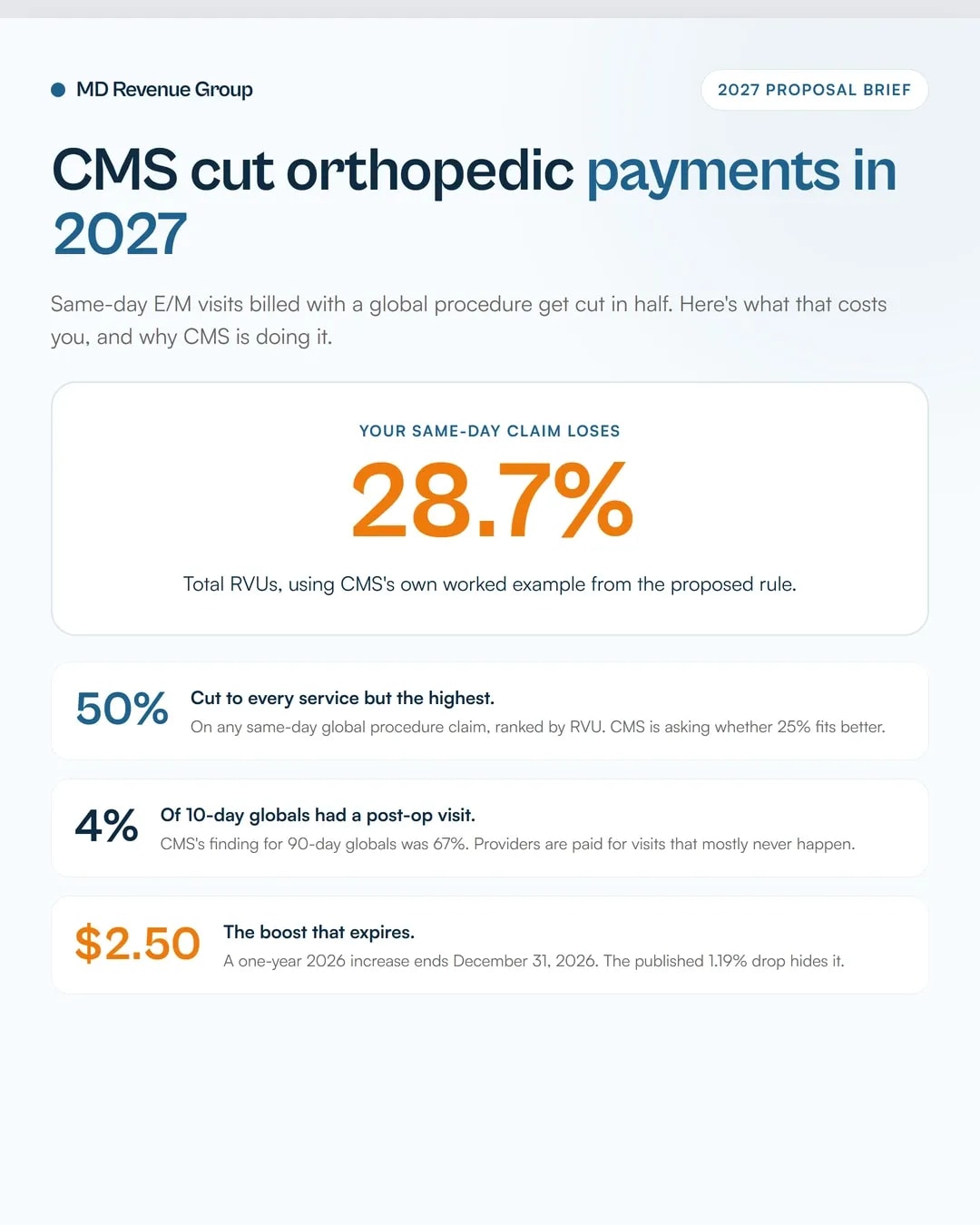
The proposal reduces payment on the higher-valued service when a physician bills a separately identifiable office or outpatient E/M visit with modifier -25 on the same day as a 0-, 10-, or 90-day global procedure. The most expensive service keeps 100%. Everything else on that claim gets cut to 50%. Orthopedic surgery is one of four specialties CMS flags for the biggest hit, alongside dermatology, otolaryngology, and hand surgery.
The comment period closed September 14, 2026. The final rule will be CMS-1848-F. Until then, everything below describes a proposal, not law.
Key takeaways
- Orthopedic surgery is named directly. CMS lists it among specialties that "would see a significant decrease" from the CY 2027 proposal.
- The mechanism is a 50% cut to the second-most-expensive service on a same-day global procedure claim. The highest-RVU service still pays 100%.
- CMS built its own worked example. CPT 99212 at 1.78 RVUs drops to 0.89 when it shares a claim day with higher-RVU procedures.
- The conversion factor falls in 2027. Proposed qualifying APM CF is 32.8409, down 1.68%.
- Post-op data collection may stop entirely. CMS proposes pausing MACRA section 523 because the visits it tracks "are not occurring, yet providers are still being paid for these visits."
What the CY 2027 proposal actually changes
The CY 2027 OPPS and ASC proposed rule is the facility-side counterpart, and the two rules interact.
Read the mechanism carefully, because most summaries get it backwards.
CMS is not cutting every E/M visit billed with a procedure. It is ranking the services on a single claim day by RVU. The highest one pays in full. Every other surgical procedure or E/M visit on that same day pays at half.
The proposal covers office or outpatient E/M visits furnished by the same physician, or a physician in the same group practice, on the same day as a 0-, 10-, or 90-day global procedure. CMS identifies the E/M with modifier -25.
Element | What CMS proposed |
|---|---|
Highest-RVU service that day | Paid at 100% |
All other surgical procedure(s) or E/M visit(s) that day | Paid at 50% |
Scope | O/O E/M with modifier -25, same physician or same group |
Global periods affected | 0-day, 10-day, 90-day |
Reduction percentage | 50%, matching the longstanding surgical MPPR |
Comment status | Seeking comment on whether 25% would fit better |
CMS wants comment on three things: the value of the adjustment, whether 25% would be more appropriate than 50%, and whether the policy should reach inpatient E/M visits too.
Our read: the 50% number is probably not where this lands. CMS itself flags 25% as a candidate, and commenters in 2019 asked for 5% or 25% instead. Two dozen comment summaries predicting the final percentage would be guesswork. The direction is the safe bet. The magnitude is not.
If you run orthopedic billing services for a practice that does a lot of arthroscopy with a post-op E/M on the same day, this single line item can move. Model it yourself with the worksheet at the end of this piece.
How much does a same-day E/M visit lose?
CMS published a worked example inside the proposed rule. Use it. It is the clearest illustration of the math anywhere.
A patient receives an office E/M visit using CPT 99212, then has two skin lesions removed: CPT 11300 and CPT 11301. Using 2026 non-facility RVU values:
Code | 2026 non-facility total RVUs | Proposed payment |
|---|---|---|
CPT 11301 | 3.48 | 3.48 (100%) |
CPT 11300 | 2.89 | 1.445 (50%) |
CPT 99212 | 1.78 | 0.89 (50%) |
CMS states the individual reductions. The aggregate effect is worth doing yourself. Pre-proposal, that day totals 8.15 RVUs. Under the proposal it totals 5.815 RVUs. That is a 28.7% reduction on the day's total RVUs.
We are flagging that 28.7% as our arithmetic on CMS's published RVU values, not a CMS claim. CMS never states the blended percentage. But it is the number a practice manager needs, because that is the question being asked: how much of my check goes away if I bill this way?
The ordering rule is what most practices get wrong. It is highest RVU wins, not first-listed, not first-performed, not highest-priced by charge amount. A high-dollar implant-heavy procedure with modest RVUs can lose to a lower-charge code with a big RVU. Sort by RVU before you sort by anything else.
Why orthopedic takes a cut even without modifier -25
Here is the part that surprises orthopedic practice owners.
The modifier -25 hit lands hardest on otolaryngology, dermatology, and podiatry, with smaller exposure for hand surgery and colon and rectal surgery. CMS says those specialties "frequently report E/M services with modifier -25 in conjunction with a 0-, 10-, or 90-day global procedure."
Orthopedic gets named in the first list, the significant-decrease list. Two other drivers are doing work there.
Indirect Practice Cost Index removal. The CY 2027 proposal removes the IPCI from the practice expense RVU calculation. CMS attributes the broader specialty declines largely to the modifier -25 change and the IPCI removal together.
A new practice expense methodology. Current PE RVUs still rely on AMA Physician Practice Information Survey data from 2008. CMS proposes phasing out the step that anchors specialty PE per hour to data from 2007 or earlier, replacing it with a stabilizer that smooths volatility without a fixed anchor.
For a high-fixed-cost specialty running expensive equipment, implant inventory, and multiple locations, changes to how indirect PE spreads across services is not a rounding error. We would model this line separately from the modifier -25 exposure so you can see which one is hurting.
Also note the site's mix. For CY 2027, CMS proposes OPPS rates up 2.4% and ASC rates up 2.4%, both net of a 0.8 percentage point productivity adjustment against a 3.2% market basket. If your orthopedic revenue is facility-weighted, that offset matters. If it is office-weighted under the PFS, it does not.
What the conversion factor does to your orthopedic revenue
Every dollar in orthopedic billing is multiplied by the conversion factor. Here is the 2027 math, exactly as CMS computed it.
Conversion factor | CY 2026 | CY 2027 proposed | Change |
|---|---|---|---|
Qualifying APM | $33.5875 | $33.1693 | −$0.40 (−1.19%) |
Nonqualifying APM | $33.4009 | $32.8409 | −$0.56 (−1.68%) |
Anesthesia qualifying APM | n/a | $20.4165 | n/a |
Anesthesia nonqualifying APM | n/a | $20.2143 | n/a |
The headline decline understates the policy change. Public Law 119-21, which CMS calls the Working Families Tax Cut legislation, provided a one-year +2.50% conversion factor increase for CY 2026. That expires after December 31, 2026.
CMS's own words: this "effectively means that current law requires −2.50% reduction in Medicare payment under the PFS compared to CY 2026." To compute the 2027 factor, CMS took the CY 2026 factors without the 2.50%, applied a +0.53% budget neutrality adjustment, then applied the statutory updates: +0.75% for qualifying APM participants, +0.25% for everyone else.
So the -1.19% and -1.68% are what survives after the 2.50% boost disappears. Practices modeling this as a flat 1.5% reduction are understating the policy change by roughly a full point. Budget around the 2.50% expiring, then apply the final factor when it lands.
What the MACRA section 523 data pause means for post-op visits
This is the story behind the policy, and it explains the direction CMS is heading.
In the CY 2015 PFS final rule, CMS finalized transitioning all 10-day and 90-day globals to 0-day globals, letting you bill post-operative visits after the procedure day as standalone visits. MACRA section 523(a) blocked implementation and forced CMS to collect data first, through a RAND research contract.
The collection instrument was CPT code 99024, a no-pay code meaning "post-operative follow-up visit, normally included in the surgical package." It pays nothing. It exists to tell CMS whether those visits actually happen. And the collection is limited to practices with 10 or more practitioners, in 9 States.
The CY 2019 PFS final rule published the finding: only 4% of reviewed 10-day globals and 67% of reviewed 90-day globals had one or more post-operative visit during the global period.
Fast forward to CY 2027. CMS proposes to pause the data collection entirely, stating the burden outweighs the value. Its rationale, verbatim: "We currently have several years of data that have continued to illustrate what we believe is the issue with the post-operative visits during the global period and how these visits are not occurring, yet providers are still being paid for these visits under the current global payment policy."
CMS also posted a public use file showing the work RVUs that would remain if all post-operative visits were removed from each global package.
Read that together with the modifier -25 proposal and the intent is clear. CMS believes the global packages overpay for post-operative care, and the -25 change is the first lever available without a full statutory fight. If you bill orthopedics, your post-op visit economics are the first thing under the microscope.
Five claim edits to build before January 1
You do not need new software. You need a review layer that catches the pattern before submission.
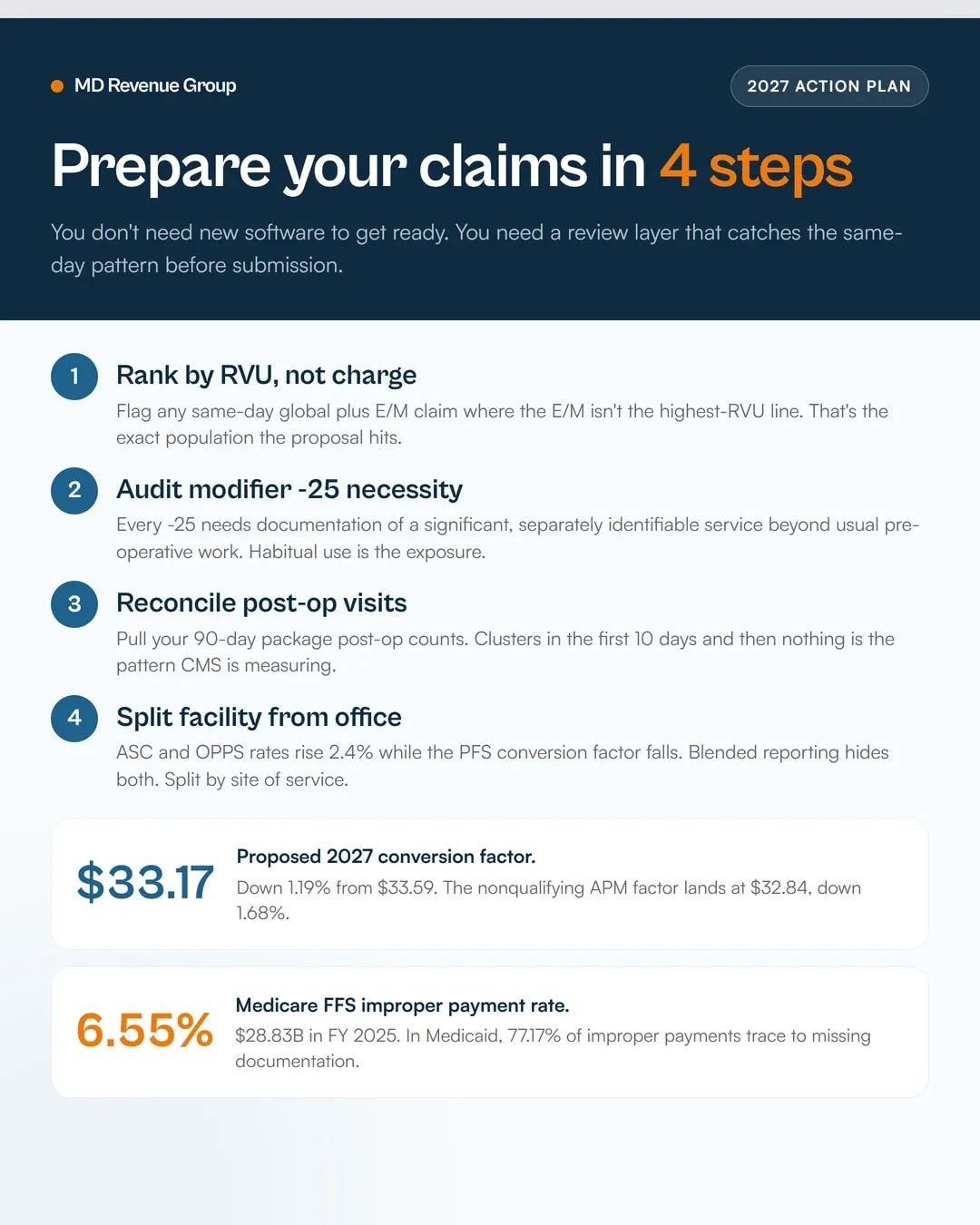
1. Rank by RVU, not charge. Flag any same-day claim with a global procedure plus an E/M where the E/M is not the highest-RVU line. That is the exact population the proposal hits.
2. Audit modifier -25 necessity. Every -25 needs documentation of a significant, separately identifiable service beyond the usual pre-operative work. Practice-wide, the modifier gets used as a default for "we had a visit that morning." That habit is the exposure.
3. Track post-op visit occurrences by global period. If you are a 10+ practitioner group, you can report 99024 today, and the data is what CMS is studying. If you are under 10 practitioners, you cannot. Know which side of that line you are on before 2027.
4. Reconcile 90-day package assumptions against actual visits. A 90-day global bundles roughly 90 days of post-operative care. If your post-op visits cluster in the first 10 days and then stop, that is the utilization pattern CMS is measuring. Document whether post-op care is being separately furnished and billed when it should be.
5. Model facility and office separately. The 2.4% OPPS and ASC updates and the PFS conversion factor decline move in different directions. Blended numbers hide that. If your revenue cycle management reports one blended AR metric, split it by site of service before you build the 2027 budget.
One more item worth flagging: G2211 becomes a modifier. The proposal replaces the standalone HCPCS code with a modifier worth +16% of the associated E/M base code, plus a second placeholder modifier (MOD2) worth +32% for practitioners in a Shared Savings Program ACO or the LEAD Model. CMS proposes keeping current limits on using it with modifier -25, and seeking comment on whether to allow it with -25 when the E/M is on the same day as a global procedure. Orthopedic groups heavily invested in the complexity add-on should watch that comment thread.
The global surgery modifier reference covers the modifier mechanics that interact with this proposal, and global surgery and same-day E/M in 2027 walks through the proposal mechanics at the code level.
Where orthopedic denials already concentrate
The CY 2027 proposal is forward-looking. These problems are in your remittance data right now.
The CY 2026 Medicare Physician Fee Schedule final rule is the baseline this proposal reacts to. CMS finalized an efficiency adjustment for CY 2026 of −2.5%, calculated from the Medicare Economic Index productivity adjustment using a 5-year look-back. It applies to work RVUs and the intraservice portion of physician time for non-time-based services. E/M, care management, and behavioral health codes are exempt.
CMS's FY 2025 improper payments fact sheet reported a Medicare fee-for-service improper payment rate of 6.55%, or $28.83 billion, down from 7.66% in FY 2024. That is the ninth consecutive year below the 10% statutory threshold. Medicaid sat at 6.12%, or $37.39 billion, where 77.17% of improper payments were caused by insufficient documentation, which CMS notes "is generally not indicative of fraud or abuse."
That last line is the one to sit with. Documentation gaps, not fraud, drive the Medicaid number. The same dynamic shows up in the HHS-OIG virtual check-in and e-visit audit issued April 23, 2026. OIG found $1,964,125 in potential improper payments across 173,287 virtual check-in services furnished within 7 days after or 24 hours before an E/M with the same diagnosis code. Another 120,316 E/M services were billed with an unnecessary modifier. A separate $298,200 across 10,237 e-visits involved services within 7 days of another e-visit, same diagnosis code.
The pattern CMS is auditing and the pattern CMS is proposing to cut are the same pattern: same-day, same-diagnosis, multiple separately billed services. Orthopedic practices already absorbing downcoding and duplicate-service edits should read the automatic downcoding and payer algorithm analysis next, because a claim pattern can be simultaneously denied by a payer edit and repriced by the CY 2027 rule.
If orthopedic denial volume is above what your clean claim rate should produce, we audit the workflow and show you the line items. Request a free revenue audit.
How to model the financial impact
Build the worksheet before the final rule publishes. Four inputs:
Line one: modifier -25 exposure. Count same-day global-plus-E/M claims from the trailing 12 months. For each, rank by RVU and halve everything below the top line. That total is your at-risk RVU volume.
Line two: post-op visit utilization. Pull your 90-day package post-op visit counts. High occurrence on 90-day packages is the profile CMS is targeting first.
Line three: conversion factor delta. Apply the expiring 2.50%, not just the published percentage. Model 32.8409 as the floor until CMS-1848-F replaces them.
Line four: site-of-service mix. Weight OPPS and ASC at +2.4% and office-based PFS at the conversion factor decline. Practices with heavy ASC volume will net out better than practices with office-heavy orthopedic visits.
Our medical billing audit team can run lines one and two against your trailing 12 months before the final rule publishes, so you are working from your own numbers rather than ours.
Then check your clean claim rate benchmark and your denial pattern against how to reduce claim denials before the rule lands. Fixing the documentation problems that cause today's denials is the same work that reduces your exposure to a payment cut based on documentation quality.
Orthopedic practices have a narrow window here. The proposal is public, the comment period has closed, and the final rule will land before January 1. Practices that build the claim-edit layer now will be ready. Practices that wait will be modeling it during open enrollment.
Author: MD Revenue Group revenue cycle team. We work with orthopedic, cardiology, and multi-specialty practices on claim edits, denial recovery, and payer follow-up, and we publish what we find in production.
Disclosure: Every CY 2027 figure in this article comes from the proposed rule (FR Doc 2026-14327, published July 16, 2026). The comment period closed September 14, 2026 and the final rule will be CMS-1848-F. Verify the final conversion factor and modifier policy against the final rule before publishing or changing budgets. The 28.7% blended reduction is our arithmetic on CMS's published 2026 RVU values and is not a CMS figure.