
How Long Does Provider Credentialing Take? Payer-by-Payer Breakdown
Credentialing takes 60-180 days depending on the payer. See the real timeline for Medicare, Medicaid, and commercial plans, plus how to avoid delays.
Provider credentialing takes 60 to 180 days depending on the payer. Medicare enrollment through PECOS typically runs 60-90 days, state Medicaid programs range 45-90+ days, and commercial payers often need 90-150 days, with some networks stretching to 180. Start the process 120 days before your provider's intended start date, not 60, or you'll create a gap where they can't bill.
This guide breaks down the real timeline payer by payer, the causes behind most delays, and the exact concrete steps you need to keep a new provider's start date from slipping.
Key takeaways
- Credentialing runs 60-180 days industry-wide. Medicare averages 60-90 days, commercial payers 90-150, and some networks take up to 180.
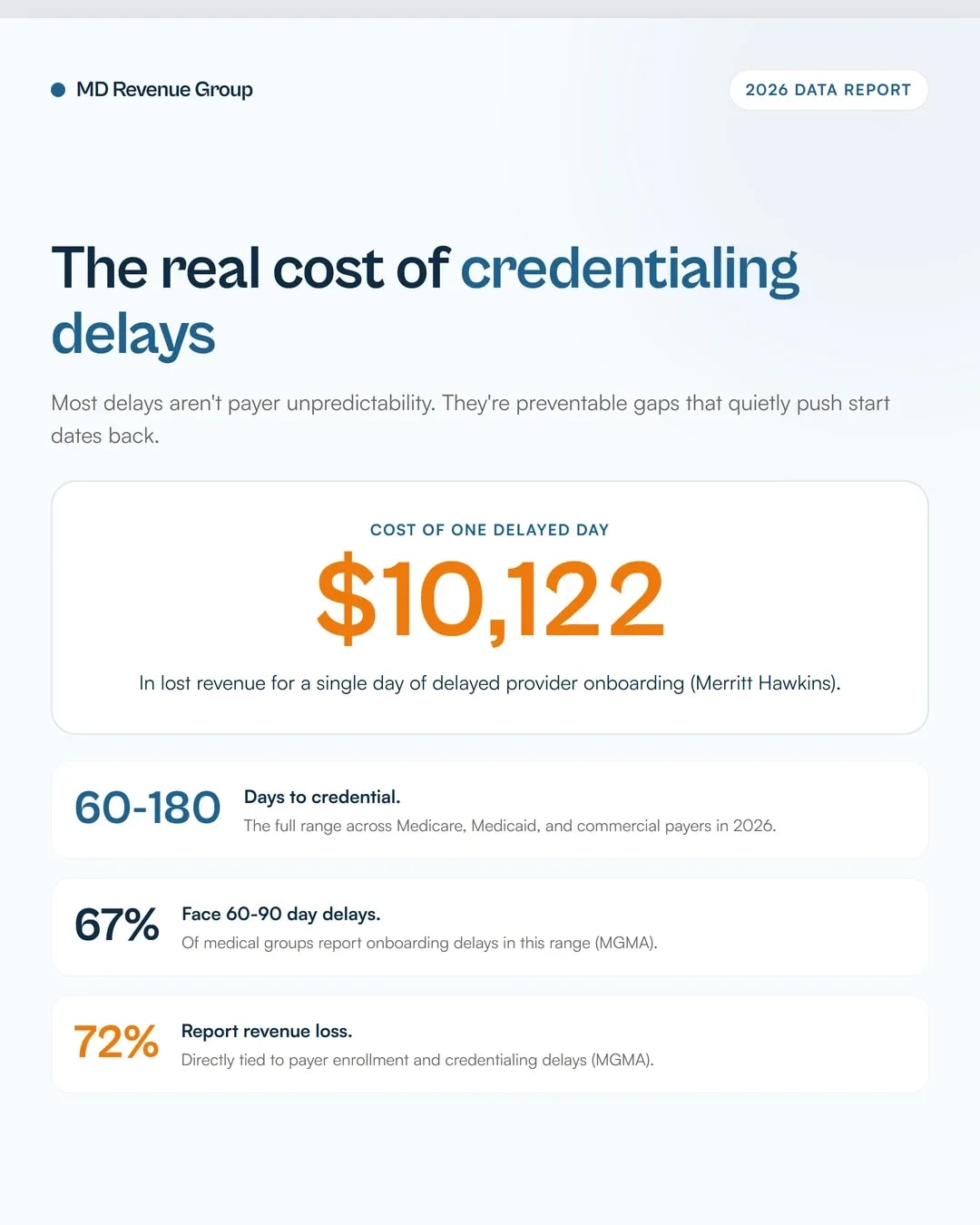
- 67% of medical groups report onboarding delays of 60-90 days, and 72% report revenue loss tied directly to enrollment delays (MGMA).
- A single day of delayed provider onboarding can cost a practice over $10,000 in lost revenue (Merritt Hawkins survey data).
- CAQH profiles must be re-attested every 120 days. An expired profile stalls every payer that pulls from it at once, not just one application.
- Start credentialing 120 days before the intended start date. Starting at 60 days almost guarantees a billing gap.
How credentialing works, payer by payer
Credentialing isn't one process. It's 3 separate tracks (Medicare, Medicaid, and commercial) running in parallel, each with its own verification system and its own pace.
Medicare runs through PECOS. Electronic submissions without a required site visit process in about 15 days for roughly 95% of clean applications, but full enrollment, including primary source verification, typically takes 60-90 days. CMS's 2026 update added enhanced primary source verification requirements, which has added time to applications that hit any documentation gap.
Medicaid is state-by-state, and the range is wide. States running automated verification close applications in 45-75 days. States still relying on manual review routinely run 90+ days. If you're credentialing in a state you haven't worked with before, don't assume last year's timeline from a different state applies.
Commercial payers typically need 90-150 days, and some larger insurer networks report timelines closer to 180 days in 2026. Most commercial payers pull data from CAQH rather than running a fully separate application, which is why a stale CAQH profile causes damage across every commercial payer at once.
Credentialing isn't a one-time event either. CMS reduced its revalidation cycle from 5 years to 3 years for certain specialties in 2026, which means a provider you credentialed a few years ago may already be due for revalidation sooner than your calendar assumes. Missing a revalidation deadline can suspend billing privileges the same way a late initial application delays them.
That's a separate clock from initial credentialing, and it's easy to lose track of once a provider is up and running. Practices that treat credentialing as a one-time project instead of an ongoing cycle are the ones who get blindsided by a revalidation notice with 30 days left on it.
Realistic timelines you can actually plan around
Here's how the 3 tracks compare when you're building a start-date plan:
Payer type | Typical timeline | Fastest case | Common risk factor |
|---|---|---|---|
Medicare (PECOS) | 60-90 days | ~15 days for clean electronic submissions | Primary source verification gaps |
Medicaid (state-run) | 45-90+ days | 45 days in automated-verification states | Manual review states running 90+ days |
Commercial (CAQH-based) | 90-150 days | 90 days with a current CAQH profile | 120-day re-attestation lapses |
Large commercial networks | Up to 180 days | Rare | High application volume, backlog |
The pattern across every column is the same: the fastest case only happens with a clean, current application. Every delay column traces back to something that was missing, expired, or out of date at submission.
Common delays and how to avoid them
Nearly every credentialing delay traces back to 3 root causes, not payer unpredictability.
Stale CAQH data is the biggest one. Providers must re-attest their CAQH ProView profile every 120 days. Miss that window and the profile lapses, which means every payer pulling from CAQH for primary source verification gets stale or incomplete data at the same time. One missed re-attestation stalls multiple applications simultaneously, not just one.
Expired documentation is the second. Licenses, DEA registration, malpractice coverage, and board certification documents all have their own expiration dates. If any one of them lapses while an application sits in review, the payer pauses the file until it's replaced, and you're back at the end of the queue.
Payer backlogs are the third, and they're the one you can't control directly. Payers are processing more applications while running tighter verification standards, which means even a perfect application can sit longer than it would have 2 years ago. Our credentialing services build buffer time into every timeline specifically because of this variable.
A fourth cause shows up less often but costs more when it does: mismatched data across systems. If a provider's PECOS enrollment lists a practice address, tax ID, or NPI that doesn't exactly match what's on file with a commercial payer or state Medicaid program, the application gets flagged for manual review even though nothing about the provider's qualifications is in question. Data mismatches are pure administrative friction, and they're entirely preventable with a single source-of-truth checklist before submission.
Network closures compound the problem in some markets. A commercial payer with a full specialty panel in your region may sit on an application for months before formally denying it, rather than rejecting it quickly. If you haven't heard anything back after 45 days, call and ask directly whether the panel is open, instead of assuming the file is simply moving slowly.
What you need to prepare before you start
Have every single one of these ready and organized before you submit anything, not after a payer asks for it:
- Current, unexpired state medical license and DEA registration
- Board certification documentation, current and not pending renewal
- Active malpractice insurance certificate with correct coverage limits
- Updated CAQH ProView profile, attested within the last 120 days
- Work history with no unexplained gaps, or a written explanation for any gap
- NPI and PECOS enrollment details matching exactly across every system
A 3-provider cardiology group we worked with lost 6 weeks on a new hire's commercial enrollment because 2 malpractice certificates in the CAQH profile had expired mid-review. Neither payer flagged it until the file was already 45 days in, and by then the group had already told the incoming physician a start date that had to be pushed back twice. Once the group started tracking document expiration dates on a shared calendar instead of relying on CAQH's own reminder emails, the same process for their next hire closed in 92 days with no rework.
Action steps to protect your start date
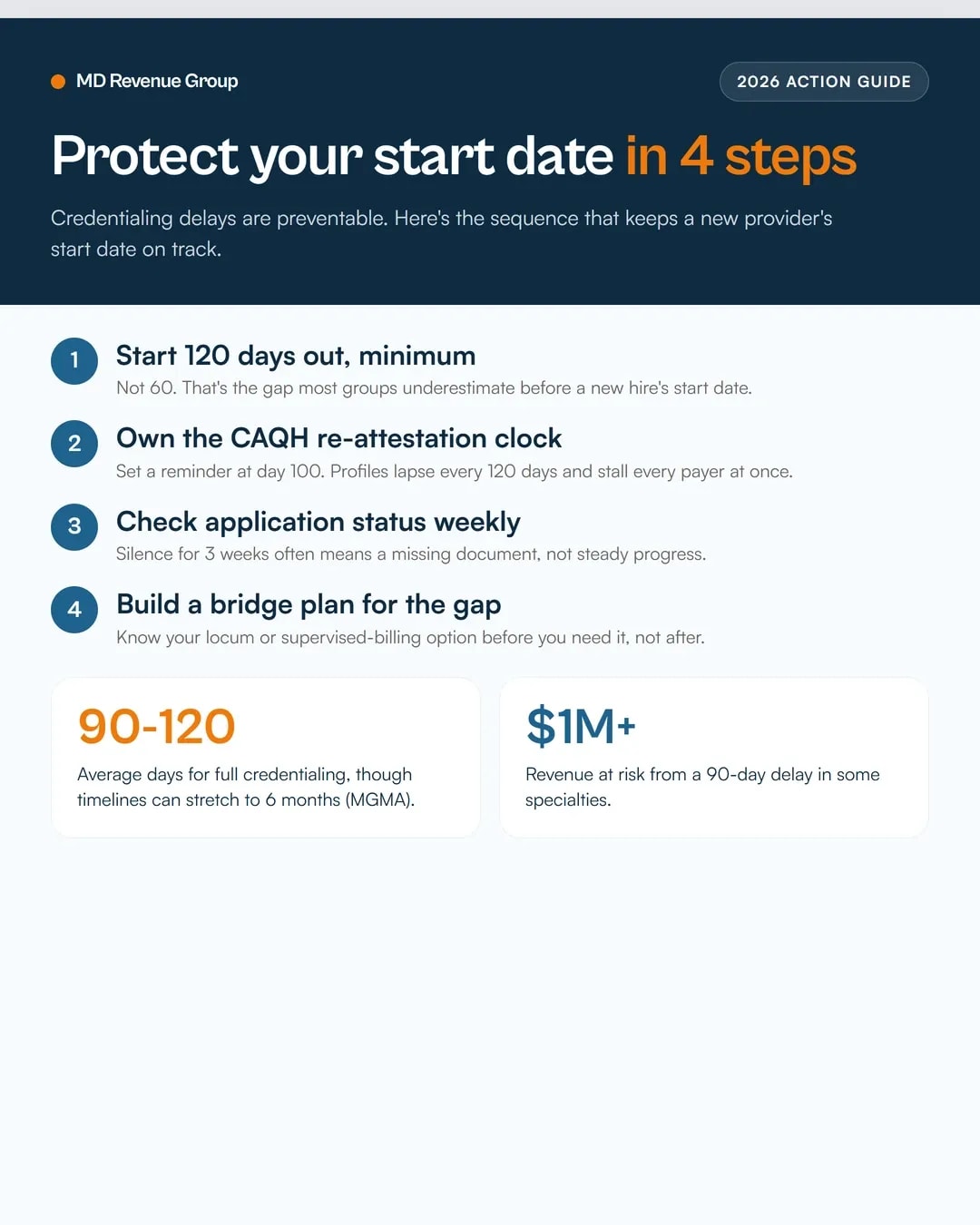
Start 120 days before the intended start date, minimum. 60 days is the number most practices default to, and it's the reason nearly 67% of groups report 60-90 day onboarding delays (MGMA). Building in the extra buffer absorbs a payer backlog without pushing the actual start date.
Assign one single owner to the CAQH re-attestation calendar. Set a reminder at day 100, not day 120, so there's enough time to fix any lapsed document well before the deadline actually hits.
Track every application's status weekly, not monthly. A payer that's silent for 3 weeks isn't necessarily still processing your file in the background. Sometimes it's simply sitting on a request for a document that nobody on your side noticed had come in.
Run medical billing services and credentialing on the same timeline, since a provider who's credentialed but whose billing setup isn't ready loses just as many billable days as one who's still waiting on enrollment. The two need to finish together, not one after the other.
Budget for the revenue risk, not just the administrative cost. A 90-day enrollment delay for a single physician can put hundreds of thousands of dollars in revenue at risk, and over $1 million in some specialties. That number should shape how much buffer time you build in, not just how annoyed the front desk gets waiting on paperwork.
Build a locum tenens or supervised-billing bridge plan for the gap you can't avoid. Even with a 120-day head start, some commercial networks and manual-review Medicaid states will still push past your target date. Knowing in advance whether a new hire can bill under a supervising physician's NPI, or whether you'll need a locum arrangement, keeps a slow payer from becoming a zero-revenue month.
Keep a single source-of-truth document for every provider's credentialing data. Practice address, tax ID, NPI, license numbers, and malpractice policy details should live in one place that every application pulls from. When that data changes, even something as small as a suite number, update it everywhere at once instead of letting individual payer files drift out of sync with each other.
Get your credentialing timeline mapped out
If you have a new provider starting in the next 6 months, the credentialing clock needs to start now, not the week before they arrive. Talk to our credentialing team and we'll map out your exact payer-by-payer timeline before a single day of billable revenue is at risk, whether you're onboarding one physician or an entire multi-specialty group.