SUD Counseling Notes vs. Billing Records: A Part 2 Documentation and Disclosure Playbook
Understand 42 CFR Part 2 rules for SUD counseling notes vs billing records. Learn QSOA requirements when you outsource psychiatric billing services.
SUD Counseling Notes vs. Billing Records: A Part 2 Documentation and Disclosure Playbook
When behavioral health practices decide to outsource psychiatric billing services, maintaining strict boundaries between Substance Use Disorder (SUD) counseling notes and standard billing records is a critical compliance requirement. On February 16, 2026, the Department of Health and Human Services (HHS) Office for Civil Rights (OCR) began enforcing updated 42 CFR Part 2 regulations. These rules align federal confidentiality standards for SUD treatment with HIPAA penalty frameworks, while introducing a clear legal distinction between clinical session notes and payment records.
Key Takeaways
- Enforcement authority: The HHS Office for Civil Rights (OCR) enforces 42 CFR Part 2 under HIPAA Civil Monetary Penalty structures as of February 16, 2026.
- SUD counseling notes definition: Notes analyzing session content must be kept physically or electronically separate from the general medical record.
- Separate consent required: Counseling notes cannot be disclosed under general Treatment, Payment, and Operations (TPO) consent. They require specific, separate patient authorization.
- Billing integration permitted: Billing records (ICD-10 codes F10 to F19, CPT codes, claims, and ERAs) fall under standard TPO consent and do not require EHR field segmentation.
- QSOA mandate: External billing companies must execute both a Business Associate Agreement (BAA) and a Qualified Service Organization Agreement (QSOA).
Understanding the 2026 42 CFR Part 2 Final Rule
Federal privacy protections under 42 CFR Part 2 historically restricted any disclosure of substance use disorder treatment records without explicit, patient consent for every single claim submission. The 2026 final rule modernized these standards by creating parity with HIPAA while protecting sensitive therapeutic communications.
Under the updated framework, providers no longer need to segregate general SUD diagnostic codes or medication-assisted treatment (MAT) billing lines within their electronic health record (EHR) systems for payment purposes. However, the rule creates heightened protection for SUD counseling notes, mirroring HIPAA psychotherapy notes.
42 CFR PART 2 RECORD CLASSIFICATION
| Record Category | Applicable Consent & Storage Requirement |
|---|---|
| SUD Counseling Notes (Therapist analysis & dialogue) | Requires separate, specific patient consent. Must be stored separately from EHR medical file |
| Billing & Payment Records (CPT 90837, ICD-10 F10.20, ERAs) | Covered under single general TPO consent. Can be integrated into standard EHR billing |
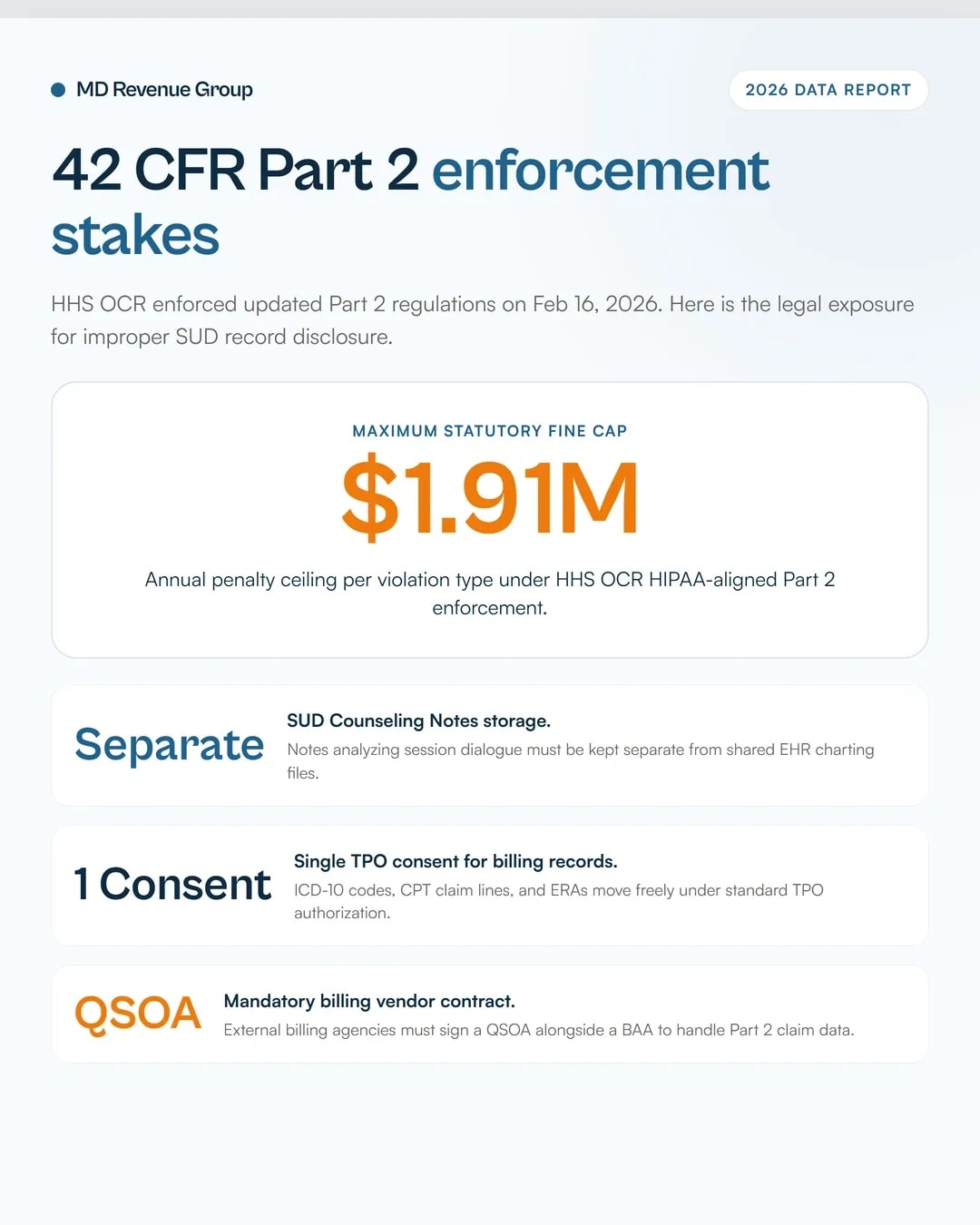
Failing to distinguish between clinical commentary and billable documentation creates severe legal exposure. OCR enforces HIPAA-aligned civil monetary penalties reaching $1.91 million per violation category per calendar year.
Practices reviewing their overall consent architecture can cross-reference our guide on 42 CFR Part 2 mental health billing 2026 consent rules to verify patient intake protocols.
Defining SUD Counseling Notes vs. Billing Records
Maintaining compliance requires clinical staff and billing personnel to understand what data elements belong in the protected counseling note versus the billing record.
SUD Counseling Notes
SUD counseling notes represent private notes recorded by an addiction counselor, psychiatrist, or licensed clinical social worker documenting or analyzing private, group, or family counseling sessions.
These notes include:
- Personal impressions regarding patient emotional state and coping mechanisms
- Detailed therapeutic dialogue summaries and sensitive disclosures
- Intimate family history details discussed during individual sessions
- Preliminary clinical hypotheses not yet finalized into diagnostic codes
SUD counseling notes must be stored separately from the patient's general medical record. Placing counseling notes into shared EHR charting tabs accessible by billing staff constitutes an unauthorized disclosure.
Billing Records
Billing records encompass operational data required to generate electronic claims (837I or 837P) and process remittances (835 ERA).
Billing records include:
- Diagnostic codes such as ICD-10 F10.20 (Alcohol dependence, uncomplicated) or F11.20 (Opioid dependence, uncomplicated)
- Procedure codes including CPT 90791 (Psychiatric diagnostic evaluation), 90834 (Psychotherapy, 45 minutes), and 90837 (Psychotherapy, 60 minutes)
- Start and stop times, session duration, and service location indicators (Place of Service 10 or 02)
- Provider NPI, taxonomy codes, and payer remittance details
Because billing records contain objective clinical data rather than session analysis, they move through normal claims adjudication channels under single TPO consent.
For practices seeking broader revenue stability across behavioral health operations, implementing dedicated medical billing services ensures billing files contain accurate claim lines without exposing restricted clinical notes.
Consent Architecture: TPO Consent vs. Specific Authorization
The 2026 rule establishes two distinct consent mechanisms for handling patient information:
Governance Category | Single General TPO Consent | Specific Patient Authorization |
|---|---|---|
Permitted Scope | Treatment, Payment, and Health Care Operations | Restricted clinical disclosure |
Records Covered | ICD-10 codes, CPT codes, claim files, ERAs | SUD counseling notes, legal proceedings |
Vendor Access | Covered under BAA and QSOA agreement | Requires named recipient and expiration date |
Revocation Standard | Written revocation applies to future TPO | Written revocation stops immediate release |
A patient signing a single general TPO consent grants your practice permission to send claims to commercial insurers, clearinghouses, and third-party billers. However, if a biller requests access to the provider's private session commentary to verify medical necessity, that access requires a specific written authorization naming the billing specialist.
If your practice manages complex authorization tracking alongside billing workflows, review our behavioral health prior authorization 10-step workflow to prevent authorization-related claim rejections.
QSOA Governance for Third-Party Billing Vendors
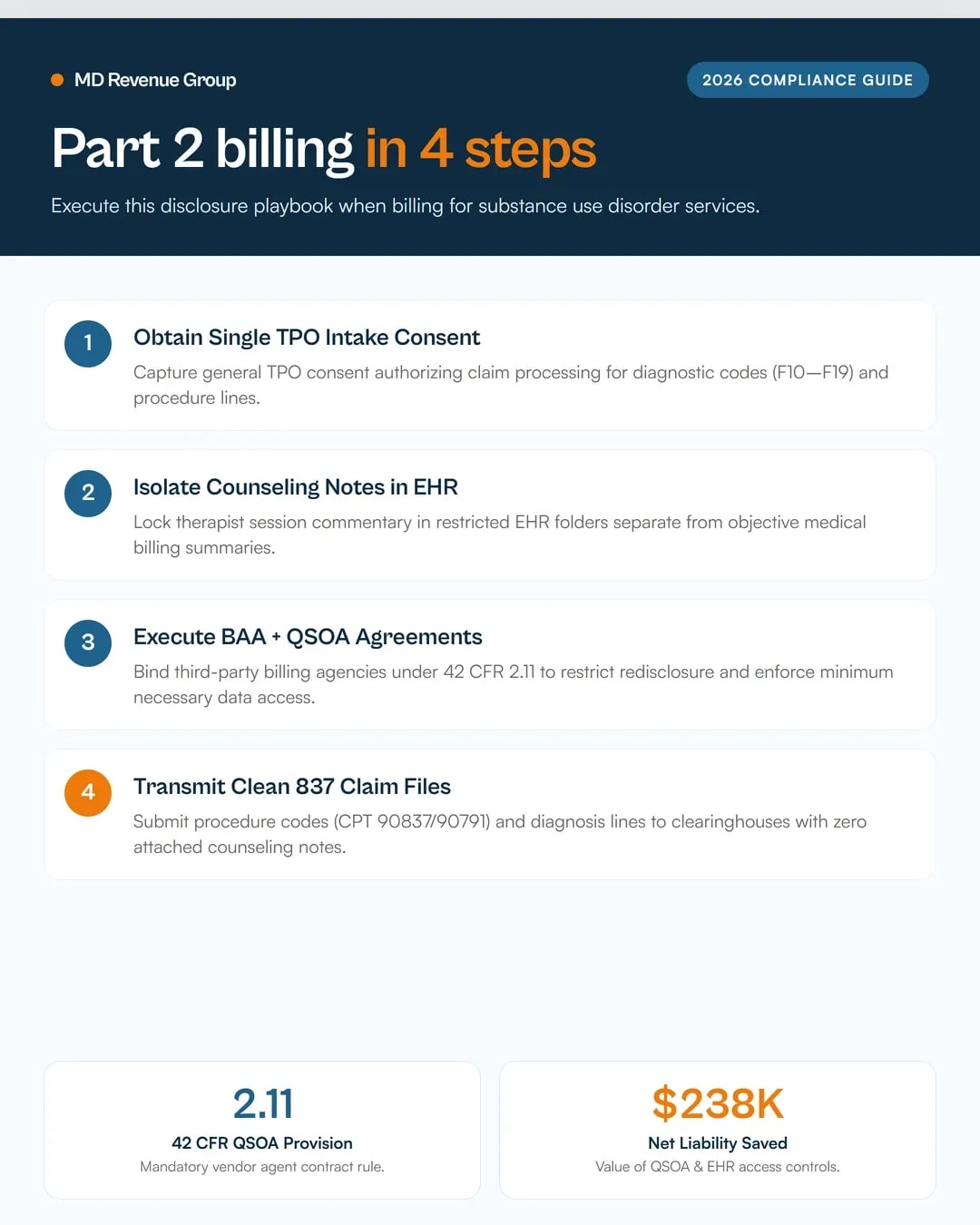
When a practice contracts with an external agency to handle claims, signing a standard Business Associate Agreement (BAA) is legally insufficient. Under 42 CFR 2.11, the vendor must also execute a Qualified Service Organization Agreement (QSOA).
A QSOA is a legally binding contract that commits the billing vendor to three specific obligations:
- Agent Acknowledgement: The vendor acknowledges that it acts as an agent of the Part 2 program and is fully bound by 42 CFR Part 2 regulations.
- Redisclosure Prohibition: The vendor agrees to resist judicial efforts to obtain patient records through subpoena unless authorized by a court order under Subpart E.
- Minimum Necessary Data Access: The vendor certifies that its staff will only access minimum necessary billing fields (CPT, ICD-10, duration, dates of service) and will not request or store SUD counseling notes.
| THIRD-PARTY BILLING VENDOR QSOA WORKFLOW |
|---|
| 1. Practice obtains Single TPO Consent from patient during intake 2. Provider charts clinical note in restricted tab; extracts CPT/ICD-10 codes 3. Billing vendor receives 837 claim data under active BAA + QSOA agreement 4. Vendor submits claim to clearinghouse; zero counseling notes transmitted |
Working with certified revenue partners who understand behavioral health compliance protects your practice from joint liability. Our team provides specialized support for practices seeking comprehensive revenue cycle management backed by strict QSOA protocols.
Literal Documentation Examples for Psychiatric Billing
Physicians and licensed therapists must structure clinical documentation so that medical necessity is obvious in the billing record without transferring narrative counseling notes into the invoice file.
Incorrect Documentation Practice (Exposes Protected Counseling Notes)
"Patient attended 60-minute session. Discussed childhood trauma regarding alcoholic parent, feeling deep shame about past heroin relapse in 2022, and argument with spouse last Tuesday. Patient cried for 20 minutes. Billed CPT 90837 and ICD-10 F11.20."
Why it fails: This note combines clinical session analysis and intimate personal details with billing indicators. If sent to a payer medical reviewer, it breaches SUD counseling note protections.
Correct Documentation Practice (Separated Billing Record)
Medical Record / Billing Summary:"Date of Service: 08/20/2026. Start Time: 09:00 AM. End Time: 10:00 AM (60 minutes).Diagnosis: F11.20 (Opioid dependence, uncomplicated).Service Rendered: CPT 90837 (Psychotherapy, 60 minutes).Medical Necessity: Patient evaluated for ongoing relapse prevention and behavioral stabilization. Patient demonstrated active participation in cognitive restructuring. Progress made toward treatment plan goal #2. Next session scheduled in 7 days."
>SUD Counseling Note (Stored in Restricted System File):"[Detailed therapeutic dialogue, emotional processing notes, and family history reflections kept strictly in separate locked folder]."
By separating the objective billing summary from therapeutic reflections, the provider satisfies payer audit requirements while upholding 42 CFR Part 2 confidentiality.
Practices needing to verify provider credentials and payer enrollment structures before billing can review our credentialing services to eliminate enrollment delays.
Proprietary Calculation: Penalty Risk vs. Audit Costs
To illustrate the financial risk of improper Part 2 record sharing, consider a 4-provider psychiatric practice processing 600 claims monthly.
If the practice allows its external billing vendor to view complete clinical notes without a QSOA, an OCR audit triggers Tier 3 HIPAA/Part 2 civil monetary penalties.
Model Assumptions:
- Monthly Claims: 600 claims
- Annual Adjudicated Records: 7,200 patient records
- Violation Classification: Reasonable cause / failure to execute QSOA (Tier 2/3 violation)
- OCR Statutory Penalty Floor: $10,000 per un-agreed vendor disclosure, capped at $250,000 annually per violation category
Potential OCR Penalty Exposure:
1 un-executed QSOA across active billing workflow = $250,000 statutory cap
Remediation and Governance Costs:
Legal Review & QSOA Agreement Drafting = $3,500
EHR Role-Based Access Control (RBAC) Reconfiguration = $4,000
Billing Vendor Compliance Audit & Staff Training = $4,500
Total Remediation Cost = $12,000
Net Risk Reduction:
$250,000 penalty exposure - $12,000 remediation cost = $238,000 net value
Investing $12,000 in vendor contract governance and EHR access controls eliminates $238,000 in net legal liability while ensuring complete compliance during federal audits.
Multi-State Compliance: Managing Regional Disclosure Laws
Federal rules under 42 CFR Part 2 establish baseline protections, but state laws frequently impose stricter behavioral health privacy rules.
For instance, behavioral health providers operating under medical billing New York regulations must navigate state Mental Hygiene Law Section 33.13, which mandates explicit state-level consent forms before releasing patient data to third-party payers. Similarly, practices managing medical billing Pennsylvania claims must comply with the Pennsylvania Drug and Alcohol Abuse Control Act, which requires specific statutory language on all redisclosure notices.
Understanding how federal Part 2 rules interact with regional laws prevents claim holds and keeps your revenue cycle moving smoothly.
Frequently Asked Questions
What is the main difference between SUD counseling notes and medical billing records?
SUD counseling notes contain a therapist's private analysis of session dialogue and must be stored separately from the medical record under specific patient consent. Billing records include ICD-10 codes, CPT codes, dates, and durations required for claims processing under general TPO consent.
Does a standard HIPAA BAA cover external billing for substance use disorder clinics?
No. External billing companies handling Part 2 records must sign both a Business Associate Agreement (BAA) and a Qualified Service Organization Agreement (QSOA) under 42 CFR 2.11.
Can billing staff view SUD counseling notes to justify medical necessity during a claim appeal?
No. Billing staff should only access objective medical record summaries containing CPT codes, diagnosis codes, session start and stop times, and progress markers. Viewing raw counseling notes requires a specific, written patient authorization.
What are the penalties for violating 42 CFR Part 2 in 2026?
HHS OCR enforces 42 CFR Part 2 under HIPAA Civil Monetary Penalty structures, which range from $137 to $68,928 per violation, capped at $1.91 million annually per violation type.
Next Steps for Your Practice
Maintaining compliance while optimizing reimbursement requires rigorous documentation standards, secure consent workflows, and experienced billing management.
If your practice needs to audit behavioral health documentation, update vendor agreements, or clean up claims, we are here to help. Request a free audit with our RCM experts to secure your billing operations today.