42 CFR Part 2 and Mental-Health Billing: How the 2026 Consent Rules Affect Payment Operations: Medical Billing for Mental Health Services
Understand 42 CFR Part 2 compliance in medical billing for mental health services under HHS 2026 single TPO consent rules and SUD counseling note safeguards.
42 CFR Part 2 and Mental-Health Billing: How the 2026 Consent Rules Affect Payment Operations: Medical Billing for Mental Health Services
Navigating 42 CFR Part 2 compliance when handling medical billing for mental health services requires practice managers to align patient consent workflows with HHS and SAMHSA regulations enforced by the Office for Civil Rights (OCR) as of February 16, 2026. The updated Part 2 regulations align Substance Use Disorder (SUD) record confidentiality with HIPAA privacy standards. Practices can now obtain a single, general patient consent covering Treatment, Payment, and Health Care Operations (TPO) for all future disclosures, eliminating the old requirement for per-disclosure consent forms. However, strict operational boundaries remain for SUD counseling notes, redisclosure protocols, clearinghouse data routing, and Qualified Service Organization Agreements (QSOAs).
Key Takeaways for Behavioral Health Administrators
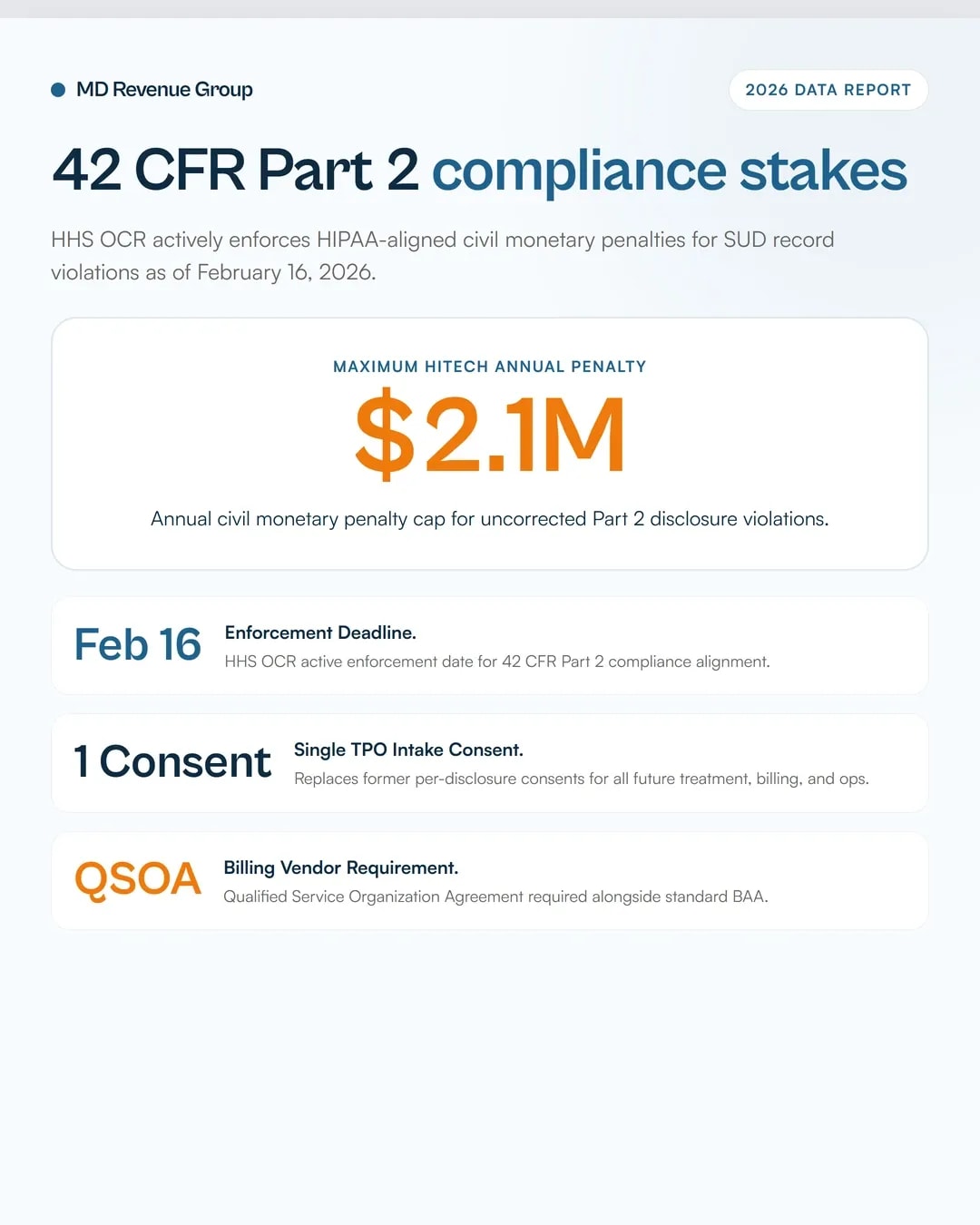
- Enforcement Active: The HHS OCR actively enforces 42 CFR Part 2 compliance standards aligned with HIPAA as of February 16, 2026.
- Single TPO Consent: Patients can sign one broad consent covering Treatment, Payment, and Health Care Operations for all future claim submissions.
- SUD Counseling Notes Protected: Counseling notes must be stored separately in the EHR and require specific, separate patient authorization for disclosure.
- QSOA Mandate: External billing companies handling SUD claims must execute a Qualified Service Organization Agreement (QSOA) in addition to a standard BAA.
What Is 42 CFR Part 2 and What Changed in 2026?
Title 42 of the Code of Federal Regulations Part 2 governs the confidentiality of Substance Use Disorder patient records created by federally assisted programs. Historically, Part 2 created severe billing operational barriers because it required specific, per-disclosure patient consents naming every insurance payer, clearinghouse, and billing vendor before a claim could be transmitted.
42 CFR PART 2 HISTORICAL VS 2026 RULES
| Rule Element | 2026 Final Rule Standard (Enforced Feb 16, 2026) |
|---|---|
| TPO Disclosures TPO Redisclosure Penalties Breach Notification SUD Counseling Notes | Single general written consent covers all future TPO HIPAA entities may redisclose under standard HIPAA Aligned with HIPAA/HITECH (up to $2.1M/year tiers) Governed under HIPAA Breach Notification Rule Protected distinct category requiring separate consent |
Under the 2024 HHS Final Rule, which reached mandatory compliance enforcement on February 16, 2026, HHS aligned Part 2 privacy standards with HIPAA under CARES Act Section 3221. This modification permits behavioral health providers to simplify claim processing while maintaining legal protections against the use of SUD records in legal proceedings.
42 CFR PART 2 COMPLIANCE LANDSCAPE (2026 DATA)
┌───────────────────────────────────────────────────────────────────┬──────────┐
│ Active Compliance Enforcement Date                                │ Feb 2026 │
│ Maximum Annual Civil Penalty Tier under HITECH                    │ $2.1M    │
│ TPO Single Consent Scope                                          │ Lifetime │
│ Distinct SUD Counseling Note Safeguard Required                   │ Yes      │
│ Required Billing Vendor Agreement                                  │ QSOA+BAA │
└───────────────────────────────────────────────────────────────────┴──────────┘
Practices offering specialized care must distinguish general mental health billing from federally regulated SUD records. Integrating compliance workflows into your behavioral health billing services ensures clean claim processing without exposing your practice to privacy audit penalties.
Single TPO Consent vs Per-Disclosure Patient Authorizations
The most critical operational update in the 2026 rule is the transition from granular disclosure consents to a single, broad TPO consent.
OLD PART 2 CONSENT WORKFLOW (PRE-2026)
[ Patient Visit ] ---> [ Specific Consent per Payer ] ---> [ Specific Consent per Biller ]
                                                                 |
                                                                 v
                                                     [ Individual Claim Sent ]
2026 STREAMLINED TPO CONSENT WORKFLOW
[ Patient Visit ] ---> [ Single TPO Consent Form ] ---> [ EHR Billing Engine ]
                                                                 |
                                                                 v
                                                     [ Automated Billing & Clearinghouse ]
1. Scope of the Single TPO Consent
Patients sign a single consent form upon initial intake authorizing the practice to use and disclose their SUD records for treatment, billing, payment posting, denial management, and healthcare operations. This consent remains valid for all future TPO activities until explicitly revoked by the patient in writing.
2. TPO Redisclosure Rules
Health plans, clearinghouses, and billing vendors that receive SUD records under a valid TPO consent can redisclose those records in accordance with standard HIPAA provisions. Recipients no longer need to obtain subsequent patient authorizations every time a claim file is transferred for secondary payer adjudication or audit review.
Practices managing psychiatric claims should cross-reference their intake forms against specialized billing guidelines. Reviewing our comprehensive psychiatry medical billing overview clarifies how diagnostic codes and E/M coding structures align with these consent rules.
SUD Counseling Notes vs Standard Psychotherapy Session Records
The 2026 final rule established a specific legal definition for SUD counseling notes, creating protections identical to psychotherapy notes under HIPAA Privacy Rules.
SUD COUNSELING NOTES VS GENERAL BILLING RECORDS
| SUD Counseling Notes (Protected) | General Medical & Billing Records (TPO) |
|---|---|
| Private clinician session analysis Group or family counseling notes Separate physical or EHR storage Mandatory specific separate consent | Session start and stop times Modalities and frequencies of treatment ICD-10 diagnosis codes and CPT procedure codes Covered under single TPO intake consent |
What Defines an SUD Counseling Note?
SUD counseling notes are notes recorded by a substance use disorder or mental health professional documenting or analyzing the contents of a private, group, or family counseling session. To maintain legal protection, these notes must be stored separately from the rest of the patient's medical and billing record.
Exclusions from Counseling Notes
Counseling notes do not include session start and stop times, treatment modalities, clinical test results, medication prescription tracking, diagnosis summaries, or billing claim codes.
If a provider writes clinical session analysis in the same chart field as the CPT procedure code or treatment plan, the notes lose special legal protection. EHR systems must be configured to separate clinical progress notes from billing claims data. Practices seeking to optimize their billing structures can reference our detailed mental health billing guide to structure documentation templates correctly.
Managing Third-Party Billing Vendors: QSOA vs BAA Requirements
Outsourcing revenue cycle management for behavioral health practices requires specific contractual safeguards. A standard HIPAA Business Associate Agreement (BAA) is legally insufficient when handling federally assisted SUD treatment records.
CONTRACTUAL SAFEGUARD HIERARCHY
┌────────────────────────────────────────────────────────────────────────────────────────┐
│ Business Associate Agreement (BAA)                                                      │
│ - Covers standard HIPAA PHI, privacy policies, and breach notification terms.           │
├────────────────────────────────────────────────────────────────────────────────────────┤
│ Qualified Service Organization Agreement (QSOA)                                         │
│ - Mandatory under 42 CFR Part 2.                                                       │
│ - Explicitly binds the billing vendor to Part 2 confidentiality restrictions.           │
│ - Requires vendor to re-disclose data strictly in compliance with patient TPO consent.  │
└────────────────────────────────────────────────────────────────────────────────────────┘
When contracting with an external billing entity, practices must execute a combined QSOA/BAA agreement. The QSOA legally binds the billing vendor to:
- Acknowledge that all patient data received from the practice is governed by 42 CFR Part 2.
- Resist any judicial or administrative effort to compel disclosure of patient records unless authorized under Part 2 regulations.
- Report any unauthorized access or data breach immediately to the covered entity under HIPAA Breach Notification Rule timelines.
Practices managing integrated care models should also evaluate how care coordination codes interact with billing contracts. Reviewing our guide on behavioral health integration billing illustrates how collaborative care management (CoCM) and BHI codes are billed under compliant vendor structures.
Notice of Privacy Practices and Breach Notification Alignment
The 2026 final rule harmonized Part 2 patient notices directly with the HIPAA Notice of Privacy Practices (NPP). Covered entities and Part 2 programs must update their written patient notices to include specific statements regarding SUD record disclosures.
MANDATORY NOTICE OF PRIVACY PRACTICES (NPP) UPDATES
| Requirement | Specific Content to Add in Updated Patient Notice |
|---|---|
| Single TPO Notice Redisclosure Notice Legal Protections Revocation Rights | Clear explanation of general TPO consent for SUD records Explicit notice regarding HIPAA TPO redisclosure limits Statement that SUD records cannot be used in legal suits Clear instructions on how patients may revoke consent |
In addition, any breach of unencrypted Part 2 records held by a practice, clearinghouse, or billing vendor is now subject to the standard HIPAA Breach Notification Rule. Unauthorized disclosures must be reported to affected individuals and HHS OCR within 60 calendar days, eliminating previous ambiguities regarding breach response protocols.
Clearinghouse Data Routing and Claim File Normalization
Submitting electronic claims containing SUD diagnosis codes (ICD-10 F10-F19 series) requires clear oversight of electronic data interchange (EDI) clearinghouses. 837P claim files transmitted across electronic clearinghouses must carry appropriate claim headers without embedding restricted clinical notes.
EDI 837P CLAIM FILE ROUTING FOR PART 2 COMPLIANCE
[ Practice EHR ] ---> [ EDI 837P File Generation ] ---> [ Clearinghouse Sanitization ]
                                                                   |
                                                                   v
                                                       [ HIPAA 837P Payer Submission ]
Ensure your clearinghouse software is configured to:
- Validate that ICD-10 SUD diagnosis codes are paired with valid patient TPO consent flags in the EHR.
- Strip any accidental clinical attachment fields containing counselor narrative notes prior to payer transmission.
- Maintain detailed 837P/835 EDI audit logs recording exact claim file recipients for HIPAA compliance verification.
Calculating Civil Monetary Penalty Exposure under HITECH Alignment
Prior to the 2026 rule update, Part 2 violations carried criminal fines enforced by U.S. Attorneys, resulting in rare enforcement action against medical billing errors. The 2026 rule replaced criminal penalties with the civil monetary penalty structure of the HIPAA/HITECH Act, managed directly by the HHS Office for Civil Rights.
HITECH CIVIL MONETARY PENALTY TIERS (2026 ADJUSTED)
┌───────────────────────────┬────────────────────────────┬─────────────────────────────┐
│ Violation Category        │ Penalty per Violation      │ Annual Maximum Limit        │
├───────────────────────────┼────────────────────────────┼─────────────────────────────┤
│ Did Not Know              │ $137 to $68,928            │ $2,067,813                  │
│ Reasonable Cause          │ $1,379 to $68,928          │ $2,067,813                  │
│ Willful Neglect (Corrected)│ $13,785 to $68,928         │ $2,067,813                  │
│ Willful Neglect (Uncorrected) $68,928                  │ $2,067,813                  │
└───────────────────────────┴────────────────────────────┴─────────────────────────────┘
Consider a medium-sized behavioral health clinic processing 1,200 SUD claims annually without an updated TPO consent form or QSOA contract in place.
Failing to audit consent forms and vendor contracts exposes behavioral health practices to devastating compliance penalties. Practice leaders should audit internal workflows regularly. Utilizing professional credentialing services ensures that provider enrollment records, NPI taxonomy codes, and billing authorizations remain fully compliant across all commercial and Medicaid payers.
Multi-State Compliance and Regional Privacy Rules
While federal 42 CFR Part 2 regulations provide a nationwide baseline, individual state privacy laws often impose additional restrictions on mental health and substance use billing.
FEDERAL VS STATE PRIVACY COMPLIANCE RULE
| Level | Rule Application Principle |
|---|---|
| Federal (42 CFR Part 2) State Law (e.g., CA/NY) | Standard baseline for all federally assisted SUD data Preempts federal law ONLY if state rule is MORE strict |
State privacy statutes frequently require separate written consent for minors, HIV status, or specialized psychiatric evaluations. For example, practices delivering medical billing services in California must navigate California Confidentiality of Medical Information Act (CMIA) provisions alongside federal Part 2 consent forms.
Action Plan for Mental Health Billing Operations
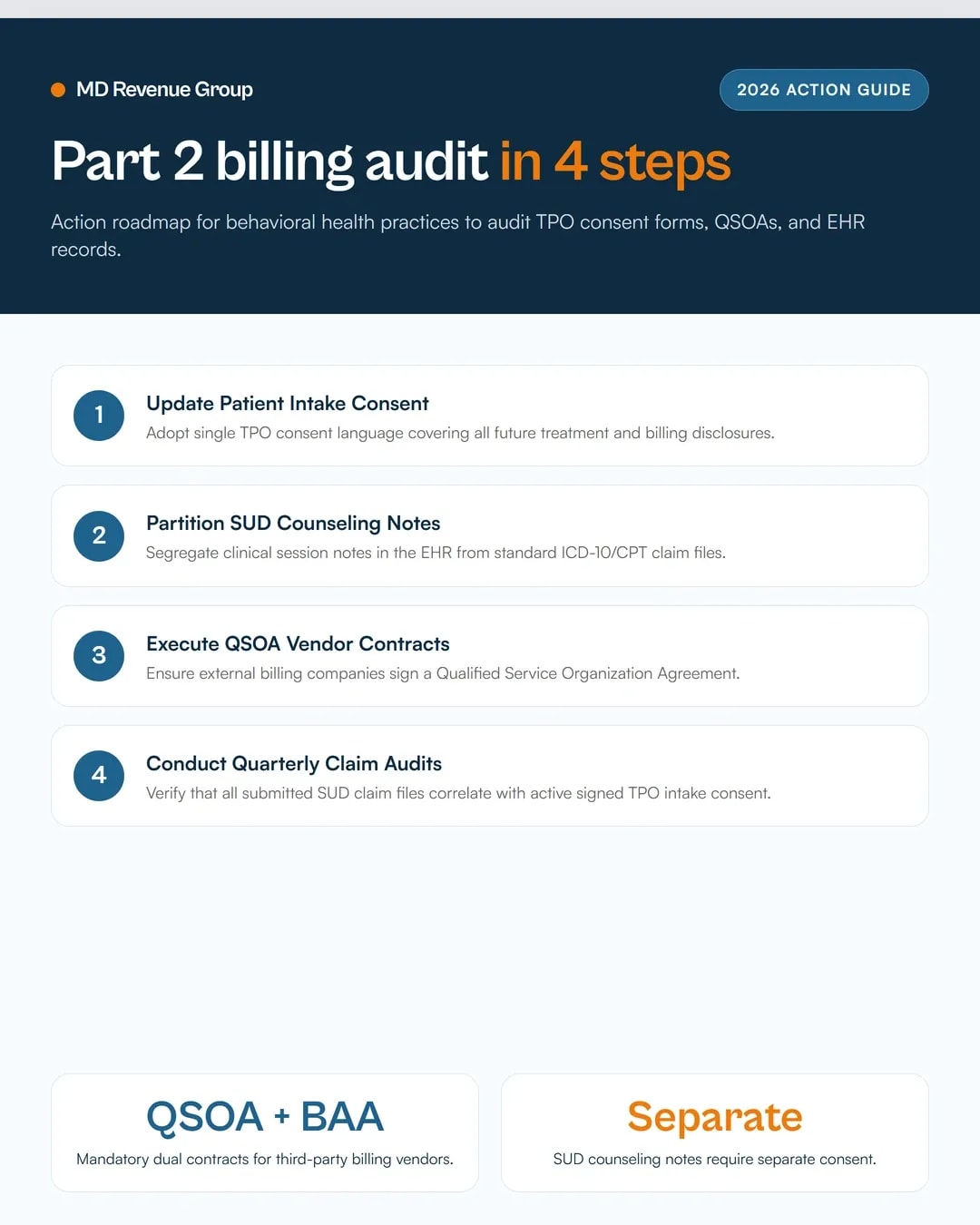
To ensure total compliance with 42 CFR Part 2 regulations while maintaining clean claim flow, practice managers should execute a 4-step compliance audit:
4-STEP COMPLIANCE AUDIT ROADMAP
┌──────────────────────┬──────────────────────┬──────────────────────┬──────────────────────┐
│ Step 1: Intake       │ Step 2: EHR Storage  │ Step 3: Contracts    │ Step 4: Quality Check│
├──────────────────────┼──────────────────────┼──────────────────────┼──────────────────────┤
│ Update patient intake│ Segregate SUD        │ Execute QSOA / BAA   │ Audit billing claim  │
│ forms with single TPO│ counseling notes from│ agreements with all  │ logs and consent     │
│ consent language     │ general billing data │ billing vendors      │ revocation records   │
└──────────────────────┴──────────────────────┴──────────────────────┴──────────────────────┘
1. Update Intake Consent Forms
Replace outdated, per-disclosure consent forms with a single, comprehensive TPO consent document. Ensure the form clearly informs patients of their right to revoke consent in writing.
2. Reconfigure EHR Chart Segmentation
Audit your EHR software settings to verify that SUD counseling notes are partitioned from standard medical records. Ensure that billing clearinghouse exports include CPT and ICD-10 data without attaching narrative session notes.
3. Review Billing Company Agreements
Verify that every third-party vendor handling billing, payment posting, or collection has signed an updated QSOA that explicitly references 42 CFR Part 2 compliance.
4. Perform Periodic Claim Audits
Conduct quarterly internal audits to verify that all claims submitted for SUD services correlate with a signed TPO consent form on file.
Protecting patient privacy while maximizing revenue recovery requires experienced billing management. Request a free medical billing audit with our RCM team to analyze your billing workflows, eliminate compliance risks, and improve your cash flow.