
Psychiatry Claims Denial Analytics: Five Dashboards That Reveal Revenue Leakage
Discover 5 psychiatric billing dashboards to track prior auth, eligibility, medical necessity, and credentialing denials to stop revenue leakage.

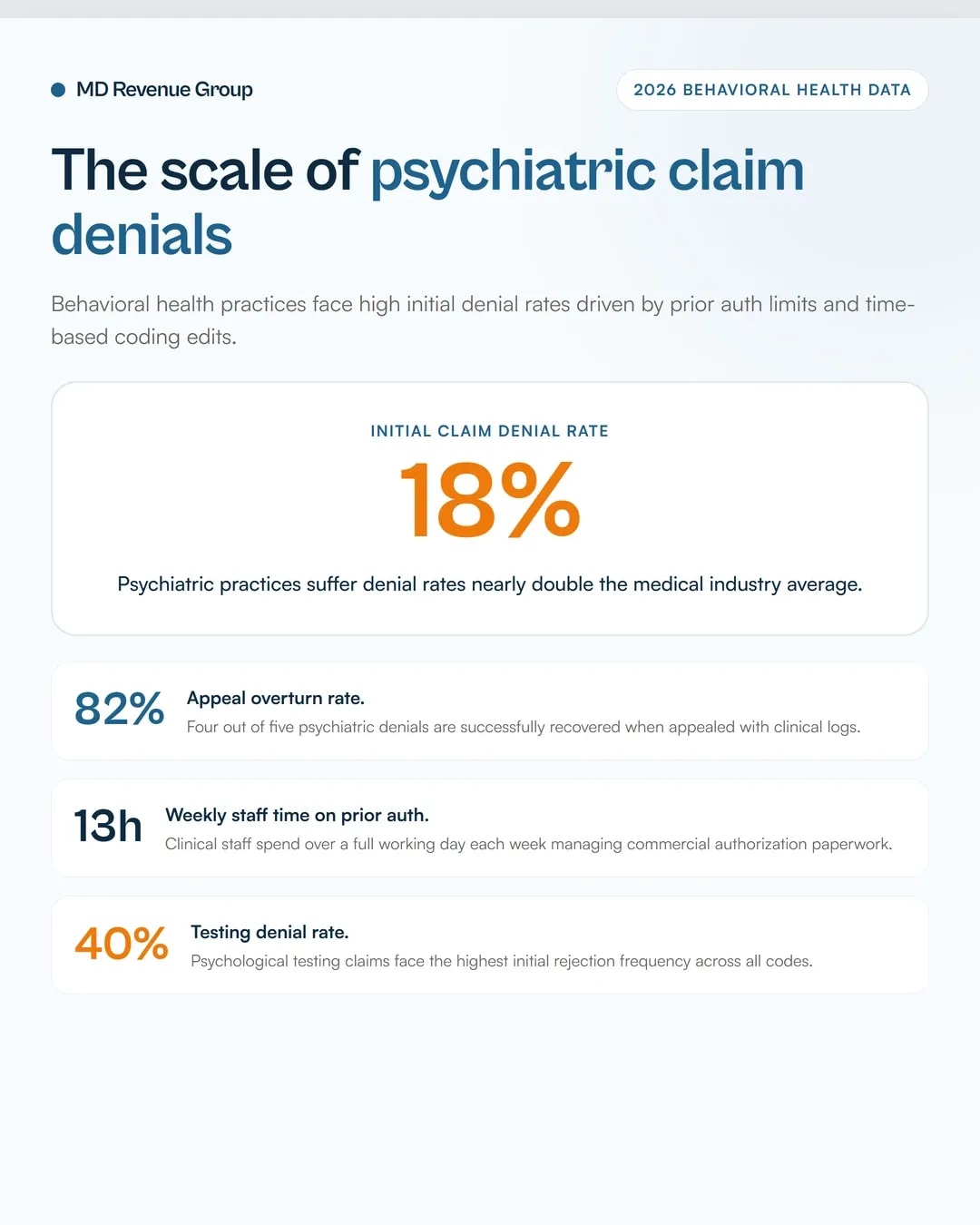
Outpatient psychiatric practices lose an average of 13% to 18% of potential gross revenue to initial claim denials, a rate nearly double that of general medical specialties. The primary root causes of psychiatric revenue leakage are medical necessity disputes (CARC 50), missing prior authorizations (CARC 197), and unbundled time-based coding errors when billing psychiatric E/M codes alongside add-on psychotherapy services (CPT 90833 and 90836). By building five specialized denial analytics dashboards, practice managers can isolate recurring claim edits, automate appeal workflows, and increase net collection rates above 96%. Industry data demonstrates that 57% to 82% of appealed mental health denials are eventually overturned when supported by structured clinical documentation and time-stamped logs.
Key takeaways
- 13% to 18% initial denial rate: Behavioral health practices face initial rejection rates up to 85% higher than general medical groups.
- 82% appeal overturn potential: Up to four out of five psychiatric denials are recoverable with clinical time logs and goal-oriented progress notes.
- 13 hours of weekly prior auth labor: Clinical staff spend over a full working day each week managing commercial authorization delays.
- Add-on code vulnerability: Psychotherapy add-on codes (90833, 90836) represent the highest volume of time-based documentation denials.
- Five core dashboards: Tracking prior auth, eligibility, medical necessity, credentialing, and appeal timelines stops cash flow leakage.
Why psychiatric claims suffer 50% higher denial rates
Behavioral health billing involves unique operational complexities that standard practice management software often fails to capture. Unlike surgical or diagnostic specialties where claims rely on objective imaging or lab reports, psychiatric reimbursement depends heavily on subjective medical necessity criteria, session time tracking, and non-quantitative treatment limitations (NQTLs) imposed by commercial payers.
Stop writing off 4.8% of your billing to preventable payer edits.
We review 50 of your recent denied claims against commercial & Medicare payer rules to show exactly which write-offs are legally recoverable.
Find My Recoverable Dollars →According to a 2026 MGMA Revenue Cycle Survey, initial denial rates for psychiatric claims average 16.4%, compared to just 8.2% across internal medicine. A primary factor is payer automated algorithms scanning electronic medical records (EMRs) for specific phrases demonstrating functional improvement.
Standard Medical Claim Processing:
[CPT Code + ICD-10] + [Objective Lab Result] = Auto-Adjudicated Payment
Psychiatric Claim Processing:
[CPT Code + Add-on Psychotherapy] + [Time Log + Medical Necessity] = Manual Payer Audit / High Denial Risk
Practices that contract for professional psychiatry billing services must transition from passive denial management to active analytics. Tracking denial trends through visual dashboards allows practice administrators to spot payer policy changes before write-offs accumulate.
Proprietary revenue leakage calculation for psychiatric practices
Uncollected psychiatric denials create a cumulative cash flow drag that weakens practice margins over time. When a claim is denied, the cost of re-working the claim combines with the delayed time-value of money, reducing the net yield even if the appeal succeeds.
Consider a 4-provider psychiatric practice generating 600 claims per month at an average allowed amount of $180 per visit ($108,000 monthly gross revenue).
Psychiatric Revenue Leakage Formula:
Monthly Gross Billed Revenue:                $108,000
Initial Denial Rate (16.5%):                 $17,820 (99 denied claims/month)
Cost of Inaction (Without Denial Analytics):
Appeal Success Rate Without Analytics:     35% ($6,237 recovered)Abandoned / Timely Filing Write-Offs:      65% ($11,583 written off)Staff Administrative Labor Cost ($25/claim): $2,475 (99 claims x $25)
Total Monthly Cash Loss:                    $14,058 ($168,696 annual revenue leakage)
Optimized Outcome (With 5 Analytics Dashboards):
Appeal Success Rate With Analytics:        82% ($14,612 recovered)Preventable Initial Denials Eliminated:    50% ($8,910 clean claim gain)Net Monthly Cash Recovery Gain:            $11,460 ($137,520 annual bottom-line lift)
By deploying analytical controls, the practice reclaims $11,460 per month in previously lost revenue, turning administrative debt into liquid working capital.
Dashboard 1: Prior authorization and peer-to-peer expiration tracker
Prior authorization failures (CARC 197) account for nearly 30% of all written-off psychiatric claims. Payers frequently issue authorizations for a fixed number of sessions (e.g., 6 visits) or a strict time window (e.g., 60 days). When a patient exceeds these limits without a formal extension, subsequent claims are denied automatically without retroactive appeal options.
A 2025 KFF Study revealed that commercial payers deny 14% of behavioral health prior authorization extension requests. A dedicated Prior Auth Dashboard monitors authorized unit balances in real time, alerting clinical coordinators before visits occur.
Dashboard Metric | Data Source | Target Benchmark | Primary CARC / RARC | Responsible Role |
|---|---|---|---|---|
Remaining Auth Units | Payer Portal API / EHR | > 2 visits remaining | CARC 197 / RARC N386 | Intake Coordinator |
Auth Expiration Date | Authorization Approval Letter | > 14 days active | CARC 197 / RARC N349 | Prior Auth Specialist |
Peer-to-Peer Deadline | Payer Denial Notice | < 5 days from denial | CARC 50 / RARC N115 | Lead Psychiatrist |
Literal clinical documentation example for peer-to-peer preparation
When scheduling a peer-to-peer review for extended psychiatric care, your clinical summary must present objective functional metrics:
"Patient exhibits persistent major depressive disorder (ICD-10 F33.2) with PHQ-9 score remaining at 18 despite 8 weeks of optimized SSRI pharmacotherapy and weekly psychotherapy. Outpatient management requires continued 45-minute psychotherapy add-on sessions (CPT 90836) to address cognitive distortions and prevent acute inpatient hospitalization."
Connecting this dashboard with a structured behavioral health prior authorization workflow ensures no patient receives care without active payer approval.
Dashboard 2: Real-time eligibility and benefit verification matrix
Patient insurance coverage changes frequently, particularly at the start of a calendar year or during job transitions. Billing a psychiatric visit under an inactive policy (CARC 27) or to an incorrect behavioral health carve-out vendor (CARC 31) stalls claims for months.
Many major commercial payers carve out behavioral health benefits to third-party administrators (TPAs). A patient presenting a standard insurance card may have medical coverage with Plan A, but mental health benefits managed by Plan B.
Patient Insurance Card (Front): Commercial Health Plan A
                               │
               ┌───────────────┴───────────────┐
               ▼                               ▼
     Medical Claims (E/M)           Behavioral Health Carve-Out
   Billed to Plan A (Payer ID 123)  Billed to TPA Plan B (Payer ID 999)
                                    (Failing to split results in CARC 31)
The Eligibility Verification Matrix tracks electronic 270/271 real-time eligibility checks prior to every scheduled appointment.
- Check 1: Active Policy Status. Confirms policy active date and verifies zero termination dates.
- Check 2: Behavioral Health Carve-Out Payer ID. Identifies designated mental health TPA routing address.
- Check 3: Individual Deductible Accumulation. Tracks remaining deductible balance to collect patient copays at check-in.
- Check 4: Telehealth Modality Coverage. Verifies audio-only or video modifier requirements (Modifiers GT, FQ, 95).
Practices servicing high-volume regions like those utilizing medical billing services in California must verify state-specific Medi-Cal and commercial parity rules to prevent sudden eligibility rejections.
Dashboard 3: Medical necessity and time-based coding audit board
Psychiatrists frequently perform an Evaluation and Management (E/M) service (e.g., CPT 99213 or 99214) alongside an add-on psychotherapy service (CPT 90833 for 30 minutes or 90836 for 45 minutes). Commercial payers target these combined claims with automated edits, demanding proof that psychotherapy time was separate from E/M medical decision-making time.
The Medical Necessity Audit Board tracks code combinations, session durations, and documentation compliance scores across all practice providers.
CPT Code Combination | Required Psychotherapy Time | Required E/M Element | High-Risk Denial Trigger |
|---|---|---|---|
99213 + 90833 | 16 to 37 minutes | Low complexity MDM | Total session time not explicitly documented in note |
99214 + 90836 | 38 to 52 minutes | Moderate complexity MDM | Overlapping start/stop times between medical and therapy |
90837 (Standalone) | 53+ minutes | N/A (Psychotherapy only) | Billing 90837 more than twice per patient in 30 days |
Literal EMR documentation entry for add-on psychotherapy
To pass a payer post-payment medical necessity audit, your EMR progress note must include a distinct time statement:
DOCUMENTATION ENTRY: COMBINED E/M AND PSYCHOTHERAPY
Total Visit Duration: 60 minutes (10:00 AM - 11:00 AM)E/M Service Time (20 mins): Medical decision making focused on medication management, vital sign review, and lab monitoring for Lithium toxicity.Psychotherapy Service Time (40 mins): Separate Cognitive Behavioral Therapy (CPT 90836) focused on grief processing and panic symptom management.Medical Necessity Statement: Patient continues to meet criteria for GAD with panic disorder (F41.1); ongoing psychotherapy required to maintain community stability.
Integrating these documentation checks into your practice's comprehensive mental health billing guide eliminates time-based downcoding risks completely.
Dashboard 4: Provider credentialing and PECOS revalidation monitor
Filing claims under an un-credentialed provider or an outdated NPI tax ID reassignment (CARC 185) leads to immediate, non-appealable claim denials. Commercial health plans often take 90 to 120 days to process behavioral health credentialing applications, creating severe cash flow bottlenecks for expanding practices.
Medicare also enforces strict revalidation schedules through the Provider Enrollment, Chain, and Ownership System (PECOS). If a psychiatrist misses their 5-year Medicare revalidation deadline, billing privileges are deactivated without warning.
The Credentialing Monitor tracks provider enrollment status across every contracted health plan:
Provider Credentialing Pipeline Monitor:
[Application Submitted] ──► [CAQH Attested] ──► [Payer Contracting] ──► [Roster Active Date]
      (Day 1)                 (Day 15)              (Day 60)               (Day 90 - Clear to Bill)
Key metrics monitored on this dashboard include:
- CAQH Attestation Expiration: Alerts staff 30 days before the mandatory 120-day CAQH re-attestation cycle.
- Medicare PECOS Due Date: Tracks upcoming revalidation notices from local Medicare Administrative Contractors (MACs).
- Payer Effective Dates: Blocks billing staff from submitting claims prior to the official contracted start date.
Practices managing complex provider rosters should utilize specialized credentialing and provider enrollment management to prevent revenue freezes during provider onboarding.
Dashboard 5: Timely filing and appeal escalation command center
Commercial payers enforce aggressive timely filing limits ranging from 90 days to 180 days from the date of service. When an initial claim is denied, the clock does not reset; your appeal must be submitted within the payer's contractual appeal window (often 60 to 180 days).
The Timely Filing Command Center categorizes denied claims by aging buckets and appeal status, ensuring no denial expires without action.
Aging Bucket | Action Required | Escalation Level | Target Resolution Time |
|---|---|---|---|
0 – 15 Days Post-Denial | Re-submit corrected claim or missing attachment | Billing Specialist | 48 hours |
16 – 30 Days Post-Denial | File Level 1 Formal Written Appeal | Claims Supervisor | 5 business days |
31 – 60 Days Post-Denial | Schedule Peer-to-Peer or Level 2 Appeal | Medical Director | 3 business days |
60+ Days Post-Denial | Escalate to State Insurance Commissioner / ERISA | RCM Director | Immediate |
Practices utilizing a psychiatric billing services in New York team can use state-specific prompt payment regulations to demand interest payments on claims held past statutory adjudication limits.
Real-world case study: New York psychiatric group recovers $64,000
A 5-provider outpatient psychiatric group in Westchester County, New York, experienced severe cash flow strain due to rising denial rates. An internal review revealed that a major regional commercial payer was systematically denying CPT 90836 (add-on psychotherapy) when billed alongside 99214 (E/M Level 4), citing lack of medical necessity (CARC 50).
Over a 9-month period, the group's billing staff had written off $64,000 in denied add-on codes, assuming the payer's automated edits were non-negotiable.
New York Psychiatric Recovery Breakdown:
Total Written-Off Claims Audited:       420 claim lines (CPT 90836)
Total Value of Written-Off Denials:    $64,260
Primary Denial Reason:                  CARC 50 (Medical Necessity / Lack of Separate Time Log)
Intervention Executed:
Implemented Dashboard 3 (Time-Based Coding Audit Board).Extracted EMR time logs proving separate 45-minute CBT sessions.Prepared batched Level 2 clinical appeal packages citing CMS CPT Coding Guidelines.
Financial Results:
Payer Overturn Rate:                   86% (361 claims overturned)Total Cash Recovered:                  $55,260Process Redesign Benefit:             Zero add-on code denials in subsequent 6 months
By deploying targeted denial analytics, the practice recovered $55,260 in liquid cash and established an automated coding audit workflow that prevented future write-offs.
Implementing denial analytics in your behavioral health practice
Building an analytical denial recovery system requires aligning your EMR software, payment posting workflows, and clinical staff. Rather than treating denials as an inevitable cost of doing business, modern psychiatric practices must treat every denial as a data point that signals an operational gap.
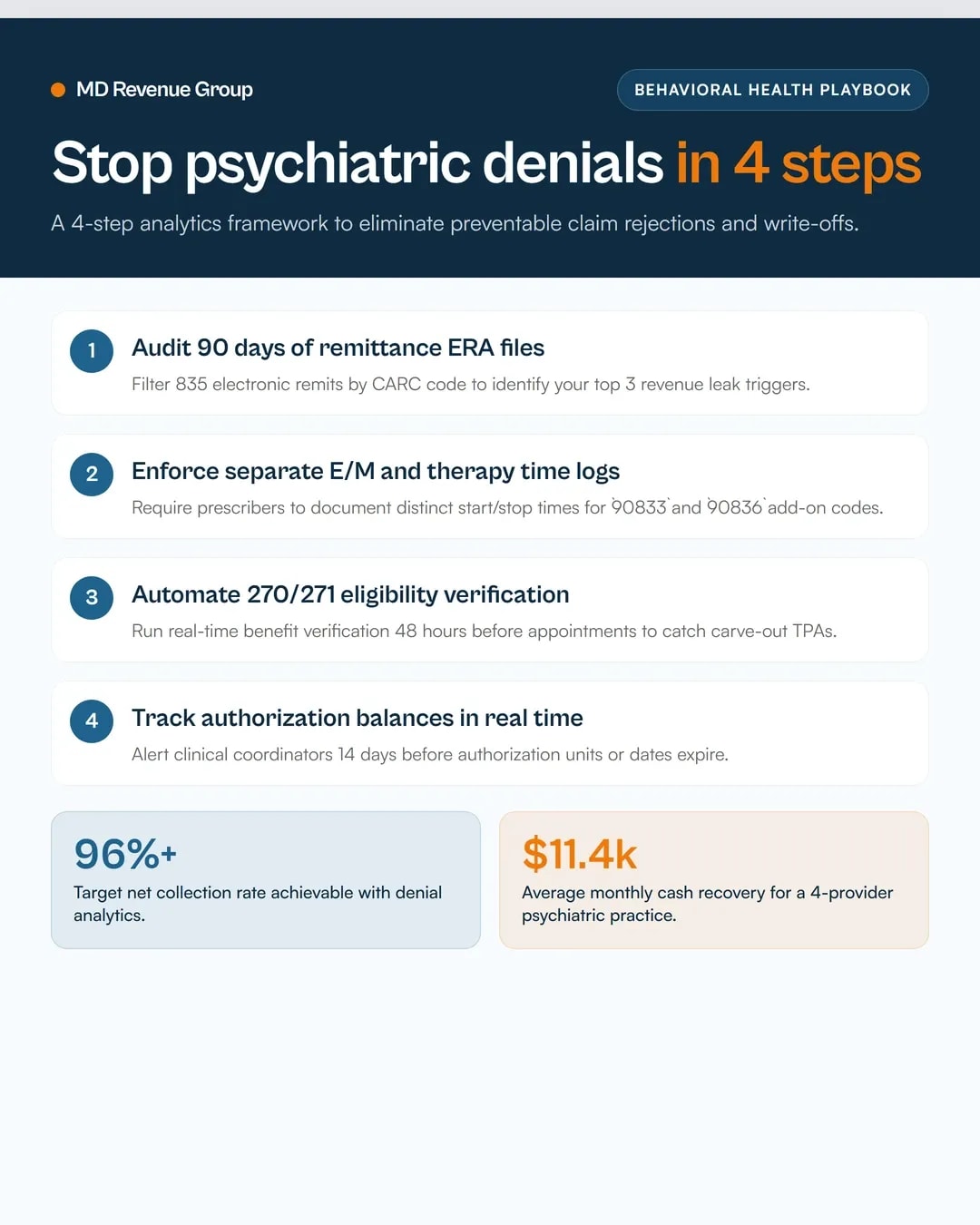
Follow these 4 implementation steps to secure your revenue cycle:
If your practice lacks the internal resources to build and monitor these analytical tools, partnering with an experienced RCM team provides immediate infrastructure and expertise.
Stop revenue leakage in your psychiatric practice
MD Revenue Group provides specialized revenue cycle management, automated denial analytics, and credentialing support for behavioral health practices. We find hidden revenue leaks, speed up prior authorizations, and maximize your cash collections. Request a free revenue audit today to unlock your practice's true earning potential.
Recover your denied claims in dollars.
Send us 50 of your recent denied claims. Our certified AAPC/AHIMA billing team will identify every recoverable dollar within 48 hours.