
AI in medical billing: how automation is changing RCM in 2026
AI is transforming revenue cycle management, with the market projected to grow from $21.49B in 2026 to $71.27B by 2031*(27.1% CAGR).
TL;DR:
- AI is now embedded across revenue cycle management in medical billing, from automated coding to pre-submission claim scoring.
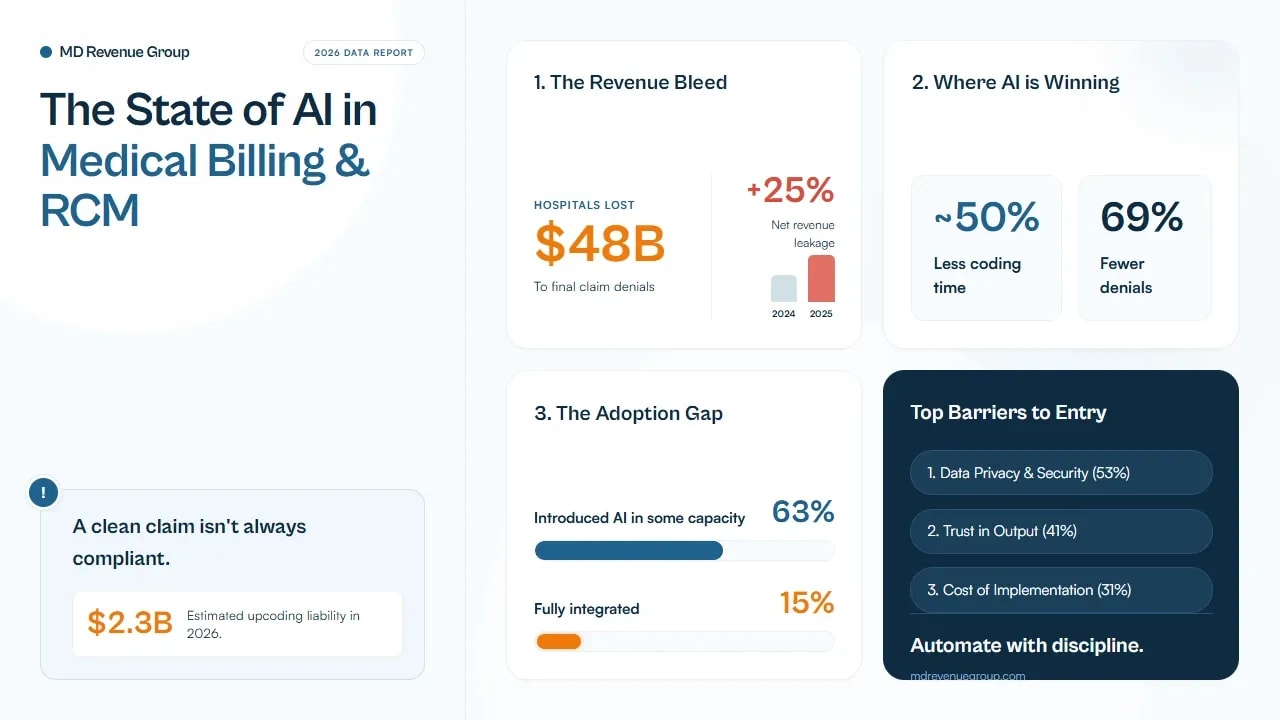
- Hospitals lost $48 billion to denials and bad debt in 2025 (up 25% from 2024).
- Only 15% of providers have fully integrated AI into their revenue cycle.
- 69% of those using AI for denial management report fewer denials.
- Payers are automating too, and AI-driven upcoding is drawing federal scrutiny.
- The winning move: automate denial prevention first, keep human oversight on every claim, and treat compliance as the priority over clean-claim rates.
AI moved out of the pilot phase. It's front-line infrastructure now.
Practices and hospitals use it for coding, claim scrubbing, prior authorization, denial management, and patient collections. The result is a full rewiring of revenue cycle management in medical billing, with real efficiency gains on one side and real compliance risk on the other.
This piece covers what the 2026 data shows: where AI is delivering, where it's creating exposure, and what your practice should do about it.
What "revenue cycle management in medical billing" means in 2026
The revenue cycle is every step between a patient scheduling a visit and your practice collecting the final dollar owed. Eligibility verification, coding, charge capture, claim submission, denial management, payment posting, patient collections.
Medical billing is the engine that drives most of that cycle.
For years, billers and coders handled each of those steps by hand. In 2026, AI is being inserted into nearly all of them. The market reflects the shift: AI in revenue cycle management is projected to grow from roughly $21.49 billion in 2026 to $71.27 billion by 2031, a compound annual growth rate of about 27.1%.
That kind of growth doesn't come from hype. It comes from financial pressure on providers that's gotten severe.
Denials are bleeding providers dry
To understand why automation is spreading this fast, look at what's happening to provider revenue.
Kodiak Solutions' year-end analysis of more than 2,300 hospitals found they lost over $48 billion in net revenue in 2025 to final claim denials and uncollected patient balances. That's up from $38.6 billion in 2024. A 25% increase in net revenue leakage in a single year.
The drivers are specific:
- Median final denial rate rose from 2.5% in 2024 to 2.7% in 2025.
- Median bad debt rate climbed from 1.1% to 1.3%.
- Clinical denials (lack of prior authorization, medical necessity) accounted for almost the entire increase.
- Medicare Advantage plans posted initial and final denial rates more than double those of traditional Medicare.
In June 2026, Kodiak followed up with data showing that even as hospitals got better at point-of-service collections, payer strategies that slow down claims adjudication wiped out much of that progress. Providers are running faster to stay in place.
That's the environment where AI billing tools find buyers.
Not sure what is draining your practice?
Our Free Revenue Leak Analysis will tell you what is
Get my free audit →How AI is changing the medical billing revenue cycle
AI isn't a single tool. It's a layer being applied across the entire billing workflow.
1. Automated coding
AI-powered coding tools read clinical documentation, including ambient recordings of physician-patient conversations, and assign billing codes on the fly. Vendors report these systems can cut coding time by roughly 50% while improving consistency. For high-volume specialties, that's the gap between same-day and week-old claims.
2. Pre-submission claim scoring
The biggest shift in 2026 is predictive billing. Instead of submitting a claim and waiting to see if it gets denied, AI scores each claim's denial risk before it goes out.
A concrete example: in late May 2026, OmniMD launched an AI Medical Biller that applies machine learning to a practice's own historical claim data. It identifies denial patterns, missed codes, and uncaptured revenue specific to that organization's payer mix and specialty. It generates a pre-submission risk score for each claim, flags documentation gaps, and routes exceptions to human billers.
This "catch it before it's denied" model is the core of how automation is reshaping revenue cycle management in medical billing right now.
3. Eligibility and prior authorization
Front-end automation is where leaders see the most opportunity. In 2026 surveys, 52% of organizations ranked insurance eligibility and benefits verification among their top-three AI opportunities. Electronic prior authorization (ePA) and clinical documentation improvement ranked close behind. Credentialing and enrollment also sit in this front-end category. Logical, given that prior-auth-related clinical denials are driving the revenue losses described above.
4. Denial management and appeals
AI is being used to triage denials, draft appeal letters, and prioritize the claims most likely to be overturned.
The adoption gap here is striking: only about 14% of providers use AI for denial reduction. But 69% of those who do report fewer denials and more successful resubmissions.
That's one of the clearest ROI signals in the data set. And it's a gap your practice can close before competitors notice.
Adoption reality: lots of pilots, few full deployments
Easy to assume everyone is already automated. The data says otherwise.
Roughly 63% of providers have introduced AI in some capacity. Only about 15% have integrated it into standard revenue cycle operations. The rest are running pilots or using AI in isolated pockets. The median first-pass claim acceptance rate sits at 85%, and fewer than half of billing firms (about 44%) hit a 90%-or-higher acceptance rate.
The field is wide open. A practice that moves from pilot to full integration in 2026 can outperform the median on clean-claim rate, days in A/R, and denial recovery.
The barriers slowing adoption are consistent:
- Data privacy and security (cited by roughly half of healthcare leaders as the top barrier)
- Trust (about 41% say they can't fully trust AI's output)
- Cost (around 31% name it their top barrier to entry)
Payers are automating too
Here's the part that doesn't make it into vendor brochures. AI in medical billing has become a two-sided contest. As providers deploy AI to code faster and get claims out the door, payers are deploying AI to deny faster.
The sentiment among billing companies is telling: 67% believe payers now use AI to increase denials. Industry coverage in June 2026 described an "AI arms race" where automation on both sides drives up administrative spending, with patients and practices absorbing the friction in between.
The practical takeaway: automating your submission side while ignoring your denial-management side leaves you fighting a faster opponent with one hand tied. A modern revenue cycle management strategy in medical billing has to automate defense as well as offense.
A "clean claim" is not a compliant claim
This is the most important risk to understand before buying any AI billing tool.
Some vendors advertise "clean" claim rates exceeding 98%, meaning payers accept the claim without intervention. But as legal analysts warned in mid-June 2026, a high clean-claim rate only proves the payer accepted the claim. It does not establish that the claim was coded correctly, was medically necessary, was supported by documentation, or was free from overpayment risk.
That gap is where False Claims Act (FCA) exposure lives.
AI systems tuned to maximize acceptance and revenue can push coding in one direction at scale. A small bias becomes a large liability. Federal payers like Medicare and Medicaid are where that exposure is most dangerous. (If you haven't had your billing audited recently, that's where a medical billing audit earns its keep.)
Concerns about AI-driven upcoding are already drawing scrutiny. Earlier 2026 research from the Blue Cross Blue Shield Association estimated that more aggressive, AI-enabled coding may be tied to roughly $2.3 billion in additional healthcare spending nationwide, with measurable jumps in case-complexity ratings at hospitals shortly after they adopted AI tools. The 2026 CMS Physician Fee Schedule changes add another layer of complexity to coding accuracy.
The lesson: human oversight is non-negotiable. Every credible 2026 deployment keeps billers and coders in the loop to review flagged claims, audit AI coding patterns, and document medical necessity. Chasing acceptance rates alone will get you into trouble.
What this means for your practice
If you manage billing for a practice or group, the 2026 data points to a clear action plan for modernizing revenue cycle management in medical billing without inheriting the risk.
Start where the ROI is proven. Denial management and pre-submission claim scoring show the strongest, best-documented returns. Clinical denials are driving revenue loss industry-wide. Focus AI on prior authorization and medical-necessity documentation first.
Measure against real benchmarks. Track your first-pass acceptance rate against the 85% median and push toward the 90%+ tier that only 44% of firms reach. Watch denial rate, bad debt rate, and days in A/R month over month.
Keep humans in the loop by design. Use AI to flag, score, and draft. Use experienced staff to review, approve, and audit. Build a routine audit of your AI's coding patterns to catch upcoding drift before a payer or regulator does. (Need a starting point? Request a free audit.)
Automate defense, not just offense. Payers are automating denials. Your denial-management and appeals workflow deserves as much automation investment as your claim submission.
Treat compliance as a feature. When evaluating vendors, ask how the tool documents medical necessity and supports audit defense. The clean-claim rate alone tells you nothing about audit risk.
The bottom line
AI is changing revenue cycle management in medical billing in 2026. It's cutting coding time roughly in half, catching denials before they happen, and giving under-resourced billing teams a fighting chance against a 25% surge in revenue leakage. The market's projected jump to $71 billion by 2031 reflects a durable shift in how healthcare gets paid.
But the speed that makes AI useful is also what makes it risky. A 98% clean-claim rate means nothing if the underlying coding can't survive an audit. The practices that win in 2026 will be the ones that automate with discipline: AI's speed paired with human oversight and a compliance-first mindset.
This article is for informational purposes and does not constitute legal or compliance advice. Consult a qualified healthcare compliance professional before deploying AI billing tools in workflows involving federal payers.