
The 2026 'Global Surgery' Payment Rebuild: What Surgeons Need to Know About CPT Changes
Learn how to bill global surgery modifiers in 2026 without triggering audits. Avoid modifier 24 and 25 denials with our compliance guide.
Surgical groups are facing increased audits on global surgical packages in 2026. The Centers for Medicare & Medicaid Services (CMS) is actively reviewing modifiers appended to evaluation and management (E/M) codes during postoperative global periods. Appending modifier 24 or 25 to bypass automated coding filters without proper documentation is leading to immediate clawbacks. To keep your payments, your documentation must prove that services were distinct from standard surgical follow-up. This guide explains how to use these codes correctly under 2026 guidelines.
Most billing resources copy and paste the federal definitions. You already know what a global period is. What you need is a practical framework to stop denials and maintain your cash flow. The 2026 rules require strict verification of surgical modifiers. If you use them incorrectly, you will trigger an audit. If you use them correctly, you will protect your clinic's bottom line.
This guide focuses on execution. It gives you the exact logic to decide when to append the modifier and when to leave it off. It breaks down the technical data into simple steps. It shows you how to train your providers to document the surgical visit correctly the first time.
Key takeaways
- Global surgical packages bundle preoperative, intraoperative, and postoperative services into a single payment.
- You must document the specific clinical reasoning that shows an E/M service was unrelated to the original surgery.
- Modifier 24 is for unrelated E/M visits during the post-op period, while modifier 25 is for same-day separate encounters.
- Payer algorithms check if your diagnostic codes match the surgical site to catch improper modifier use.
- Audits from the OIG are targeting clinics with modifier utilization rates that exceed the national average.
What global surgery billing actually involves in 2026
You fixed the bone, you closed the skin. Now you want to bill for the visit where you checked the wound. Medicare says that is already paid.
The global surgical package bundles all care related to a procedure into one reimbursement. This bundle includes the preoperative visit, the surgery itself, and typical postoperative recovery. The challenge is separating normal post-op visits from new, unrelated clinical issues.
Payer software uses automated scrubbing tools to find claims within a global window. If a surgeon bills an E/M code during a global period without a modifier, the clearinghouse rejects it. If the surgeon appends a modifier without matching notes, the payer denies the claim later.
This billing strategy requires absolute precision. You must document the clinical path of the patient to prove the encounter was not part of the recovery. If you cannot prove it, you must absorb the cost of the visit.
Key Medicare global surgical package rules and timelines
Medicare assigns every surgical CPT code a specific global period indicator. You must check these indicators in the Physician Fee Schedule database before billing.
The timelines follow three standard structures:
Global indicator | Duration | Scope of bundle |
|---|---|---|
000 | 0 days | Day of the procedure only. Pre-op and post-op E/M are billed separately. |
010 | 10 days | Day of the procedure and 10 days after. Minor surgical procedures. |
090 | 90 days | 1 day before the procedure, day of surgery, and 90 days after. Major surgeries. |
Medicare also uses special indicators like XXX, YYY, and ZZZ. XXX means the global concept does not apply. YYY represents contractor-defined periods, and ZZZ means the code is an add-on that inherits the global period of the primary procedure.
You must track these windows. A major joint replacement carries a 90-day global indicator. A simple lesion excision carries a 10-day indicator. If a patient returns on day 89 with an unrelated issue, the global rules apply.
Common modifiers for global surgery and when to use them
You must use modifiers to tell the payer that a service sits outside the bundle. The most frequent codes are modifiers 24, 25, 57, 58, 78, and 79.
Modifier 24 (Unrelated E/M in post-op)
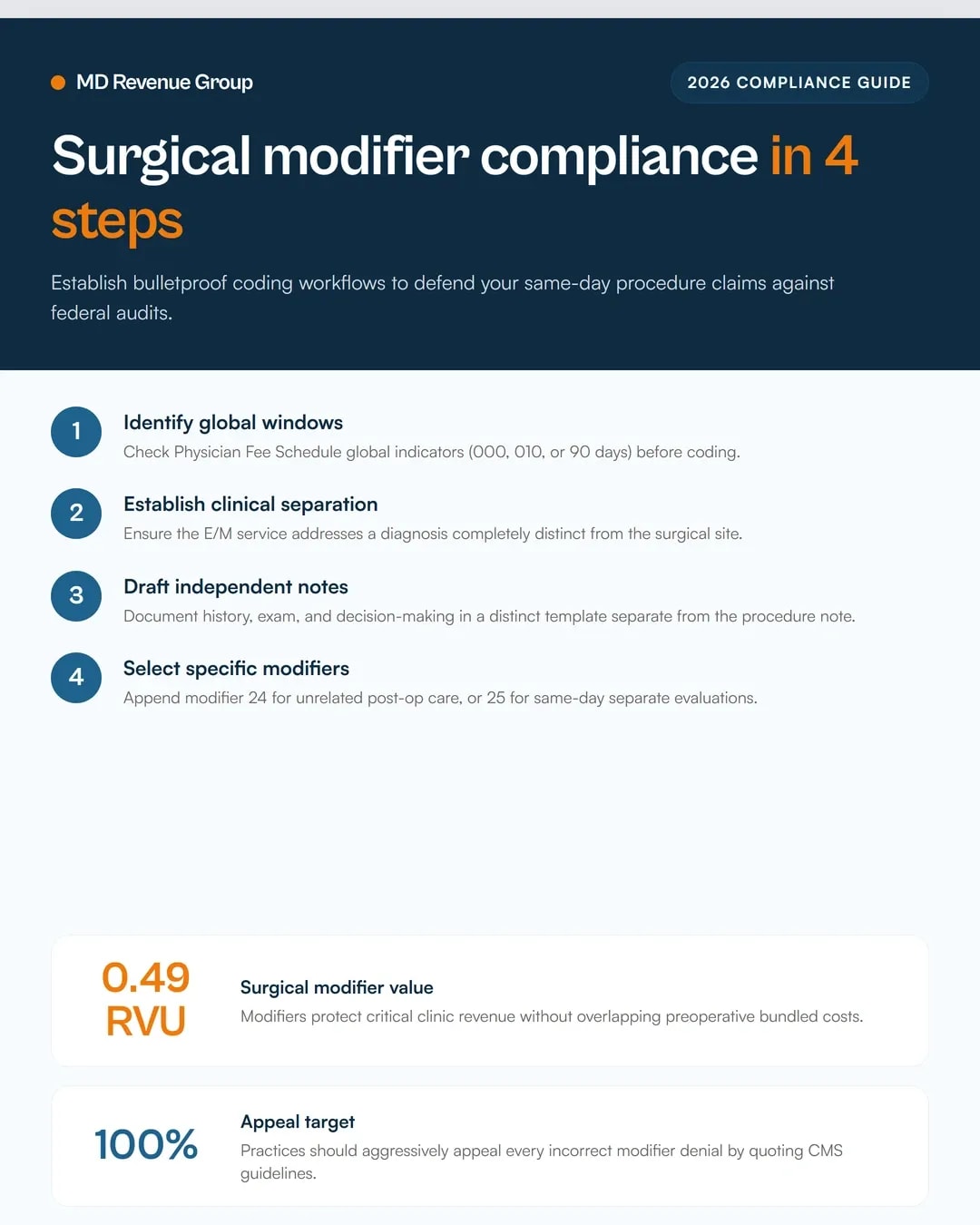
Use modifier 24 when you see a patient during their global recovery for a different problem. The clinical issue must be unrelated to the original surgery.
For example, a patient recovering from a hip replacement returns to check a new skin infection. You must append modifier 24 to the E/M code. The diagnosis code must point to the infection, not the hip.
Modifier 25 (Same-day separate encounter)
Use modifier 25 when you perform a minor procedure and a separate E/M on the same day. The E/M service must go beyond the standard pre-op assessment.
If a patient visits for knee pain and you decide to do an injection, you bill the injection. You only bill the E/M if you also evaluated their back pain during the same visit. The notes must show two distinct clinical workflows.
Modifier 57 (Decision for surgery)
Use modifier 57 when an E/M visit results in the decision to perform a major surgery. The surgery must take place on the same day or the next day.
If you evaluate a patient in the emergency room and schedule an appendectomy for the next morning, append modifier 57 to the E/M. Do not use modifier 57 for minor surgeries carrying a 10-day global period.
The staged vs unrelated procedure decision grid
When a patient needs another surgery during the global period of the first, you must choose between modifiers 58, 78, and 79.
Surgical Modifier Decision Flow:
- Planned or staged procedure: Append modifier 58 (paid at 100% of the fee schedule)
- Unplanned return to OR (related): Append modifier 78 (paid at intraoperative value only)
- Unrelated procedure in post-op: Append modifier 79 (paid at 100% of the fee schedule)
Modifier 58 applies when the second procedure was planned at the time of the first. It also applies when the second surgery is more extensive than the first. For instance, a surgeon performs a partial amputation and later must perform a complete amputation.
Modifier 78 applies when the patient has a complication that requires a return to the operating room. An example is a patient who bleeds post-surgery and needs immediate surgical repair. Payers discount modifier 78 claims because they exclude the pre-op and post-op care.
Modifier 79 applies when you perform an entirely different surgery during the global window. A patient recovering from gallbladder surgery breaks their wrist and needs fixation. You append modifier 79 to the wrist CPT code.
Top modifier denial reasons and how to prevent them
Modifier claims are primary targets for automated denials. Payers know that many clinics use these codes to bypass billing edits without clinical justification.
The most common denial reason is documentation failure. Providers often write a single paragraph that mixes the E/M evaluation and the surgical procedure. Auditors look for a clear separation.
To prevent this denial, your electronic health record templates must create two distinct notes. The E/M portion must have its own history, exam, and decision-making sections. The procedure portion must document the technique, consent, and outcomes.
Another denial trigger is diagnostic code mismatch. If the diagnosis on your E/M code matches the diagnosis on the surgery, the payer will deny modifier 24. They assume the visit was part of the postoperative care. You must train your providers to select distinct ICD-10 codes.
You must regularly audit your workflows to catch these patterns. Partnering with professional medical billing services ensures your claims are reviewed before submission. This keeps your clean claim rate high and stops cash leaks.
How different payers audit global surgery modifiers
Commercial payers do not always follow Medicare rules. Many major insurers use custom algorithms to audit modifier 24 and 25 claims.
UnitedHealthcare and Blue Cross Blue Shield have historically implemented prepayment reviews for modifier 25. They require clinics to submit the full chart note before they release the payment. If your note does not show a separate service, they pay only the procedure.
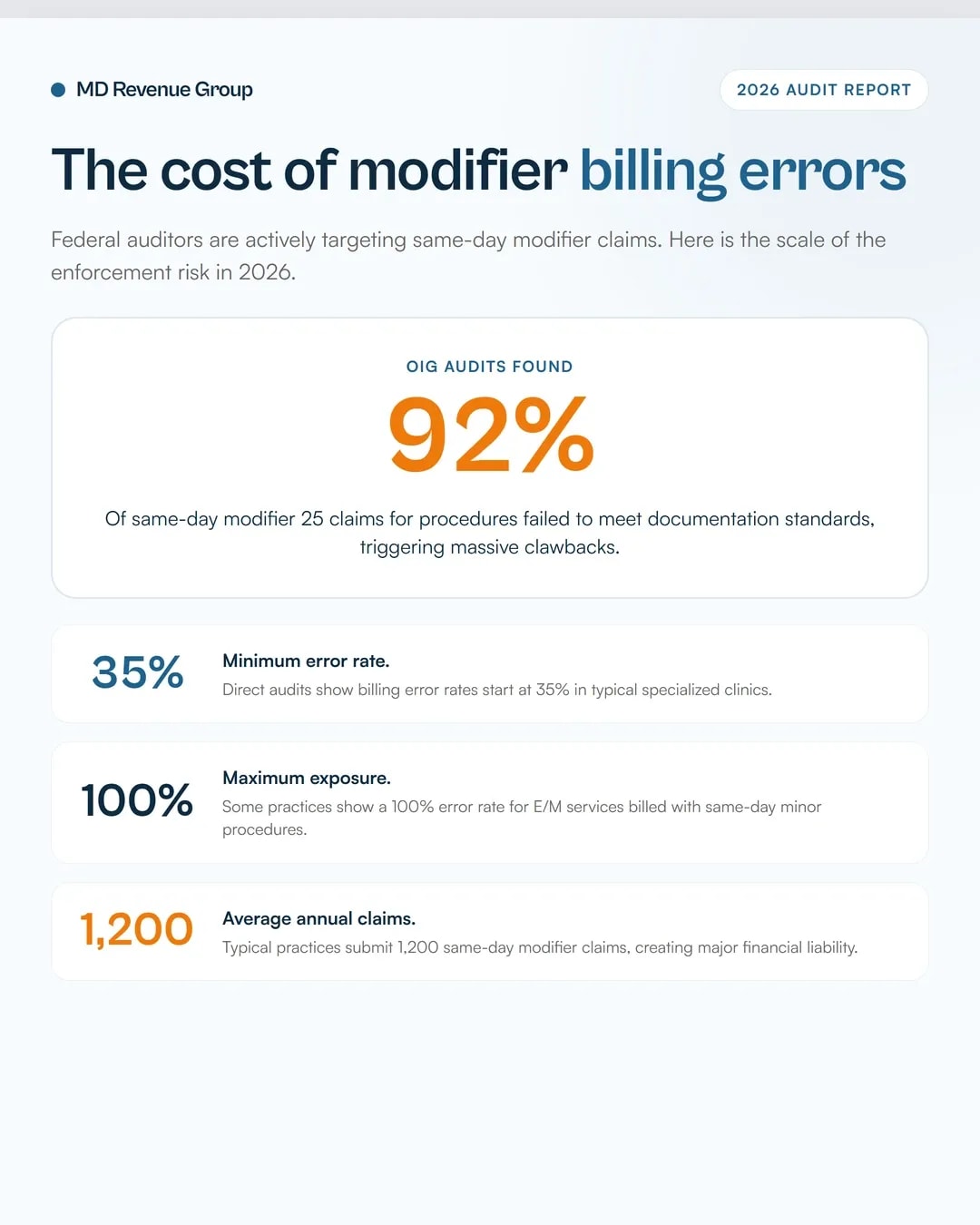
A May 2025 audit by the Office of Inspector General (OIG), Report A-09-23-03014, highlighted the severity of this issue. The audit reviewed claims for same-day E/M visits and procedures. It found that 92% of the audited claims (22 of 24) failed to meet the documentation requirements. This led to massive payment recoveries by the government.
Similar reviews by the OIG show general modifier error rates between 35% and 100% in specialized clinics. The government uses these data benchmarks to flag practices that exceed average usage. If your clinic bills modifier 25 on 80% of your procedure claims, you will face an audit.
You must build a strict compliance program. This includes regular internal audits and training for your coders. Working with a specialized general surgery billing team helps you navigate these payer-specific variations.
The cash cost of failing an audit
Let us calculate the financial impact of a modifier audit.
Assume an orthopedic clinic bills 1,200 encounters per year using modifier 25. An external audit reviews a sample and determines a 25% error rate. That represents 300 claims that were billed incorrectly.
If the average reimbursement for the attached E/M service was $95, the direct repayment demand is:
- Overpayment recovery: $28,500
- Extrapolation penalty (multiplied across the panel): $114,000
- Administrative labor and legal defense fees: $22,000
- Total Audit Cost: $164,500
This represents a significant cash loss for a small group practice. The audit process also drains your staff's time, diverting them from patient scheduling.
By contrast, conducting an internal audit on a sample of 100 charts costs a fraction of this amount. Resolving these coding errors internally allows you to protect your cash flow. If you want to benchmark your current risk, you can check your metrics with our revenue integrity tool to locate billing errors.
When to outsource surgical billing to protect your revenue
Many practices struggle to keep up with coding updates. Your in-house biller is busy managing patient calls and submitting daily claims. They do not have the time to analyze complex payer policies.
You should consider outsourcing if your surgical denials are increasing. If your clean claim rate is below 95%, your workflow is leaking cash. You are likely missing revenue by failing to bill complex modifiers, or you are creating compliance risks by using them incorrectly.
Outsourcing shifts the liability to a dedicated team. Professional coders monitor CMS policy adjustments and payer updates daily. They verify that every surgical claim is supported by the chart note before it is sent.
This strategy protects your practice. It ensures you collect the maximum reimbursement you are legally owed. It also gives you peace of mind during a period of intense federal audits. You can schedule a consult to review our pricing models and find a structure that fits your volume.
Global surgery billing FAQs
What is a global surgical package? It is a single payment bundle that covers all preoperative, intraoperative, and postoperative care related to a procedure.
Can I bill an E/M visit during a 90-day global period? Only if the visit is for a completely unrelated clinical issue. You must append modifier 24 and use a distinct diagnosis code.
What is the difference between modifier 58 and modifier 79? Modifier 58 is for staged or planned procedures during the postoperative window. Modifier 79 is for entirely unrelated surgeries performed during that same window.
Does Medicare allow modifier 25 for minor procedures? Yes. You can bill modifier 25 if the E/M service was significant and separately identifiable from the procedure. Your notes must prove this.
Why did CMS audit modifier 25? The OIG found high rates of billing errors. Their audits show that many clinics bill for routine pre-op checks that are already included in the procedure fee.
Can a clinic use modifier 57 for minor surgeries? No. Modifier 57 is restricted to major surgical procedures carrying a 90-day global period.
CTA: Protect your surgical practice from modifier audits. We audit RCM workflows and find the revenue leaks. Request a free audit.