
Global Surgery and Same-Day E/M in 2027: What the Proposed 50% Payment Policy Could Mean for Claims
CMS proposed a 50% payment reduction for same-day E/M visits with global surgery billing under the CY 2027 fee schedule. Learn compliance rules.

Global Surgery and Same-Day E/M in 2027: What the Proposed 50% Payment Policy Could Mean for Claims
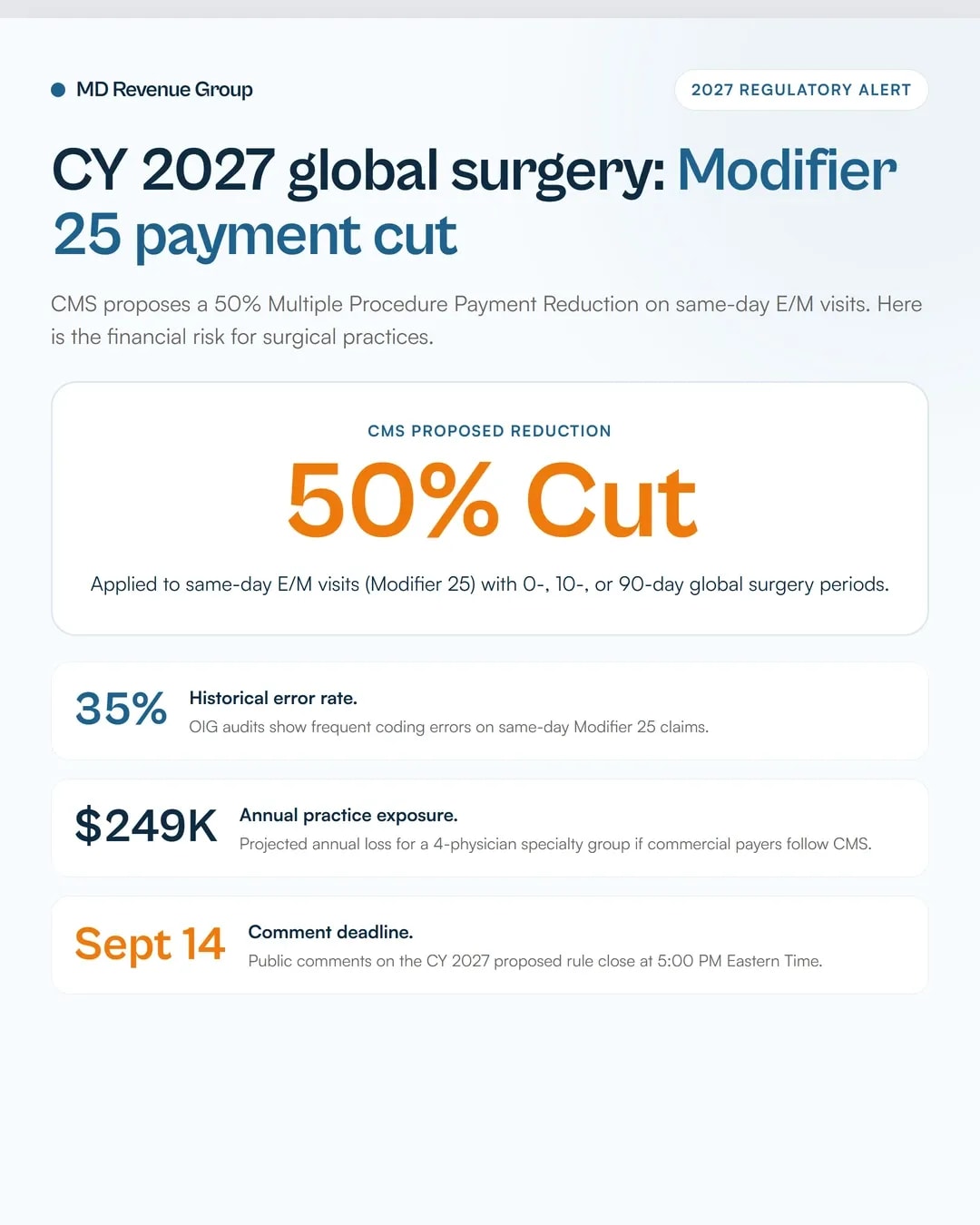
CMS proposed a policy in the CY 2027 Medicare Physician Fee Schedule proposed rule released on July 14, 2026, that reduces payment by 50% for Evaluation and Management (E/M) visits billed with Modifier 25 when performed on the same day as a procedure with a 0-day, 10-day, or 90-day global surgical period. Under this rule, global surgery billing for same-day encounters pays the highest-valued procedure at 100% of the Medicare fee schedule, while the secondary E/M service receives a 50% reduction. CMS bases this proposal on shared clinical staff time, exam room overhead, and administrative check-in activities that overlap between the visit and the procedure. Public comments on the proposed rule close on September 14, 2026. Practices operating in surgical, dermatological, podiatric, and orthopedic specialties must audit their current Modifier 25 volume now to quantify potential cash flow losses and tighten clinical documentation standards.
Key Takeaways
- 50% E/M Reduction: The CY 2027 MPFS proposed rule reduces reimbursement by 50% for office E/M visits billed with Modifier 25 alongside minor or major global procedures.
- Scope of Impact: The policy targets encounters involving 0-day, 10-day, and 90-day global periods across Medicare Part B fee-for-service claims.
- Historical Context: CMS attempted a similar restriction in the CY 2019 proposed rule but withdrew it following widespread industry opposition.
- Audit Scrutiny: OIG audits show historical error rates near 35% on Modifier 25 claims, making this modifier a top target for automated payer edits.
- Immediate Task: Practices should model their financial exposure before the September 14, 2026 comment window closes and audit note separation.
What CMS Proposes for CY 2027 Global Surgery Billing
The Centers for Medicare & Medicaid Services introduced a major payment policy shift in the CY 2027 Medicare Physician Fee Schedule proposed rule. If finalized, the policy changes how Medicare reimburses Evaluation and Management services provided on the same day as a procedure with a global surgical period.
Under current coding rules, when a physician performs a significant, separately identifiable E/M service on the same day as a minor or major surgical procedure, the practice appends Modifier 25 to the E/M code. Both the procedure and the E/M visit currently pay at 100% of the allowable fee schedule rate.
The CY 2027 proposal establishes a Multiple Procedure Payment Reduction logic for Modifier 25 encounters. The service with the highest relative value unit (RVU) weight pays at 100%. The secondary E/M service receives a 50% reduction to its practice expense and work RVU reimbursement.
This change applies across all global surgical designations:
- 0-Day Global Procedures: Endoscopies, minor skin lesion removals, simple destruction of lesions, and diagnostic injections.
- 10-Day Global Procedures: Minor surgical procedures such as simple biopsies, wound debridements, and uncomplicated laceration repairs.
- 90-Day Global Procedures: Major surgical procedures, including joint arthroplasties, open reductions, and major abdominal operations.
CMS explicitly clarified that the proposal does not eliminate Modifier 25. Providers must continue appending the modifier to report distinct E/M services. However, payment for that modifier-adjusted visit will drop by half automatically in MAC claims processing systems. Practices seeking guidance on managing fee schedule updates can consult our specialized revenue cycle management team for operational support.
The Shared Resource Rationale Behind the 50% E/M Cut
CMS defends the 50% payment reduction by arguing that same-day E/M visits and procedures involve overlapping practice expenses. The agency asserts that Medicare currently makes duplicate payments for clinical infrastructure when both services occur during a single patient visit.
According to the CMS rationale in the proposed rule narrative, several operational components overlap:
- Front-Desk Administration: Patient registration, insurance verification, and scheduling happen once per encounter regardless of service count.
- Clinical Rooming and Vitals: Medical assistants check in the patient, measure blood pressure, record weight, and enter allergy data a single time.
- Equipment and Space: The exam room, sanitation supplies, and basic medical overhead support both the evaluation and the minor procedure.
- Post-Visit Administrative Handoffs: Checkout processing, educational material distribution, and billing entry run through a single administrative pipeline.
Physician advocacy organizations, including the American Medical Association and the Medical Group Management Association, strongly contest this framing. Medical groups point out that evaluating a complex clinical condition requires independent cognitive work, detailed medical decision-making, and separate history-taking that minor procedure RVUs do not cover.
Practices facing heavy denial volume or payer audits surrounding Modifier 25 can schedule a comprehensive medical billing audit to evaluate their documentation risk profile.
Impacted Specialties and Common Clinical Encounters
While the proposed policy applies to all Medicare Part B billers, specific outpatient specialties face disproportionate exposure due to high same-day procedure volume.
Dermatology Practices
Dermatologists frequently evaluate multiple skin lesions during a routine visit. When a patient presents for an annual skin check and the physician identifies a suspicious dysplastic nevus requiring an immediate punch biopsy (CPT 11100, 10-day global), the practice bills CPT 99214-25 alongside CPT 11100. Under the proposed rule, the E/M payment drops by 50%. Groups looking to safeguard practice revenue should review tailored dermatology medical billing workflows to ensure accurate coding.
Orthopedic and Musculoskeletal Medicine
An orthopedic surgeon evaluates a knee pain patient (CPT 99214). After examination and X-ray review, the surgeon decides to administer an intra-articular corticosteroid injection (CPT 20610, 0-day global). Under the CY 2027 proposal, CPT 99214-25 pays at half price because CPT 20610 carries a 0-day global period. Explore specialized orthopedic billing operations to insulate your practice against fee schedule cuts.
Podiatry and Wound Care
Podiatrists routinely perform same-day nail debridement or wound care procedures following an evaluation of diabetic peripheral neuropathy or localized infection. Under the proposed policy, every routine visit resulting in a same-day minor procedure incurs a 50% haircut on the E/M component.
Ophthalmology and Otolaryngology
Ophthalmologists performing same-day foreign body removals or diagnostic laser procedures, alongside otolaryngologists performing flexible nasopharyngoscopy (CPT 31575) during an E/M visit, will see identical 50% reductions on their evaluation services.
Decision Matrix: Modifier 25 vs. Modifier 57 vs. Modifier 59
Correct modifier selection prevents immediate claim rejections and downstream audit clawbacks. Review the functional differences between the three primary surgical modifiers below:
Modifier | Official Definition | Global Period Scope | Billing Application | Audit Risk Indicator |
|---|---|---|---|---|
Modifier 25 | Significant, separately identifiable E/M service by the same physician on the same day of the procedure. | 0-Day or 10-Day global (and minor 90-day visits unrelated to surgical decision). | Appended to E/M codes (99202–99215). Indicates E/M went beyond routine pre-op work. | High. Automated MAC edits flag high-frequency billers. |
Modifier 57 | Decision for major surgery made during an E/M service on the day of or day before surgery. | 90-Day major surgical procedures only. | Appended to E/M codes (99202–99215, 99221–99223). Waives pre-op global bundling. | Moderate. Requires documented decision-making timeline. |
Modifier 59 | Distinct procedural service performed on the same day as another non-E/M procedure. | All procedural codes (non-E/M). | Appended to CPT procedure codes. Indicates different anatomical site or session. | Very High. Replaced by X{EPSU} modifiers where possible. |
Practices operating regional clinics in the Northeast can compare their regional billing rules against our state-specific guides for medical billing services in New Jersey or review New York practice revenue cycle protocols.
Practice Financial Impact: Worked Revenue Loss Model
To understand the financial threat posed by the CY 2027 proposal, consider a 4-physician group practice in a mid-sized metropolitan area.
Practice Baseline Assumptions
- Physician Count: 4 full-time equivalent (FTE) providers.
- Patient Volume: Each physician sees 25 patients per day, 4 days per week (400 total patient visits per week for the practice).
- Same-Day Procedure Rate: 20% of visits involve a same-day minor procedure (80 same-day E/M + procedure encounters per week).
- E/M Code Mix: Average E/M service billed is CPT 99214 (Established Patient, Level 4).
- 2026 Medicare Allowed Amount (CPT 99214): Approximately $130.00 (national average rate).
Financial Projection Calculations
Weekly Modifier 25 Encounters = 80 visits
Current Weekly E/M Revenue = 80 visits × $130.00 = $10,400.00
Proposed 50% Reduction Per E/M Visit = $130.00 × 0.50 = $65.00 loss per visit
Weekly Practice Revenue Loss = 80 visits × $65.00 = $5,200.00
Annual Practice Revenue Loss (48 working weeks) = $5,200.00 × 48 = $249,600.00
If Medicare fee-for-service represents 30% of this practice's payer mix, the direct annual loss from Medicare Part B alone equals $74,880.00.
If commercial payers adopt CMS logic across their contracts (as UnitedHealthcare and Anthem attempted in prior fee schedule cycles), the total annual loss for this 4-physician group expands to $249,600.00.
Practices can test their own facility data using our interactive revenue integrity calculator to forecast net collections under changing payer policies.
Documentation Controls Required to Defend Modifier 25 Claims
If CMS finalizes the 50% reduction, clinical documentation will face stricter payer review. Insurers will use automated software to verify whether same-day E/M services meet the "significant and separately identifiable" standard before paying even the 50% reduced rate.
The Independent Medical Necessity Test
Medical auditors apply a direct test when reviewing Modifier 25 claims: If the procedure were canceled or not performed, would the E/M documentation stand on its own as a medically necessary visit?
If the answer is no, the modifier fails the audit.
Essential Documentation Structure
To withstand payer scrutiny, clinical notes must follow strict structural separation:
- Chief Complaint: Document distinct chief complaints for the evaluation and the procedure.
- History of Present Illness (HPI): Record separate HPI elements detailing the history of the medical condition alongside the specific indication for the procedure.
- Physical Examination: Detail examination findings across relevant body systems. Avoid combining procedure site prep notes with the general physical exam.
- Medical Decision-Making (MDM): Outline the clinical rationale, risk assessment, and treatment options discussed. The MDM section must clearly reflect why the evaluation was required prior to deciding on the procedure.
- Separate Procedure Note: Complete a standalone procedure note detailing consent, prep, local anesthesia, technique, findings, and post-procedure plan.
Never use pre-formatted EHR macros that automatically insert text claiming "a significant separately identifiable E/M was performed." Commercial payers and OIG auditors treat generic boilerplates as fraudulent documentation indicators.
Review our earlier analysis on 2026 global surgery modifiers guide to contrast current billing rules against the 2027 proposed changes.
Action Items Before the September 14, 2026 Comment Deadline
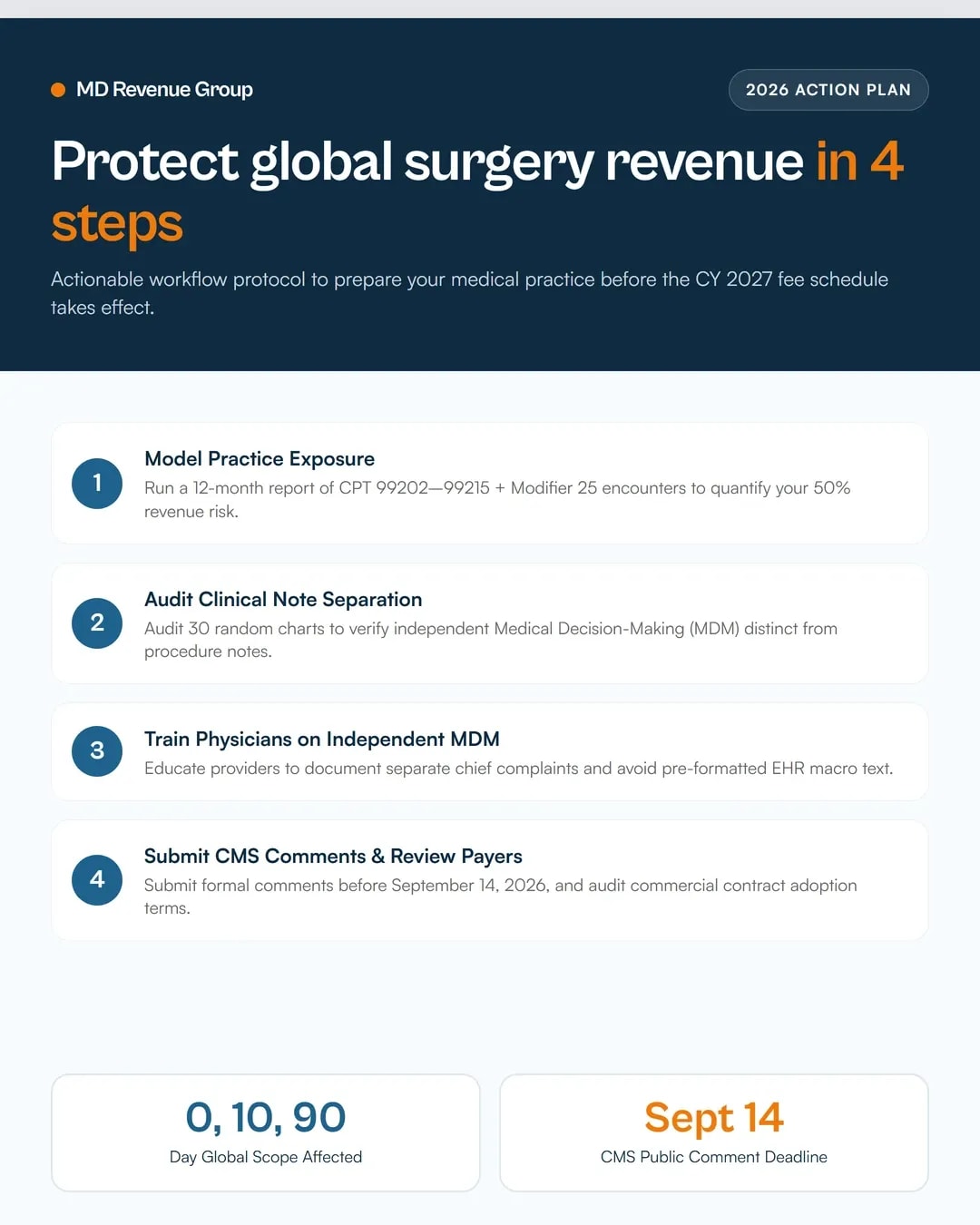
Medical practices should not wait for the final rule release in November 2026 to take action. Revenue cycle leaders should complete five operational preparation steps immediately:
- Calculate Modifier 25 Exposure: Run a 12-month claim report filtering for CPT 99202–99215 billed with Modifier 25. Multiply the total allowable amount by 0.50 to calculate your maximum Medicare fee exposure.
- Submit Formal Comments to CMS: Submit written comments detailing the impact on patient access and practice overhead before the public comment window closes on September 14, 2026.
- Conduct an Internal Note Audit: Pull 30 random Modifier 25 charts across all practice providers. Verify whether the E/M portion contains independent MDM and separate exam documentation.
- Train Clinical Providers: Educate physicians and mid-level providers on how to document distinct chief complaints and separate decision-making paragraphs in the EHR.
- Review Commercial Payer Contracts: Inspect commercial contract language to determine whether private payers automatically adopt Medicare Payment Policy Statements or MPPR fee schedule modifications.
Implement proven claim denial reduction strategies to protect existing cash flow while navigating proposed regulatory changes.
Frequently Asked Questions
Is CMS eliminating Modifier 25 in 2027?
No. CMS is not proposing to eliminate Modifier 25. Providers will still use Modifier 25 to report significant, separately identifiable E/M services on the same day as a procedure. However, the proposed rule reduces payment for that E/M service by 50%.
Does the 50% reduction apply to Modifier 57?
No. The CY 2027 proposed policy specifically targets Modifier 25 appended to E/M services performed alongside 0-day, 10-day, or 90-day procedures. It does not apply the 50% reduction to Modifier 57 when deciding on major surgery.
When would this policy take effect if finalized?
If CMS finalizes the policy in the final rule published in November 2026, the payment reduction will take effect for claims with dates of service on or after January 1, 2027.
Will commercial payers adopt this 50% reduction?
Commercial payers are not legally mandated to adopt Medicare Part B fee schedule reductions. However, major private insurers frequently adopt CMS payment reduction logic within 12 to 24 months of Medicare finalization.
What is the deadline to submit comments to CMS regarding this proposal?
The public comment period for the CY 2027 Medicare Physician Fee Schedule proposed rule closes at 5:00 PM Eastern Time on September 14, 2026.