
Medical Billing vs Medical Coding: 4 Update Clocks and a $40.42 Gap
Medical billing vs medical coding: who owns which errors, why a one-level E/M gap is $40.42 in 2026, and the 4 code set update clocks.
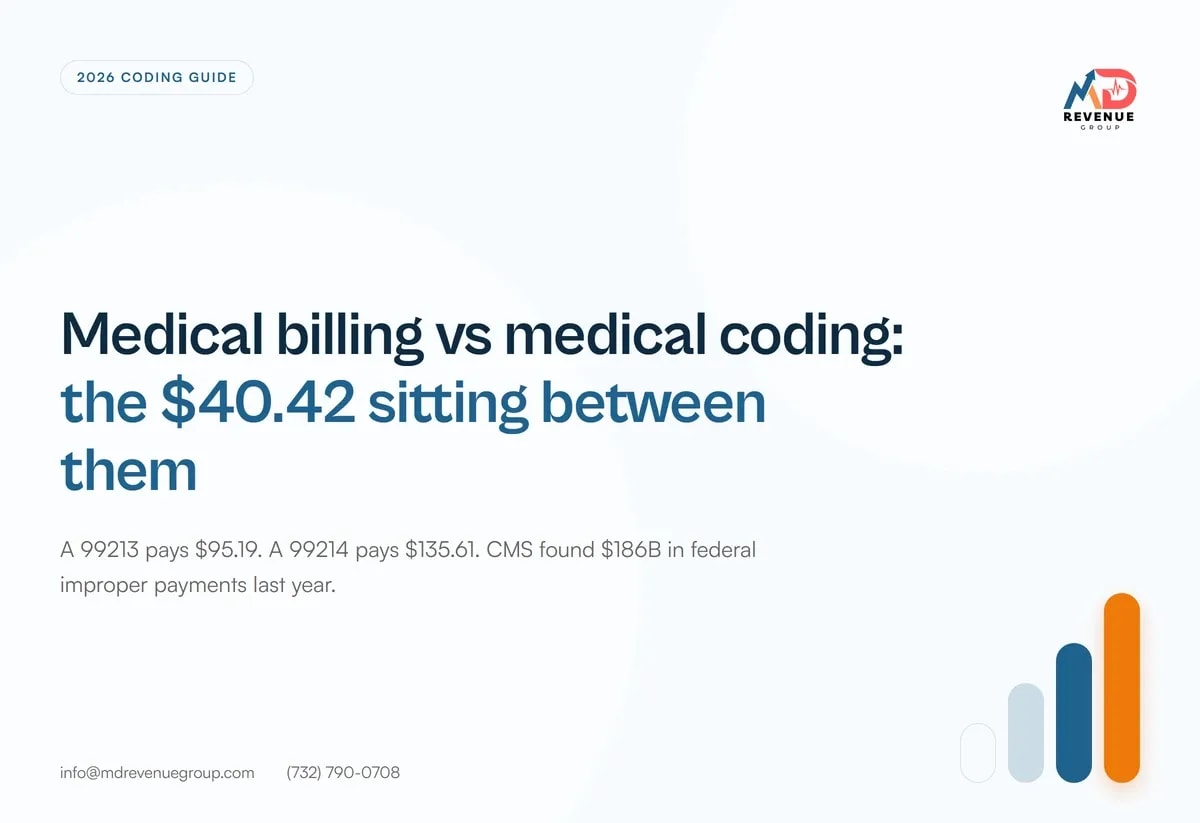
Medical billing and medical coding are 2 jobs with 2 different failure modes.
The coder reads the chart and decides what was done and why. The biller takes those codes and decides whether the claim gets paid.
The divide shows up in dollars first. Under the 2026 Medicare Physician Fee Schedule, an established patient office visit coded 99213 pays $95.19. Document one level higher and bill 99214, the same visit pays $135.61. That $40.42 sits on the claim with no flag attached when you leave it at the lower level.
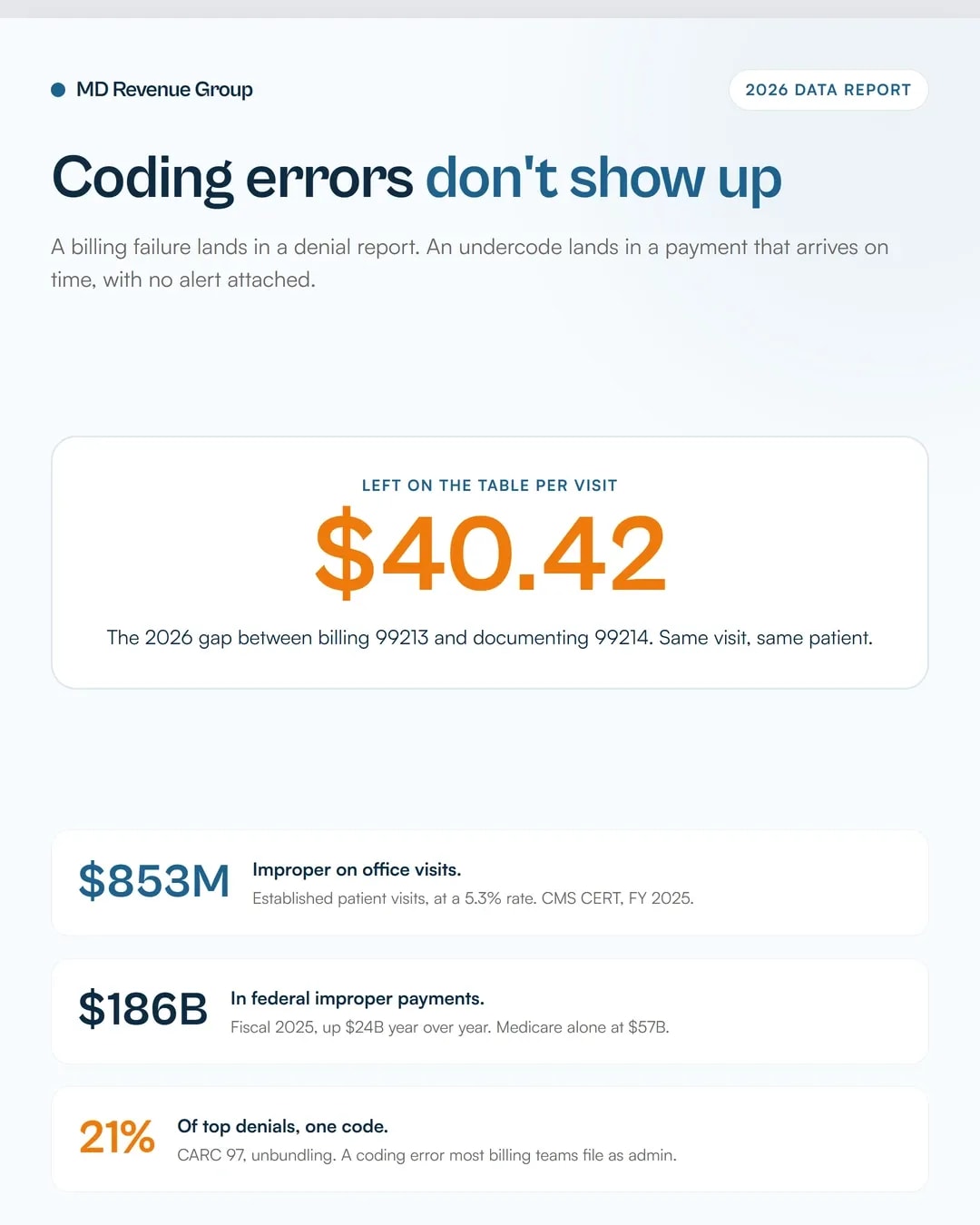
It shows up in denials too. Optum's 2024 Revenue Cycle Denials Index found 12% of claims denied on first submission, 84% of those potentially avoidable, and 44% traced to front-end processes such as registration and eligibility.
Coding failures are quieter. A billing failure lands in a denial report. A coding failure lands as a payment that arrived, or as revenue that never got claimed and never triggered an alert.
Here's who owns what, what each mistake costs, and the calendar that keeps the 2 desks disagreeing.
If your team is split already, medical coding resources covers the code set updates in depth.
Key takeaways
- A one-level E/M coding difference is $40.42 per visit in 2026. At 25 established visits a week, that's $52,546 a year.
- The 2026 non-QP conversion factor is $33.4009, up 3.26%. The first increase after 5 straight declines.
- Coding errors are invisible in dashboards. Billing errors show up as aging A/R.
- MedPAC found most Medicare improper payments trace to missing documentation, with fraud accounting for a smaller intentional share.
- Modifier 59 never goes on an E/M code. Different diagnoses alone don't justify a distinct procedural service.
- Code sets update on 4 separate clocks. A coder tracking January and a biller tracking October will disagree on the same claim.
What does coding do that billing doesn't?
Coding turns documentation into codes. Billing turns codes into money.
Concretely, that's a different set of daily work.
Task | Owner | Reference used |
|---|---|---|
Read the operative report, assign procedure codes | Coding | CPT, HCPCS, NCCI edits |
Sequence diagnoses, link them to procedures | Coding | ICD-10-CM guidelines |
Decide whether documentation supports the level billed | Coding | AMA CPT guidelines, LCD/NCD |
Send a query to the provider for clarification | Coding | Practice policy |
Scrub the claim for format and field-level errors | Billing | Payer rules, X12 |
Submit the 837 and read the acknowledgement | Billing | Clearinghouse, MAC |
Work the CARC and RARC on a remittance | Billing | Payer policy |
Post payment and split patient responsibility | Billing | Contract terms |
Chase eligibility, authorization, and filing deadlines | Billing | Payer contracts, 42 CFR 424.44 |
Coding owns accuracy of representation. Billing owns accuracy of delivery and follow-through.
The handoff is where the losses live. The medical billing resource hub covers the submission side in full.
How much does a one-level coding decision cost in 2026?
Here are the actual numbers, pulled from the CMS 2026 Physician Fee Schedule relative value file and multiplied by the 2026 non-QP conversion factor of $33.4009.
Code | Time | Work RVU | Non-fac total RVU | 2026 payment |
|---|---|---|---|---|
99212 | 10 to 19 min | 0.70 | 1.78 | $59.45 |
99213 | 20 to 29 min | 1.30 | 2.85 | $95.19 |
99214 | 30 to 39 min | 1.92 | 4.06 | $135.61 |
99215 | 40 to 54 min | 2.80 | 5.76 | $192.39 |
G2211 | complexity add-on | 0.33 | 0.52 | $17.37 |
G2212 | each add 15 min | 0.61 | 1.02 | $34.07 |
The gaps: $40.42 from 99213 to 99214, and $56.78 from 99214 to 99215.
Annualized at a set volume of established patient visits:
Visits per week | 99213 to 99214 | 99214 to 99215 |
|---|---|---|
10 | $21,018 | $29,526 |
25 | $52,546 | $73,814 |
40 | $84,077 | $118,082 |
These figures use the non-QP conversion factor and national RVUs with no geographic adjustment. Your GPCI will move them. The relative gap between levels is the part that holds.
The 2026 Medicare Physician Fee Schedule breakdown covers the conversion factor and quality payment changes in more detail.
Place of service is worth as much as the code level
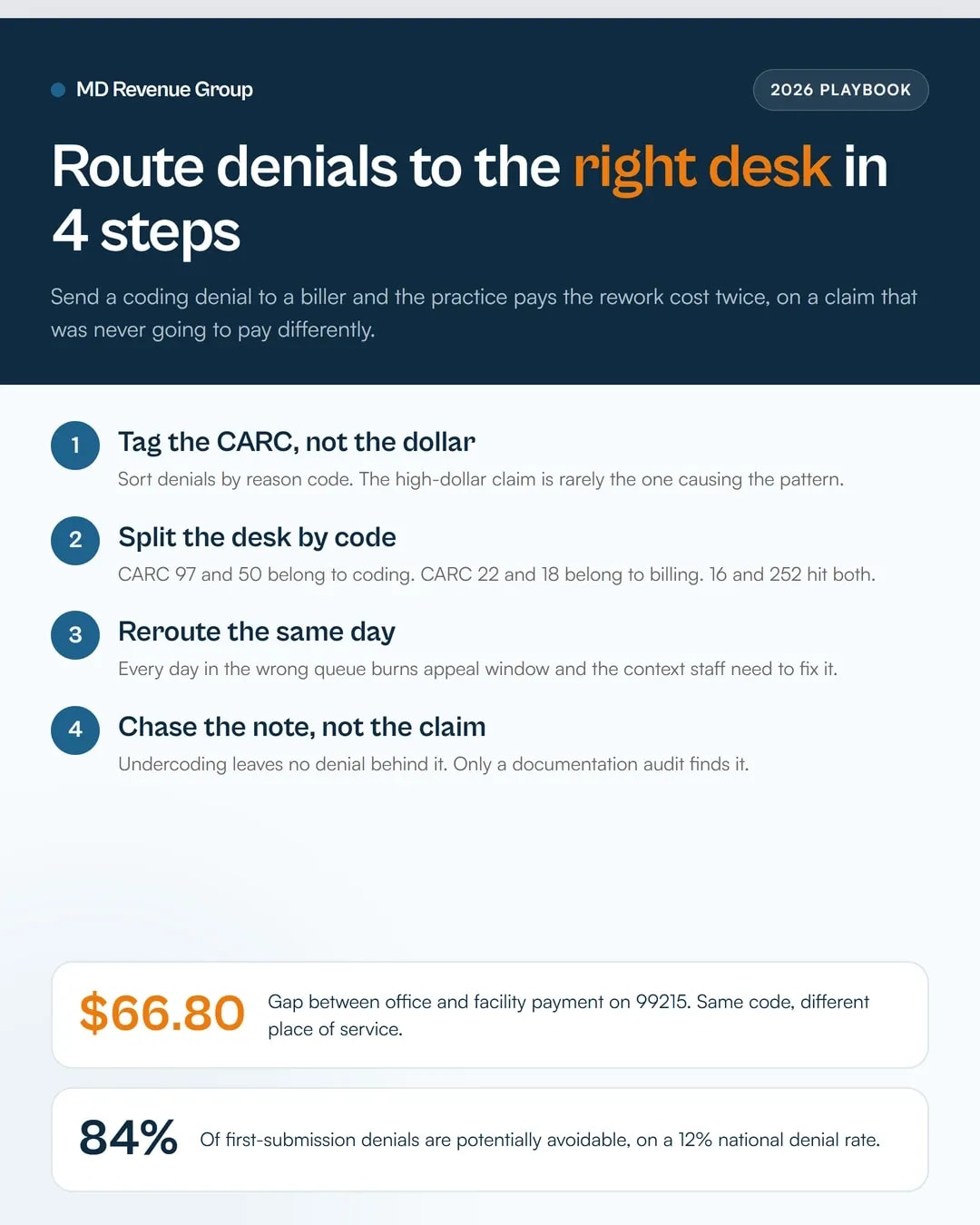
99215 pays $192.39 in a non-facility setting and $125.59 in a facility setting. That $66.80 gap is practice expense RVU alone, 2.75 non-facility against 0.75 facility.
The code is identical. The place of service code drives the payment. One is a coding decision, the other is a billing decision, and they sit in the same claim.
What documentation supports a higher E/M level?
Under the 2021 E/M revisions, you select the level on medical decision making or on total time. Time counts only on the date of the encounter.
For time-based selection, the note has to contain enough of these to reach the threshold:
- Preparing to see the patient, including reviewing external results
- Obtaining and reviewing a separately obtained history
- Performing an appropriate examination or evaluation
- Counseling and educating the patient, family, or caregiver
- Ordering medications, tests, or procedures
- Documenting the total time on the date of the encounter
Here is what a note actually needs to say to support 99214 on a 32-minute visit:
"Patient presents for 6-day history of pleuritic chest pain, unrelated to the scheduled procedure. ROS positive for fever and dyspnea. Reviewed chest radiograph from 3 days prior and discussed findings with radiologist. Ordered troponin and CBC, both resulted today. Diagnosis: acute pleurisy, other. Counselled on return precautions and activity modification. Total time on encounter: 32 minutes."
That note gives you 99214 by time. It gives you 99213 by MDM unless the record supports moderate complexity through prescription decisions or risk.
The failure mode runs in both directions. An under-documented 99214 gets downcoded. A note that reaches 32 minutes and supports only low MDM still bills 99214 correctly on time. Coding has to pick the right one, which is why charge entry errors start at the documentation step.
Modifier 25 and the documentation trap
Modifier 25 marks a significant, separately identifiable E/M service on the same day as a procedure, by the same physician or qualified health care professional.
Two rules surprise most practices:
- The E/M does not need a different diagnosis. CPT states the service may be prompted by the same symptom or condition that prompted the procedure. Medicare applies the same rule.
- Modifier 59 never goes on an E/M code. CMS's MLN Booklet MLN1783722 says use modifier 25 instead. Different diagnoses alone don't justify a distinct procedural service either. The XE, XS, XP, and XU modifiers apply to procedure codes.
Write the note so the separate work is visible:
"E/M above and beyond usual pre-procedure evaluation: evaluated new-onset urinary retention and incontinence, including urinalysis and bladder scan. Diagnosis: acute urinary retention. Treatment: catheterization. Distinct from the pre-operative assessment documented above."
Medicare pays modifier 25 without documentation attached to the claim. Payer scrutiny comes later, through prepayment review or post-payment audit, and the record has to hold up.
Which denial reasons belong to the coder and which to the biller?
Route them wrong and the claim gets denied twice. Here's the ownership map, with Community Oncology Alliance's onPoint data as the frequency reference.
Reason code | Meaning | Root owner | Why |
|---|---|---|---|
CARC 16 | Missing information or submission/billing error | Both | Clerical at claim build; coding if the missing field was a code |
CARC 97 | Service bundled into another payment | Coding | Duplicate or unbundled CPT on the claim |
CARC 50 | Not medically necessary | Coding plus provider | Diagnosis doesn't support the procedure under LCD/NCD |
CARC 22 | Covered by another payer | Billing | Coordination of benefits unresolved at registration |
CARC 252 | Attachment or documentation required | Both | Coding decides what exists, billing decides it got sent |
CARC 18 | Exact duplicate claim or service | Billing | Double submission or missing void |
CARC 97 alone was 21.31% of that dataset's top denials across 484,337 claims. Most billing teams file it as an administrative issue. It's a coding error. Resubmitting it without fixing the unbundling produces the same denial with a smaller window left.
Change Healthcare's research breaks denials down by cause: eligibility 26.6%, missing or invalid claims data 17.2%, authorization 11.6%, service not covered 10.6%, medical documentation 9.2%, medical necessity 6.6%, medical coding 4.8%. They also found 86% of denials potentially avoidable.
How to reduce claim denials covers the prevention workflow, and denial management covers the rework queue.
The rework math is why routing matters
Optum's Medicaid data shows the asymmetry. A Medicaid claim averages $98.57 submitted. The initial denied amount averages $19.26 per claim, against $9.38 for Medicare and $8.80 for commercial.
Admin cost to resubmit one line: Medicaid $14.00, Medicare $10.00, commercial $17.00. Three lines: $33.00, $26.00, $37.00.
Net lost revenue: Medicaid 17.4%, Medicare 5.0%, commercial 2.8%.
Send a coding denial to a biller and the practice pays the rework cost twice, on a claim that was never going to pay differently.
What are the 4 code set update clocks?
Coding and billing sit on different calendars. That produces recurring arguments that look like competence problems and aren't.
Code set | Primary owner | Cadence | Effective date |
|---|---|---|---|
ICD-10-CM | Coding | Annual | October 1 |
CPT | Coding | Annual | January 1 |
HCPCS Level II | Coding | Quarterly | Jan 1, Apr 1, Jul 1, Oct 1 |
NCCI PTP and MUE edits | Shared | Quarterly | Jan 1, Apr 1, Jul 1, Oct 1 |
Payer policy and edits | Billing | Rolling | No fixed date |
The FY 2027 ICD-10-CM guidelines took effect October 1, 2026. CPT 2027 took effect January 1, 2027. A coder working only the January cycle misses half the year.
NCCI version 32.1 landed April 1, 2026 and is the clearest example of why both desks need the quarterly file. CMS published 3,759 new procedure-to-procedure code pairs, deleted 4,863, and revised 6. It added 121 MUEs and revised 7.
Where the new pairs landed matters more than the count:
Code range | PTP pairs added |
|---|---|
0001U to 0284U | 1,872 |
0001T to 0999T | 1,308 |
A0000 to V9999 | 280 |
80000 to 89999 | 229 |
Nearly 3,200 of the 3,759 new bundles sit in lab codes and Category III codes. That is a coding-side workload that lands on the billing side as rejections.
The same release capped G0447, behavioral counseling for obesity at 15 minutes, at 1 unit per date of service, down from 2. A practice billing two units on a date of service lost one of them overnight.
How do ICD-10-CM and CPT fail differently?
The two code sets fail in opposite directions, and that difference drives who should fix what.
CPT fails loudly
CPT errors produce denials with a specific reason code. An unbundled pair triggers a PTP edit. A missing modifier triggers an NCCI modifier check. A level of service that doesn't match documentation triggers a post-payment audit.
You see CPT errors within weeks.
ICD-10-CM fails quietly
A truncated diagnosis code, an unspecified code where the record supports something specific, or a sequencing error that puts a symptom ahead of the condition being treated produces a claim that pays. Usually.
CMS's own improper payment data shows the split. For established patient office visits, $853,651,814 in improper payments at a 5.3% rate, confidence interval 4.1% to 6.6%.
GAO-26-108694 put total federal improper payments at $186 billion for fiscal 2025, up about $24 billion year over year, with Medicare at $57 billion and Medicaid at $37 billion.
MedPAC's June 2026 report to Congress draws the distinction that matters for how you talk to a provider: "most improper payments are due to lack of documentation or other errors, but some result from fraud, which is intentional deception or misrepresentation of the information submitted on claims."
CMS's FY 2025 Financial Report names the same two drivers when it commits to strengthening corrective action plans: insufficient documentation and medically unnecessary services.
CMS FY 2025 improper payments covers what those figures mean for audit readiness.
Documentation is where the volume sits. Coding is where the discipline has to sit.
The specificity rule gets missed constantly
ICD-10-CM diagnosis codes run 3 to 7 characters. All categories are 3 characters. Subcategories are 4 or 5. A code with an applicable 7th character is invalid without it, and the letter "X" works as a placeholder when no alphanumeric option exists without breaking the structure.
Coding to the full number of characters required is not a formatting preference. The FY 2026 guidelines are explicit that a code reported without its required characters is invalid.
Payers layer their own rules on top
Federal coverage policy sets the floor. AmeriHealth Caritas updated reimbursement policy RPC.0010.1200 in February 2026 across its state plans, restricting distinct procedural service modifiers and excluding E/M services from them entirely.
The same NCCI edit gets treated differently by an employer plan, a state Medicaid agency, and a Medicare MAC. North Carolina medical billing covers how state rules diverge from the federal baseline.
When should one person do both jobs?
AAPC allows a CPC-A apprentice credential, and full CPC designation requires at least 2 years of coding experience. In a small practice, one person holding both roles is normal and workable.
It stops working at a specific point.
Situation | Split the roles? | Why |
|---|---|---|
1 to 2 providers, primary care, routine visits | No | Hybrid coder-biller handles the volume cleanly |
Single specialty, no surgical global periods | No | Coding decisions stay routine |
Any practice with surgical global periods | Yes for coding | Global tracking won't survive alongside claim follow-up |
Behavioral health or any time-based service | Yes | Time documentation drives the entire revenue model |
Multi-state or plan-specific edit load | Yes for billing | Edits change weekly |
Multiple specialties under one roof | Yes | A coder can only track one code set well at a time |
Under 10 FTE provider with outside billing help | Keep billing split | ASCA exceptions hold; coding still needs a dedicated owner |
The failure case for a hybrid role is quiet. Undercoding never generates an alert. Nothing ages. Nothing appears in a denial report. The practice collects less every month and nobody can point to the month it started.
That's what a medical billing audit looks for.
Not sure which desk your revenue is leaking from? We run a coding and billing split analysis and show you which side owns the gap before you restructure anything.