
Charge Entry Errors: What They Cost and How to Catch Them
Charge entry errors come in two kinds, and only one of them shows up on a denial report.
One kind is loud. A claim goes out wrong, the payer returns it with a code, you fix it, you pay $57.23 in rework. Painful, expensive, and recoverable.
The other kind is silent. A service was performed, the charge never got entered, and the claim submitted without it. No code arrives, no letter arrives, no report line appears. The revenue is gone and nothing flags it.
Practices spend all their optimization effort on the loud kind because the loud kind is measurable. That is why a practice with an excellent denial rate can still be losing six figures a year.
Three words the industry uses interchangeably, and should not
Charge capture is the provider recording what happened during the encounter. It happens at the point of care or right after. The provider documents the visit, the procedures performed, the supplies used.
Charge entry is billing staff taking those documented services and putting them into the practice management system with the correct fee schedule amounts and codes. It happens after the encounter, usually in a queue.
Coding is assigning the code set to a charge that has already been entered. A coding error is a clerical mis-assignment of the right service to the wrong code.
Three different people, often three different systems, three different failure modes. When a practice reports "charge entry errors" without specifying which, the number is meaningless.
- ✓Provider records the service at the point of care. Fails silently when a service is performed and never recorded. No payer ever sees it, so no denial and no report exists.
- ✗Billing staff enter documented services with codes and fee amounts. Fails loudly when wrong data produces CO-16, CO-18, or CO-22, and when charge lag pushes a claim toward its filing deadline.
The silent leakage problem, in numbers
Run this with your own figures. The worked example below uses a $2.4 million practice.
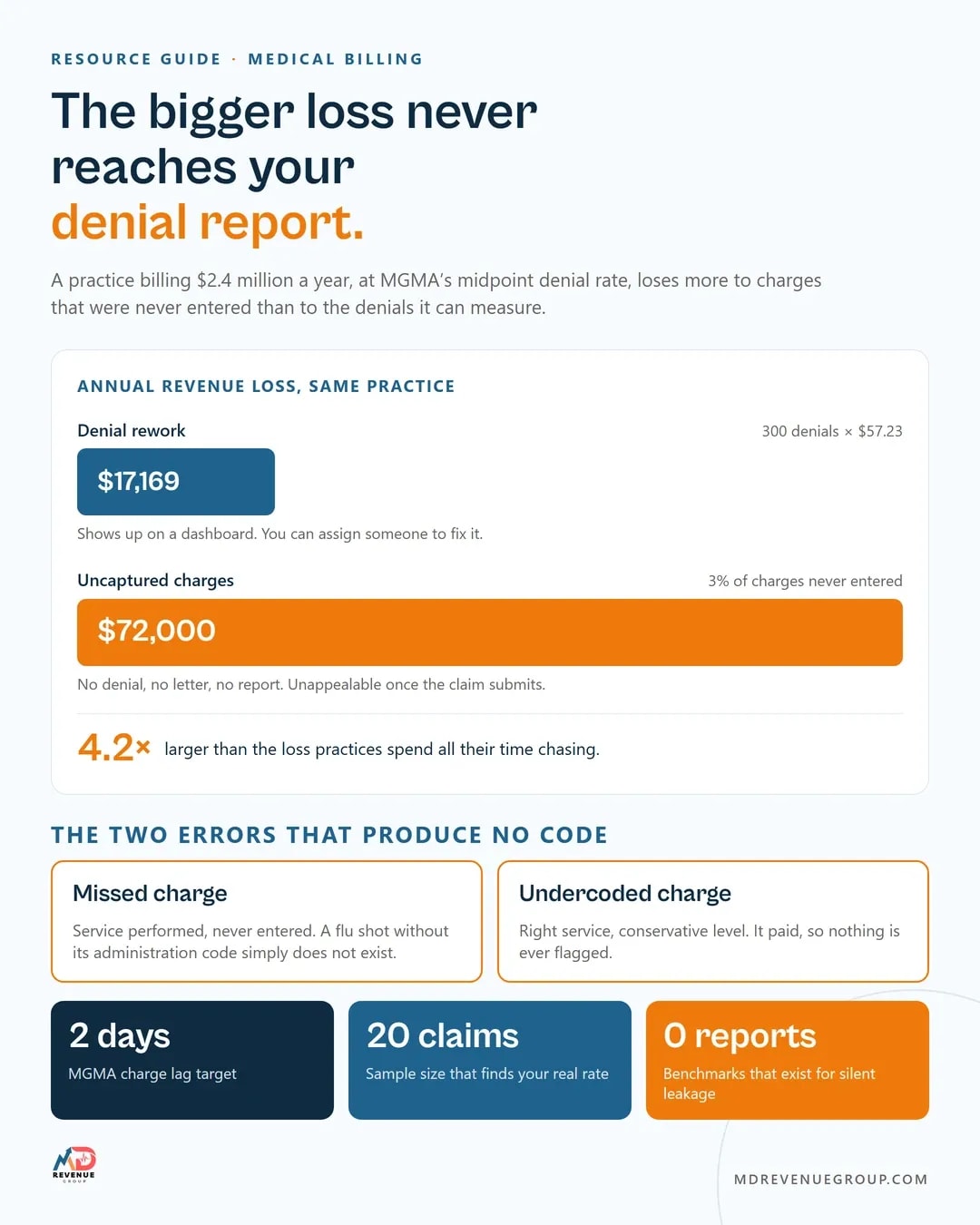
Visible loss first. MGMA puts first-submission denials at 7% to 8% across four years. Take the midpoint, 7.5%. On $2.4 million in charges that is $180,000 denied on first submission. Premier's survey of 280 hospitals across 23 states prices the rework at $57.23 per claim, up from $43.84 in 2022, with Medicare Advantage running $80.16.
For a practice at roughly 4,000 claims a year, 7.5% is about 300 denials. At $57.23 that is roughly $17,000 in rework labor for the year. Painful. Visible. Manageable.
Now the silent loss. Assume, and change this number to match your own experience, that 3% of billable services performed never reach the billing system. A vaccine without its administration code. A supply used during a procedure. A second procedure documented in passing. A cancelled slot adjustment that never got reversed.
Three percent of $2.4 million is $72,000 that you billed for nobody. It produces zero denials. It appears in zero reports. It cannot be appealed, because once the claim submits, the payer has paid for what you sent and the difference is yours.
The silent loss is roughly four times the loud one. And the loud one is the one that shows up on a dashboard.
That ratio is the whole argument for this article. Practices manage the number they can see.
The 8 charge entry errors that cost the most
Ranked by what they actually take out of a practice, with the code each one produces where one exists.
Error | What happened | Code | Recoverable? |
|---|---|---|---|
Missed charge | Service performed, never entered | none | No, after submission |
Undercoded charge | Correct service, conservative level | none | No, it paid |
Missing diagnosis pointer | Code present, not linked to the line | CO-16 | Yes |
Duplicate charge | Same service billed twice | CO-18 | Yes, if caught |
Wrong payer order | COB loops out of sequence | CO-22 | Yes |
Modifier omitted | Required modifier missing | CO-97 | Yes |
Charge lag | Charges sit unentered too long | CO-29 | Only before the window closes |
Data entry typo | Transposed member ID or NPI | CO-29 or CO-16 | Sometimes |
The top two rows have no code. That is the entire problem.
The timer nobody watches: charge lag
Charge lag is the days between the encounter and the charge reaching the billing system. MGMA recommends posting charges within 2 days of the encounter. MGMA's operational guidance recommends closing encounters within 72 hours and posting charges within 2 days, against a 3-to-7-day lag it describes as common across the sector.
Under 42 CFR 424.44, a Medicare claim must reach the correct Administrative Contractor within 12 months of the date of service. There is no appeal available on a late-filing denial. A claim that sits in a queue because nobody owned the queue loses the whole balance.
Charge lag is the point where a slow process becomes a permanent loss rather than a delay.
Where the errors come from
Optum's denial category breakdown puts eligibility and registration at 24% of denials and missing or invalid claim data at another 16%. Those two buckets are both front-end, and both happen before or during charge entry.
UASI's write-up on charge capture describes the structural cause well: charge capture spans clinical operations, physician documentation, clinical documentation improvement, coding, revenue integrity, finance, and IT. Each team owns a piece. Few organizations establish clear accountability for the end-to-end outcome, and the result is a fragmented operating model where no single person is responsible for whether the encounter converted to a billable charge.
That is the diagnosis. A charge entry error is usually a process-design problem wearing a data-entry costume. Fixing the individual who made the error fixes that error. Fixing the ownership gap fixes the rate.
How to find leakage nobody reported
Four checks. None requires new software.
Pull charges entered per provider per day. Compare against encounter volume. A provider seeing 14 encounters and entering 9 charges has a capture problem, and the size of the gap tells you roughly what it is costing.
Sample 20 encounters against their claims. Pick encounters at random across a month. For each one, list every service documented and check whether each one reached the claim. Twenty encounters is enough to estimate a rate within a range wide enough to act on.
Reconcile fee schedule to billed amount. Pick 50 charges at random and compare the amount entered against the contracted rate. Underbilling shows up here as a pattern, not as an event.
Check the modification report. Every practice management system tracks who changed a charge after entry. Look for the same person or the same code set appearing repeatedly. That is a training or access-control issue with a name on it.
Fixing the ownership gap rather than the keystroke
A charge entry error caught in training recurs, because training addresses the symptom and the process still produces the condition. The four structural fixes that hold.
Assign charge capture to a named role per service line. For a multi-specialty group, each service line needs an owner who confirms capture completeness before closing out the day. UASI describes the failure precisely: each team owns a piece, few organizations establish clear accountability for the end-to-end outcome.
Set a service-line reconciliation, not a claim-level audit. Compare documented services to entered charges daily by provider. A claim-level audit runs after the money is gone. This one runs while it can still be fixed.
Automate the entries nobody should be typing. Fee amounts pulled from the contracted fee schedule rather than keyed. Diagnosis pointers defaulted from the documentation. The errors that repeat are usually the ones a person retypes every day.
Separate under-coding review from denial review. Denials get worked because someone is measured on them. Undercoding gets nobody. Put it on a review cycle with its own owner, because no dashboard will surface it.
CAQH reported that more than half of health plans and about a quarter of provider organizations now use AI in administrative workflows, with provider use concentrated on eligibility checks, note-taking, and patient communications. Charge capture is a reasonable next target for that tooling, with a human reviewing the output. Our automation ROI analysis covers what that kind of program returns and where it stalls.
Our guide to charge capture and the process stage it belongs to covers where each of these fits, and medical billing vs medical coding covers who owns the handoff when a code is wrong.
What the industry data says about the scale
Kodiak Solutions aggregates revenue cycle data from more than 2,300 hospitals and 350,000 physicians. Its 2026 benchmarking release, as reported in industry coverage, put the median final denial rate at 2.7% in 2025, up from 2.5% in 2024. Bad debt climbed from 1.1% to 1.3% of net patient revenue. Combined, providers in that data set missed out on $48.4 billion in 2025.
The American Hospital Association estimates hospitals spent $43 billion in 2025 collecting payment from insurers for care already delivered, including nearly $18 billion overturning claim denials.
Those figures measure the loud loss. The silent loss sits outside every one of them, which is why no industry benchmark exists for it. Our guide to what the OIG audits covers what auditors look for, and the 2026 medical billing audit playbook covers the sampling method.
Frequently asked questions
Charge capture is the provider recording services at the point of care. Charge entry is billing staff entering those documented services into the billing system with codes and fee amounts. Capture failures are silent because no payer ever sees them. Entry failures produce denial codes.
Nothing visible. The claim submits without that service, the payer pays for what you sent, and the balance is yours. There is no denial, no letter, and no appeal, because the payer never knew the charge was missing.
The days between the encounter and the charge reaching the billing system. MGMA recommends closing encounters within 72 hours and posting charges within 2 days. and MGMA recommends closing encounters within 72 hours and posting charges within 2 days.
Fix the ownership model before the training. UASI's analysis of charge capture describes the problem as fragmented across clinical operations, documentation, CDI, coding, revenue integrity, finance, and IT, with no single owner for whether an encounter converted to a billable charge.
Generally not. Once a claim adjudicates, the payer has paid for what you sent. A missed charge becomes a patient balance or a write-off. Some payers allow an adjustment request within a narrow window, and it is worth asking, but plan around it not being available.
The claim is an exact duplicate of one already processed. It points to charge entry or a resubmission workflow that did not check whether the original had already gone through.
It depends on direction. Billing below what documentation supports is recoverable revenue loss. Billing above it creates recovery exposure and, depending on knowledge and intent, False Claims Act risk. The same keystroke produces opposite consequences depending on which direction it went.
There is no reliable industry benchmark, which is part of the problem. Practices measure denial rates, and undercoding produces no denials. The honest way to find your own number is the 20-encounter sample described above.
Where to go next
Charge capture and charge entry in the full chain shows where this stage sits. Who owns a coding error, coder or biller covers the handoff. For the code sets themselves, medical coding resources have the ICD-10, CPT, and HCPCS rules.
If your problem is finding the losses rather than preventing them, medical revenue recovery covers aged balances and denied claims, and improper payment audits covers the recovery side. Practices billing in New Jersey and New York have extra state layers; the states directory lists all of them.
Request a free revenue audit and we will run the 20-encounter sample against your own data and show you which kind of leakage is larger.