The Lower Premiums Faster Payments Act: What Ending No Surprises Arbitration Would Mean for Your Out-of-Network Revenue
Rep. Pallone's Lower Premiums Faster Payments Act would end No Surprises arbitration in 2028. See what it means for your out-of-network revenue and disputes.
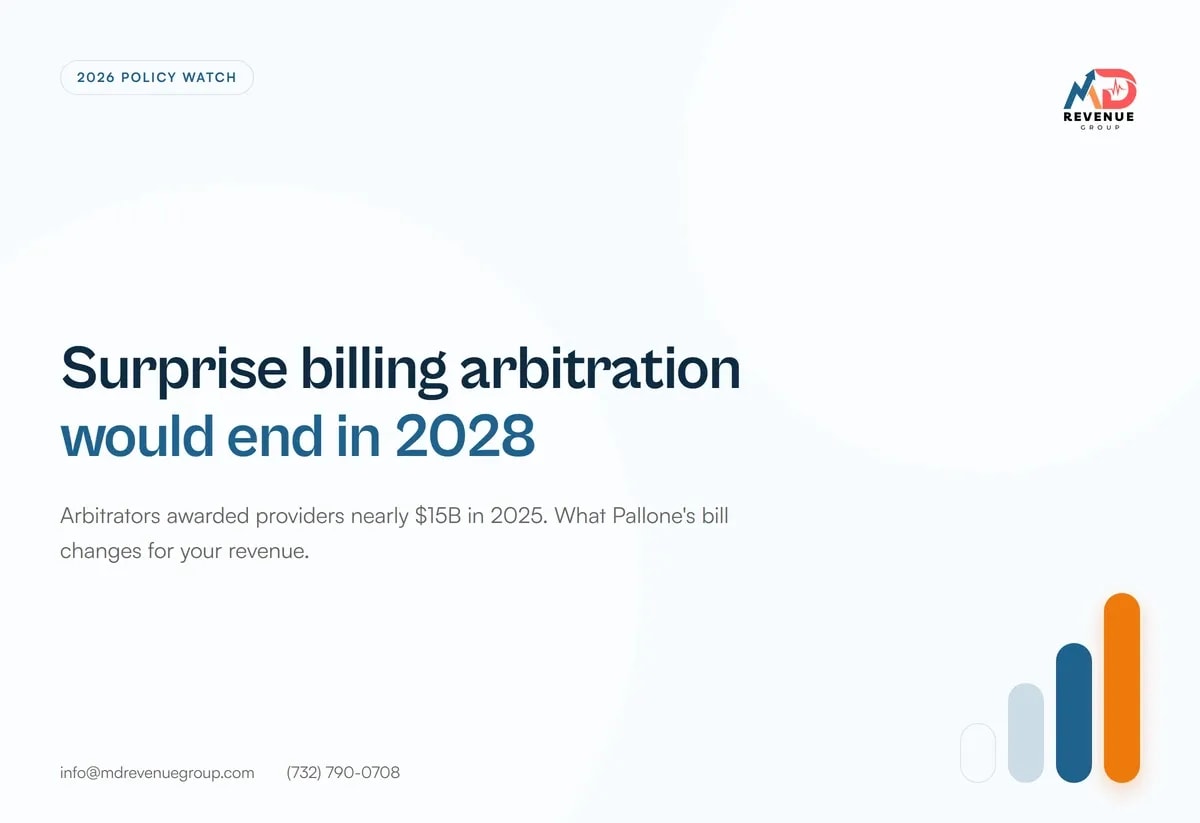
The Lower Premiums Faster Payments Act is a bill Rep. Frank Pallone Jr. (D-N.J.) introduced on October 8, 2026. It would end independent dispute resolution for out-of-network payment disputes on services furnished on or after January 1, 2028, replacing arbitration with the qualifying payment amount, an insurer's median in-network rate recalculated from a January 31, 2019 base and indexed to inflation.
This is proposed legislation. It has no bill number, no named cosponsors, and no Congressional Budget Office cost estimate yet. It would change the economics of every out-of-network dispute you file, so the next 14 months matter more than the vote.
Here is what the bill says, what the current system costs, which groups win and lose, and what a practice should do while arbitration still exists.
Key takeaways
- The Lower Premiums Faster Payments Act would end arbitration for services furnished on or after January 1, 2028. The current process runs through 2027 even if the bill passes.
- Out-of-network payment would be set at the qualifying payment amount: the insurer's median in-network contracted rate as of January 31, 2019, indexed to CPI-U.
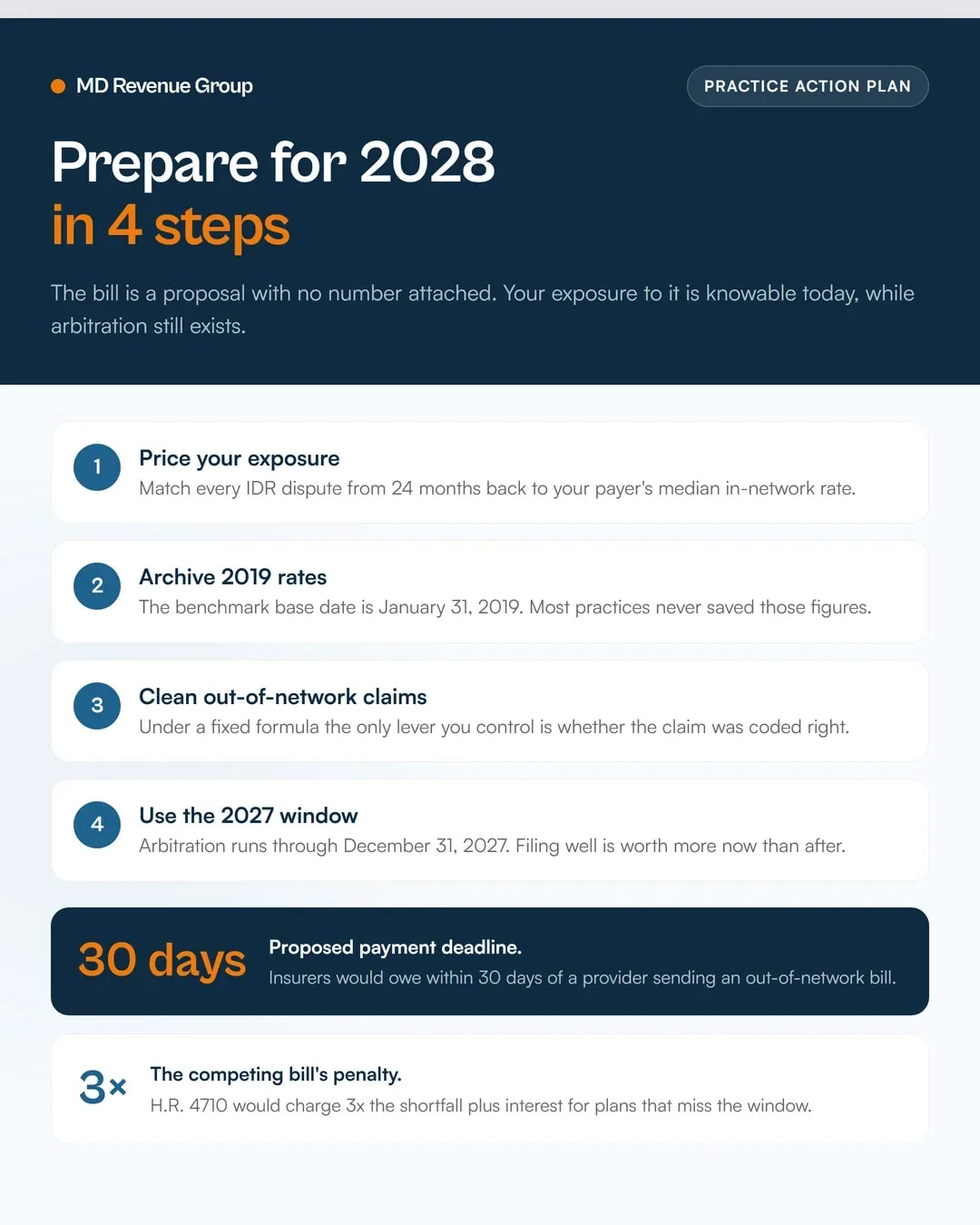
- Insurers would have 30 days from the date a provider sends the bill to pay, with no arbitrator in between.
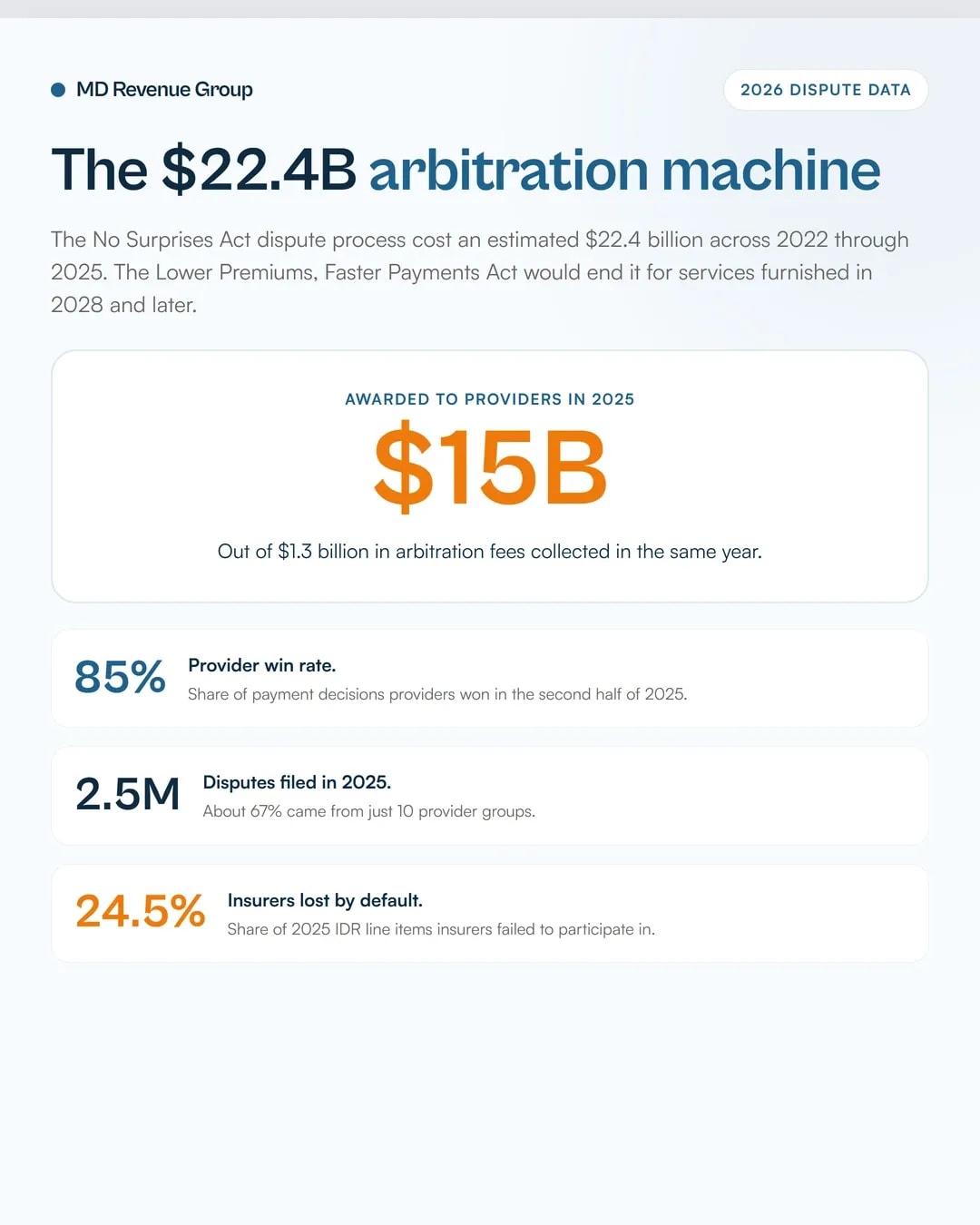
- Arbitrators awarded providers nearly $15 billion in 2025. Georgetown researchers put the total cost of the dispute process at $22.4 billion over four years.
- Three provider groups filed more than three-quarters of resolved disputes in 2025. If the bill passes, the filers with the highest OON exposure absorb the biggest change.
What the bill would change
The No Surprises Act took effect in January 2022. It bars surprise bills for most emergency care, for certain out-of-network providers treating patients at in-network facilities, and for air ambulance services. Patients pay only their normal in-network cost sharing. That part stays exactly as it is under this bill.
What the Lower Premiums Faster Payments Act would change is how the provider gets paid for the balance.
Element | Under current law | Under the Lower Premiums Faster Payments Act |
|---|---|---|
Payment dispute forum | Independent dispute resolution, arbitrator picks the higher of two offers | No arbitration. Payment set by formula |
Payment basis | Negotiated offer or arbitrator award | Qualifying payment amount, the insurer's median in-network contracted rate |
QPA base year | January 1, 2019 | January 31, 2019 |
Inflation adjustment | CPI-U applied annually | CPI-U applied through 2027, then annually after |
What the QPA formula counts | Varies by regulation | Total payment including patient cost sharing and the average expected value of bonuses, risk sharing, and other incentive payments |
"Ghost rates" | Counted in the QPA calculation | Excluded. Rates for physicians who did not furnish the service in the 2019 plan year would be dropped |
Payor payment deadline | Set by the arbitrator's decision | 30 days after the provider sends the bill |
Judicial review of the QPA methodology | Available | Barred by the bill |
Regulator role | CMS operates the IDR program | Federal agencies get 180 days to rewrite the calculation rules, then must audit claims data from at least 25 plans a year starting in 2028 and publish findings |
Patient surprise bill protections | In force since 2022 | Unchanged |
Sources: Medical Economics and Medical Daily.
Two provisions in that table raise the median rather than lower it. Dropping ghost rates and counting full incentive payments both push the benchmark up, and both track the August 11 ruling by the full Fifth Circuit that struck down the ghost-rate regulations. Holland & Knight's read is that both changes would tend to raise the median.
The bill also landed with no number attached. Medical Daily reported it has no bill number, no named cosponsors, and no CBO cost estimate as of publication, and that it is unlikely to move this year.
For practices already running an arbitration program, the mechanics are covered in our No Surprises Act IDR batching workflow, which walks the 50-line-item cap and the 30-business-day cooling-off period.
Why Congress is doing this
The dispute volume ran far past every projection made when the law passed. The Congressional Budget Office expected roughly 22,000 disputes a year and projected the law would lower commercial premiums by about 1%. In June, CBO wrote that arbitration outcomes could instead lead to higher prices and premiums over time.
The actual numbers, from CMS reports cited by Medical Daily:
Metric | Figure |
|---|---|
Disputes started, April 2022 through July 2026 | more than 7 million |
Disputes filed in July 2026 alone | 394,140 |
Disputes filed in 2025 | about 2.5 million |
Share filed by 10 provider groups | about 67% |
Share started by the top 3 filers (HaloMD, TeamHealth, SCP Health) | about 38% |
Provider win rate on payment decisions, second half of 2025 | about 85% |
Decisions where the winning offer exceeded the insurer's benchmark | about 87% |
Fees collected by 15 arbitration firms in 2025 | $1.3 billion |
Fees collected across all of 2022 through 2024 | $885 million |
Amounts awarded to providers in 2025 | nearly $15 billion |
Georgetown University researchers put the total cost of the dispute process at $22.4 billion across 2022 through 2025, including $15.6 billion in awarded payments that exceeded in-network rates. Dispute volume rose 77% from 2024 to 2025 and payment amounts rose 264% over the same period. New York's state employee health plan named arbitration awards as the main driver of a 10% premium increase this year.
One Georgetown finding explains why this keeps coming back. For some services, including breast reductions, providers were paid more than 80 times what Medicare would have reimbursed the same work.
Pallone's stated reason, from his announcement: "A few bad actors, largely backed by private equity, are gaming the system, creating backlogs, delaying payments, and driving up premiums." He called the law an overwhelming success for patients while saying the arbitration process is clearly not working (The Fiscal Times).
The pressure is bipartisan. The Trump administration said earlier in 2026 that the arbitration system is being gamed and needs cleanup. Reform pressure does not depend on which party controls the House after November.
Who wins and who loses
The median in-network rate is a fundamentally different payment floor than an arbitrator award. For a specialty whose contracted rate already sits near the median, the change may be small. For a specialty priced well above its own median, it is severe.
Emergency medicine accounted for 41% of dispute filings from 2023 to 2025, and radiology for 29%, according to the Georgetown study. Three organizations filed more than three-quarters of dispute lines resolved in 2025: Radiology Partners, HaloMD, and TeamHealth. Those are the exact filers whose economics would reset under a median benchmark.
The provider groups opposed the bill the day it was announced. The American Society of Anesthesiologists, the American College of Emergency Physicians, and the American College of Radiology released a joint statement. Their argument centers on insurer conduct in 2025:
2025 CMS data cited by the specialty groups | Share of IDR line items |
|---|---|
Insurers failed to participate and lost by default | 24.5% |
Insurer offers of $1 or less | 8.2% |
Insurer offers at or below the QPA, excluding defaults | nearly 40% |
ACEP President Ryan Stanton, M.D.: "Smaller and independent practices are often shut out of the IDR process altogether, and continue to face mounting pressures of consolidation as insurers attempt to drive them out of network." ASA President Patrick Giam, M.D.: "Giving health insurance companies even greater control over physician payments is not the solution to concerns about the IDR process."
The groups also called the bill premature. Agencies have not finished carrying out the IDR operations rule finalized this year, which cut the fee to file a dispute from $115 to $15, and they have not brought QPA calculations in line with the Fifth Circuit ruling.
Read together, the specialty position is that a fixed formula hands insurers the pricing power they have been criticized for using. Providers who won 85% of decisions in arbitration would be paid the benchmark they were already offered and refused. Consumer advocates see it the other way. Families USA's executive director, Anthony Wright, said the bill would ensure providers "receive fair but not inflationary payments that raise costs for everyone."
On specialty-level batching economics, our IDR batching by specialty guide maps the CPT ranges that make radiology, pathology, lab, and anesthesia disputes worth batching.
What your practice should do now
Quantify your exposure before January 2028. Pull every out-of-network claim you submitted to IDR in the last 24 months. For each one, find your payer's contracted median rate for that CPT code, in your specialty, in your geography. That number is the payment you would have received under the bill. The gap between it and what you actually collected is your exposure.
Document your contracted rates now, while they are easy to pull. The QPA is built from January 31, 2019 contracted rates, which most practices never archived. If you cannot produce what you charged on that date, you cannot verify an insurer's benchmark calculation. The bill would make those audits mandatory on at least 25 plans a year starting in 2028.
Get your OON claims clean and correct. Under the current system, a documentation defect can be fixed through the dispute process and a 30-day collection window. Under a fixed benchmark, the only lever you control is whether the service was billed and coded correctly in the first place. Run your OON line items through claim denial management before they become disputes.
Check the 30-day clock. The bill would require insurers to pay within 30 days of a provider sending the bill. Today, a large share of IDR awards never get collected at all. On September 17, 2026, the Second Circuit refused to revive a practice's bid to collect more than $3 million in unpaid awards from Cigna, ruling that the law leaves enforcement to regulators. Anders Gilberg, senior vice president of government affairs at MGMA, put it plainly: the larger problem is collecting afterward. Practices with solid denial follow-up and timely filing processes do better under either system.
Model a blended revenue scenario. Most practices are a mix of in-network and out-of-network work. If OON volume falls by half under a median benchmark, what does your revenue cycle management plan look like at that revenue level, and how much of it is fixed cost?
Use the 2027 window. Arbitration still exists for services furnished through December 31, 2027. Every dispute you file in that window is under the current system, with an arbitrator and the existing QPA. Filing well is worth more in the next 14 months than at any point after the bill's effective date.
What could still change
This is a proposal in a Congress where the sponsor has limited power to move it. Pallone is ranking member of the minority on Energy and Commerce. He would be in line to chair the committee if Democrats take the House on November 3. As ranking member now, he has limited ability to move the bill himself, and the House Ways and Means Committee reportedly prefers a different approach to overhauling the No Surprises Act, which complicates any reform push.
There is a competing bill from the other direction. The No Surprises Act Enforcement Act, H.R. 4710 and S. 2420, from Rep. Greg Murphy (R-N.C.) and Sen. Roger Marshall (R-Kans.), would penalize plans that fail to pay within 30 days of an arbitration decision. The penalty would be three times the difference between the plan's initial payment and the awarded rate, plus interest. MGMA and dozens of physician organizations support it. The Senate Health, Education, Labor and Pensions Committee has held roundtables on IDR chaired by Bill Cassidy (R-La.), with Marshall, Josh Hawley (R-Mo.), and Maggie Hassan (D-N.H.) participating. Federal funding expires December 11, and a year-end spending package could carry a narrower fix.
Watch three things: whether a bill number gets assigned, whether the CBO scores it, and whether leadership on both committees signals a markup. Pallone's investigation is already active. In September 2026 he sent letters to six arbitration firms requesting documents on how they decide claims.
There is also a scope question. Jack Hoadley, a research professor emeritus at Georgetown's Center on Health Insurance Reforms, argued that primary care practices operating outside facilities should never have been eligible for this process at all. A narrower bill that keeps arbitration for facility-based specialties and ends it elsewhere would produce a very different revenue picture for a radiology group than a full repeal.
Get your out-of-network exposure measured
Nobody can price this bill for you without your own claims data. We pull your last 24 months of IDR disputes, match each one to your payer's median in-network rate, and show you the dollar gap. You get the number whether or not the bill passes. Request a free audit and we'll run it.
Frequently asked questions
It is a bill Rep. Frank Pallone Jr. introduced on October 8, 2026 that would replace the No Surprises Act's arbitration process with a formula. Out-of-network providers would be paid the qualifying payment amount, an insurer's median in-network rate, with 30 days for insurers to pay. It is a proposal with no bill number yet.
Arbitration would end for services furnished on or after January 1, 2028. If the bill became law, the current arbitration process would continue for services furnished through December 31, 2027. Patients would keep their existing surprise bill protections in both periods, since the No Surprises Act's patient-side rules date to January 2022.
For many specialties, yes. Payment would shift from an arbitrator's award to the insurer's median in-network rate, and providers won about 85% of payment decisions in the second half of 2025. Practices priced near their own contracted median would see a small change. Hospital-based specialties with high OON exposure and an arbitrator-favorable history would see the largest reduction.
No. Patient protections would remain in force. The law continues to bar surprise bills for most emergency care, certain out-of-network providers at in-network facilities, and air ambulance services, and patients would continue to owe only in-network cost sharing. The bill removes the arbitration mechanism for provider payment disputes rather than the consumer protections themselves.
The QPA would become the out-of-network payment rate directly. The 2028 benchmark would be each plan's median contracted rate as of January 31, 2019, for the same service in the same specialty and region, increased by CPI-U. The formula would exclude rates for physicians who did not actually furnish the service in 2019.
The existing arbitration process continues, and the IDR fee cut from $115 to $15 that took effect this year stays in place. Competing legislation, including the No Surprises Act Enforcement Act, would still target insurer nonpayment. Practices should assume the current system remains in force unless a final rule or statute says otherwise.
See your real out-of-network exposure
The bill is a proposal with no number attached and an uncertain path to a floor vote. Your exposure to it is knowable today. We pull your IDR dispute history, match each line item to your payer's median in-network rate, and give you the dollar difference. That number works as a negotiating input and a budgeting input either way. Request a free audit and we'll put it on your service mix.