
Electronic vs. Paper Claims: The 6-Line Limit and the $4.54 Cost Gap
Paper claims cost $7.93 each. Electronic cost $3.39. The CMS-1500 holds 6 lines, the 837P holds 50. What CMS requires and where paper works.
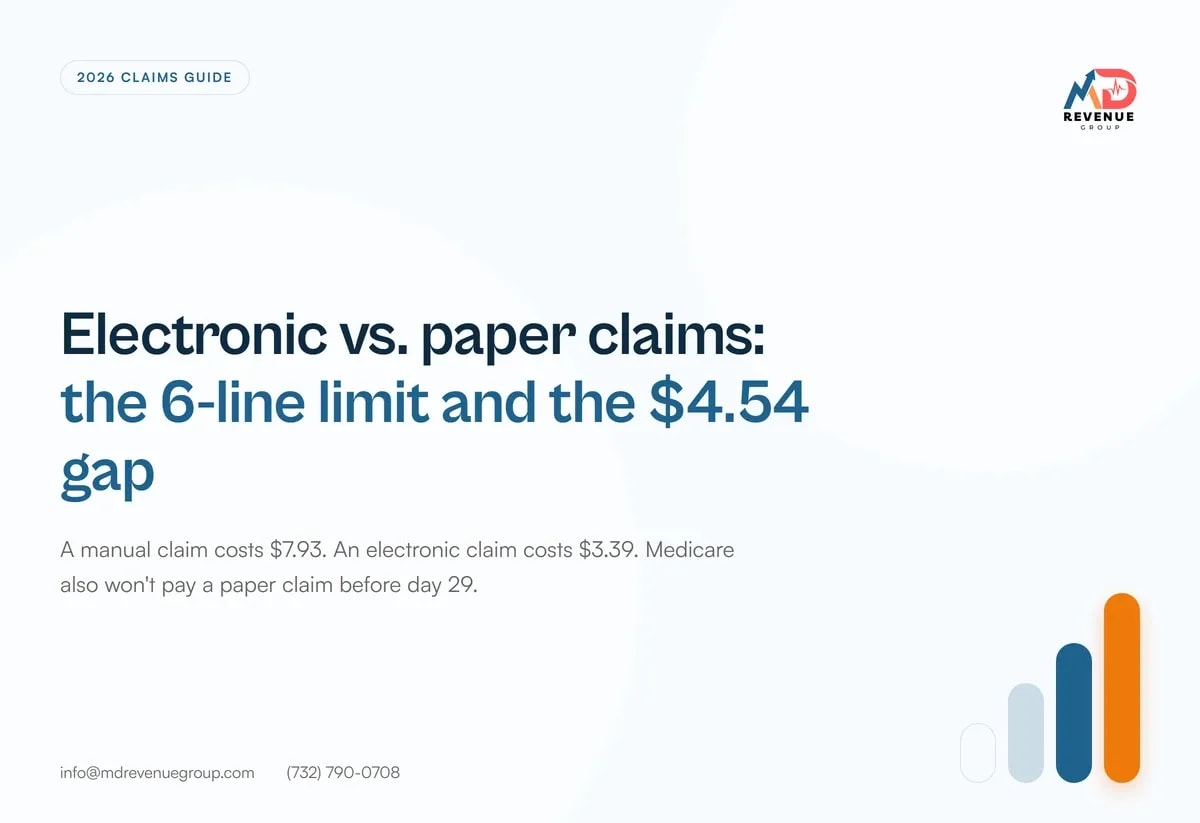
Electronic vs. paper claims come down to one number and one rule.
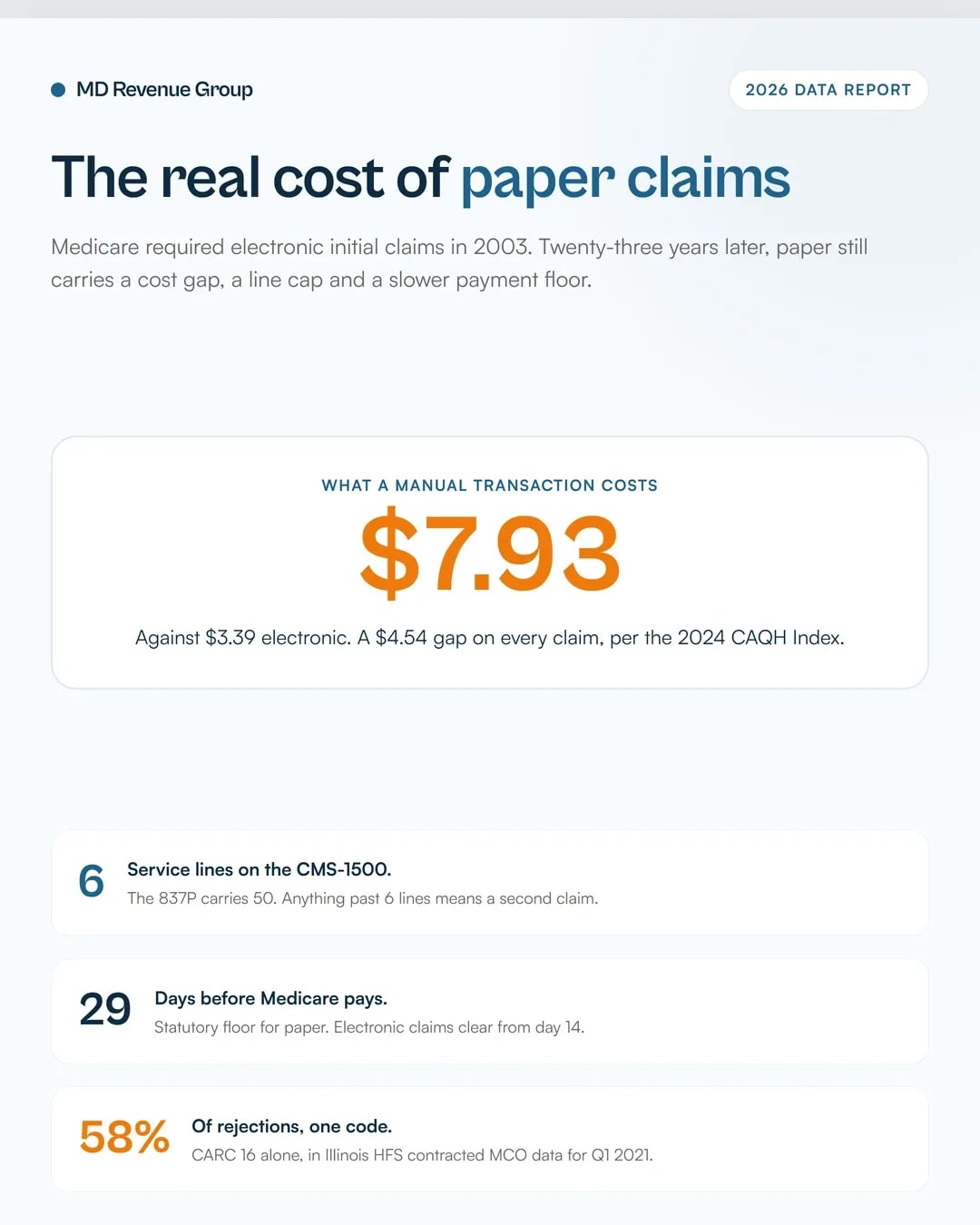
A manual claim costs about $7.93 to process. An electronic claim costs about $3.39. That $4.54 gap is the medical provider average across all 9 administrative transactions the CAQH Index measures.
Then there's the structural limit. The CMS-1500 paper form holds 6 lines of service. The 837P electronic transaction holds 50. And CMS has required electronic submission for Medicare since October 16, 2003, under the Administrative Simplification Compliance Act.
Paper still works in narrow cases. A provider with fewer than 10 full-time employees qualifies for an ASCA exception. Some payers accept nothing else. A few Medicaid programs still want a form in an envelope.
For everything else, that decision was made for you 23 years ago.
If you need the terminology first, what is medical billing sets the base.
Key takeaways
- Medicare has required electronic initial claims since October 16, 2003. Paper needs an exception under 42 CFR 424.32.
- Medical providers pay $7.93 per manual transaction against $3.39 electronic, per the 2024 CAQH Index.
- The CMS-1500 carries 6 service lines. The 837P carries 50.
- Paper claims must print in Flint OCR Red, J6983 ink. Photocopies get rejected.
- A file that fails basic HIPAA compliance gets the entire batch rejected, not just the one bad claim.
- On May 26, 2028, paper-based attachment submission becomes noncompliant under X12N 275 and 277.
What does CMS require for electronic claim submission?
The Administrative Simplification Compliance Act, Pub. L. 107-105 Section 3, amended the Social Security Act so that no Medicare payment is made for a claim submitted in non-electronic form. The implementing rule sits at 42 CFR 424.32. The date is October 16, 2003.
Twenty-three years in, this is still the part of healthcare billing practices understand worst. Most assume HIPAA only tells you what format to use if you go electronic. ASCA goes further. For Medicare, it decides whether you can go on paper at all.
HIPAA's role is separate and still active. On January 16, 2009, HHS published a final rule adopting ASC X12 Version 5010 for HIPAA transactions, with a compliance date of January 1, 2012. Enforcement discretion ended June 30, 2012. If you transmit electronically, you transmit in 5010, using the 837P for professional claims and the 837I for institutional ones.
How to submit a medical claim walks through the 837P structure field by field.
The exceptions that still exist
CMS publishes the qualifying exceptions. They're narrower than most practices assume:
- Small provider. Fewer than 10 full-time equivalent employees for physicians and suppliers, 25 FTE for institutional providers
- Roster billing of mass immunizations, unless the company agreed to submit those electronically as a condition for flu shots administered across multiple states
- Claims under a Medicare demonstration project that specifies paper
- Medicare Secondary Payer claims where a primary payer made an Obligated to Accept as Payment In Full adjustment
- Claims submitted by Medicare beneficiaries or Medicare Managed Care Plans
- Dental claims
- Services furnished outside the United States
CMS names 3 situations as unusual cases and grants those waivers: dental claims, an electricity or communications outage lasting longer than 2 business days, and a large group practice submitting fewer than 10 claims a month and no more than 120 per year.
Everything else requires Medicare pre-approval, including the case where the HIPAA implementation guides can't carry the data needed for adjudication.
What enforcement actually looks like
CMS runs ASCA enforcement by paper volume. Contractors pull reports of providers submitting the highest numbers of paper claims and review them monthly.
If a contractor sends you an ASCA letter, you have 45 calendar days to respond, and that window already includes postal delivery both ways. Paper claims arriving more than 90 calendar days after the initial letter are denied and not paid.
The determination lands 91 calendar days after the letter. A contractor can push that to the 121st day if you tell them you'll have your electronic conversion finished by then.
One line in the CMS instruction is worth reading twice: a Medicare decision that a provider is ineligible to submit paper claims is not subject to appeal.
What does a paper claim cost per submission?
The 2024 CAQH Index reports medical provider cost per transaction across the 9 administrative transactions it studies. The manual-versus-electronic gap has grown most years since 2015:
Year | Manual | Electronic | Gap |
|---|---|---|---|
2015 | $3.54 | $1.34 | $2.20 |
2016 | $4.68 | $1.07 | $3.61 |
2017 | $3.49 | $1.28 | $2.21 |
2018 | $4.14 | $1.70 | $2.44 |
2019 | $5.28 | $1.64 | $3.64 |
2020 | $5.60 | $1.48 | $4.12 |
2021 | $7.59 | $1.61 | $5.98 |
2022 | $7.48 | $2.46 | $5.02 |
2023 | $7.19 | $3.45 | $3.74 |
2024 | $7.93 | $3.39 | $4.54 |
Source: CAQH Index, medical provider average cost per transaction.
The same Index puts the claim submission savings opportunity specifically at $2.6 billion combined, $2.5 billion of it medical, with providers saving 7 minutes per claim submitted.
Read those numbers honestly. A manual claim costs more in labor, postage, and handling. A clearinghouse charges you a per-claim fee to send it electronically. The labor figure is what you recover; the clearinghouse fee is what you spend to recover it.
Why do paper claims get rejected more often?
This is where the structural argument lives.
CMS applies 3 tiers of edits to an 837 file:
- Basic HIPAA compliance. A file that fails here gets the entire batch rejected for correction and resubmission.
- Implementation guide compliance. Errors at this tier reject only the individual claim.
- Coverage and payment policy. Errors at this tier reject or deny the individual claim.
A paper claim gets none of these checks before it ships. It goes to the payer's mailroom, gets run through OCR, and enters adjudication. Its first real review happens inside the payer's system, weeks after you mailed it.
The errors that get caught in seconds electronically:
- A diagnosis pointer that doesn't resolve to a diagnosis listed on the same claim
- A Type of Bill frequency digit that contradicts what the payer has on file
- A rendering provider NPI reassigned to a different billing group
Form requirements make it worse. The CMS-1500 must print in Flint OCR Red, J6983 ink or an exact match. Photocopies can't be scanned and aren't accepted by all carriers and DMERCs. A downloaded CMS copy can't be submitted either, because it won't reproduce the OCR color.
Then volume. Community Oncology Alliance's onPoint data for 2020 put CARC 16, the code for a claim that lacks information or carries a submission or billing error, at 24.38% of the top 10 denial reasons across 554,190 claims. Illinois HFS contracted MCO data for Q1 2021 showed CARC 16 as the single largest rejection code at 58.35%, or 19,675 claims.
Denial management covers how to route each reason code to the right desk.
The 6-line cap creates its own problem. Charge entry errors covers what happens when a claim line gets missed. A single date of service generating more than 6 billable lines can't fit on one CMS-1500. You split it into 2 claims, which means 2 filing clocks, 2 OCR passes, and 2 chances for a rejection.
How much slower is paper, and what does it do to days in A/R?
Medicare gives you 1 calendar year from the date of service to file. That's 42 CFR 424.44, effective for services furnished on or after January 1, 2010.
Here's a number that comes from statute rather than vendor estimates.
Medicare law sets a payment floor. A HIPAA-compliant electronic claim cannot be paid earlier than the 14th day after the contractor receives it. A paper claim cannot be paid earlier than the 29th day. Congress extended that paper floor from 26 to 28 days for claims received on or after January 1, 2006.
That's a 15-day gap written into Medicare's own payment rules, and it lands before you add postal transit time to the receipt date. CGS Medicare, the DME MAC, put it plainly in a 2022 contractor call: electronic claims can take 14 days to process and paper claims can take 29 days.
The filing clock doesn't pause while the claim is in the mail or while a rejection letter gets generated and sent back. If a paper claim bounces for a fixable field error, you're at 60 to 90 days before you know there's a problem. An electronic claim carrying the same error gets corrected the same business day, often before it's left the clearinghouse.
There's a harder consequence waiting behind that. If a provider omits an item or service from the initial Medicare claim, the Medicare Claims Processing Manual Chapter 70 states there is no longer a timely filing period for adjustments. That window closed with the initial claim.
MGMA's July 2026 poll found 32% of medical group leaders reporting days in A/R had risen over the prior year, against 22% who improved. One respondent cut days in A/R from 67 to under 34 after an RCM overhaul. Timely filing denials covers the mechanics behind that number.
Orlando Health published the cleanest example. Routing claims through front-end edits that checked LCD and NCD policy before submission cut their net days in A/R by more than 30% and cut coding rejections 44% over 4 years, while absorbing 622,000 additional claims per year in volume. They saved $431,800 a year.
When is paper still the right answer?
A short table beats a long explanation here.
Situation | Paper? | Why |
|---|---|---|
Under 10 FTE, Medicare only | Allowed | ASCA small provider exception, 42 CFR 424.32 |
Group under 10 claims/month, under 120/year | Allowed | CMS grants this unusual circumstance waiver |
Dental claim | Allowed | Excluded from the ASCA electronic mandate |
Communications outage over 2 business days | Allowed | CMS grants this automatically |
Payer accepts nothing else | Required | No electronic channel exists |
Workers comp or auto carrier | Often | Frequently not HIPAA-covered entities |
State Medicaid, certain claim types | Varies by state | Each state sets its own channel rules |
Commercial appeal with attachments | Varies | Payer portal or X12N 275 may be required |
Anything with meaningful volume | No | Cost, speed, and rejection math all agree |
State Medicaid programs run their own rules. North Carolina's NCTracks, for example, accepts professional claims only through its provider portal or an 837P X12 transaction, with exceptions limited to adjustments, time limit overrides, and Medicare overrides. North Carolina medical billing covers the state requirements that sit outside the Medicare baseline.
One caution on the small provider exception. Qualifying for it doesn't make paper the better choice. The exception exists as a safety valve. Practices that qualify still submit electronically, because the cost and cycle-time math favors it.
What changes on May 26, 2028?
The paper question is about to get bigger.
On March 24, 2026, HHS published a final rule at 91 FR 14350 adopting the first national standards for electronic claims attachments. The rule took effect May 26, 2026. Compliance is required by May 26, 2028.
What it adopts:
- X12N 275 for transmitting additional information supporting a claim
- X12N 277 for responding to a payer's request for additional information
- An electronic signature standard
The signature requirement gets missed most often. Manual attestations and informal sign-offs don't satisfy it. The signature applies only to the attachment package, and only when the health plan requires one.
CMS put a number on it: $781 million in annual savings. Providers and clinicians get 80%. Hospitals get 20%, or $130 million a year. Hospital preparation runs $1.4 billion to $2.84 billion, with CMS allocating about 60% of that to health IT vendors.
Attachments are also the laggard in adoption. The 2025 CAQH Index put electronic attachments at 24% for medical and 28% for dental, down from 32% and 37% the prior year.
So a practice still faxing or mailing documentation is carrying a per-claim cost gap and a deadline at the same time. CMS-0057-F and the January 2027 API deadline covers the separate prior authorization track, where 63% of medical plans were still building FHIR-based ePA APIs as of the 2025 Index.
Is converting your paper volume worth it?
Run your own number before you commit budget.
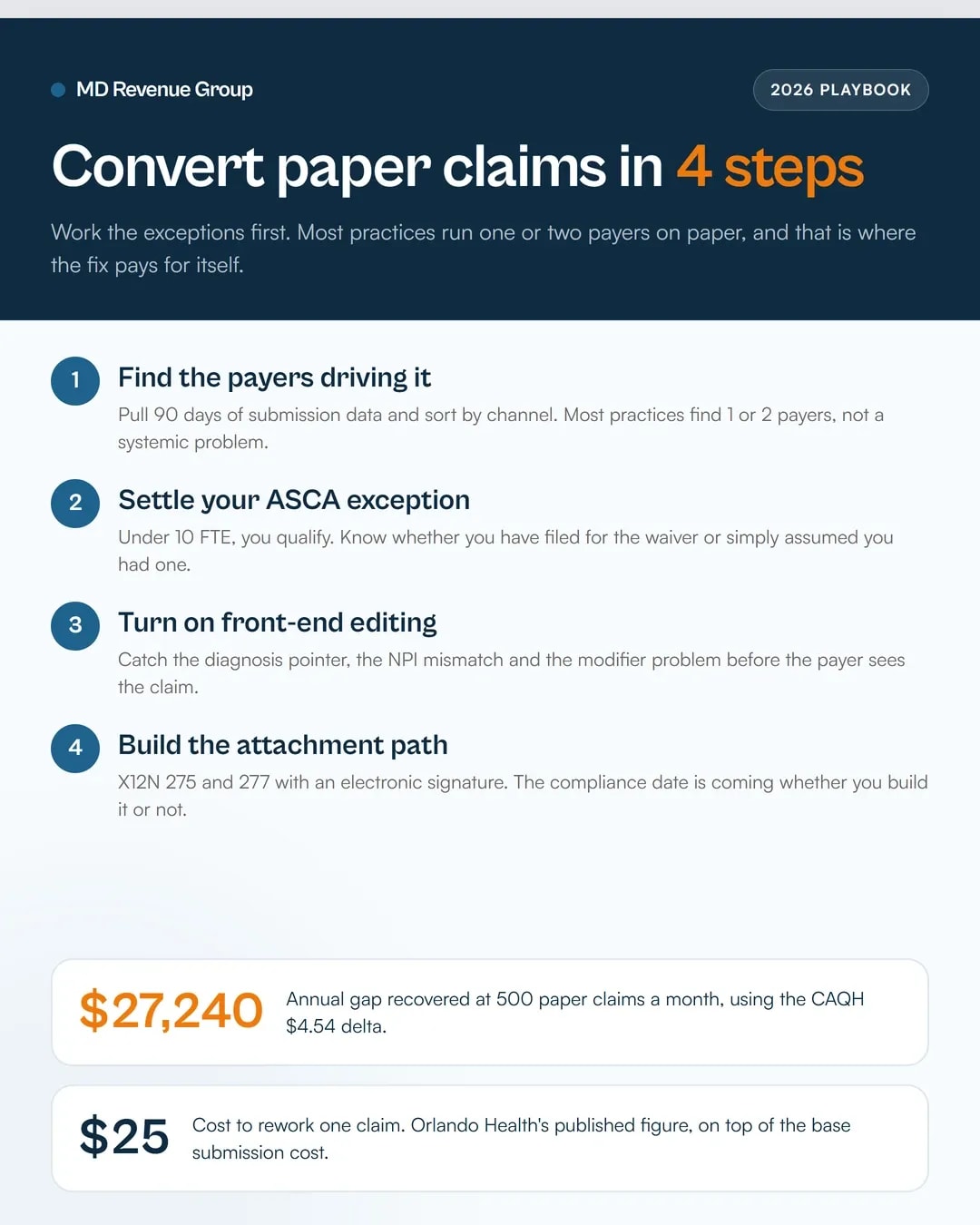
Take the CAQH gap of $4.54 per transaction:
Paper claims per month | Annual gap recovered |
|---|---|
50 | $2,724 |
100 | $5,448 |
250 | $13,620 |
500 | $27,240 |
1,000 | $54,480 |
Now add rework. Orlando Health's published rework cost was $25 per claim. If 10% of your paper claims bounce once, 500 monthly paper claims cost another $15,000 a year in rework alone.
Practices still running meaningful paper volume usually have one specific cause. A single Medicare Advantage payer that rejects EDI. A workers comp carrier with no portal. A line cap problem on a procedure-heavy day. Find that cause first, because fixing it is worth more than a blanket conversion.
Struggling to find which payers are driving your paper volume? We pull your submission mix by channel and show you exactly where the paper claims come from before you spend anything on conversion.