
How to Submit a Clean Insurance Claim the First Time
How to submit a medical claim the first time: CMS-1500 vs UB-04, 837P and 837I, POS codes, 999 and 277CA files, and CMS filing deadlines.
To submit a medical claim the first time without rework, you need 4 things correct: the right claim form, valid member and provider identifiers, the correct place of service code, and a submission date inside the payer's filing window. Miss any one and the claim comes back.
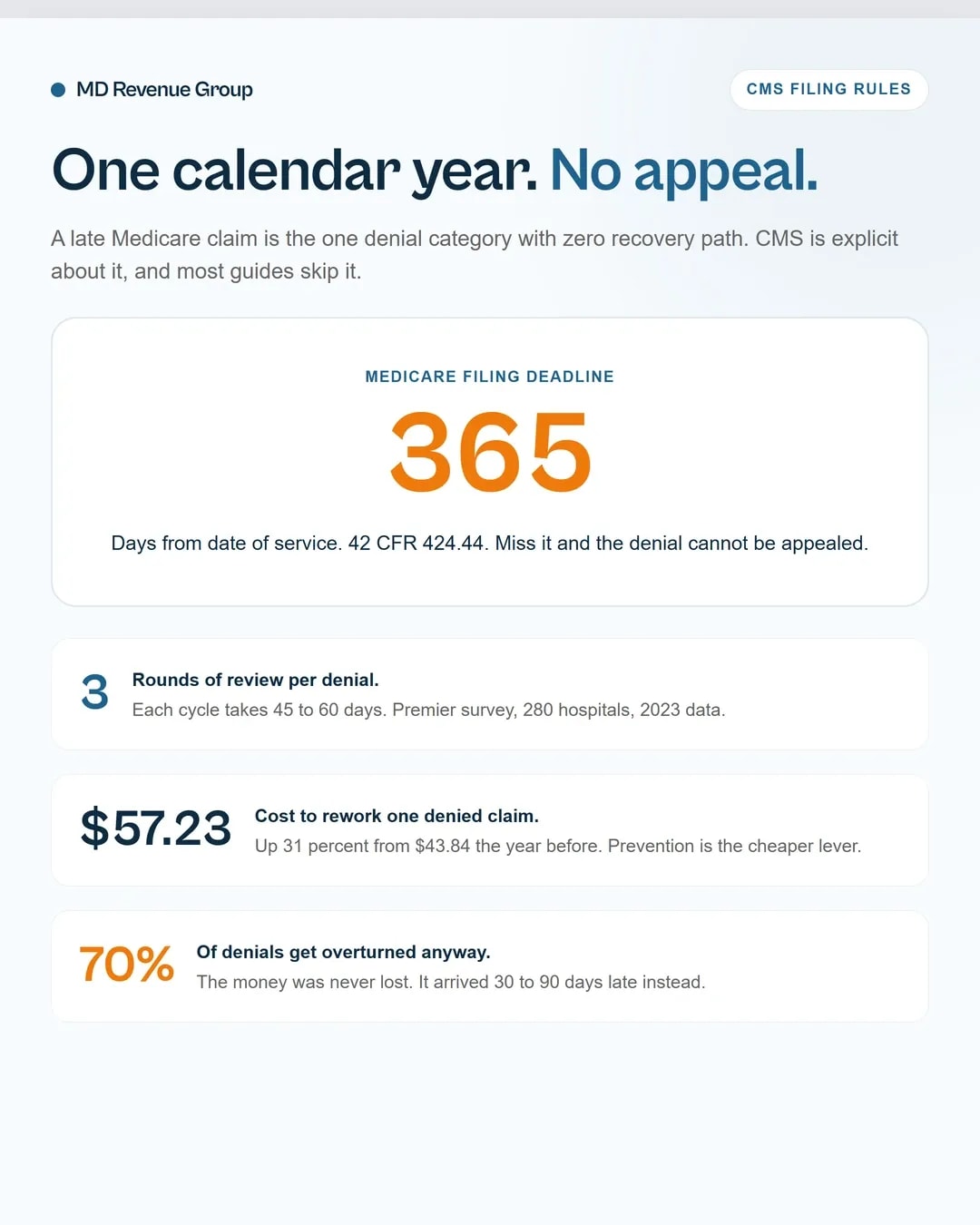
The filing window is the one with no second chance. 42 CFR 424.44 requires Medicare claims to be filed no later than the close of the period ending 1 calendar year after the date of service. CMS's own Medicare Learning Network material states that when Medicare denies a claim as untimely, that denial is not an initial determination and is not subject to appeal.
Most guidance on this topic skips the acknowledgment chain entirely, which is where the actual work lives. Below is the full path a claim takes, including the four files that come back and what each one is telling you.
For the underlying concepts, start with what is medical billing.
Key takeaways
- Medicare requires filing within 1 calendar year of the date of service (42 CFR 424.44). Untimely Medicare denials carry no appeal right.
- Medicaid agencies must require claims within 12 months, and must pay 90% of clean practitioner claims in 30 days and 99% in 90 days (42 CFR 447.45).
- CMS-1500 is the 02/12 version with 33 numbered boxes and 6 service lines. Electronic equivalent is the 837P, X12 version 005010X222A1.
- Place of service code determines whether the Medicare Physician Fee Schedule pays the facility or non-facility rate.
- Reworking a denied claim cost $57.23 on average in 2023, up from $43.84 in 2022 (Premier). A denied claim goes through 3 rounds of review on average, each taking 45 to 60 days.
- For a paper batch that fails HIPAA front-end edits, every claim in the batch is rejected, not just the bad one.
What do you need on the claim before you submit it?
Four data blocks. Every rejection traces back to one of them.
Patient and subscriber block. Legal name exactly as the payer has it, date of birth, member ID, group number, subscriber name, and relationship to the patient. Secondary coverage has to be captured at check-in, not discovered at posting.
Provider block. Billing provider NPI, rendering provider NPI, taxonomy code, billing address, and TIN. A missing or invalid NPI is an instant reject. Common remark combinations on billing-side NPI errors are CO-16 or CO-208 with N257, and rendering-side errors pair with N290. Taxonomy mismatches surface as clearinghouse reject A3/145/85.
Service block. Date of service, ICD-10-CM diagnosis codes with pointers, CPT or HCPCS procedure codes, modifiers, units, and itemized charges per line. The diagnosis has to support the procedure or the claim fails medical necessity review. Our medical coding guides cover how to code to the highest specificity from the record.
Authorization block. Prior authorization number and the valid date range. If the authorization window doesn't cover the date of service, the number being present doesn't help.
Coordinator of benefits errors add a fifth layer. Billing secondary without the primary payer's remittance attached leaves the secondary payer unable to calculate remaining liability, so it rejects or denies. In the 837, the usual culprits are missing prior payer data, mismatched payment amounts, and incorrect loop usage in the 2320 and 2430 elements.
CMS-1500 or UB-04: which form do you use?
The form follows who rendered the service and in what setting. Get it wrong and the claim dies before anyone reads a field.
Form | Used for | Electronic transaction |
|---|---|---|
CMS-1500 (HCFA-1500) | Professional services: physicians, NP, PA, therapists, solo practitioners | 837P |
UB-04 (CMS-1450) | Institutional: hospitals, SNF, rehab, ASC, facility services | 837I |
Dental claim (paper or electronic) | Dental services | 837D |
The CMS-1500 is currently the 02/12 version, with 33 numbered boxes and room for 6 service lines. Claim form and clearinghouse guides cover the field-level details.
The case that trips people up: a surgeon operates in a hospital. The hospital submits a UB-04 for the facility. The surgeon submits a CMS-1500 for the professional fee. Same payer, same date of service, adjudicated separately.
Place of service determines facility versus non-facility payment. Under the Medicare Physician Fee Schedule, some procedures carry separate rates depending on the setting, and the POS code is what identifies that setting. Here are the codes that cause the most trouble:
POS | Description |
|---|---|
02 | Telehealth provided other than in the patient's home (effective 1/1/2017) |
10 | Telehealth provided in the patient's home (effective 1/1/2022; Medicare 4/1/2022) |
11 | Office |
12 | Home |
19 | Off-campus outpatient hospital |
20 | Urgent care facility |
21 | Inpatient hospital |
22 | On-campus outpatient hospital |
23 | Emergency room, hospital |
24 | Ambulatory surgical center |
49 | Independent clinic (effective 10/1/2023) |
99 | Other place of service |
Codes 28-30, 35-40, 43-48, 59, 63-64, 67-70, 73-80 and 82-98 are unassigned. If your system offers one of those, it's a configuration error, not a valid code.
Telehealth rules differ by payer and by modality, which is why audio-only and video visits get edited differently. That breakdown is in our behavioral health telehealth billing through 2027 guide.
How do you submit a claim electronically?
Almost all professional claims go out as the 837P. The current X12 version is 005010X222A1. Institutional claims use the 837I, dental uses the 837D.
HIPAA's administrative simplification rules require electronic use of the 837I, 837P, 835, 270/271, 276/277, and NCPDP D.0 transactions. CMS has been in full production with all Coordination of Benefits Agreement trading partners since July 1, 2012, in 837 5010A2 institutional and 837 5010A1 professional formats.
The practical path: practice management system generates the 837, scrubbing rules run, the claim goes to a clearinghouse, the clearinghouse applies payer-specific edits and routes it. If your PBM or a large plan requires direct submission, that bypasses the clearinghouse layer but doesn't change the transaction.
Paper still exists, with a batch-level risk most practices don't know about. CMS contractors run edits against a paper batch to determine whether the claims meet basic HIPAA standard requirements. If errors are detected at that level, the entire batch is rejected for correction and resubmission. One bad claim in a stack of 50 takes all 50 back.
Paper also pays slower, and the gap is large. CGS Medicare states that paper claims are not paid before the 29th day after the date of receipt, a 28-day payment floor, while clean claims filed electronically can be paid as early as 14 days after receipt, a 13-day payment floor. That's a DME MAC figure, but the direction holds across Medicare contractors, and commercial prompt-pay rules generally run 30 to 45 days for clean electronic claims.
What do the 999, 277CA, 277 and 835 files mean?
This is where most guides stop, and it's where the work actually happens.
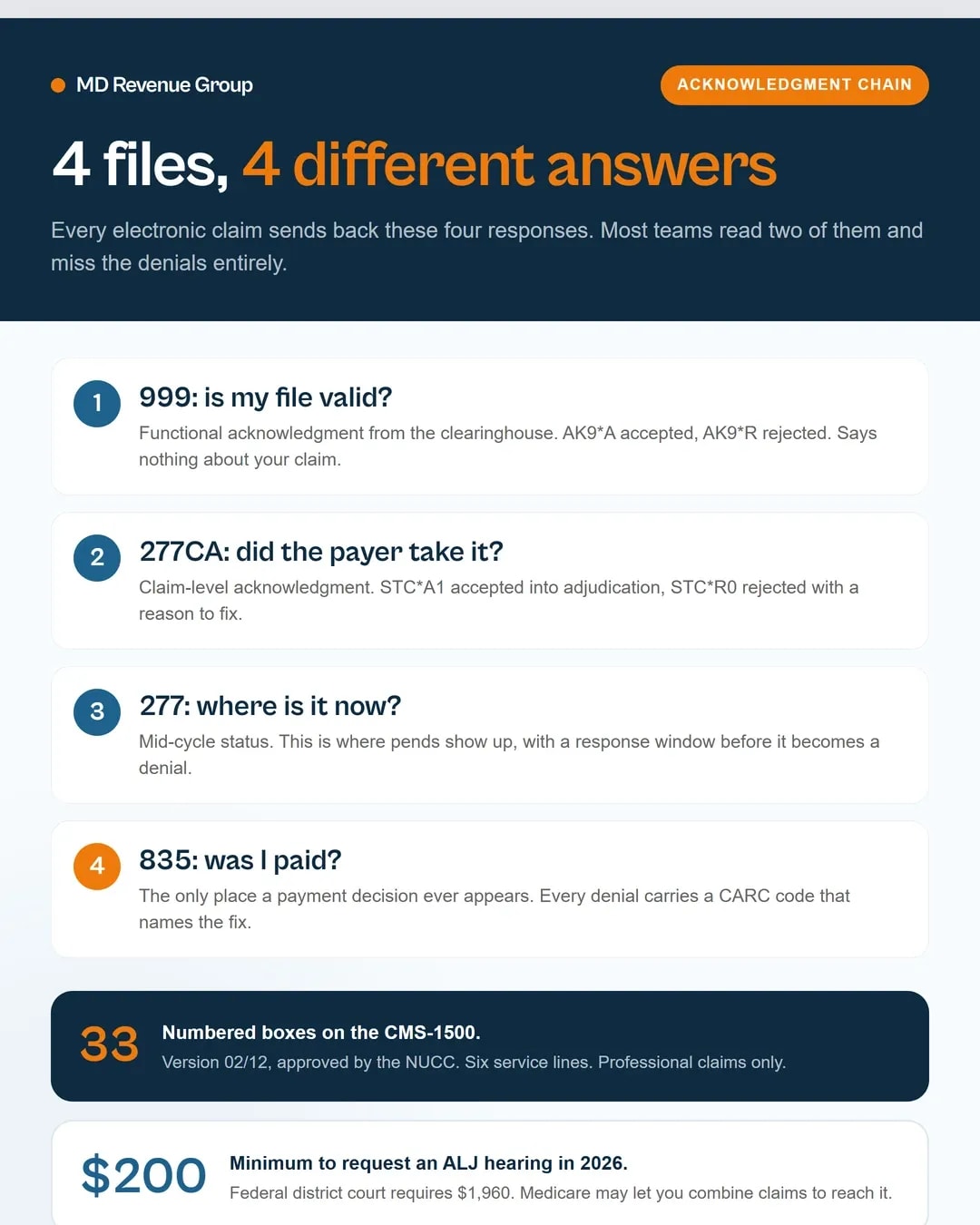
After you submit, 4 different responses come back. They answer different questions.
File | Question it answers | Key status codes |
|---|---|---|
999 | Did the clearinghouse accept my file? | AK9A accepted, AK9R rejected |
277CA | Did the payer accept my claim for processing? | STCA1 accepted, STCR0 rejected |
277 | Where is my claim right now? | Claim status, pend reason |
835 | Was I paid, and why not if I wasn't? | CARC and RARC codes |
The 999 is a functional acknowledgment. It confirms the file was syntactically valid enough to be parsed. A clean 999 tells you nothing about whether your claim is correct.
The 277CA is the payer's claim-level acknowledgment. STCA1 means the claim entered adjudication. STCR0 means the payer rejected it, with a reason attached, and you fix and resubmit. A 277CA never tells you whether you got paid.
The 277 reports mid-cycle status. This is where pends show up: the payer wants records, a review, or more information, and there's a response window.
The 835 is the only place a payment decision appears. Denials only ever show up in the 835. If your team reads the 277CA and stops, they will miss denials entirely.
Two more files you may see: the TA1 interchange acknowledgment, and the 997, the older version of the 999 still referenced in some payer guides.
Why this matters operationally: a practice that watches 999 and 277CA catches rejections fast and denials late or never. A practice watching all four knows the claim's location at every point. Denials caught inside 7 days versus 30 days is the difference between an appeal with live staff context and an appeal with nobody left who remembers the visit.
The same discipline applies to your denial queue afterward. Medical billing denial management covers how to route each CARC to the right owner once you have the remittance.
What are the timely filing deadlines by payer?
Payer | Filing window | Appeal path after a denial? |
|---|---|---|
Medicare Parts A and B | 1 calendar year from date of service | None for untimely denials |
Medicaid | Varies by state, generally 90 days to 12 months | Varies by state |
Medicaid MCO | Contract terms, within federal limits | Contract terms |
Commercial payers | Commonly 90 to 180 days, some up to 365 | Typically yes, 30 to 180 days |
Corrected or replacement claim | Commonly 90 to 180 days from the original denial | Per payer |
The Medicare rule traces to Section 6404 of the Affordable Care Act, which cut the Medicare fee-for-service filing window to one calendar year for services furnished on or after January 1, 2010. Before that, providers had 36 months, which is why so much legacy guidance still lists 3 years.
Medicaid has no national filing rule. Each state sets its own, and a managed care organization contracted by that state can set its own within federal limits. 42 CFR 447.45 requires states to cap filing at 12 months from date of service, and requires payment of 90% of all clean claims from practitioners within 30 days of receipt and 99% within 90 days. 42 CFR 447.46 applies the same prompt-payment requirement to Medicaid MCOs by contract.
Load each payer's deadline into your system as an automated alert. This is the single easiest denial category to eliminate, because the error is purely procedural. If you're currently working these reactively, Change Healthcare timely filing denials covers how much they're costing and how to stop generating them.
What are the most common claim rejections?
Ranked by how often they appear at the clearinghouse and in early payer acknowledgment:
1. Invalid or missing member ID. Wrong plan, expired coverage, or a member ID that doesn't match the subscriber on file.
2. Incorrect or missing NPI. Both billing and rendering provider identifiers are checked. Missing rendering NPI is more common than people expect.
3. Outdated payer ID. A stale payer identifier in your system routes the claim to a clearinghouse that can't parse it.
4. Code set mismatch. Diagnosis without a supporting procedure, procedure without a diagnosis pointer, or an invalid code for the payer.
5. Missing required field. Date of service inconsistency, missing modifier, missing authorization number.
6. Duplicate claim. Same patient, same date, same provider, same codes, already on file.
The rework cost is measurable. Premier's 2023 survey of 280 member hospitals found the average administrative cost of reworking a denied claim rose to $57.23 from $43.84 in 2022. It also found that once a claim is denied, providers go through an average of 3 rounds of review, with each cycle taking 45 to 60 days.
Do the arithmetic on a single $400 claim denied once: 3 cycles at roughly 50 days each is about 150 days of delay on top of the original adjudication window, and 70% of the time it gets paid anyway.
MGMA benchmarks first-submission denials at 7% to 8%, and its 2025 Financials and Operations data report indicates practices can reach below 5% with targeted fixes. If your practice is running a first-pass acceptance rate under 95%, you're feeding this list. Prevention controls that actually move the rate covers which ones to build first.
Corrected claim or appeal: how do you decide?
A corrected claim replaces the original and gets reprocessed. An appeal disputes the payer's decision and asks for reconsideration. Sending the wrong one burns a cycle.
Situation | Use | Deadline |
|---|---|---|
Coding error, wrong modifier, missing diagnosis | Corrected claim | Payer's corrected claim window |
Wrong or missing patient demographic data | Corrected claim | Payer's corrected claim window |
Charge amount submitted incorrectly | Corrected claim | Payer's corrected claim window |
Medical necessity denial | Appeal | Per payer, often 30 to 180 days |
Coverage limitation or benefit interpretation | Appeal | Per payer |
Untimely filing on Medicare | Neither | No recovery path exists |
Payer contract term interpretation | Appeal or IDR | Contract dispute provisions |
Medicare's appeal ladder, for Original Medicare fee-for-service Parts A and B:
Level | Who decides | File within |
|---|---|---|
1. Redetermination | MAC contractor | 120 days of the initial determination |
2. Reconsideration | Qualified Independent Contractor | 180 days of the redetermination |
3. ALJ hearing | Office of Medicare Hearings and Appeals | 60 days of the reconsideration decision |
4. Medicare Appeals Council | MAC | 60 days of the ALJ decision |
5. Federal district court | Federal court | 60 days of the Council decision |
Two levels carry a dollar threshold. For ALJ hearing requests filed on or after January 1, 2026, the amount remaining in controversy must be at least $200. For judicial review in federal district court in 2026, the minimum is $1,960, and Medicare notes you may be able to combine claims to reach it. CMS adjusts both annually, so confirm the current figure before you rely on it.
Ask about peer-to-peer review first on medical necessity denials. It's a direct conversation between your clinician and the payer's medical director. It skips the formal appeal process entirely and reverses a meaningful share of medical necessity denials in one call.
Timely filing deadlines and appeal windows vary enough by state and payer that a national checklist misfires. Our medical billing in California page covers state-specific rules, and all state pages cover the rest.
What should you check before you hit send?
Run this list against every claim. It takes under 2 minutes and catches the 6 rejection categories above.
Patient data: name and date of birth match the payer file exactly. Member ID verified against the card, not typed from memory. Subscriber relationship recorded.
Coverage: eligibility confirmed on the date of service, not the date of scheduling. Secondary coverage captured. Network status confirmed.
Authorization: authorization number present and the valid date range covers the date of service.
Provider data: billing NPI and rendering NPI both populated. Taxonomy code matches the enrollment record.
Coding: diagnosis pointer attached to each procedure. Modifier present where the payer requires it. Place of service code matches the actual setting.
Submission: within the payer-specific filing deadline. Not a duplicate. Batch passes payer-specific edits before it leaves your system.
If clearinghouse rejections are eating more than about 1% of your monthly volume, the fix is upstream in scrubbing rules, not in resubmitting faster. Run a free audit of your claim submission process and we'll tell you which of the 6 categories is actually driving your rejection rate.