
What Is Medical Billing? A Complete Guide for Practices
Medical billing is the process of turning patient care into payment. After a visit, the practice documents the diagnosis and every service performed, codes them, builds an insurance claim, sends it to the payer, and follows up until the money arrives or the claim gets a clear answer.
That answer can take days or months. It can come back paid, denied, rejected, or underpaid. What is medical billing, then, in plain terms? It is the revenue engine of every medical practice, and the work happens mostly backstage while the patient experiences a short front-office visit.
Why it matters, in dollars
Medical billing decides how much of the care you delivered actually turns into revenue. The scale of the money flow is large: CMS puts total U.S. health spending at $4.9 trillion in 2023, a figure that has crossed $14,000 per person. Behind every dollar of that is a claim, a code, and a posting decision.
The failure points are expensive. MGMA and HFMA research put the cost of reworking a single denied claim at roughly $25 to $118 depending on complexity. Industry surveys from Experian Health and others put first-pass denial rates between 5% and 15% of all claims.
Take a small practice billing $200,000 a month. A 10% denial rate means $20,000 a month in stalled revenue. Even if 80% of that is eventually recovered, the practice worked twice for it, and the rest never comes back. That is why this guide exists: billing skill is a margin skill.
The terms you need before anything else
Medical billing has its own vocabulary. Six terms cover 90% of daily work.
CPT codes. Procedure codes, maintained by the AMA, that describe what was done: an office visit, a lab draw, an excision. The current set holds over 10,000 codes.
ICD-10-CM codes. Diagnosis codes that explain why the service was needed. There are over 70,000 of them, and payers tie payment to this link. No diagnosis, no payment.
HCPCS Level II codes. Codes for supplies, drugs, equipment, and non-physician services that CPT does not cover: a walker, chemotherapy drugs, ambulance transport.
Claim. The electronic or paper request for payment. Most claims ride the 837P (professional) or 837I (institutional) transaction.
Remittance. The payer's response. Either an 835 electronic remittance advice or a paper EOB, showing paid lines, adjustments, and denials.
Denial vs. rejection. A rejection never entered the payer's system because of a format or data error. A denial entered, was reviewed, and was refused. The fix is different for each.
How the medical billing process works, step by step
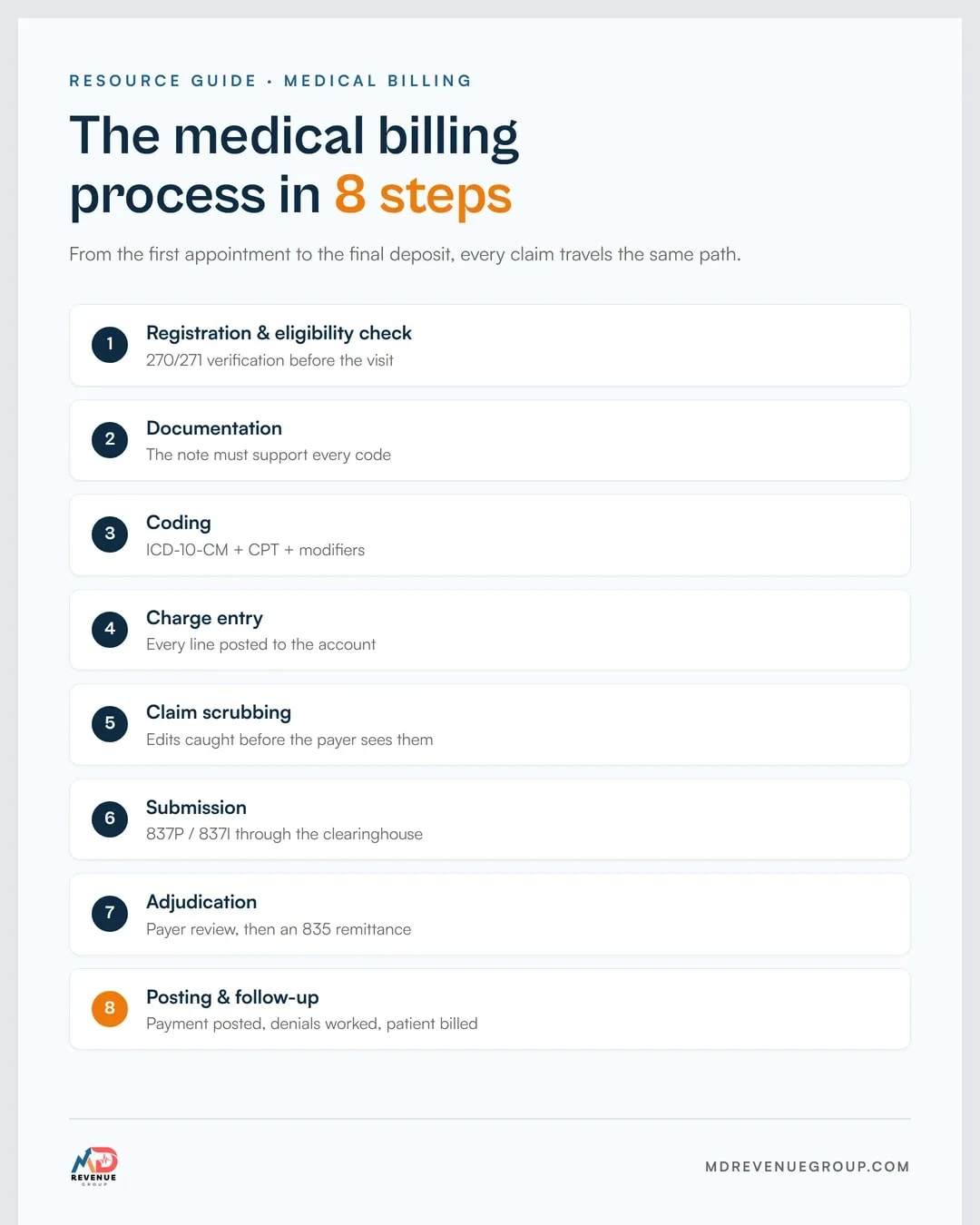
This is the full chain, from the moment a patient books to the moment the deposit posts. Every step has an owner, a deadline, and a failure mode.
1. Patient registration and insurance verification
The front desk captures the patient's name, date of birth, insurance ID, and group number. Before the visit, someone verifies eligibility, usually with a 270/271 electronic transaction. The question answered here: does this plan cover this service on this date?
Literal example of what good looks like: the registrar notes "Verified BCBS PPO, copay $30, deductible met 2026, no auth needed for 99213." One line, on the account, before the visit.
2. Visit documentation
The provider records the encounter: history, exam, medical decision-making, orders, and findings. Billing can only code what the note supports. A thin note is a downcode or an audit finding. (See our free audit if your notes are not supporting what billing submits.)
3. Coding
A coder or biller assigns the ICD-10-CM diagnosis, the CPT procedure codes, and any modifiers. Modifiers change the story of a claim: "this procedure was distinct," "this side," "this visit was separate." Wrong modifier, wrong payment.
4. Charge entry
Every coded line moves into the practice management system with its fee. The superbill is the physical or digital worksheet that carries this information from the clinical side to billing.
5. Claim scrubbing
Software checks the claim before it leaves: missing fields, invalid code combos, duplicate dates, payer-specific edits. The goal is a clean claim on the first pass.
6. Submission to the clearinghouse or payer
Almost all claims travel through a clearinghouse, which formats, batches, and routes them. Clearinghouses also return rejections fast: usually within 24 to 48 hours, so errors get fixed before the filing clock burns.
7. Adjudication, in more detail
The payer's system now does its work, and it checks roughly five things: is the patient covered on the date of service, is the diagnosis billable, is this procedure a covered benefit, is it medically necessary for that diagnosis, and is there a coordination-of-benefits or duplicate-claim issue.
Each "no" produces a different outcome. A coverage failure means the patient or the practice eats the bill. A coding mismatch sends the claim to medical review. A duplicate flag means someone already billed it. The remittance line carries a CARC code for the reason and an RARC for the remark: CARC 16 means the information you sent was incomplete, CARC 50 means the payer calls it not medically necessary. Those codes are the vocabulary of every denial conversation.
Clean electronic claims typically pay in 14 to 30 days. Paper claims and those flagged for review can take 60 days or more.
8. Remittance posting
The 835 posts: paid lines, contractual adjustments, patient responsibility, and any denials or underpayments. Posting is where money most often leaks, because the posted payment sets the baseline for every follow-up decision.
Post the remit, not the check. The check is cash. The 835 is the story: which lines paid, which adjusted, which denied, and what the patient owes.
9. Patient billing and collections
Whatever the insurance did not cover goes to the patient: a statement, a portal balance, or a payment plan. Good statements show the service date, what insurance paid, the adjustment, and one clear amount due. Vague statements get phone calls and get ignored.
The patient-billing hub covers how to set those up without losing the balance or the patient.
10. Denial management and follow-up
Denied and underpaid claims go to worklists by denial reason and age. Each gets researched, corrected, appealed, or written off per policy. Then the loop feeds back: the same front-end error that caused a denial this week gets fixed next month.
Where practices actually lose money
A diagnostic for your own operation. If any of these sound familiar, billing is leaking:
- Denial rate above 10%. The 2026 healthy benchmark is under 5%.
- Days in A/R above 35 for commercial payers.
- Charge lag over 3 days from date of service to charge entry.
- No monthly denial report by root cause.
- No posted contractual adjustment audit. You are trusting payer math.
Each one has a fix, and each fix has a dollar value. The denial-management hub walks through the recovery playbook.
The worked example: cost of a 10% denial rate
Here is the math nobody publishes, done end to end for a small practice.
Assumptions: the practice bills $200,000 per month, average claim value $150, first-pass denial rate 10%, 75% of denied dollars eventually recovered after rework, rework cost $50 per claim, 2026 benchmark denial rate 5%.
- Monthly claims: $200,000 / $150 = about 1,333 claims
- Denied at 10%: 133 claims, $20,000 of stalled revenue
- Recovered on rework: 15,000, eventually
- Never recovered: $5,000 per month, $60,000 per year
- Rework cost: 133 claims x 6,650 per month, $79,800 per year
- Total annual cost of a 10% denial rate: $60,000 + $79,800 = $139,800
Drop the denial rate to the 5% benchmark and that cost falls to roughly $69,900. Closing half the gap is worth $69,900 a year to a practice of this size. That number is why denial prevention, not faster appeals, is the whole strategy.
Who actually does the work
Medical billing is a team function, not a job title. The typical division:
- Front desk or patient access: registration, eligibility, copay collection. Their errors cause 40% or more of preventable denials.
- Coders: assign diagnosis, procedure, and modifier codes. A certified coder (CPC, CCS) reads the note, not the schedule.
- Billers: build and scrub claims, submit them, post remittances, work denials and appeals.
- Practice manager or RCM lead: watches the scorecard, sets policy, decides when to write off and when to appeal.
- Clearinghouse and PM software: does not think, but decides whether your rejections surface in an hour or a week.
Small practices merge all five into two people. That is possible, and it is also why so many small-practice denials trace back to one overloaded person doing front-end and back-end work on the same morning.
The numbers: benchmarks worth grading against
Metric | Below benchmark | Healthy range |
|---|---|---|
First-pass claim acceptance | Below 90% | 95%+ |
Days in A/R | Above 45 | 25-35 |
Denial rate | Above 10% | Under 5% |
Charge lag | Above 5 days | Under 48 hours |
Clean claim rate | Below 90% | 95-98% |
Net collection rate | Below 95% | 96-98% |
The National Health Expenditure data from CMS, MGMA cost-to-collect research, and HFMA benchmarks all sit behind these ranges.
A 14-day plan to find your own leaks
Do not try to fix everything at once. Run this sequence:
- Pull your last 90 days of A/R. Sort by bucket: 0-30, 31-60, 61-90, 90+.
- Pull denials for the same period and group by root cause, not by denial code.
- Measure charge lag from date of service to charge entry.
- Check your top 5 payers for denial rate separately. One payer usually accounts for most of it.
- Pick the single largest leak and assign an owner and a date.
That is the audit. Run it yourself, or get it run for you: MDRG offers a free billing audit that produces this scorecard in writing.
The calendar edges: timely filing and audit windows
Every payer sets a timely filing limit, and it ranges from 90 days (some commercial plans) to 12 months (Medicare). Miss it and the claim is not denied so much as erased: no appeal rights on the base claim for most payers.
Audit windows matter too. Medicare can review and recoup for 60 months in many cases, and the OIG publishes its work plan every year naming the services most likely to draw scrutiny. Billing that is clean in week one is defensible in year three. Billing that is a mess in week one is evidence in year three.
How billing connects to the rest of the workMedical billing is the umbrella. Almost every other function in revenue cycle touches it directly:
- Coding decides what the claim says. Our medical-coding guide covers that side.
- Credentialing decides whether the payer will pay the provider at all. See credentialing.
- Payment posting decides whether the money that arrives matches the contract. See payment-posting.
- Analytics tells you which of these is broken this month. See healthcare-analytics.
If your practice is losing money at any step, the fix usually sits one step upstream from where you are looking.
Next steps
Start with the two numbers that move fastest: denial rate and charge lag. Pull both this week. If denial rate is above 5% or charge lag is above 48 hours, you have a specific, fixable leak.
Then go deeper on the pieces: the revenue-cycle-management hub covers the full picture, and MDRG's medical billing services page lays out what we do for practices that would rather outsource the work.
Frequently asked questions
Medical billing is the process of converting patient care into insurance claims and collecting payment. The practice documents the visit, codes it, sends the claim, and follows up until the money arrives.
Coding decides what the claim says: the procedure, the diagnosis, the modifiers. Billing takes those codes, builds the claim, submits it, posts the payment, and works the denials. Coders create the content, billers move it through the system.
A clean electronic claim typically pays in 14 to 30 days. A rejected claim can be fixed in 2 to 5 days. A denied claim that goes to appeal can take 60 to 180 days, which is why first-pass accuracy matters more than speed.
A claim is the electronic request for payment a practice sends to a payer after a visit. Most claims use the 837P format for professional services and the 837I for institutional care. You can read more about the format in our guide to claims management.
Accuracy first, then process discipline. Billers need to read remits, spot underpayments, track timely filing, and write clear appeals. Software literacy matters more than coding depth, which belongs to the coding side.
Yes, if the practice has a disciplined biller, current coding resources, and a scrubbing tool. Below about 2 providers, outsourcing often costs less than a full-time hire, but only if you compare the numbers honestly. Our free audit can show you which side of that line you are on.