
Behavioral Health Telehealth Billing Through 2027: What the In-Person Visit Extension Does and Does Not Change
Explore how the Consolidated Appropriations Act of 2026 extends behavioral health telehealth billing flexibilities through 2027 without in-person visit rules.
Behavioral Health Telehealth Billing Through 2027: What the In Person Visit Extension Does and Does Not Change
Practices seeking expert billing services for mental health providers must navigate the extended Medicare telehealth rules enacted under the Consolidated Appropriations Act of 2026 (H.R. 7148), signed into law on February 3, 2026. This federal legislation delays the statutory mandate requiring an in-person visit within six months of an initial tele-mental health service (and annually thereafter) through December 31, 2027. Under these rules, mental health practices can bill Medicare Part B for audio-video and audio-only encounters provided to patients in their homes without geographic originating-site restrictions. However, high claim denial rates ranging from 12% to 20% persist due to Place of Service (POS 10 vs. POS 02) misallocations, missing telehealth modifiers (95, 93, FQ), and incomplete start and stop time logs on time-based psychotherapy CPT codes (90832, 90834, 90837).
Key Takeaways
- Extension Through 2027: The Consolidated Appropriations Act of 2026 extends key Medicare telehealth flexibilities through December 31, 2027.
- In-Person Requirement Delayed: The mandatory six-month initial and annual in-person visit requirement for mental health telehealth remains suspended until January 1, 2028.
- Home as Originating Site: Patients can receive tele-mental health encounters in their home (POS 10) nationwide without rural geographic limits.
- Audio-Only Parity Preserved: Audio-only coverage remains valid for behavioral health services when patients lack video access or decline video technology.
- High Denial Risk: Up to 60% of denied behavioral health claims are never resubmitted, creating major cash flow leakage for private therapy groups.
Consolidated Appropriations Act of 2026: Legislative Framework
Federal telehealth policy reached a major milestone when Congress passed the Consolidated Appropriations Act of 2026 (H.R. 7148), signed into law on February 3, 2026. This bipartisan legislation resolved a brief technical expiration of pandemic-era flexibilities and established a multi-year extension for virtual care delivery.
The law includes retroactive coverage back to February 1, 2026, ensuring that claim submissions incurred during legislative deliberations remained fully reimbursable.
For behavioral health practices, the act provides statutory stability by locking in Medicare telehealth billing policies through December 31, 2027. Key legislative provisions extended under H.R. 7148 include:
- Originating Site Flexibilities: The patient's home remains a qualified originating site for tele-mental health encounters nationwide.
- Practitioner Eligibility Extensions: Licensed Clinical Social Workers (LCSWs), Licensed Mental Health Counselors (LMHCs), Marriage and Family Therapists (MFTs), clinical psychologists, and psychiatric nurse practitioners retain full telehealth billing privileges.
- Audio-Only Communication: Telephonic behavioral health visits remain billable for patients who cannot access or consent to two-way audio-video platforms.
- Federally Qualified Health Centers (FQHCs) and Rural Health Clinics (RHCs): FQHCs and RHCs maintain distant-site provider status for behavioral health virtual encounters.
Mental health practices seeking to optimize their billing infrastructure can evaluate professional outsourced medical billing services to align with evolving Medicare requirements.
The In-Person Visit Rule Suspension: What Applies Through 2027
A primary concern for psychiatric clinics and therapy groups has been the statutory requirement for in-person evaluations. Under original Medicare rules enacted in the Consolidated Appropriations Act of 2021, patients receiving tele-mental health care were required to see the billing provider in person within six months prior to the initial virtual encounter, followed by an in-person visit at least once every 12 months thereafter.
The 2026 legislation extends the complete suspension of this requirement through December 31, 2027.
What Is Suspended Through December 31, 2027
- No Initial 6-Month In-Person Exam: Providers can establish care with new patients entirely via telehealth without performing an initial office examination.
- No Annual In-Person Follow-Up: Established tele-mental health patients do not need to attend an annual in-office evaluation to maintain telehealth billing eligibility.
- No Geographic Distance Exceptions Required: Providers do not need to document distance obstacles or travel hardship exceptions to bypass in-person visits.
What Remains Mandatory Today
- State Licensure Compliance: The billing practitioner must hold an active license in the U.S. state where the patient is physically located at the time of the encounter.
- Patient Location Documentation: The medical record must document the specific street address and physical setting where the patient received care.
- Payer-Specific Policy Verification: Commercial payers and state Medicaid programs are not bound by Medicare statutory timelines. Practices operating regional clinics should verify commercial rules using our state guides for Texas medical billing specialists or review guidelines for Pennsylvania mental health providers.
Place of Service Codes and Telehealth Modifiers (POS 10, POS 02, 95, 93, FQ)
Billing errors surrounding Place of Service (POS) codes and telehealth modifiers represent the single largest cause of automated claim denials in mental health billing. Billing software edits deployed by Medicare Administrative Contractors (MACs) and commercial payers check the alignment between the POS code and the modifier.
Place of Service (POS) Code Definitions
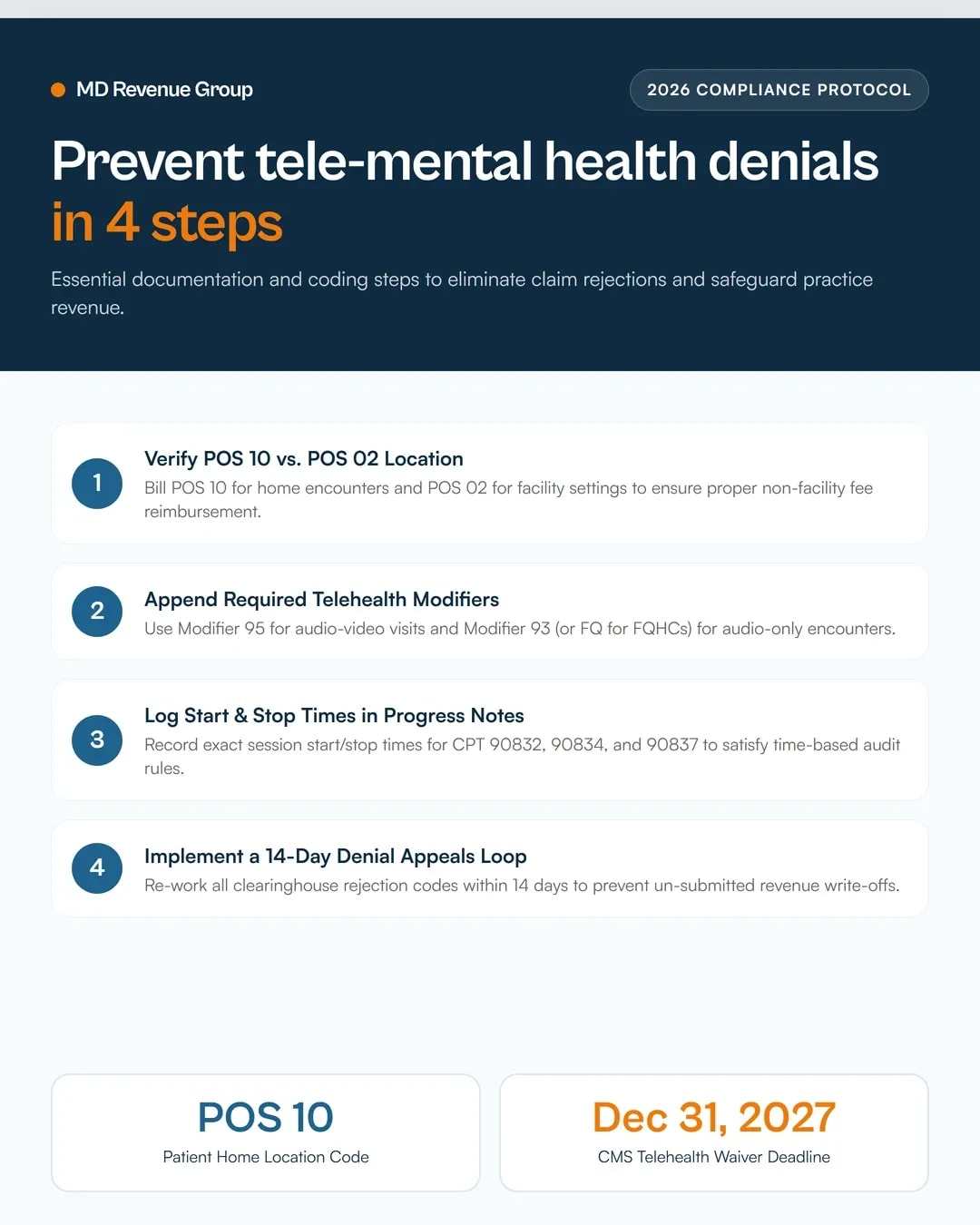
- POS 10 (Telehealth Provided in Patient's Home): Use when the patient is located in a private residence, temporary lodging, or non-facility setting during the encounter. Reimbursement pays at the higher non-facility fee schedule rate to cover practice overhead.
- POS 02 (Telehealth Provided Other than in Patient's Home): Use when the patient is located in a medical facility, hospital, skilled nursing facility, or outpatient clinic during the encounter. Reimbursement pays at the lower facility fee schedule rate.
Mandatory Telehealth Modifiers
Modifier | Technology Description | Clinical Application | Primary Payer Target |
|---|---|---|---|
Modifier 95 | Synchronous Audio-Video Communication | Real-time, two-way interactive video encounters (e.g., HIPAA-compliant video platforms). | Commercial Payers & Medicare Part B fee-for-service claims. |
Modifier 93 | Synchronous Audio-Only Communication | Telephone encounters where video technology is unavailable, clinically contraindicated, or declined by the patient. | Medicare Part B, Medicaid, & select commercial contracts. |
Modifier FQ | Synchronous Audio-Only for FQHC/RHC | Audio-only behavioral health services delivered by clinicians at FQHC or RHC facilities. | Medicare FQHC/RHC institutional claims. |
Modifier GT | Via Interactive Audio and Video | Legacy telehealth modifier retained by specific Medicaid programs and commercial plans. | State Medicaid programs & legacy private contracts. |
Effective September 1, 2026, major claims clearinghouses enforce strict billing edits rejecting any claim where telehealth modifiers (95, 93, FQ) are submitted alongside non-telehealth POS codes (such as POS 11 for office).
Practices transitioning clinicians onto insurance panels can utilize our dedicated physician credentialing services to prevent credentialing-related payment holds.
Behavioral Health Telehealth Denial Rates and Financial Risks
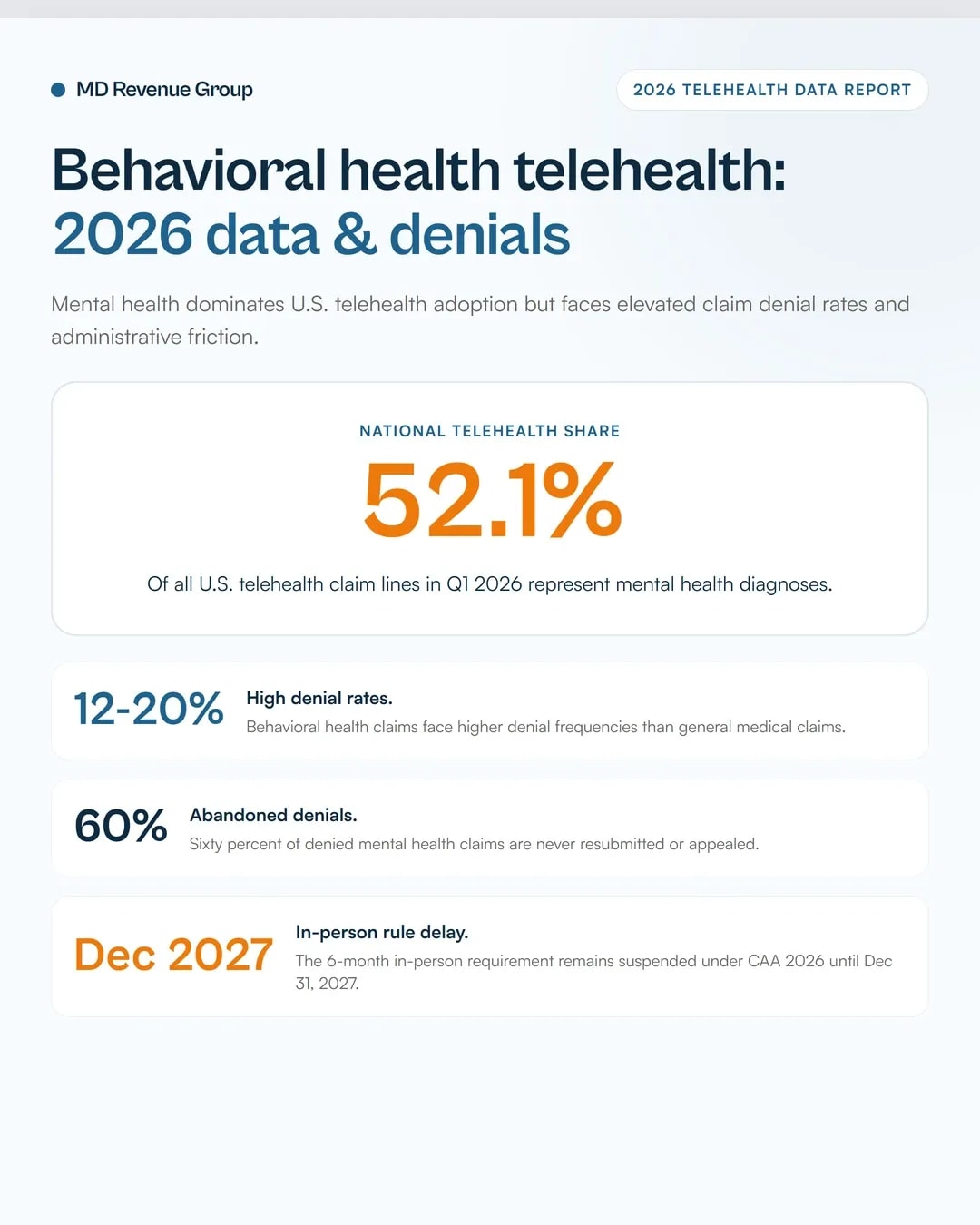
Data from Q1 2026 indicates that behavioral health accounts for 52.1% of all telehealth claim lines submitted in the United States, making virtual care the primary delivery channel for mental healthcare. Overall mental health telehealth adoption sits at 28.9%, far exceeding primary care (7.5%) and specialty medicine.
Despite high adoption, behavioral health claims experience severe denial rates ranging from 12% to 20%.
Top 4 Causes of Mental Health Telehealth Denials
- POS and Modifier Mismatch: Submitting POS 11 (office) with Modifier 95, or submitting POS 10 without the required modifier.
- Missing Time Logs on Psychotherapy Codes: Failing to document exact start and stop times for CPT 90832 (30 min), CPT 90834 (45 min), and CPT 90837 (60 min).
- Carve-Out Plan Verification Gaps: Failing to identify that a patient's mental health benefits are managed by a third-party behavioral health organization (DBHO) separate from their primary medical insurer.
- Lack of Documentation for Audio-Only Encounters: Omitting the specific clinical reason why video technology was not utilized during a Modifier 93 encounter.
Industry benchmarking data reveals a troubling trend: 60% of denied behavioral health claims are never resubmitted. Private therapy practices frequently write off valid claims due to administrative exhaustion, resulting in severe long-term cash flow erosion.
Review our dedicated guide on behavioral health billing services or explore specialized psychiatry medical billing solutions to improve claim submission accuracy.
Practice Financial Calculation: Worked Un-Recovered Denial Model
To illustrate the financial impact of un-submitted claim denials, consider a 5-therapist outpatient group practice.
Practice Baseline Metrics
- Clinician Count: 5 full-time licensed therapists (LCSWs / LMHCs).
- Patient Volume: Each therapist completes 22 sessions per week (110 total patient visits per week).
- Average Claim Value: CPT 90834 (45-minute psychotherapy) allowed rate average = $110.00 per session.
- Gross Weekly Billing: 110 sessions × 12,100.00 per week ($580,800.00 annually over 48 weeks).
Denial and Abandonment Calculations
Gross Annual Billing = $580,800.00
Initial Denial Rate = 15% ($87,120.00 in denied claims annually)
Un-Resubmitted Claim Rate = 60% of denied claims write-off
Annual Lost Revenue = $87,120.00 × 0.60 = $52,272.00
In this realistic scenario, a 5-therapist practice loses $52,272.00 in cash flow every year simply because denied telehealth claims sit uncollected in the billing queue.
Practices can request a free revenue audit to identify hidden billing errors and reclaim un-collected insurance balances.
Documentation Standards for Time-Based Psychotherapy Codes
To withstand payer audits, mental health providers must adhere to rigorous clinical documentation standards. Time-based psychotherapy CPT codes require specific elements in every progress note.
CPT Psychotherapy Time Ranges
- CPT 90832 (Psychotherapy, 30 minutes): Requires a minimum of 16 minutes up to 37 minutes of direct face-to-face therapy.
- CPT 90834 (Psychotherapy, 45 minutes): Requires a minimum of 38 minutes up to 52 minutes of direct face-to-face therapy.
- CPT 90837 (Psychotherapy, 60 minutes): Requires a minimum of 53 minutes or more of direct face-to-face therapy.
Essential Note Components for Telehealth
- Exact Start and Stop Times: Record exact times (e.g., "Session start: 10:02 AM, Session end: 10:49 AM (47 total minutes)"). Stating "45 minutes" without start and stop times leads to immediate claim recoupment during post-payment audits.
- Delivery Modality Statement: Document the platform used (e.g., "Session conducted via HIPAA-compliant audio-video platform").
- Patient Physical Location: State the patient's physical address (e.g., "Patient located at home address: 123 Main St, Newark, NJ").
- Audio-Only Justification (if applicable): Document why video was not used (e.g., "Audio-only session conducted due to patient broadband disruption; patient consented to telephone modality").
- Clinical Interventions and Patient Response: Outline specific therapeutic modalities applied (CBT, DBT, psychodynamic) and observable patient progress.
Evaluate our comprehensive telemedicine billing protocols to ensure full compliance across all virtual care platforms.
Preparing Mental Health Billing Operations for the 2028 Expiration Horizon
While the Consolidated Appropriations Act of 2026 provides regulatory certainty through December 31, 2027, mental health practices must prepare for the statutory expiration date of January 1, 2028.
Strategic Operational Preparation Steps
- Implement Automated Front-End Claim Edits: Configure billing software to validate POS and modifier pairings prior to clearinghouse transmission.
- Establish Hybrid Care Workflows: Build operational protocols to transition local patients to periodic in-office visits should Congress allow the in-person waiver to expire in 2028.
- Audit Denial Tracking Logs: Monitor weekly denial reports to ensure no denied claim exceeds 14 days without an active appeal or corrected resubmission.
- Standardize EHR Note Templates: Update electronic health record progress notes to require mandatory start/stop time fields and patient location text boxes.
- Cross-Train Billing Staff: Ensure revenue cycle staff understand carve-out payer identification, secondary insurance rules, and state-specific Medicaid telehealth regulations.
Compare current practice standards against our comprehensive mental health billing guide and review behavioral health integration billing guidelines to maintain optimal practice financial health.
Frequently Asked Questions
Has the in-person visit requirement for Medicare tele-mental health been extended?
Yes. The Consolidated Appropriations Act of 2026 (H.R. 7148) extended the suspension of the in-person visit requirement for Medicare behavioral health telehealth services through December 31, 2027.
What Place of Service code should I use when a patient is at home?
Use POS 10 (Telehealth Provided in Patient's Home) when the patient receives services in their private residence. Use POS 02 when the patient is located in a medical facility.
Can mental health providers still bill audio-only telehealth visits in 2026 and 2027?
Yes. Audio-only behavioral health services remain billable under Medicare through December 31, 2027. Providers must append Modifier 93 (or Modifier FQ for FQHCs/RHCs) and document the clinical reason why video was not used.
What happens if I forget to document start and stop times on CPT 90837?
If start and stop times are missing, insurance auditors will downcode CPT 90837 to an un-timed code or disallow the claim entirely, resulting in full payment recoupment.
When do the current telehealth extensions expire?
Unless Congress passes additional legislation, current Medicare telehealth flexibilities expire on December 31, 2027. Pre-pandemic restrictions are scheduled to resume on January 1, 2028.