
Psychiatry Billing Services: Medicare Enrollment and Payer-Ready Workflow for 2026
Master 2026 psychiatry billing services with our Medicare PECOS enrollment workflow, NCCI edit rules, E/M add-on rates, and denial prevention strategies.
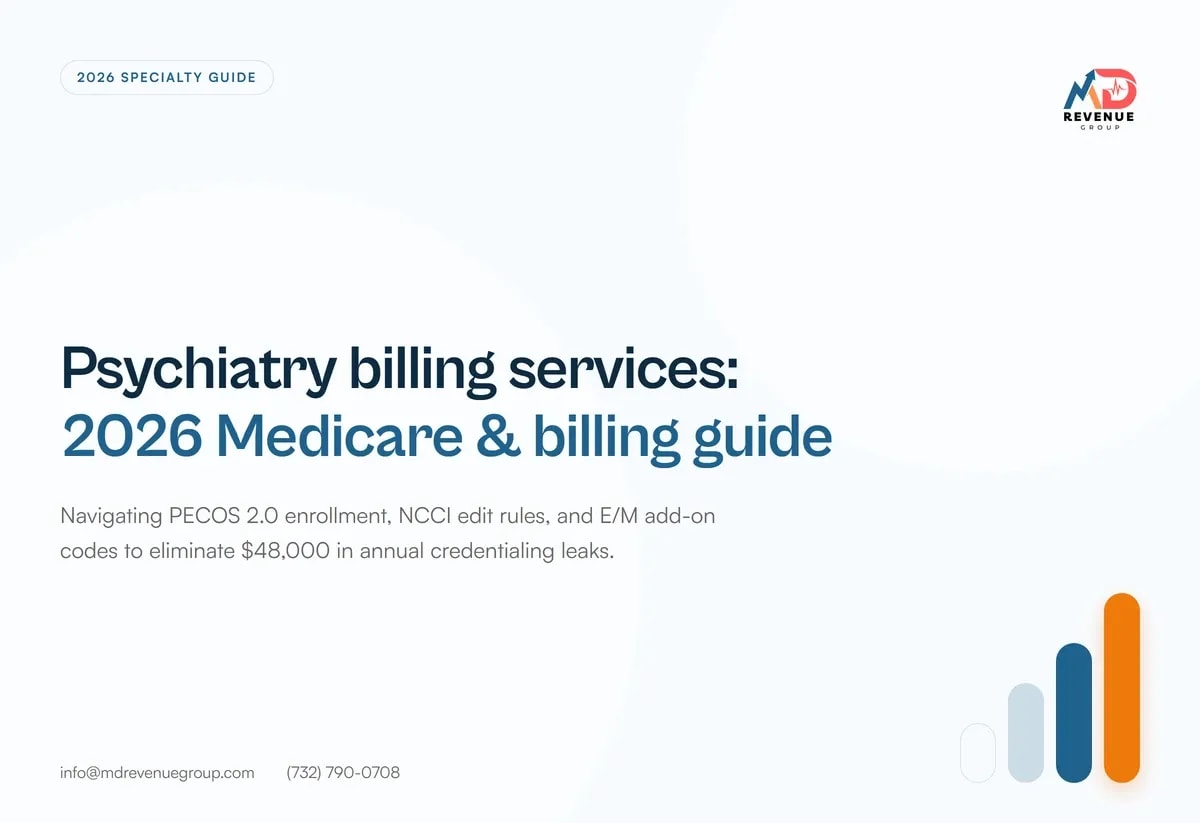
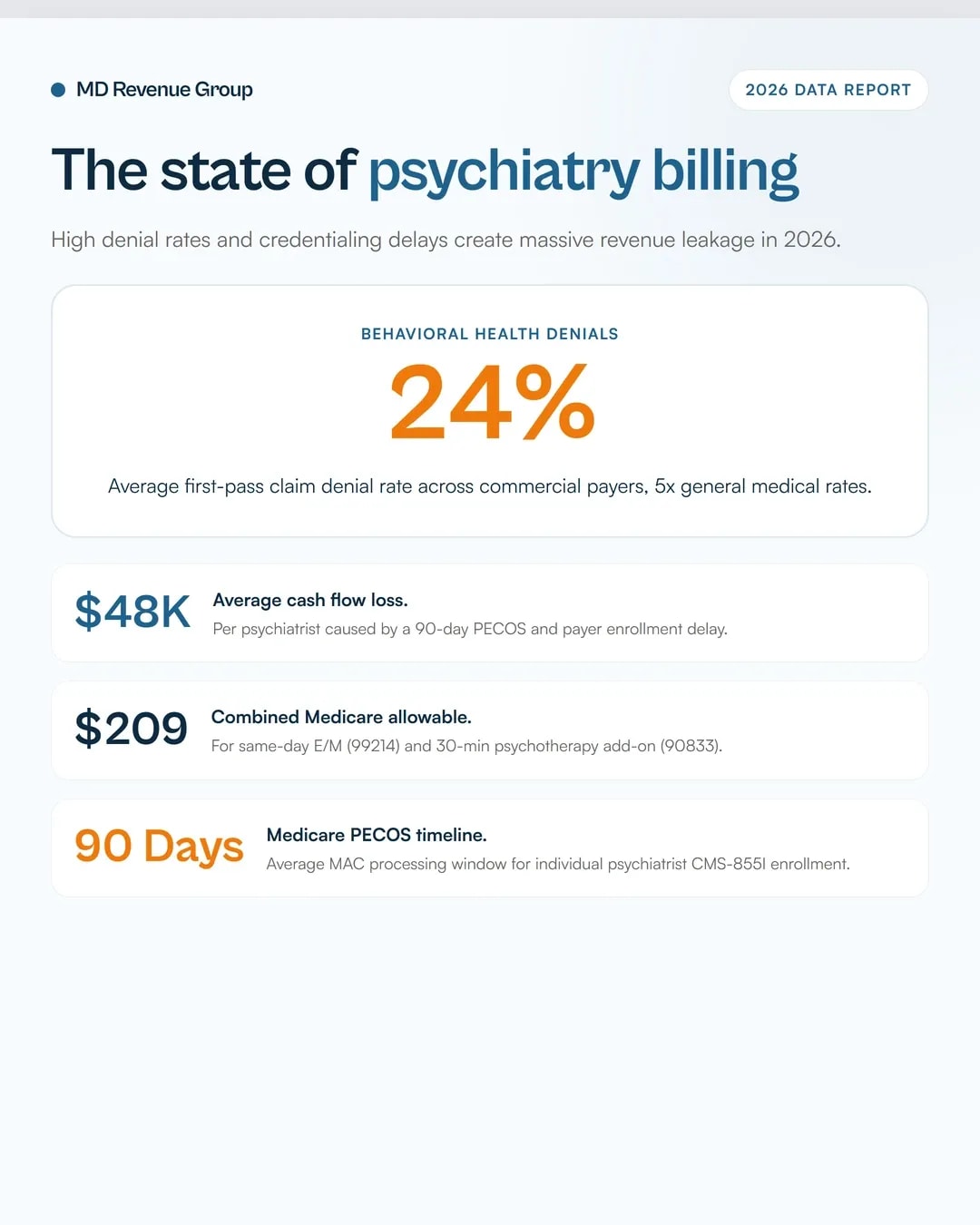
Psychiatry billing services require precise navigation of Medicare Provider Enrollment, Chain, and Ownership System (PECOS 2.0) guidelines, National Correct Coding Initiative (NCCI) edit rules, and strict start-to-stop time documentation. Under the 2026 CMS Physician Fee Schedule, standalone 60-minute psychotherapy (CPT 90837) reimburses a national non-facility average of $167.00, while pairing established patient Evaluation and Management (E/M) code 99214 ($135.61) with 30-minute add-on psychotherapy code 90833 ($74.20) yields $209.81. Medical practices using dedicated psychiatry medical billing workflows reduce first-pass claim denial rates from the industry average of 24% down to under 3%. This guide delivers an actionable 2026 enrollment checklist, code tables, and compliance controls for psychiatric practices.
Key Takeaways
- NCCI Compliance: Never bill standalone psychotherapy (CPT 90834 or 90837) alongside an E/M code (CPT 99214) for the same provider on the same day; doing so triggers an immediate claim rejection. Use add-on codes 90833, 90836, or 90838 instead.
- PECOS 2.0 Maintenance: Practices must update PECOS within 30 days of any address change, NPI reassignment, or adverse legal action to prevent immediate billing privilege suspensions.
- Time Documentation: Medical necessity audits by Medicare Administrative Contractors (MACs) require exact start and stop times recorded directly in the psychiatric encounter note.
- Credentialing Financial Impact: Enrollment delays average 60 to 90 days for Medicare and up to 180 days for commercial payers, costing practices $7,000 to $12,000 per month per un-credentialed psychiatrist.
Why Psychiatry Billing Differs From General Medical Billing
Psychiatric practices face administrative pressures that differ significantly from surgical or diagnostic specialties. While general medical claims average a first-pass denial rate of 3% to 5% across commercial payers, behavioral health claims suffer first-pass denial rates between 20% and 30% according to 2026 Medical Group Management Association (MGMA) benchmark data.
Payer scrutiny centers on three areas: time tracking validation, medical necessity for extended psychotherapy sessions, and dual-service coding when medication management occurs during the same session as psychotherapy.
When psychiatrists attempt to bill time-based E/M codes alongside individual therapy without explicit structural separation in the electronic health record (EHR), clearinghouse edits fail and claims drop into manual medical review queues. Establishing structured revenue cycle management processes prevents these administrative bottlenecks before claims are submitted to clearinghouses.
| PSYCHIATRY CLAIM EDITS WORKFLOW | |
|---|---|
| Encounter Note --> Validate Start/Stop Time --> Check NCCI Edits Claim Paid <-- Submit 837P to Payer <-- Apply Add-On Code |
2026 Medicare Fee Schedule and Psychiatry CPT Code Rates
Selecting the appropriate CPT code requires balancing medical decision-making complexity against exact session duration. The 2026 CMS Physician Fee Schedule sets clear allowable rates for office-based psychiatric services.
CPT Code | Service Description | 2026 Medicare National Average Rate | Coding Type |
|---|---|---|---|
90791 | Psychiatric Diagnostic Evaluation (No Medical) | $182.40 | Standalone |
90792 | Psychiatric Diagnostic Evaluation (With Medical) | $205.15 | Standalone |
90834 | Individual Psychotherapy (45 minutes, 38-52 min) | $113.97 | Standalone |
90837 | Individual Psychotherapy (60 minutes, 53+ min) | $167.00 | Standalone |
99214 | Established Office Visit (Level 4 E/M, 30-39 min) | $135.61 | Standalone E/M |
90833 | Psychotherapy Add-On (30 minutes, 16-37 min) | $74.20 | Add-On (Requires E/M) |
90836 | Psychotherapy Add-On (45 minutes, 38-52 min) | $108.50 | Add-On (Requires E/M) |
90838 | Psychotherapy Add-On (60 minutes, 53+ min) | $142.10 | Add-On (Requires E/M) |
Note that standalone psychotherapy codes (90834 and 90837) cannot be combined with any Evaluation and Management code. If medication management occurs during the visit, the prescriber must bill the primary E/M code plus the applicable add-on code.
Managing Same-Day E/M and Psychotherapy Add-On Billing
Combining psychiatric medication management with psychotherapy during a single visit requires strict adherence to coding rules. Payers routinely audit high-volume billers of CPT 90837 combined with 99214 to identify unbundled or inflated service claims.
Use this decision matrix when structuring encounter notes and selecting claim codes:
Patient Clinical Scenario | Medical Decision Making / Time | Primary Code | Allowed Secondary Code | Incorrect Combination (Triggers Denial) |
|---|---|---|---|---|
Psychotherapy Only (45 min) | No medication management | 90834 | None | 99214 + 90834 |
Psychotherapy Only (60 min) | No medication management | 90837 | None | 99214 + 90837 |
Med Management (20 min) + Therapy (30 min) | Moderate MDM or 30 min E/M | 99214 | 90833 | 90834 standalone |
Med Management (30 min) + Therapy (45 min) | Moderate/High MDM | 99214 | 90836 | 99214 + 90834 |
Complex Med Review (40 min) + Therapy (60 min) | High Complexity MDM | 99215 | 90838 | 99215 + 90837 |
Literal Documentation Example for Clinical EHR Notes
To pass a post-payment Medicare audit for combined service (99214 + 90833), your encounter note must contain distinct paragraphs for medical evaluation and psychotherapy:
E/M CLINICAL EVALUATION (14:00 - 14:15): Patient returns for bipolar II medication management. Reviewed Lithium level (0.8 mEq/L) and renal panel. Patient reports mild tremor, zero nausea. Mental status exam: calm, euthymic, goal-directed. Plan: Continue Lithium 600mg BID.
PSYCHOTHERAPY SESSION (14:15 - 14:45): 30-minute cognitive behavioral therapy focused on mood tracking and sleep hygiene. Patient identified work stress triggers. Developed coping mechanisms for evening anxiety. Start time: 14:15, Stop time: 14:45. Total psychotherapy duration: 30 minutes.
If the encounter note groups the medication review and psychotherapy into a single narrative without separate time entries, MAC auditors will recoup the psychotherapy portion during post-payment review.
Step-by-Step Medicare PECOS Enrollment for Psychiatric Practices
Enrolling psychiatrists, psychiatric nurse practitioners, and physician assistants into Medicare requires navigating the Provider Enrollment, Chain, and Ownership System (PECOS 2.0). Individual providers must enroll using Form CMS-855I and reassign benefits to the practice entity using PECOS reassignment protocols.
Practices expanding their behavioral health workforce should also review guidelines for allied clinicians. Review our detailed analysis on digital mental health billing for updated coverage rules.
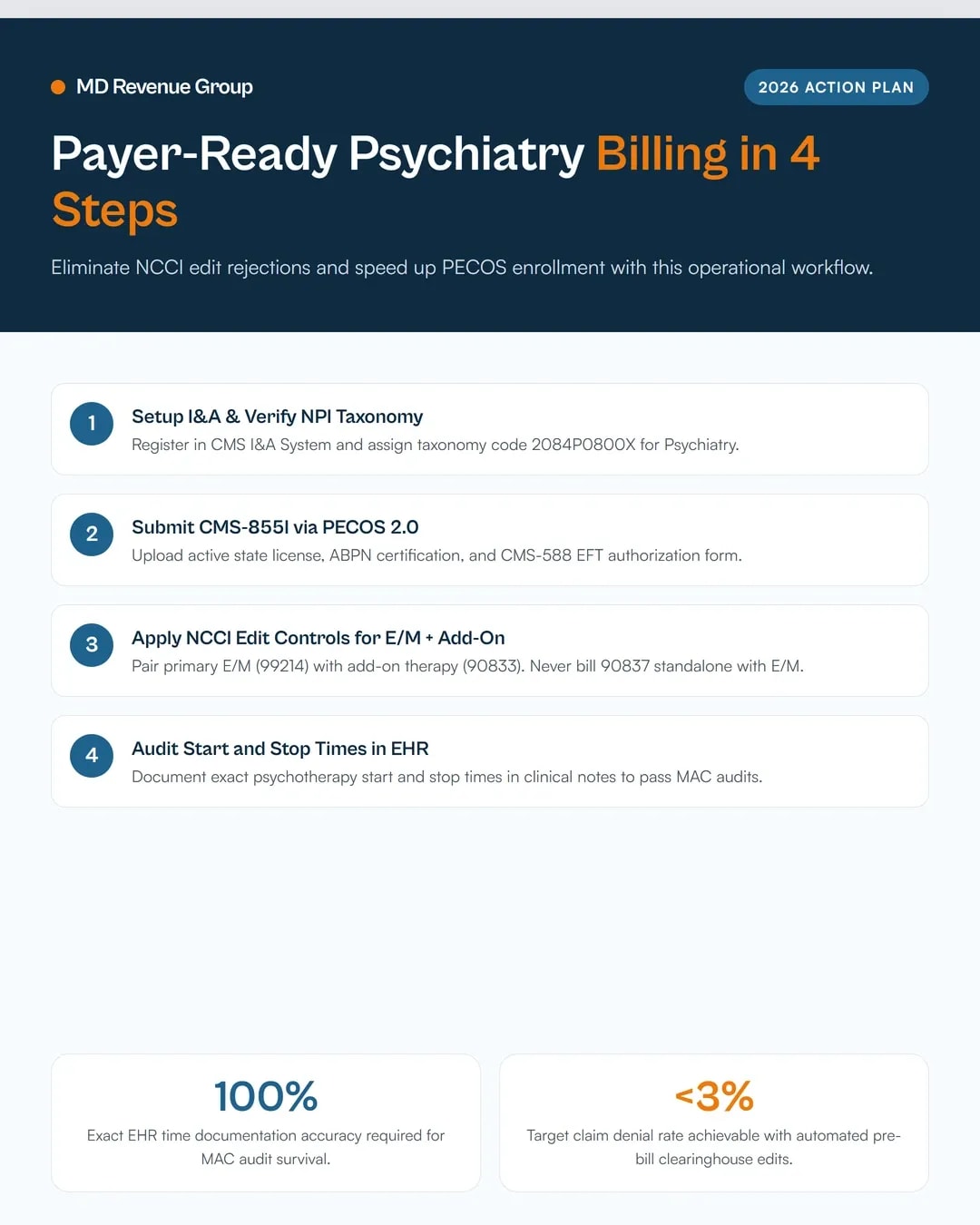
1. Identity & Access (I&A) Account Setup
Before accessing PECOS 2.0, the practice administrator or physician must establish an account in the CMS I&A System. Ensure the authorized official's legal name matches their Social Security record exactly.
2. NPPES National Provider Identifier Verification
Confirm that the psychiatrist holds an active Type 1 (Individual) NPI. The taxonomy code for Psychiatry must be set to 2084P0800X (or 2084P0804X for Child & Adolescent Psychiatry).
3. CMS-855I Submission via PECOS
Log into PECOS 2.0 and create a new individual enrollment application. You must upload:
- State medical license (active, unrestricted)
- Medical school diploma and residency completion certificates
- Board certification documentation from ABPN (American Board of Psychiatry and Neurology)
- Electronic Funds Transfer (EFT) agreement (Form CMS-588) with a voided practice check
4. Group Reassignment Execution
Reassign billing privileges to the practice's Type 2 Group NPI. Verify that the practice's physical rendering location matches PECOS records within 100% precision.
5. Application Tracking and Verification
Medicare Administrative Contractors take between 60 and 90 days to process complete PECOS submissions. Check application status weekly in the PECOS self-service portal to clear any development letters within the 30-day response window.
| PECOS 2.0 ENROLLMENT TIMELINE | |
|---|---|
| Day 1: I&A / NPI Check --> Day 5: PECOS CMS-855I Upload Day 90: Approval Issued <-- Day 30-60: MAC Review & Verification |
Proprietary Calculation: The $48,000 Cost of Credentialing Delays
When a practice hires a new psychiatrist, credentialing delays create severe cash flow gaps. Below is an explicit financial impact model for a 3-psychiatrist practice bringing on a full-time associate in 2026.
Model Assumptions
- Expected Patient Encounters: 20 patients per day (4 days per week = 80 encounters/week)
- Payer Mix: 40% Medicare, 40% Commercial, 20% Self-Pay/Other
- Average Blended Reimbursement (CPT 99214 + 90833): $200 per encounter
- Expected Weekly Revenue per Psychiatrist: $16,000
- Standard PECOS/Payer Credentialing Delay: 12 Weeks (3 Months)
Revenue Loss Calculation
Weekly Gross Revenue Capacity: 80 encounters * $200 = $16,000
Total 12-Week Gross Capacity: $16,000 * 12 weeks = $192,000
Un-Credentialed Billable Encounters (80% insured): $192,000 * 0.80 = $153,600
Retroactive Billing Recovery (50% approved retroactively): $153,600 * 0.50 = $76,800
Uncollectible Revenue from Expired Filing Windows & Out-of-Network Denials: $76,800
Direct Staff Labor for Re-Work & Payer Appeals: $3,200
Fixed Overhead Cost of Idle Physician Capacity (Salary + Benefits): $48,000 net margin loss
A 90-day credentialing delay results in a net cash flow hit of $48,000 for a single psychiatrist. Practices that fail to submit PECOS applications 120 days prior to a provider's start date risk permanent revenue leakage. For a broader analysis of credentialing bottlenecks, examine our guide on physician credentialing revenue bottlenecks.
State-Specific Billing and Credentialing Considerations
Commercial insurance enrollment rules and Medicaid managed care regulations vary significantly across geographic regions. Practices operating in high-volume markets must tailor their credentialing workflows accordingly.
- New Jersey: Psychiatric practices in NJ face strict state-mandated prompt pay laws but face lengthy credentialing review cycles with Horizon BCBS. Ensure your team utilizes our regional insights for medical billing in New Jersey.
- New York: New York Medicaid managed care plans require separate credentialing applications for each health maintenance organization (HMO) plan, even after Medicare PECOS approval is granted. Practices can review our targeted workflow for medical billing in New York.
Maintaining active provider enrollment management ensures uninterrupted reimbursement across all state networks. Our dedicated credentialing services team assists multi-state practices with full PECOS and commercial application tracking.
Payer-Specific Claim Audit Controls and Common Denial Triggers
Commercial payers use automated algorithms to analyze claims data for psychiatric billing patterns that deviate from regional averages. Identifying these denial triggers before submitting claims protects your cash flow.
1. High-Frequency CPT 90837 Audits
Payers flag practices where 60-minute psychotherapy (CPT 90837) accounts for more than 75% of total therapy volume. Insurers expect a distribution split between 45-minute (90834) and 60-minute sessions based on patient acuity. When auditing CPT 90837 claims, payers request full medical records to verify that 53 or more minutes of face-to-face treatment occurred.
2. Lack of Measurable Treatment Goals
Commercial payers like Optum and Beacon Health frequently deny authorization extensions when clinical notes lack quantifiable treatment objectives. Notes stating "patient discussed stress management" without listing baseline metrics or target goal dates will result in medical necessity denials. Clinical documentation must include objective functional scales (such as PHQ-9 or GAD-7 scores) updated every 90 days.
3. Telehealth Place of Service Mismatches
Billing telehealth psychiatric encounters using improper Place of Service (POS) codes triggers automated clearinghouse rejections. For Medicare claims, use POS 10 for services rendered in the patient's home and POS 02 for teletherapy delivered in a non-home location. Always append Modifier 95 or Modifier FQ depending on individual MAC instructions.
Implementing pre-submission audit controls dramatically lowers denial rates. Practices seeking comprehensive denial prevention strategies can refer to our guide on mental health billing.
Frequently Asked Questions
Can a psychiatrist bill CPT 90837 and 99214 on the same day?
No. Standalone CPT 90837 cannot be billed alongside E/M code 99214. When medication management and psychotherapy are performed in the same visit, bill E/M code 99214 plus psychotherapy add-on code 90833 (for 30 minutes) or 90836 (for 45 minutes).
What is the Medicare reimbursement rate for CPT 90837 in 2026?
Under the 2026 Medicare Physician Fee Schedule, the national non-facility average rate for CPT 90837 is approximately $167.00. Exact reimbursement varies based on your local Medicare Administrative Contractor geographic practice cost index (GPCI).
How long does Medicare PECOS enrollment take for a psychiatrist?
PECOS enrollment typically takes 60 to 90 days from initial electronic submission. Submitting incomplete documentation or failing to respond to MAC development letters within 30 days extends the processing window up to 180 days.
What taxonomy code should be used for psychiatry Medicare enrollment?
The primary individual taxonomy code for adult psychiatry is 2084P0800X. For child and adolescent psychiatry, use 2084P0804X. Ensuring taxonomy codes match across NPPES, PECOS, and commercial payer applications prevents claim rejections.
Payer-Ready Psychiatry Revenue Audit
If your psychiatric practice experiences denial rates above 10%, credentialing backlog delays, or clearinghouse rejections on add-on codes, your revenue cycle needs attention. MD Revenue Group audits clinical documentation, coding setups, and payer contracts to eliminate cash flow leakage.
Request a free revenue audit with our certified behavioral health coding specialists today.