
How to Submit a Medical Claim the First Time
How to submit a medical claim that clears the first time comes down to four things: complete patient and insurance data, correct codes with modifiers, the right claim form for the setting of care, and a submission path whose acknowledgments you actually read. Get those right and the payer pays. Miss any one and the claim comes back.
Two different people search this phrase. Some are patients filing their own bill after a provider refused. Some are practice staff building and submitting claims all day. Both deserve a straight answer, so this guide covers the provider path in full and tells the patient exactly what to do at the end.
- ✓You pay out of pocket, then ask the payer for reimbursement. Original Medicare uses form CMS-1490S plus your provider's itemized bill. Commercial plans set their own deadline and often require their own form.
- ✗You build an 837P or 837I from encounter data, scrub it, send it through a clearinghouse, and read the 999 and 277CA before assuming the payer has it. The filing deadline is measured to MAC receipt, not to your send date.
What has to be on the claim before you send it
Every claim carries the same core data blocks. Professional claims go on the CMS-1500 paper form or the 837P electronic transaction. Institutional claims go on the UB-04 or the 837I.
Patient block. Legal name exactly as the insurance card shows it, date of birth, member ID, group number, and the subscriber details when the patient is not the subscriber. A transposed digit in the member ID is the single most common reason a clean encounter never reaches a human at the payer.
Provider block. Rendering provider NPI, billing provider NPI, taxonomy code, and the payer's provider ID. Rendering and billing provider NPIs are not interchangeable when the two differ.
Service lines. For each line: date of service, place of service code, procedure code with any required modifier, diagnosis code pointers, units, and the billed charge.
Coordination of benefits. Primary, secondary, and tertiary payer fields in the right loops. Get the order wrong and loops 2400 and 2430 produce balancing errors that reject the whole claim.
Our step-by-step process guide covers where each of these blocks gets populated, and what is medical billing covers the terminology underneath them.
CMS-1500 or UB-04: which form do you use
Use the CMS-1500 for professional claims billed by a physician, nurse practitioner, therapist, or any non-facility provider. It goes out as the 837P.
Use the UB-04 for facility claims from a hospital, skilled nursing facility, hospice, or ambulatory surgery center. It goes out as the 837I.
The place-of-service code is what ties the claim to the right form. An observation patient seen in a hospital outpatient department and a surgery performed at the same hospital can generate different claim types from the same encounter. Billing the wrong form produces a rejection, and a rejection is invisible until someone looks at the rejection report.
The three acknowledgments that tell you where your claim actually is
This is the part most practices get wrong. Submitting a claim and assuming the payer has it is the most expensive assumption in the cycle.
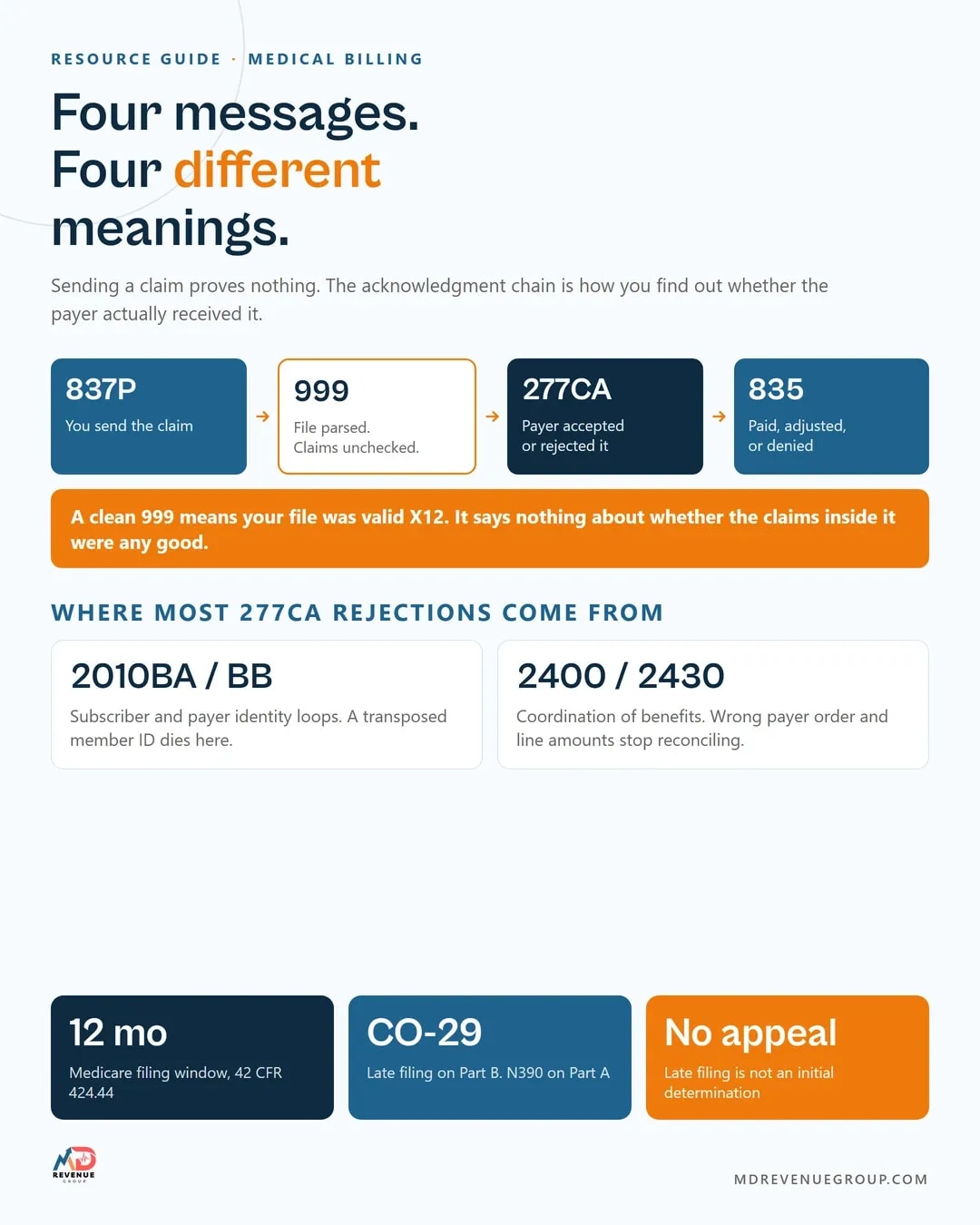
The 999, implementation acknowledgment. File-level. It confirms your file was syntactically valid X12. A 999 accept means the file parsed. It says nothing about whether the individual claims inside it were good.
The 277CA, claim acknowledgment. Claim-level. It confirms the payer accepted or rejected each individual claim. Loops 2010BA and 2010BB, which carry subscriber and payer identity, generate most 277CA rejections. Fix the identity data and a large share of your rejections disappear on their own.
The 835, electronic remittance advice. The payer's answer with the money. It shows paid lines, contractual adjustments, patient responsibility, and denial reasons.
A claim can pass the clearinghouse with a clean 999 and still get rejected at the payer's door by a 277CA. Until you see a 277CA acceptance, you have sent a file, not a claim.
CAQH's 2025 Index found claim status inquiry adoption reached 81% and claim payment reached 78%. The industry can ask where its claims are far more often than it used to. Most teams still do not ask.
The federal filing clock, and why your date is probably wrong
Under 42 CFR 424.44, Medicare Part A and Part B fee-for-service claims must reach the correct Medicare Administrative Contractor within 12 months of the date of service. Section 6404 of the Affordable Care Act set that limit for services furnished on or after January 1, 2010.
Three details catch experienced billers.
The clock measures MAC receipt. Not your submission date. Not a postmark. A claim uploaded at 11:58pm on the deadline and processed the next morning is late.
The anchor date depends on the claim type. Part B uses the "From" date on the CMS-1500. Part A uses the "Through" date on the UB-04. On a multi-day institutional claim, one service line can be inside the window while another is outside it, and the contractor will split the line and deny the untimely portion. That is how a single claim returns partly paid and partly denied.
There is no appeal. A late-filing denial is not an initial determination. The code is CO-29 on professional claims and N390 on institutional ones, and CMS instructions state the determination is not subject to appeal. Your only route is a reopening request, and only when a documented CMS exception applies.
Commercial contracts run shorter. Ninety to 180 days from date of service is common, and some payers go well below that. Medicaid deadlines vary by state, so the New Jersey guide and the full states directory cover the variation. How the Change Healthcare disruption altered filing behavior covers the 2024 aftermath.
Rejection or denial: the difference that decides your next move
A rejection never entered the payer's adjudication system. It came back from the clearinghouse or the payer's front-end edits with an error code. You correct the data and resubmit. No appeal letter, no clinical documentation, no deadline pressure beyond your own filing window.
A denial entered the system, got adjudicated, and was refused. Now you choose between a corrected claim and a formal appeal, and the clock is running.
Denial code | What it means | Correct response |
|---|---|---|
CO-16 | Missing or invalid information | Corrected claim with the missing data |
CO-18 | Exact duplicate of a claim already processed | Verify before resubmitting |
CO-22 | Coordination of benefits conflict | Corrected claim with payer order fixed |
CO-29 | Time limit for filing has expired | Reopening request only, if a CMS exception exists |
CO-50 | Not deemed medically necessary by the payer | Appeal with clinical documentation |
CO-97 | Procedure bundled into another line | Corrected claim or appeal with modifier support |
Filing an appeal when a corrected claim was the right answer wastes the cycle and burns filing days. Sending a corrected claim when the payer wanted an appeal does the same.
The checklist before you hit send
What a first-pass rejection costs you
Premier's survey of 280 hospitals across 23 states found the average cost of fighting a denied claim rose to $57.23 in 2023, up from $43.84 in 2022. Medicare Advantage claims ran higher at $80.16.
Work the arithmetic on a rejection instead. Say it takes 20 minutes to find the missing diagnosis pointer, 10 minutes to fix it, and 20 minutes to research the resubmission window. That is roughly 50 minutes of staff time, plus the clearinghouse fee, plus 10 to 14 days of delay.
At a loaded billing cost of $45 an hour, that is about $37 of labor per rejected claim before the delay. At 500 claims a month with a 4% rejection rate, that is 20 rejections and $740 in pure rework every month, plus the aging it causes.
The same arithmetic with Premier's $57.23 figure, if those rejections become denials instead of corrections, runs past $1,100 a month. That is the gap between a claim that comes back for a data fix and a claim that comes back needing an appeal packet.
What happens after the payer accepts
Acceptance is a milestone, not a finish. From the 277CA onward the claim runs on clocks you do not control, and knowing which clock is running prevents most of the panic.
Medicare clean claims must be paid or denied within 30 days of receipt under CMS prompt-pay requirements, which Medicare Administrative Contractors administer and publish. Interest is owed on a clean claim that goes unpaid past that. Medicare Advantage plans must pay 95% of clean claims within 30 days under 42 CFR 422.520(a)(1), with interest owed on clean claims that go unpaid past that, and all other claims from non-contracted providers paid or denied within 60 days under 42 CFR 422.520(a)(3).
The MA clean claim definition is where practices get caught. Under 42 CFR 422.520, a clean claim is one with no defect, impropriety, or missing required substantiating documentation. That last clause is the wide one. A plan can request records, delay the claim, and treat the request as restarting its own payment timeline. Practices that assume the 30-day clock runs from submission get surprised.
The acknowledgement you did not read. A 277CA that comes back with an error code days later is a rejection you can still fix. Practices that do not monitor for it learn about the problem from the aging report, which is 30 to 60 days later and no longer correctable.
Submit: clearinghouse accepts your file
a clean 999 confirms syntax only
Payer receives the 837P
front-end edits run against implementation guide requirements
277CA returned
claim-level acceptance or rejection, typically within days
Adjudication
payer applies benefits, contract terms, and medical necessity edits
835 returned
paid lines, adjustments, patient responsibility, and denial reasons
Post and split
contractual adjustments applied, patient balance billed
30 to 180 days
appeal window if anything was denied, closing by payer terms
If you are a patient filing your own claim
You can only do this when a provider declined to file, or when you paid out of pocket and want reimbursement. Contact the insurer first and get their claims mailing address and form. Sending an Original Medicare claim uses form CMS-1490S, the Patient Request for Medical Payment, along with your provider's itemized bill. A letter explaining why you are filing helps. Sending the claim to the wrong address is the most common reason patient-filed claims disappear.
Commercial and Medicare Advantage plans set their own deadlines and forms, and those usually run shorter than Original Medicare's 12 months.
Practices that want the provider side handled end to end can see how our medical billing service runs submission, or read how behavioral health practices handle it with a different authorization profile.
Frequently asked questions
For a professional claim: patient name, date of birth, member ID, group number, provider tax ID, diagnosis codes, procedure codes with modifiers, units per code, the billed amount per code, and the place of service code. Institutional claims add revenue codes, room and board detail, and a through date.
Medicare requires clean claims to be paid or denied within 30 days of receipt under CMS prompt-pay requirements. Commercial payers typically pay in 14 to 30 days, and paper claims run slower because the payer keys them in by hand. A claim that needs an appeal routinely runs 60 to 180 days.
Medicare allows 12 months from the date of service under 42 CFR 424.44, measured by when the Medicare Administrative Contractor receives the claim. Commercial contracts commonly run 90 to 180 days and Medicaid varies by state.
The CMS-1500 bills professional services from a physician or non-facility provider and goes out as the 837P. The UB-04 bills institutional facility services from a hospital or similar facility and goes out as the 837I.
A rejection never entered the payer's system, usually a format or data error, and you correct and resubmit it. A denial was adjudicated and refused, and needs a corrected claim or a formal appeal.
For Medicare, no. A late-filing denial is not an initial determination and carries no appeal rights under CMS instructions. A reopening request is the only option, and only when a documented CMS exception applies. Commercial plans vary by contract.
The payer received your claim and refused to accept it into adjudication. Loops 2010BA and 2010BB, carrying subscriber and payer identity, cause most of them. Fix the data and resubmit, no appeal needed.
Yes. The superbill is the source document your coder reads to assign codes. Without it, diagnosis and procedure codes come from somewhere else, which is usually a guess.
Where to go next
Start with what is medical billing if the terminology is new. For the full chain from booking to posting, read the medical billing process steps. For scrubbing rules, clearinghouse mechanics, and rejection codes, claim management covers it.
Practices billing in California or Texas run state surprise-billing and Medicaid rules that sit on top of everything above. The states directory lists every state we cover.
Request a free revenue audit and we will trace your rejection and denial codes to the stage that produced them.