
CMS-0057-F and the January 2027 Prior-Authorization API Deadline: Prior Authorization Automation and Provider Readiness Guide
Prepare your medical practice for CMS-0057-F and the January 2027 API deadline with our guide to prior authorization automation and EHR workflows.
CMS-0057-F and the January 2027 Prior-Authorization API Deadline: Prior Authorization Automation and Provider Readiness Guide
Transitioning to prior authorization automation under the CMS-0057-F Interoperability and Prior Authorization Final Rule requires medical practices to align EHR systems with FHIR-based application programming interfaces (APIs) before the mandatory January 1, 2027 deadline. CMS-0057-F mandates that Medicare Advantage, Medicaid, CHIP, and Qualified Health Plan issuers implement standardized Prior Authorization, Provider Access, Patient Access, and Payer-to-Payer APIs to eliminate manual faxing and portal entry. Payers must also adhere to strict turnaround times of 72 hours for expedited requests and 7 calendar days for standard requests, accompanied by specific denial reasons for every determination.
Key Takeaways for Medical Practice Leaders
- Jan 1, 2027 API Mandate: Payers must deploy FHIR-based Prior Authorization APIs, Provider Access APIs, expanded Patient Access APIs, and Payer-to-Payer APIs.
- Turnaround Enforcement: Payers are bound to 72-hour expedited and 7-day standard response limits, with mandatory specific denial reason codes.
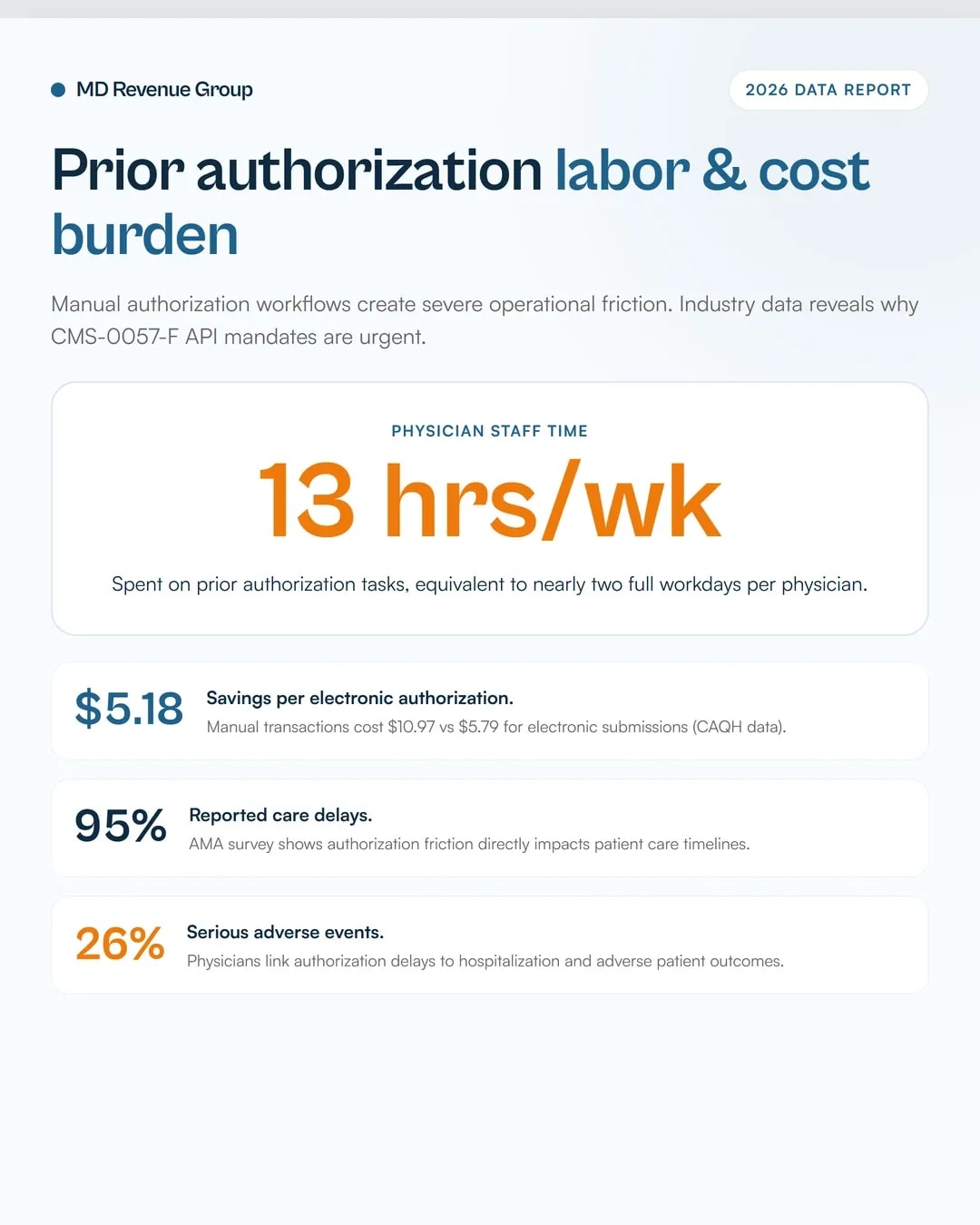
- Cost Reduction: Automated prior authorization transactions cost $5.79 compared to $10.97 for manual processing, saving $5.18 per submission according to CAQH data.
- MIPS Attestation: Eligible clinicians must attest to using electronic prior authorization APIs during the CY 2027 MIPS performance period.
What Is CMS-0057-F and Why Does the 2027 Deadline Matter?
CMS-0057-F is the landmark Interoperability and Prior Authorization Final Rule released by CMS in January 2024. The rule addresses administrative friction in prior authorization, which currently costs the healthcare system billions in wasted administrative overhead.
CMS-0057-F TIMELINE & MILESTONES
| Date | Requirement / Operational Milestone |
|---|---|
| January 1, 2026 March 31, 2026 January 1, 2027 CY 2027 Performance Year | Turnaround times (72h urgent / 7 days standard) Mandatory public posting of prior auth metrics by plan All 4 FHIR APIs live (PA, Provider, Patient, Payer) MIPS Promoting Interoperability Electronic PA Check |
Prior authorization delays cause documented patient care disruption. The American Medical Association (AMA) reported that 95% of physicians experience care delays due to prior authorization requirements. In addition, 26% of physicians report that authorization delays led directly to serious adverse patient events.
AMA PRIOR AUTHORIZATION IMPACT ON PHYSICIANS (2024 DATA)
┌───────────────────────────────────────────────────────────────────┬──────────┐
│ Administrative Time Burden                                        │ 13 hrs/wk│
│ Practices with Dedicated Auth Staff                               │ 40%      │
│ Care Delays Reported by Physicians                                │ 95%      │
│ Negative Clinical Outcomes Reported                               │ 92%      │
│ Patient Treatment Abandonment Rate                                │ 80%      │
└───────────────────────────────────────────────────────────────────┴──────────┘
The January 1, 2027 deadline marks the enforcement date for FHIR-based data exchange. While payers bear the legal burden of creating the APIs, healthcare practices that fail to integrate their EHR systems into these APIs will remain trapped in manual portal workflows. Integrating these digital channels directly into your practice revenue cycle management workflow ensures your team receives automated determinations without manual portal checks.
Which Payers Are Impacted by CMS-0057-F?
CMS-0057-F applies to specific government-regulated health plans. Commercial non-exchange plans and fee-for-service Medicare fall outside the direct scope of CMS-0057-F, though state legislation increasingly mirrors these requirements.
Payer Category | Impacted by CMS-0057-F | Excluded Coverage Areas |
|---|---|---|
Medicare Advantage (MA) | Yes | Prescription Drugs (Part D) |
State Medicaid Fee-For-Service | Yes | Non-covered state benefits |
Medicaid Managed Care Organizations (MCOs) | Yes | Non-emergency transportation |
Children's Health Insurance Program (CHIP) | Yes | Standard vision-only plans |
Qualified Health Plan (QHP) Issuers | Yes | Off-exchange individual plans |
Prescription drug prior authorizations under Medicare Part D are excluded from CMS-0057-F because they are governed under separate NCPDP standards. Practice managers handling high-cost specialty drug orders or diagnostic procedures must evaluate payer-specific rule triggers. For instance, practices offering cardiology medical billing must track medical necessity criteria for advanced cardiac imaging alongside these API rollouts.
State governments are also stepping in with state-level prior authorization reform bills. Practice administrators must evaluate how federal CMS-0057-F requirements combine with state-specific prompt payment mandates.
How FHIR-Based APIs Replace Manual Prior Authorization Workflows
Manual prior authorization relies on paper forms, phone calls, and discrete payer web portals. Staff log into separate portals, copy data from EHR fields, attach PDF clinical notes, and periodically refresh the portal to check authorization status.
MANUAL PRIOR AUTHORIZATION WORKFLOW (10.97 COST / 13 HOURS WEEKLY)
[ EHR Chart ] ---> [ Manual Data Entry ] ---> [ Payer Web Portal / Fax ]
                          |
                          v
                 [ 3-5 Phone Follow-ups ] ---> [ 7-14 Day Determination ]
AUTOMATED FHIR API WORKFLOW (5.79 COST / REAL-TIME DETERMINATION)
[ EHR Chart ] ---> [ FHIR CRD Check ] ---> [ FHIR DTR Auto-populate ]
                          |
                          v
                 [ FHIR PAS Submission ] ---> [ Real-time Decision ]
HL7 FHIR (Fast Healthcare Interoperability Resources) APIs eliminate manual steps by establishing direct data transactions between EHRs and payers across four core standards:
- Prior Authorization API (PARDEX): Enables providers to query prior authorization requirements directly from their EHR, send clinical documentation, and receive approval or denial determinations electronically.
- Coverage Requirements Discovery (CRD): Checks in real-time during clinical ordering whether the ordered procedure, code, or service requires prior authorization based on patient insurance.
- Documentation Template and Rules (DTR): Pulls the specific clinical documentation requirements and questionnaires directly from the payer into the EHR window.
- Prior Authorization Support (PAS): Packages the structured clinical evidence and HIPAA standard transactions (X12 278) to send the authorization request electronically and receive an immediate decision code.
Data from the CAQH Index shows that moving from manual to electronic authorization reduces transaction costs from $10.97 to $5.79 per submission, representing a direct savings of $5.18 per authorization request. Electronic submissions also eliminate 3 to 5 manual follow-up inquiries per claim, avoiding an additional $3 to $5 in administrative overhead per file.
Understanding Mandatory Payer Denial Reason Codes
A vital component of CMS-0057-F taking effect prior to the API mandate is the requirement for payers to provide specific denial reasons for every adverse determination. Previously, health plans issued vague denial notices such as "insufficient clinical information," forcing practice staff to call payer call centers to figure out what was missing.
CMS-0057-F MANDATORY DENIAL REASON CATEGORIES
| Denial Category | Specific Requirements Under CMS-0057-F |
|---|---|
| Missing Clinical Step Therapy Medical Necessity Administrative | Must cite exact missing lab result, note, or imaging report Must identify failed prerequisite drug or treatment trial Must state exact clinical guideline section or LCD rule Must specify invalid provider taxonomy or missing NPI data |
Under the updated framework, payers must state the precise clinical guideline or missing documentation element in the electronic response payload. When integrated into your EHR queue, your authorization coordinator can view the missing requirement instantly and upload the exact missing record without waiting for a written letter.
Calculating the True Cost of Manual Prior Authorization Labor
Medical practices routinely underestimate the labor cost of manual authorizations because staff time is split across nurses, billers, and medical assistants.
MANUAL VS AUTOMATED AUTHORIZATION COST (CAQH DATA)
┌──────────────────────────────────────────────┬───────────────┬───────────────┐
│ Metric                                       │ Manual Auth   │ Electronic    │
├──────────────────────────────────────────────┼───────────────┼───────────────┤
│ Transaction Cost                             │ $10.97        │ $5.79         │
│ Staff Time per Transaction                   │ 20 minutes    │ 8 minutes     │
│ Required Follow-up Contacts                  │ 3 to 5 calls  │ 0 calls       │
│ Industry Adoption Rate                       │ 60% Manual    │ 40% Electronic│
└──────────────────────────────────────────────┴───────────────┴───────────────┘
Consider a 4-physician specialty practice submitting 40 prior authorization requests per week (2,080 authorizations annually).
Failing to modernize authorization workflows leads to severe operational vulnerabilities. However, adopting software without clear oversight introduces compliance risks. Practices that rely on uncalibrated clearinghouses without clinical review frequently suffer denial spikes, as highlighted in our breakdown of prior authorization automation failure.
How to Audit EHR Readiness for HL7 Da Vinci Implementation Guides
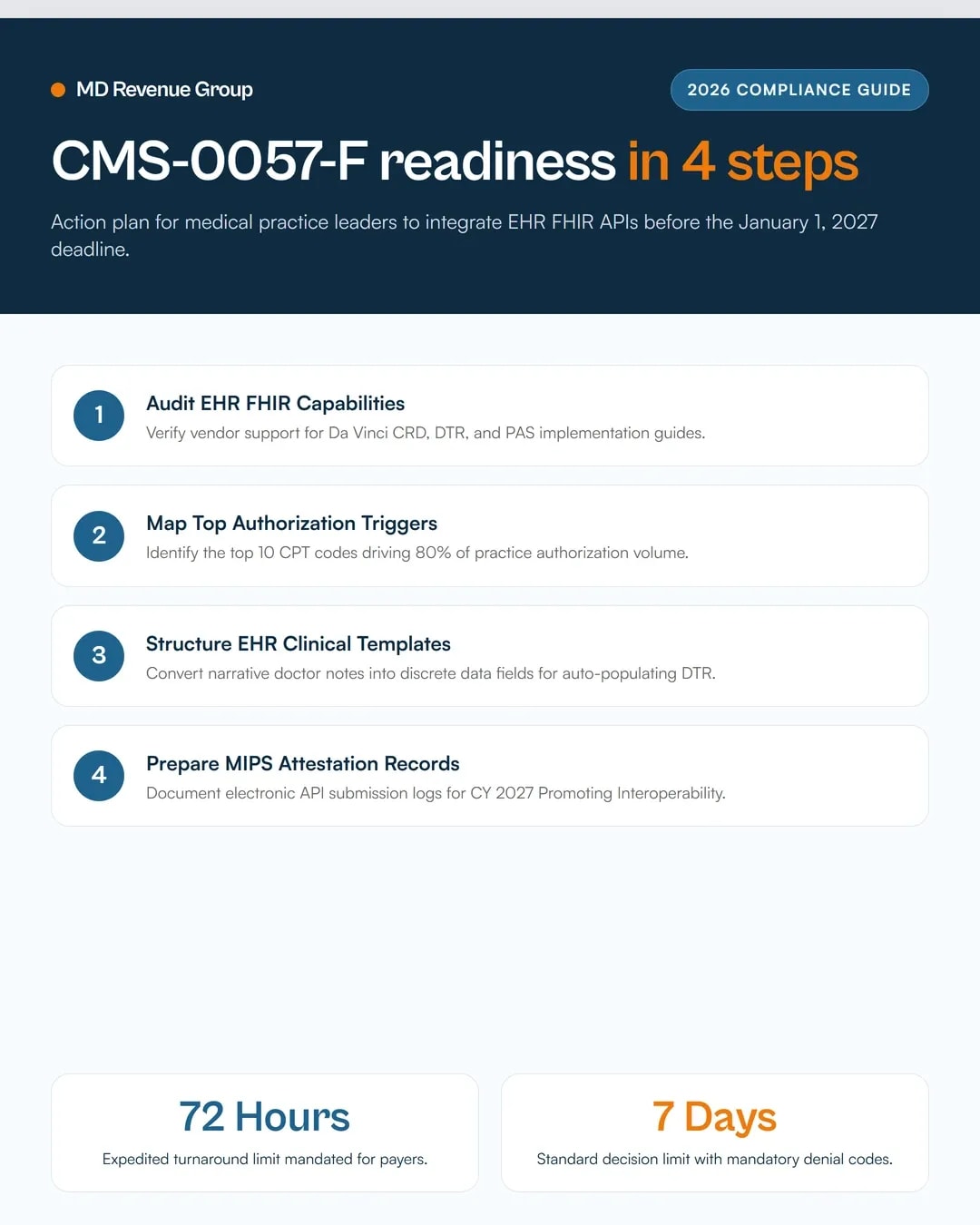
To take advantage of payer APIs in 2027, your Electronic Health Record system must support the HL7 Da Vinci Project Implementation Guides. Practice managers should conduct an immediate audit of their EHR vendor software release notes.
EHR API INTEGRATION CHECKLIST
| IG Standard | Required Functional Capability |
|---|---|
| Da Vinci CRD Da Vinci DTR Da Vinci PAS FHIR R4 / US Core | Real-time trigger on CPT/HCPCS selection Smart Questionnaire rendering inside ordering screen Automated X12 278 translation and attachment bundling Structured clinical data mapping for clinical notes |
Ask your EHR software representative these four questions:
- Does the EHR support native FHIR R4 resources for CRD, DTR, and PAS?
- Is the system configured to capture required clinical notes in structured data fields rather than unstructured PDF attachments?
- Does the software automatically ingest payer denial reason codes into the billing queue?
- What are the add-on fees or interface engine costs for enabling real-time PAS transactions?
Practices operating in strict regulatory environments must ensure their audit logs comply with federal standards. Medical groups seeking external reviews can evaluate their compliance readiness through a structured medical billing audit to identify billing documentation gaps before payers update their audit rules.
Managing Payer Transparency and Public Reporting Metrics
Beginning March 31, 2026, CMS-0057-F requires impacted payers to publish prior authorization metrics annually on their public websites. This public transparency data provides revenue cycle leaders with valuable negotiating strength when evaluating commercial payer contracts.
MANDATORY PAYER PUBLIC REPORTING METRICS (CMS-0057-F)
┌────────────────────────────────────────────────────────────────────────────────────────┐
│ Total Prior Authorization Requests Submitted                                           │
│ Percentage of Requests Approved (Overall and by Specific Service Category)            │
│ Percentage of Requests Denied (With Specific Denial Reason Categories)                  │
│ Percentage of Approvals Issued After Appeal                                            │
│ Average Time Elapsed Between Request Submission and Final Determination                │
└────────────────────────────────────────────────────────────────────────────────────────┘
Revenue cycle teams can use these metrics for benchmarking payer behavior. If a health plan reports a 45% denial rate on diagnostic imaging compared to an industry average of 18%, your practice can adjust contracting terms or request prior authorization exemptions under gold-carding frameworks.
Action Plan for Medical Practices Before January 2027
Preparing your medical practice for the 2027 mandate requires a structured operational roadmap across clinical, administrative, and financial teams.
RECOMMENDED 4-PHASE ROADMAP
┌──────────────────────┬──────────────────────┬──────────────────────┬──────────────────────┐
│ Phase 1: Q3 2026     │ Phase 2: Q4 2026     │ Phase 3: Q1 2027     │ Phase 4: Q2 2027     │
├──────────────────────┼──────────────────────┼──────────────────────┼──────────────────────┤
│ Audit EHR API capabilities│ Standardize clinical │ Test payer FHIR APIs  │ Monitor turnaround   │
│ Map top 10 authorization│ templates for common  │ Train staff on exception│ metrics and appeal   │
│ code triggers        │ procedures           │ management queues    │ non-compliant delays │
└──────────────────────┴──────────────────────┴──────────────────────┴──────────────────────┘
1. Map Your Top Authorization Triggers
Pull your practice denial and authorization reports for the past 12 months. Identify the top 10 CPT codes and commercial plans responsible for 80% of your authorization volume.
2. Standardize Clinical Documentation Templates
API automation requires structured data. If a physician types clinical notes as unstructured narrative text, the DTR engine cannot automatically populate payer clinical questionnaires. Update EHR templates to capture key clinical metrics in discrete form fields.
3. Establish Regional Payer Verification Controls
Payer API readiness varies across state lines. Regional plans often implement API endpoints on different software schedules. For instance, practices managing medical billing in Texas must verify whether local Medicaid MCOs are launching testing portals ahead of state regulatory deadlines.
4. Align Workflows with OIG Audit Guidance
Federal oversight of medical necessity documentation is expanding. Reviewing the updated 2026 OIG work plan medical billing audits helps practices maintain compliance while accelerating authorization submissions.
MIPS Promoting Interoperability Attestation in 2027
CMS is embedding electronic prior authorization adoption directly into physician quality reporting programs. Beginning with the CY 2027 performance year, MIPS-eligible clinicians must complete a mandatory attestation regarding their use of electronic prior authorization APIs.
MIPS PROMOTING INTEROPERABILITY ELECTRONIC PRIOR AUTHORIZATION MEASURE
[ Eligible Clinician ] ---> [ Requests Prior Auth via FHIR PAS API ]
                                      |
                                      v
                      [ EHR Records Electronic Exchange ]
                                      |
                                      v
              [ MIPS Attestation: YES / NO (CY 2027 Performance) ]
Clinicians who fail to attest or do not utilize certified electronic prior authorization software risk penalties under the MIPS Promoting Interoperability category, which can reduce total Medicare reimbursements by up to 9%.
Building an automated prior authorization workflow protects practice cash flow while shielding physicians from administrative burnout. Contact our revenue integrity team to audit your current authorization workflows using our revenue integrity calculator tool and schedule a comprehensive operational review.