
Behavioral-Health Billing for Group Therapy, IOP, and PHP: What the CY 2027 OPPS Proposal Signals
Navigate CY 2027 OPPS proposed rates, CPT 90853 group therapy, Condition Codes 92 & 41, and medical billing for mental health services." author: "MDRG Behavioral Health RCM Team
Medical billing for mental health services requires precise setting alignment across outpatient group psychotherapy, Intensive Outpatient Programs (IOP), and Partial Hospitalization Programs (PHP). In the CY 2027 Outpatient Prospective Payment System (OPPS) proposed rule (CMS-1850-P, released July 2, 2026), CMS proposed per diem rate increases of 1.48% for 3-service daily IOP/PHP care and 3.03% for 4-plus service programs. Understanding Condition Code 92 for IOP and Condition Code 41 for PHP prevents claims rejections across hospital outpatient departments and Community Mental Health Centers (CMHCs).
Key Takeaways
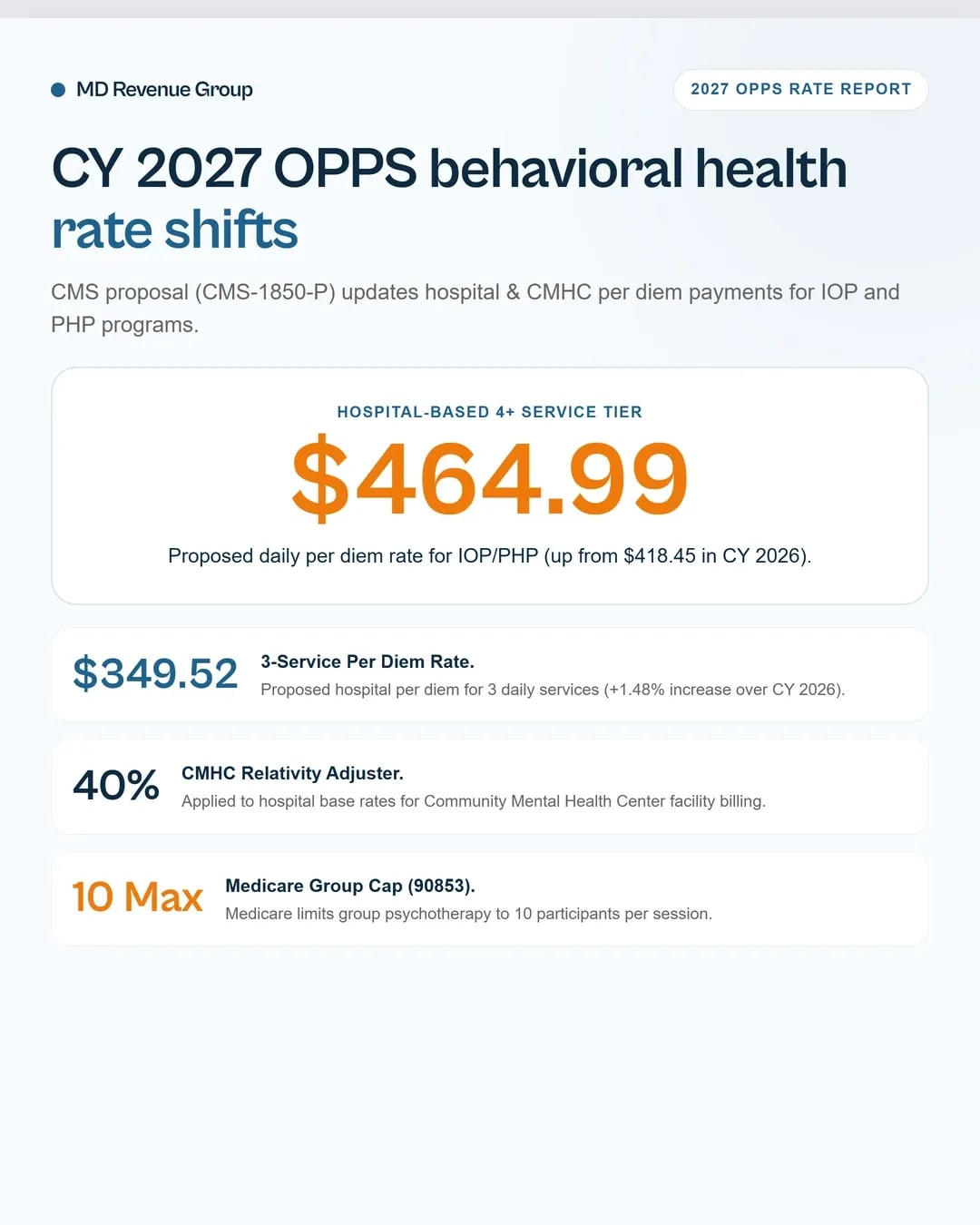
- The CY 2027 OPPS proposed rule increases hospital-based 3-service IOP/PHP per diem rates from 349.52 and 4+ service rates from 464.99.
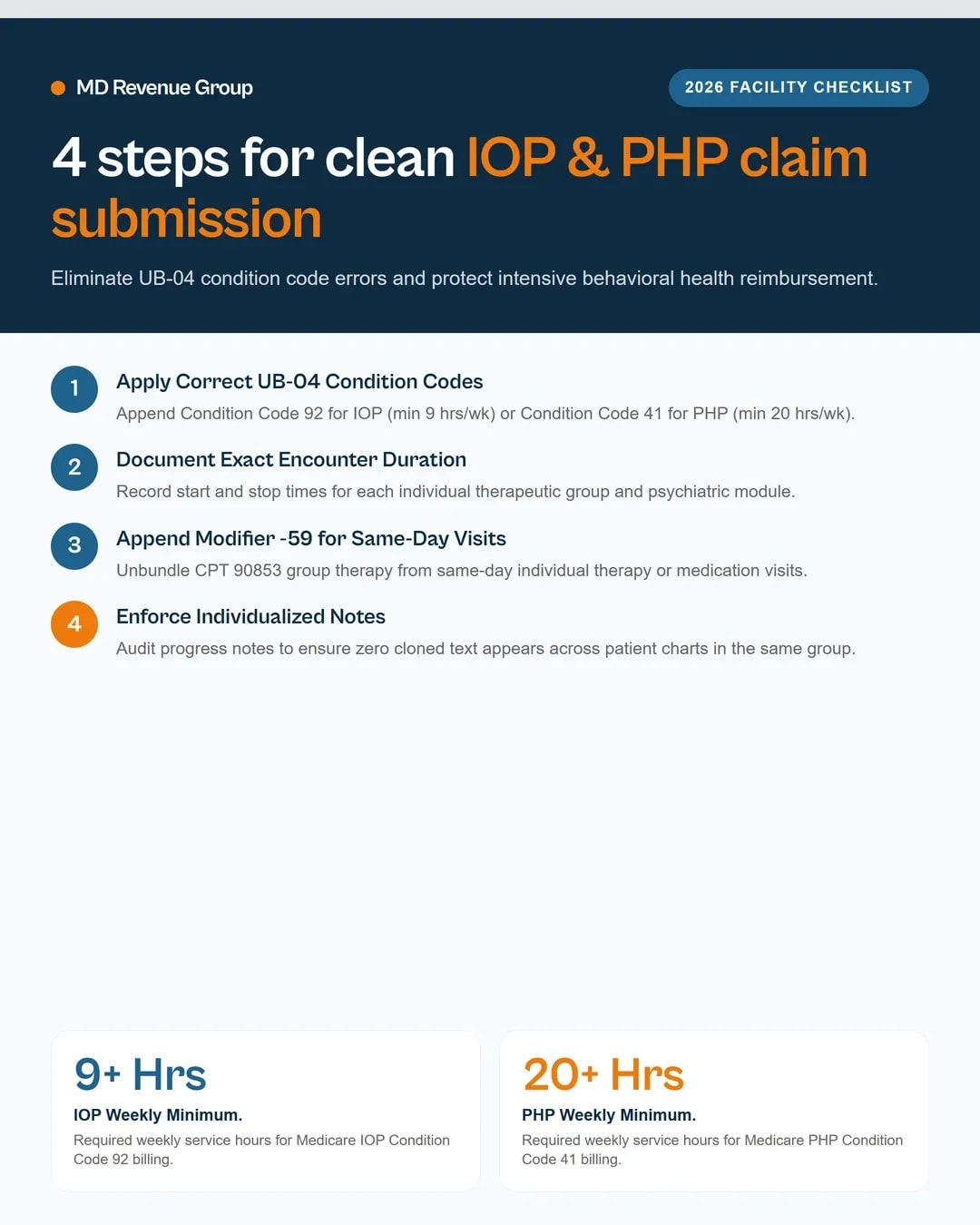
- Medicare IOP claims require Condition Code 92 and a minimum of 9 service hours weekly, while PHP claims require Condition Code 41 and a minimum of 20 service hours weekly.
- Community Mental Health Centers receive payments adjusted by CMS's 40% relativity adjuster to account for facility overhead differences.
- Group psychotherapy (CPT 90853) caps Medicare group size at 10 participants and prohibits cloned progress notes across group members.
CY 2027 OPPS proposed rate updates for IOP and PHP
The Centers for Medicare & Medicaid Services published the CY 2027 Outpatient Prospective Payment System (OPPS) proposed rule (CMS-1850-P) on July 2, 2026. This proposed rule updates payment structures for intensive behavioral healthcare delivered in hospital outpatient departments (HOPDs), Community Mental Health Centers (CMHCs), Federally Qualified Health Centers (FQHCs), and Rural Health Clinics (RHCs).
CMS proposed maintaining the two-tiered per diem structure finalized in CY 2026, which categorizes reimbursement based on whether a patient receives 3 distinct services per day or 4 or more distinct services per day. For hospital-based programs, the 3-service daily per diem rate is proposed to increase by 1.48%, rising from 349.52 in CY 2027.
Program Tier           CY 2026 Rate (Hospital)   CY 2027 Proposed Rate (Hospital)   Proposed Change
──────────────────────────────────────────────────────────────────────────────────────────────────
3 Services / Day       $319.38                   $349.52                             +1.48% (adjusted)
4+ Services / Day      $418.45                   $464.99                             +3.03% (adjusted)
Providers managing specialized behavioral health billing services must track these per diem shifts to model annual revenue projections accurately. Commercial payers frequently benchmark their intensive outpatient contracts against Medicare OPPS per diem rates within 90 days of final rule publication.
CMS also expanded coverage definitions to ensure that licensed professional counselors (LPCs) and marriage and family therapists (LMFTs) can render covered IOP services within CMHC and hospital settings. Billing teams must verify that provider taxonomy codes match state licensing profiles before transmitting Medicare claims.
Condition Code 92 (IOP) vs. Condition Code 41 (PHP) billing rules
Differentiating Intensive Outpatient Programs from Partial Hospitalization Programs depends on weekly service hours, patient acuity, and required UB-04 claim condition codes. Billing errors occur when facility coders swap condition codes or fail to document mandatory weekly hour thresholds.
Intensive Outpatient Program (IOP)       Partial Hospitalization Program (PHP)
Claim Code: Condition Code 92          - Claim Code: Condition Code 41Weekly Hours: Minimum 9 hours/week     - Weekly Hours: Minimum 20 hours/weekDaily Structure: Typically 3 hrs/day   - Daily Structure: Typically 4-6 hrs/dayAcuity: Step-down or structured outpatient - Acuity: Acute psychiatric stabilization alternative
For IOP reimbursement under Medicare, claims must include Condition Code 92 (Intensive Outpatient Services). Patient treatment plans must reflect a minimum of 9 hours of therapeutic services per week (typically 3 hours per day, 3 days per week). At least one primary psychiatric service, such as individual psychotherapy, group therapy, or medication management, must occur during each treatment day.
For PHP reimbursement, claims require Condition Code 41 (Partial Hospitalization Services). Treatment plans must document a minimum of 20 hours of structured care weekly (typically 4 to 6 hours daily, 5 days per week). If a patient drops below the 20-hour weekly threshold due to missed sessions, medical records must explain the clinical justification to prevent audit recoupments.
Facilities operating psychiatric billing services must audit UB-04 Form Locators 18-28 to confirm that condition codes match the documented treatment plan. Missing condition codes cause immediate claim rejections at the clearinghouse level.
CPT 90853 group psychotherapy coding rules and documentation boundaries
Outpatient mental health clinics frequently bill CPT 90853 (Group psychotherapy, other than of a multiple-family group) as part of structured outpatient treatment. While 90853 represents personal interaction within a group setting, strict coding guidelines govern group size, session length, and note individuality.
Medicare Administrative Contractors cap CPT 90853 group size at 10 participants. Commercial payers may permit up to 12 members, but groups exceeding payer limits face retroactive claim denials for all attendees.
Coding Requirement       CPT 90853 Standard
──────────────────────────────────────────────────────────────────────────────────────────
Maximum Group Size       Medicare: 10 patients max | Commercial: 10-12 patients max
Session Duration         Typically 45 to 60 minutes (must be documented)
Same-Day Individual E/M  Allowed with Modifier -59 or -XU if distinct time & purpose
Prohibited Activities    Socialization, recreational therapy, art/movement classes, ADL training
Coders must ensure that providers do not use "cloned" or identical progress notes across different group members. Auditors inspect group therapy documentation to verify that each patient's chart contains individualized clinical observations, specific treatment responses, and unique progress toward treatment plan goals.
When a patient participates in an individual therapy session (CPT 90834 or 90837) on the same day as a 90853 group session, append Modifier -59 (Distinct Procedural Service) to the second claim line. Without modifier -59, clearinghouse edits bundle the group session into the individual visit. Practices submitting behavioral health prior authorization documentation must verify that group therapy units are explicitly requested in initial authorization packages.
State-specific billing considerations: NY and California mental health compliance
Behavioral health billing regulations vary significantly between state Medicaid programs and commercial insurance Commissioners. Multi-state therapy organizations must adjust billing logic based on state licensure and parity enforcement.
In New York, the Office of Mental Health (OMH) and the Office of Addiction Services and Supports (OASAS) enforce strict clinic licensing rules under Article 31 and Article 32. Practices following New York medical billing rules must include state specific licensing modifiers (such as modifier HE for mental health services) on all Medicaid managed care claims.
State          Primary Regulatory Body              Key Billing Mandate
──────────────────────────────────────────────────────────────────────────────────────────
New York       OMH & OASAS (Article 31/32)          Mandatory HE/HF licensure modifiers
California     Department of Health Care Services   Medi-Cal CalAIM payment reform & CPT billing
In California, the Department of Health Care Services (DHCS) transitioned Medi-Cal specialty mental health services under the CalAIM initiative. Providers offering California mental health billing must bill using standardized CPT and HCPCS codes rather than legacy state-specific local codes. CalAIM mandates explicit documentation of social determinants of health (SDOH) using ICD-10 Z-codes (Z55-Z65) to support complex care coordination.
Proprietary calculation: Hospital-based IOP per diem vs. CMHC 40% relativity adjuster payment math
CMS applies a 40% relativity adjuster to hospital-based OPPS per diem rates when calculating reimbursement for Community Mental Health Centers. This adjustment accounts for lower facility overhead costs in non-hospital settings.
Understanding this payment calculation allows practice administrators to evaluate service line margins across facility types. Below is the comparative payment calculation for a 30-patient IOP program operating over a 20-day billing month:
PROPRIETARY BEHAVIORAL HEALTH REVENUE CALCULATION:
Program Parameters:
Active IOP Patients: 30 patientsProgram Attendance: 3 days per week (12 days per month per patient)Daily Service Intensity: 3 services per day (Tier 1 IOP)Total Monthly Patient Encounters: 30 patients × 12 days = 360 patient days
Calculation 1: Hospital-Based Outpatient Department (HOPD)
CY 2027 Proposed Per Diem Rate (3 Services): $349.52Monthly Gross Reimbursement: 360 patient days × $349.52 = $125,827.20Annual Gross Reimbursement: $125,827.20 × 12 months = $1,509,926.40
Calculation 2: Community Mental Health Center (CMHC - 40% Relativity Adjuster)
CMHC Per Diem Calculation: $349.52 × (1 - 0.40) = $209.71 per patient dayMonthly Gross Reimbursement: 360 patient days × $209.71 = $75,495.60Annual Gross Reimbursement: $75,495.60 × 12 months = $905,947.20
REVENUE VARIANCE ANALYSIS:
Annual HOPD Reimbursement: $1,509,926.40
Annual CMHC Reimbursement:   $905,947.20
Net Annual Facility Difference: $603,979.20
This calculation highlights why CMHC administrators must optimize staff scheduling, reduce missed attendance, and eliminate documentation errors to maintain strong clinical margins. Coordinating collaborative care management workflows alongside IOP programs helps capture eligible psychiatric care management revenue.
Decision matrix: Choosing between IOP, PHP, and outpatient group therapy workflows
Clinical teams and billing managers must align patient acuity with the correct billing workflow. Use this decision matrix to determine billing routing for mental health services:
Program Metric | Outpatient Group Therapy | Intensive Outpatient (IOP) | Partial Hospitalization (PHP) |
|---|---|---|---|
CPT / Coding Format | CPT 90853 | Revenue Code 0905 + Condition Code 92 | Revenue Code 0912 + Condition Code 41 |
Weekly Service Target | 1 to 2 hours per week | 9 to 19 hours per week | 20+ hours per week |
Payer Authorization | Standard outpatient authorization | Intensive outpatient prior authorization | Acute partial hospitalization authorization |
Primary Claim Form | CMS-1500 (Professional) | UB-04 (Institutional) or CMS-1500 | UB-04 (Institutional) |
Medical Necessity Focus | Interpersonal group goals | Multi-disciplinary stabilization | Daily acute stabilization alternative to inpatient |
Literal documentation examples for IOP encounter notes
Incomplete progress notes lead to post-payment recoupments. Auditors require detailed documentation showing start and stop times, specific therapeutic interventions, and patient progress.
Non-Compliant IOP Progress Note Example:
"Patient attended Day 4 of IOP. Participated in group discussion regarding coping skills. Patient was cooperative. Plan to continue IOP."
Why it fails: Missing specific start and end times, missing total service hours, missing specific CPT/HCPCS codes for individual group modules, no documented individual response, and no evidence of multi-disciplinary coordination.
Compliant IOP Progress Note Example:
"Program: Intensive Outpatient Program (Condition Code 92). Date: 09/04/2026. Total Duration: 3.5 Hours (9:00 AM - 12:30 PM).
Module 1 (9:00 AM - 10:15 AM): Cognitive Behavioral Therapy Group (CPT 90853). Focused on identifying automatic negative thoughts triggering anxiety (F41.1). Patient actively contributed, identifying 2 personal work stressors.
Module 2 (10:30 AM - 11:30 AM): Psychoeducation Group on Relapse Prevention. Patient completed personal trigger management worksheet.
Module 3 (11:30 AM - 12:30 PM): Individual Medication Management & Check-in (CPT 90863 / 99213). Dr. Arslan Khan evaluated medication tolerance; SSRI dosage maintained. Patient demonstrates improved affect and reports 4/10 anxiety level. Patient meets medical necessity criteria for continued IOP level of care."
This compliant note documents exact service times, distinct clinical modules, and individual responses, satisfying all CMS and commercial payer audit standards.
Prior authorization control checklist for intensive mental health services
Commercial health plans enforce strict utilization management rules for IOP and PHP admissions. Establishing a pre-admission authorization checklist prevents non-covered stay denials.
- Verify Patient Benefit Eligibility: Confirm covered treatment days, daily visit caps, and co-insurance requirements before day one.
- Submit Initial Clinical Summary Within 24 Hours: Provide standardized DSM-5-TR diagnostic criteria, ASAM level of care scoring, and safety risk assessments.
- Track Authorized Unit Expiration Dates: Set automated EHR alerts 3 days prior to authorization unit exhaustion to submit concurrent review clinicals.
- Document Peer-to-Peer Discussions: Record medical director reviewer names, rationales, and approval extensions directly in the patient billing chart.
Author Byline
Written by the MDRG Behavioral Health RCM Team. Reviewed by Arslan Khan, Behavioral Health Billing Specialist, with over 12 years of experience optimizing psychiatric revenue cycles, IOP/PHP facility enrollment, and parity audit defense.
Ready to optimize your behavioral health billing?
Facing high denial rates for group therapy or IOP claims? MD Revenue Group specializes in behavioral health revenue cycle management, prior authorization tracking, and facility billing. Request a free behavioral health revenue audit today to unlock your practice revenue.