
G2211 in 2027: Preparing for the Proposed Modifier-Based Payment Model in Medical Billing and Practice Management Services
CMS proposed replacing G2211 with 16% and 32% modifiers in CY 2027. Learn how medical billing and practice management services must prepare.
G2211 in 2027: Preparing for the Proposed Modifier-Based Payment Model in Medical Billing and Practice Management Services
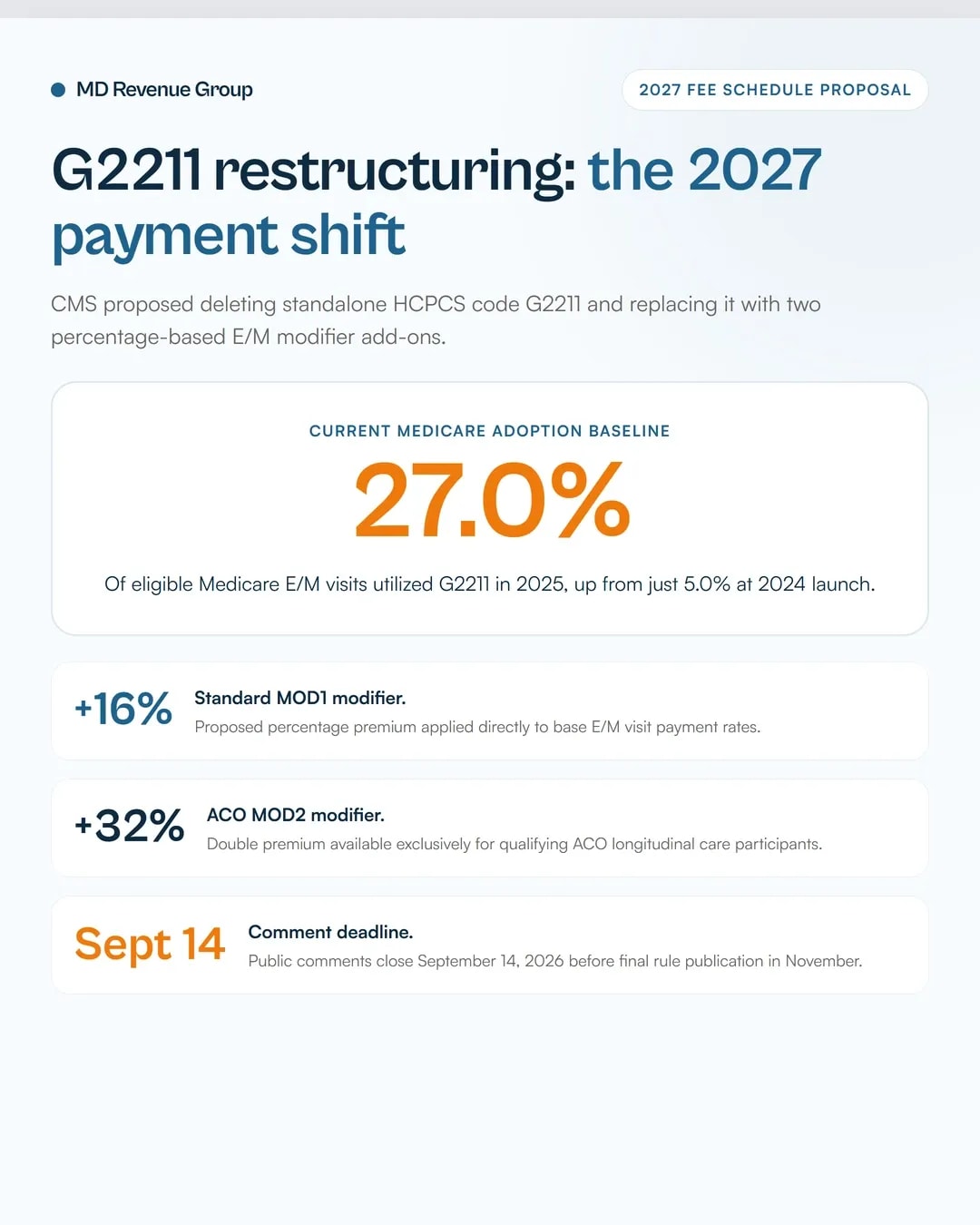
The Centers for Medicare & Medicaid Services (CMS) proposed deleting standalone HCPCS add-on code G2211 effective January 1, 2027, replacing it with a percentage-based modifier reimbursement structure that pays a 16% or 32% premium on base evaluation and management (E/M) codes. Medical billing and practice management services must audit clinical documentation and update billing software rules before the public comment window closes on September 14, 2026.
Key Takeaways
- CMS proposed retiring HCPCS code G2211 on December 31, 2026, replacing it with two new modifier add-ons starting January 1, 2027.
- Proposed modifier MOD1 provides a 16% payment increase on base office/outpatient E/M codes (99202–99215) for general practices.
- Proposed modifier MOD2 provides a 32% payment increase on base E/M codes for practices enrolled in qualifying ACO models like the Shared Savings Program or LEAD models.
- Utilization of G2211 grew from 5.0% of Medicare E/M visits in January 2024 to 27.0% in mid-2025 across outpatient and residential settings.
- Medical records must document ongoing, longitudinal care relationships to defend against payer recoupments during post-payment audits.
What CMS Proposed for G2211 in the CY 2027 Physician Fee Schedule
On July 14, 2026, CMS published the Calendar Year (CY) 2027 Medicare Physician Fee Schedule (PFS) proposed rule. The centerpiece of the evaluation and management update is a complete structural overhaul of HCPCS code G2211.
Under the proposed rule, CMS intends to eliminate the standalone G-code format. Instead, CMS proposed creating two new modifiers to capture visit complexity:
- Standard Modifier (placeholder MOD1): Appends to base E/M claims to yield a 16% payment boost above the standard fee schedule allowance.
- ACO Longitudinal Care Modifier (placeholder MOD2): Appends to base E/M claims for qualifying Accountable Care Organization participants, yielding a 32% payment boost.
This shift moves Medicare away from a fixed dollar add-on (which was $16.05 per claim in 2024 at 0.33 RVUs) toward a proportional adjustment. Higher-level E/M visits like 99215 will generate higher dollar adjustments than lower-level visits like 99212.
CMS established a public comment deadline of September 14, 2026. Practices operating in high-volume Medicare states like medical billing in California must analyze their code mix now to submit data-backed comments before final rulemaking in November 2026.
How G2211 Evolved From 2024 to 2026
To understand why CMS proposed this modifier shift, you need to track how G2211 performed over its three-year run. When CMS launched G2211 on January 1, 2024, adoption was slow.
In January 2024, Medicare claims data showed that only 5.0% of eligible E/M visits included G2211. The low uptake stemmed from strict billing rules. CMS initially prohibited reporting G2211 on any claim containing modifier 25 (significant, separately identifiable service).
G2211 Medicare Adoption Timeline:
Jan 2024:  5.0% of eligible E/M visits (Strict Modifier 25 ban)
Dec 2024: 19.0% of eligible E/M visits (Relaxed for AWV & preventive services)
Mid-2025: 27.0% of eligible E/M visits (Established baseline)
Jan 2026: Expanded to home & residence visits (CPT 99341–99350)
Jan 2027: Proposed transition to 16% / 32% modifiers (MOD1 / MOD2)
On January 1, 2025, CMS relaxed the restriction. Clinicians were allowed to bill G2211 alongside modifier 25 when the secondary service was an Annual Wellness Visit (G0438/G0439), vaccine administration, or routine Part B screening. Adoption jumped to 19.0% by December 2024 and stabilized at 27.0% in mid-2025.
On January 1, 2026, CMS expanded G2211 eligibility to home and residence E/M codes (99341–99350). If you reviewed our previous G2211 and APCM billing guide, you know that longitudinal care tracking requires tight integration between clinical notes and clearinghouse edits.
Proprietary Revenue Model: 2026 Flat Rate vs 2027 Modifier Payment
Because the proposed 2027 rule replaces a fixed dollar add-on with a percentage multiplier, the financial impact varies depending on your E/M code distribution.
Below is a worked revenue comparison for a practice performing 1,000 Medicare E/M visits per month, assuming a baseline conversion factor of $32.84 and average national Medicare E/M payment rates.
Base E/M Code | Monthly Volume | Base Medicare Payment | 2026 G2211 Flat Add-On ($16.05) | Proposed 2027 MOD1 (+16%) | Proposed 2027 MOD2 (+32%) | Net Annual Difference (MOD1 vs 2026) |
|---|---|---|---|---|---|---|
99212 (Level 2 Established) | 100 | $58.00 | $1,605 | $928 | $1,856 | -$8,124 |
99213 (Level 3 Established) | 400 | $92.00 | $6,420 | $5,888 | $11,776 | -$6,384 |
99214 (Level 4 Established) | 400 | $131.00 | $6,420 | $8,384 | $16,768 | +$23,568 |
99215 (Level 5 Established) | 100 | $184.00 | $1,605 | $2,944 | $5,888 | +$16,068 |
Total Monthly Add-On | 1,000 | - | $16,050 | $18,144 | $36,288 | +$25,128 / year |
Practices that bill predominantly level 4 (99214) and level 5 (99215) visits will see annual revenue gains under proposed MOD1. Practices that rely heavily on level 2 and level 3 visits will experience a revenue reduction unless they qualify for the 32% MOD2 rate.
Comprehensive revenue cycle management teams should run this exact calculation on their 12-month billing history to forecast cash flow changes before 2027.
Modifier 25 and Global Surgery Edit Intersections in 2027
The 2027 proposed rule does not evaluate G2211 in isolation. CMS also proposed a 50% payment reduction on same-day E/M visits reported with modifier 25 when billed alongside minor surgical procedures or global diagnostic tests.
If finalized, this dual policy creates two distinct workflow checks for your billing staff:
- When Modifier 25 applies to a minor procedure: The base E/M visit payment drops by 50%. The 16% MOD1 premium is calculated off the reduced E/M payment amount, not the full fee schedule rate.
- When Modifier 25 applies to a Part B preventive service: The E/M visit pays at 100%, and MOD1 applies to the full base rate.
Practices managing multi-specialty operations in states like medical billing in Texas must update claim scrubbing software. If your clearinghouse automatically appends modifier 25 without verifying preventive status, claims will trigger automatic downcoding and revenue loss.
To understand broader fee schedule adjustments, read our detailed CY 2027 Medicare fee schedule proposed rule analysis.
Decision Matrix: When to Append Proposed MOD1 vs MOD2
Never guess whether a claim qualifies for the standard 16% modifier or the 32% ACO rate. Use this decision matrix during chart audits.
Is the patient-provider relationship longitudinal and ongoing?
├── NO ──> Do NOT append MOD1 or MOD2 (Unqualified visit)
└── YES
    ├── Is the practice enrolled in an eligible CMS ACO model (MSSP / LEAD)?
    │   ├── YES ──> Append MOD2 (32% Premium)
    │   └── NO  ──> Append MOD1 (16% Premium)
Qualifying Clinical Conditions
MOD1 and MOD2 apply when you serve as the continuing focal point for all healthcare needs, or when you manage a single, complex, or high-risk condition.
- Primary Care: Managing diabetes, hypertension, and hyperlipidemia over multi-year intervals.
- Specialty Care: Managing active rheumatoid arthritis, congestive heart failure, or chronic kidney disease stage 4.
Excluded Clinical Conditions
You cannot bill MOD1 or MOD2 for discrete, episodic, or short-term care where another provider holds the primary relationship.
- Minor acute injuries (e.g., uncomplicated ankle sprain treated during a single visit).
- One-time second opinion consultations.
- Urgent care visits for temporary viral infections where long-term follow-up is not established.
Literal EHR Documentation Examples for Longitudinal Care
Payer audits do not fail because clinicians lacked medical necessity. They fail because clinical notes use template boilerplate instead of explicit longitudinal statements.
When CMS audited G2211 claims in 2025, commercial Medicare Advantage auditors flagged notes containing generic phrases like "patient seen for follow-up." To defend claims under proposed MOD1 or MOD2, your EHR progress notes must include explicit, patient-specific longitudinal documentation.
Incorrect (Will Fail Audit)
"Patient returns for blood pressure check. Continuation of current medication management advised. Follow up in 3 months."
Correct (Audit-Proof Documentation)
"I am continuing as the primary managing physician for this patient's chronic stage 3 CKD and resistant hypertension. We discussed medication adjustments for lisinopril (increased to 40mg daily) and reviewed home BP logs averaging 142/88. Patient's care plan requires ongoing longitudinal monitoring every 12 weeks to prevent disease progression."
Notice the difference. The correct example explicitly states the ongoing physician-patient relationship, documents specific clinical adjustments, and outlines the long-term management plan.
If your practice struggles with documentation compliance, outsourcing to professional medical billing services ensures certified coders audit your charts before claims are generated.
Practice Management Action Steps Before January 1, 2027
Do not wait until December 2026 to update your practice management systems. Execute these four operational steps now:
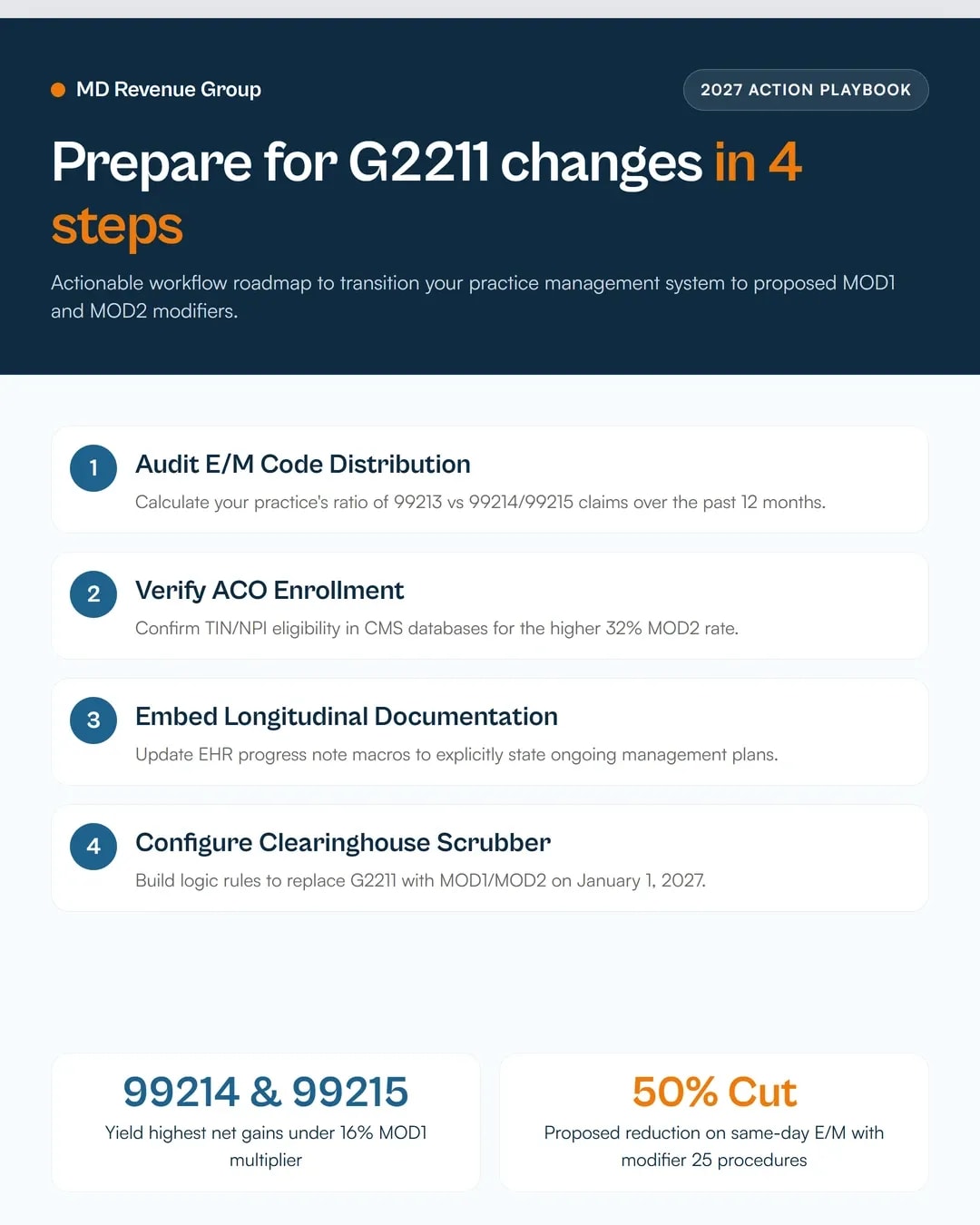
Step 1: Quantify E/M Code Distribution (Calculate ratio of 99213 vs 99214/99215)
Step 2: Verify ACO Enrollment Status (Confirm MSSP / LEAD model qualification for MOD2)
Step 3: Update EHR Templates (Embed longitudinal care prompts into progress notes)
Step 4: Configure Clearinghouse Scrubber (Prepare rule logic for MOD1 / MOD2 replacing G2211)- Run a 12-Month E/M Code Distribution Report: Identify what percentage of your Medicare claims are 99213 versus 99214 and 99215. Use our financial model to project revenue changes under the 16% MOD1 rate.
- Verify ACO Provider Rosters: If your practice participates in an Accountable Care Organization, verify that your TIN/NPI combination is active in CMS databases to support 32% MOD2 modifier claims.
- Audit Progress Note Templates: Eliminate generic macro text. Replace static templates with structured fields that capture long-term treatment goals and care coordination efforts.
- Schedule Clearinghouse Rule Updates: Work with your billing vendor to ensure your practice management software can seamlessly replace G2211 with MOD1 and MOD2 on January 1, 2027.
Frequently Asked Questions
Will commercial payers adopt proposed MOD1 and MOD2 in 2027?
Commercial payer adoption varies by contract. Historically, commercial payers took 12 to 18 months to adopt Medicare G-codes. However, because MOD1 and MOD2 are standard CPT/HCPCS modifiers rather than Medicare-specific G-codes, commercial health plans may adopt the percentage modifier structure faster. Check your payer contracts during Q4 2026 renewal windows.
Can specialists bill MOD1 and MOD2, or is it restricted to primary care?
Specialists can bill MOD1 and MOD2 if they act as the continuing focal point for a specific, complex condition. For example, a cardiologist managing chronic heart failure or an endocrinologist managing type 1 diabetes qualifies, provided the medical record documents ongoing longitudinal care.
What happens if I bill G2211 after January 1, 2027, if the rule is finalized?
If CMS finalizes the deletion of G2211, submitting HCPCS code G2211 for dates of service on or after January 1, 2027, will result in an unprocessable claim denial (CARC 96 / RARC M51). Claims must use the new MOD1 or MOD2 modifiers attached to the primary E/M code.
Optimize Your Practice Revenue for 2027
Navigating fee schedule revisions and complex modifier rules requires constant vigilance. If coding updates and payer audits are draining your clinical staff's time, let our expert team evaluate your billing performance.
Use our free revenue integrity tool to calculate your practice's hidden denial leakage, or schedule a comprehensive audit with our revenue cycle specialists today.