
Electronic vs Paper Claims: Which to Send and Why
Electronic vs paper claims stopped being a preference question for Medicare in 2003, and the argument people still have is about speed and cost rather than permission.
Section 3 of the Administrative Simplification Compliance Act, Pub. L. 107-105, implemented at 42 CFR 424.32, requires initial Medicare claims to be submitted electronically. Paper claims are legal only under an approved exception waiver. Every commercial payer and state Medicaid program has its own rules, and most of them point the same direction.
What the federal rule actually says
The requirement covers initial claims, which includes first submissions and resubmissions of claims previously rejected. Providers must file through a mechanism meeting the HIPAA claim standard and CMS enrollment requirements.
Small providers are the named exception category, and the exceptions after that are narrow. Paper submission needs a waiver approved by your Medicare Administrative Contractor, and the waiver process itself starts with a development letter from the contractor. Nobody gets paper filing because it is easier.
There is a second paper rule people miss. ICD-10 has been required on paper claims too, for dates of service on or after October 1, 2015. A paper claim carrying ICD-9 codes for a date inside that window comes back to the provider as unprocessable. Paper filing does not buy you a coding exemption.
The payment floor nobody mentions
Here is the detail that settles the argument financially. Medicare operates both a payment floor and a payment ceiling.
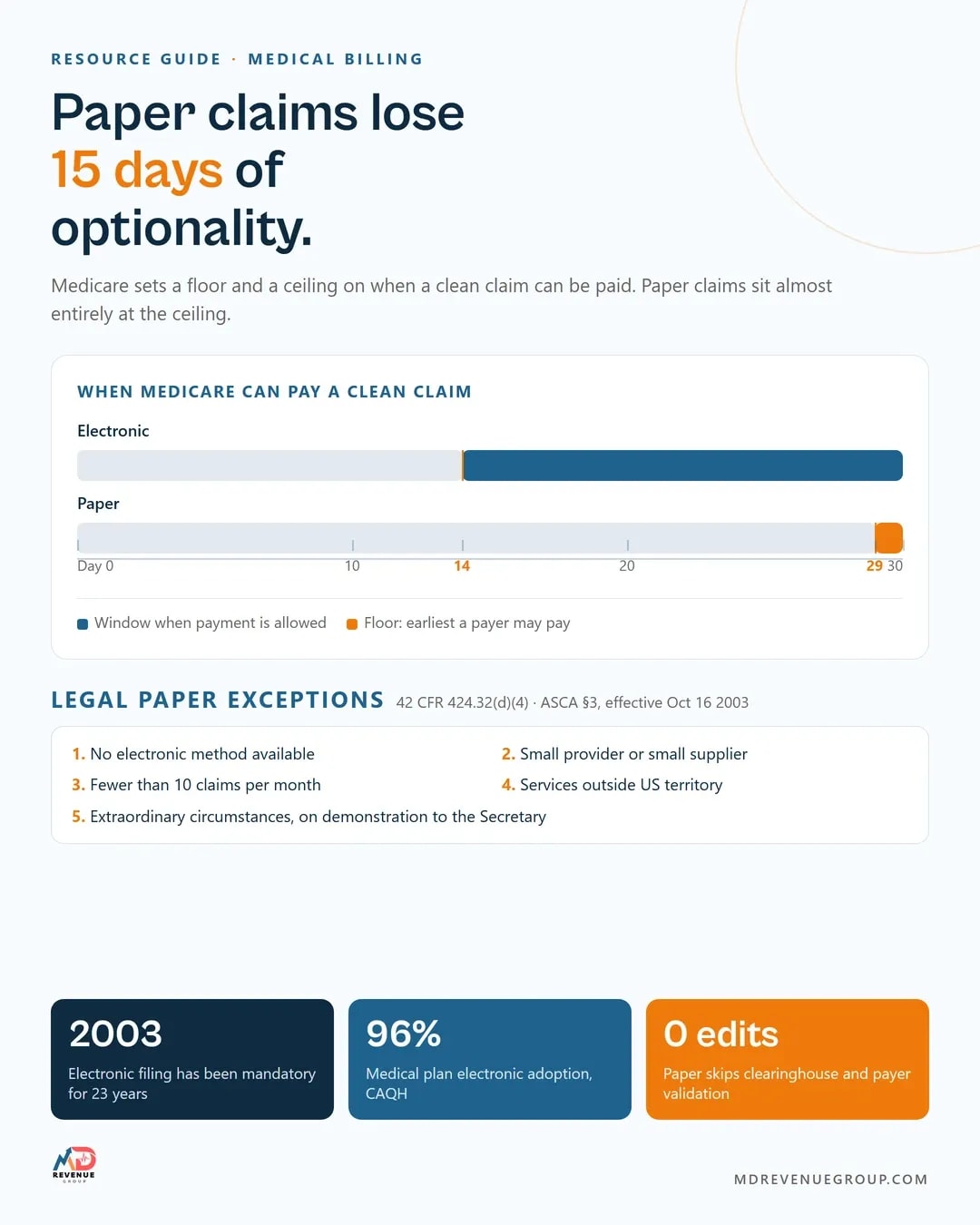
The floor is the earliest date a payer may pay. For electronic claims it is 14 days after receipt. For paper claims it is 29 days.
The ceiling comes from CMS prompt-pay requirements, which Medicare Administrative Contractors administer and publish. Every clean claim must be paid or denied within 30 days of receipt, and interest is owed on a clean claim that goes unpaid past that.
Medicare Administrative Contractors also publish the floor directly. Noridian, a Part B contractor, states it plainly: the payment floor is 14 days for electronic claims, as opposed to 29 days for paper claims.
Put those together and you get a 16-day structural disadvantage on paper. Electronic claims can be paid somewhere between day 14 and day 30. Paper claims can only be paid between day 29 and day 30. You lose two weeks of optionality on every paper claim, and the payer gets to use all of it.
Why paper claims fail more often
Electronic claims pass through two automated validation layers before a human sees them. The clearinghouse checks syntax and payer-specific rules. The payer's front-end edits check the claim against implementation guide requirements. CMS describes this directly: if a batch fails at the MAC's initial HIPAA-standard level, the entire batch returns for correction and resubmission.
Paper claims skip all of it. The payer's staff open the envelope and key the claim into their system by hand. A transposed member ID on paper does not get caught by an edit rule. It gets typed in wrong, adjudicated against the wrong member, and returned weeks later as an eligibility denial on a claim that was correct on the form.
That is the structural reason paper denial rates run higher. It is not carelessness at your end. It is the absence of a machine reading your claim before a human acts on it.
When paper is still legal
The exceptions are real but they are a short list, and they are worth knowing precisely because so many practices assume they have one and do not.
- ✓The default and, for Medicare, the legal requirement since October 16, 2003. Two automated validation layers before adjudication. Payment possible between day 14 and day 30. Rejections returned with error codes in hours.
- ✗Legal for Medicare only under an approved ASCA waiver, and the waiver starts with a development letter from your MAC. Zero automated edits. Payment possible only between day 29 and day 30. Errors surface as denials weeks later.
If you believe you hold a waiver, you can confirm it. If you received an ASCA development letter and never responded, you do not have one. A practice that has been mailing paper to Medicare for years without a waiver is operating outside the rule, and the exposure is denial of the claims plus False Claims Act territory.
The regulation itself lists exactly five exceptions, at 42 CFR 424.32(d)(4). They are narrower than most practices assume.
- No method is available for electronic submission, including situations where the standard adopted at 45 FR 162.1102 does not carry the information necessary for payment.
- The entity is a small provider of services or a small supplier.
- The entity submits fewer than 10 claims to Medicare per month, on average.
- The entity only furnishes services outside US territory.
- Other extraordinary circumstances, on demonstration to the Secretary.
Exception 3 is the one that catches people. A practice under 10 claims a month is exempt. A practice at 11 claims a month is not, and the exemption does not apply to a single claim inside an otherwise-large submission.
The data on where the industry actually sits
CAQH's 2025 Index, built from more than 600 provider organizations and health plans representing 63% of insured lives, puts medical plan electronic adoption at 96%.
Transaction by transaction, the adoption rates tell a more useful story:
Transaction | 2023 Index | 2025 Index |
|---|---|---|
Electronic prior authorization | 31% | 40% |
Claim status inquiry | 74% | 81% |
Claim payment / remittance | 73% | 78% |
Claim submission | stable | stable |
Attachments | 32% | 24% |
Two things in that table matter for this question.
Acknowledgments reached 100% electronic adoption and were retired from the Index entirely, because the industry finished that transaction.
Attachments went the other direction. Electronic adoption of attachments fell from 32% to 24% while every other line rose. Attachments are how supporting documentation reaches a payer. The transaction that carries your clinical evidence to justify the claim is the one that got less automated, right as federal interoperability rules push toward electronic exchange.
Our guide to submitting a claim covers the acknowledgment chain in full, including why a clean 999 still does not mean the payer has your claim.
What paper claims actually cost
Take a practice billing $2.4 million a year. Average daily charges run about $6,575.
Every paper claim pushes payment toward day 29 instead of day 14. On 16 days of delay at that daily charge rate, the working capital sitting in the pipeline is $105,200 per paper claim month. That is not recoverable revenue, it is revenue that exists on paper while cash does not.
Now price the rework. Premier's survey of 280 hospitals across 23 states found the average cost of fighting a denied claim at $57.23 in 2023, up from $43.84 in 2022, with Medicare Advantage claims running $80.16. Paper claims reach that stage more often because nobody validated them first.
Run both numbers on 100 paper claims a month and you get a defensible case for clearinghouse fees several times over. Our automation ROI breakdown works through the same math for a full automation program, and the CAQH automation data covers where the remaining $21 billion of savings sits.
The claim that paper is faster, and why it keeps appearing
You will read that electronic claims process in 7 to 14 days and paper claims in 30 or more. That comparison is usually comparing two different things: a clean electronic claim that pays on the early end of the allowed window against a paper claim already sitting in a manual keying queue.
Against the actual federal framework, electronic can pay from day 14 and paper cannot pay before day 29. Electronic has a wider window and it uses it. The speed claim, tested against the regulation rather than against an anecdote, does not hold.
Where paper still makes sense
A small number of legitimate cases remain.
A payer that does not accept electronic claims. Some liability, workers' compensation, and casualty carriers still run paper-only intake. Check the payer's own requirements before assuming.
A claim needing documentation the clearinghouse cannot carry. When an attachment has to travel with the claim and your clearinghouse cannot send one, paper with a document attached is a legitimate fallback.
Systems failure. When the practice management system or the clearinghouse connection is down and the filing deadline is close, getting a claim into the mail beats missing the window. Document the outage.
In all three, the trigger is a specific documented failure, not a general preference.
Moving off paper, in the order that avoids surprises
If your practice is still sending paper, the switch is a configuration project rather than a purchase. Work it in this order.
The step people skip is the parallel run. Thirty days of side-by-side comparison shows you exactly which of your historical rejections were data errors that a scrub rule now catches, and which were judgment calls that will not fix themselves.
CAQH found claim status inquiry adoption at 81% and claim payment at 78% in its 2025 Index. You have the tools to ask where your claims are. Most teams just never ask, and they find out about a rejection when the filing deadline is already gone.
State Medicaid is its own rulebook
ASCA binds Medicare. It does not bind Medicaid, and state programs do not move together.
Each state Medicaid agency sets its own submission method, its own portal or clearinghouse arrangement, and its own filing deadline. Some accept the 837 through a state-designated clearinghouse. Some run their own portal that takes web-based entry rather than an EDI file. A few still accept paper for specific claim types.
The practical consequence: the question "can I send this electronically" has a different answer in New Jersey than it does in Texas, and neither answer is given by the federal rule. The full states directory lists what we cover.
Commercial payers are a third system again. They set their own enrollment process, and most now run EDI-only for professional claims with paper as a documented fallback.
Before you assume a payer accepts electronic submission, ask them for their requirements in writing and keep the answer. An enrollment nobody confirmed is an enrollment nobody tested.
Frequently asked questions
Only under an approved ASCA exception waiver. Section 3 of the Administrative Simplification Compliance Act, implemented at 42 CFR 424.32, has required electronic submission of initial Medicare claims since October 16, 2003. The waiver process begins with a development letter from your Medicare Administrative Contractor.
Medicare sets a payment floor of 14 days for electronic claims and 29 days for paper claims, as published by Medicare Administrative Contractors, with a 30-day ceiling for clean claims under CMS prompt-pay requirements. Paper claims also skip the clearinghouse and payer edit layers, so errors surface as denials instead of fast rejections.
No. The 12-month limit under 42 CFR 424.44 applies to both paper and electronic Medicare claims, measured by when the Medicare Administrative Contractor receives the claim.
No, for dates of service on or after October 1, 2015. Paper claims carrying ICD-9 codes for those dates come back to the provider as unprocessable.
Professional claims go out as the 837P, institutional claims as the 837I, and dental claims as the 837D. X12 5010 is the mandated HIPAA standard under 45 CFR Part 162.
File the claim another way before your deadline, and document the outage. Note that the timely filing clock measures receipt, so an outage that pushes a claim past the window costs you the whole claim with no appeal rights. How the Change Healthcare disruption reshaped submission covers the scale of that risk.
The data points that way, though vendors will quote you a number. CAQH reports 96% medical plan electronic adoption for claim submission. Structural accuracy comes from the edit layers: electronic claims get validated by the clearinghouse and the payer before a person touches them, paper claims do not.
Clearinghouse fees plus whatever it takes to get your practice management system producing a clean 837. Most of the cost is in scrubbing configuration rather than the transaction itself. How our medical billing service handles submission covers the setup.
Where to go next
How to submit a medical claim the first time covers the acknowledgment chain and the data fields. The 10 medical billing process steps puts submission in context with the other nine stages. For the coding layer underneath, medical coding resources cover ICD-10, CPT, and HCPCS rules.
If you are still on paper, ask every payer on your roster for its electronic enrollment requirements. Most will tell you within a week. Practices billing in New York and Texas have extra state disclosure and surprise-billing layers to work through; the states directory lists all of them.
Request a free revenue audit and we will show you what share of your volume is still moving on paper and what it is costing in cash.