
Medical Billing Process Steps: Registration to Payment
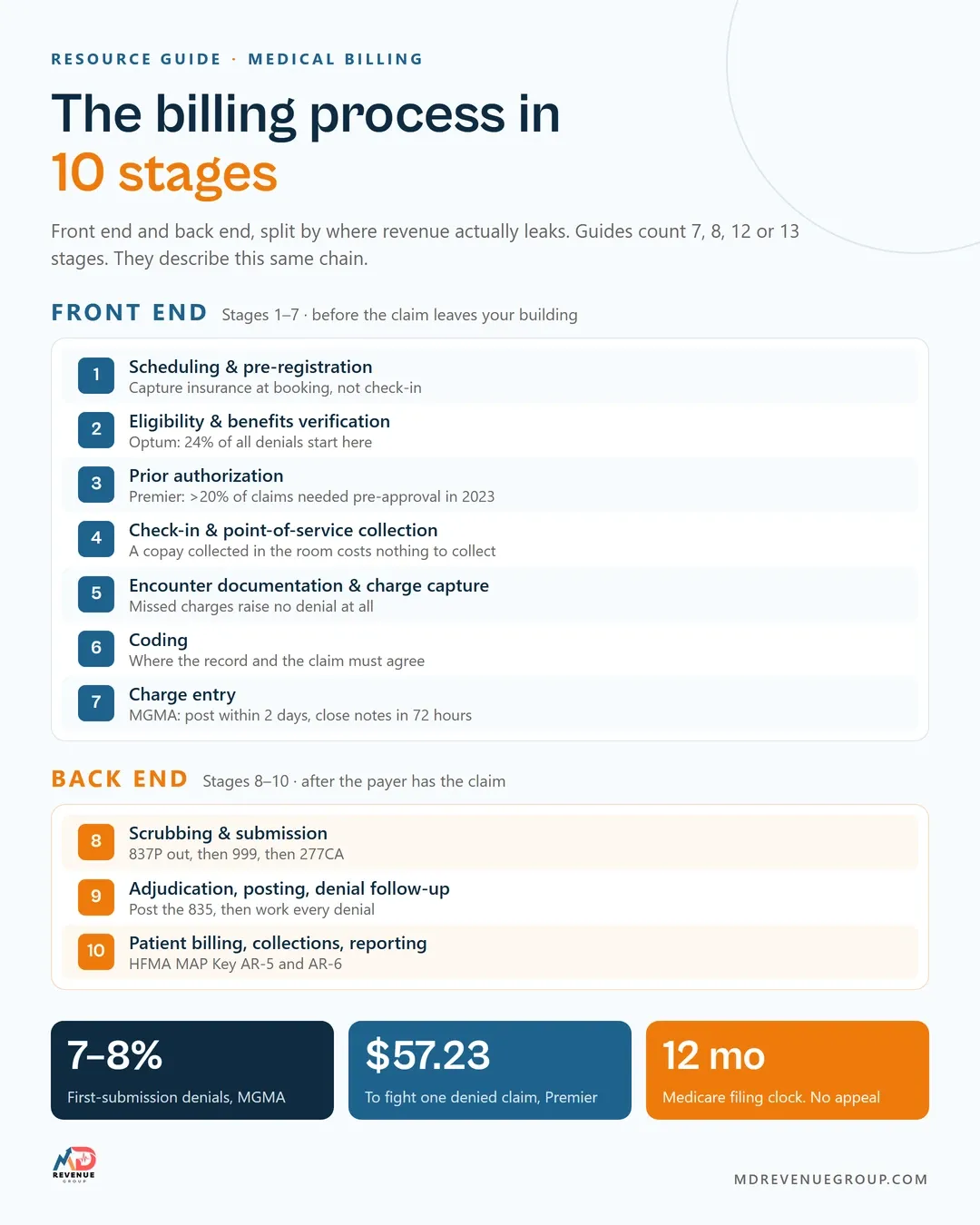
The medical billing process steps run in 10 stages, from the moment a patient books an appointment to the day the last balance clears. Each stage has an owner, a clock, and a specific way it fails. Get the order right and a claim pays the first time. Get it wrong and the failure shows up weeks later, attached to a payer code nobody on your team can explain.
This guide walks all 10 stages, names the regulation behind each one, and shows what each stage costs when it breaks.
Why the process matters, in dollars
MGMA benchmarking puts first-submission denials at 7% to 8%, steady across four years, and its 2025 Financials and Operations data says practices can push that under 5% with targeted fixes. In a January 2026 poll, 48% of MGMA leaders named denials and appeals as their largest source of revenue leakage, against 23% who blamed front-end issues.
Premier's national survey of 280 hospitals across 23 states puts the number harder. Claims adjudication cost providers $25.7 billion in 2023, up 23% from $19.7 billion. The cost to fight one denied claim rose from $43.84 in 2022 to $57.23 in 2023, and $80.16 for Medicare Advantage claims. About 68.6% of those denied claims were ultimately overturned and paid, which means roughly $18 billion went into arguing about claims that should have paid at submission.
Read that last number twice. The rework was mostly wasted. It was spent proving the claim was right the first time.
The vocabulary you need before the steps
Claim. The request for payment. Professional claims ride the 837P transaction, institutional claims the 837I. If you want the foundation underneath those codes, what is medical billing covers the terminology in full.
Clean claim. A claim with no defect, no impropriety, and no missing documentation. Under 42 CFR 422.520, that definition is deliberately broad, which lets a Medicare Advantage plan request records, delay them, and restart its own payment clock.
Charge lag. The gap between the encounter and the charge hitting the system. MGMA recommends posting charges within 2 days of the encounter.
Rejection versus denial. A rejection never entered the payer's system. It came back from the clearinghouse with an error code, and you correct and resubmit it. A denial entered, got adjudicated, and was refused. Different fix, different clock.
ERA. The 835 electronic remittance advice. It is the payer's machine-readable answer, and it is the only document that tells you what actually happened to every line.
CARC. The Claim Adjustment Reason Code that explains a denial. CO-29 means the filing window closed. CO-16 means something was missing.
The 10 steps, and why your competitors count differently
Here is the thing that makes this industry confusing: search for the medical billing process steps and you will find 7-step lists, 8-step lists, 10-step lists, 12-step lists, and 13-step lists. All of them are describing the same work.
Source | Steps | How they divide it |
|---|---|---|
Neolytix | 10 | Splits superbill creation from coding |
Allied Billing | 10 | Splits check-in from pre-registration |
PRMS | 10 | Merges posting with denial follow-up |
Curogram | 12 | Adds reporting as its own stage |
MedPrecision | 12 | Splits charge entry from scrubbing, and submission from both |
ClaimRev | 8 | Collapses everything after submission into one chain |
RemoteScouts | 13 | Splits reporting into AR follow-up and analytics |
Nobody is wrong. They are drawing the front-end and back-end line in different places, and some of them split coding, charge entry, and scrubbing into separate stages while others merge them into one. Our companion article on the 7-stage view collapses the middle of the cycle into a single coding stage, which is why it reads shorter and lands the timing benchmarks.
Use this 10-stage model, then translate whatever framework your team already uses.
Stage 1: scheduling and pre-registration
Insurance gets captured when the appointment is booked, not at check-in. You need the legal name exactly as the card shows it, date of birth, subscriber details, member ID, group number, and the payer's claims address.
MGMA's operational guidance is blunt about this. It recommends closing encounters within 72 hours and posting charges within 2 days, against a 3-to-7-day lag common across the sector.
Stage 2: eligibility and benefits verification
Confirm coverage is active on the date of service. Learn the plan type, the copay, the remaining deductible, the out-of-pocket maximum, and whether the service needs authorization.
An Optum denial category breakdown, reproduced in industry benchmarking, attributes 24% of denials to eligibility and registration and another 16% to missing or invalid claim data. Two-fifths of preventable denials happen before a coder ever looks at the chart.
Stage 3: prior authorization
Payer approval before the service, with the authorization number and the valid date window recorded on the encounter.
Premier found payers required prior authorization on more than 20% of claims in 2023, up from 17% in 2022. Among Medicare Advantage plans the figure was 30.5%, up from 25%.
CAQH tracks how this is actually being done. Electronic prior authorization adoption rose from 31% in its 2023 Index to 40% in the 2025 Index. Progress is real and most of the work is still manual.
Stage 4: check-in and point-of-service collection
Confirm what pre-registration captured, scan the card, collect signatures, and take the copay while the patient is in the room. A balance collected at the visit costs nothing to collect. The same balance at the third statement costs staff hours.
Stage 5: encounter documentation and charge capture
The provider documents the visit and every billable service gets captured. Miss a flu vaccine and its administration code and that revenue disappears with no denial to alert you. Nobody gets a rejection letter for work you never billed.
Our guide to charge entry errors covers this failure mode in detail, because it is the one that never shows up on a denial report.
Stage 6: coding
The note becomes ICD-10-CM diagnoses and CPT or HCPCS procedure codes. Coding is where the record and the claim have to agree.
Stage 7: charge entry
Coded services enter the practice management system with fee schedule amounts attached. This is a distinct stage from coding and a distinct stage from scrubbing, which is where the 12-step lists get their extra two.
Stage 8: scrubbing and submission
Claims pass automated edits before they leave your building. Then they go out as the 837P through a clearinghouse, and three acknowledgements come back: the 999 confirms the file was syntactically valid, the 277CA confirms individual claims were accepted for processing, and the 835 eventually returns with the remittance.
Loops 2010BA and 2010BB, which carry subscriber and payer identity, generate most 277CA rejections. Fix those and a large share of your front-end rejections disappear. Claim scrubbing covers the edit logic in depth.
Stage 9: adjudication, posting, and denial follow-up
Post the 835, split payer and patient responsibility, apply contractual adjustments, then work every denial before it ages. An AMA revenue-cycle benchmarking guide sets the denial target at under 10% of claim volume, with 2% to 3% exceptional, and first-pass resolution at 95%.
Stage 10: patient billing, collections, and reporting
Bill the remaining balance, run the statement cycle, and report on the whole thing. HFMA's MAP Key AR-5 and AR-6 give you standardized denial metrics so your trend line means something.
The federal clock nobody puts on the flow chart
Timely filing is the stage that ends careers quietly. Under 42 CFR 424.44, Medicare Part A and Part B fee-for-service claims must reach the correct Medicare Administrative Contractor within 12 months of the date of service. Section 6404 of the Affordable Care Act set that limit for services furnished on or after January 1, 2010.
Three details cause most of the failures:
- The clock is measured by MAC receipt, not your submission date and not a postmark.
- The anchor date differs by claim type. Part B uses the "From" date on the CMS-1500. Part A uses the "Through" date on the UB-04. On a multi-day institutional claim, one line can be timely while another is not.
- There is no appeal. A late-filing denial is not an initial determination, so it carries no appeal rights. The code is CO-29 on professional claims and N390 on institutional ones.
Commercial payers run far shorter windows, often 90 to 180 days. Medicaid varies by state. Our New Jersey billing guide covers the state-level variation, and the timely filing changes after Change Healthcare covers what the 2024 disruption did to submission windows.
The decision table: which stage is actually costing you
Symptom | Stage that broke it | What it costs | Fix |
|---|---|---|---|
CO-16 missing information | 1 or 2 | Clearinghouse rework, then a denial if unworked | Verify at booking, not check-in |
CO-29 filing expired | 5 or 7 | Entire claim, no appeal | Cut charge lag under 2 days |
CO-97 bundling | 6 | $57.23 per appeal | Modifier review before submission |
CO-22 coordination of benefits | 1 | Loops 2400 and 2430 rejections | Confirm primary payer at scheduling |
Clean claim rate under 95% | 8 | Structural, not clerical | Audit scrub rules, not staff speed |
What a 4-day charge lag costs you
Here is the number to take to a management meeting. Take your annual charges and divide by 365. That is your average daily charge.
A practice billing $2.4 million a year runs about $6,575 in charges per day. Running a 6-day charge lag instead of a 2-day lag puts 4 days of work in the queue, which is $26,300 of billed work sitting in receivables when it could already be collected.
That is a timing difference, not new revenue. You get it back in cash flow, once, the day you fix the lag. Run it the other way and 4 extra days of lag eats $26,300 of your cash position, permanently.
For context on what rework costs when you do not catch it at entry: the American Hospital Association estimates hospitals spent $43 billion in 2025 collecting from insurers for care already delivered, including nearly $18 billion overturning denials.
How to tell whether your own process is broken
Pull your last 90 days of denial data by CARC. Then ask three questions.
Is your first-submission denial rate above 8%? MGMA's four-year range tops out there. Above it, your problem is upstream in registration, verification, or authorization, and no amount of appeal work will fix it.
Is your charge lag over 2 days? MGMA recommends 2 days. Every day past that is a day of timely filing risk and a day of cash you already earned.
What are your top 5 CARCs? If CO-16 and CO-18 dominate, you have a data problem. If CO-97 dominates, you have a coding problem. If CO-29 appears at all, you have a process failure that costs you the full claim with no appeal. An RCM audit reads all three in a week.
CAQH's wider finding is worth keeping in view. Healthcare avoided an estimated $258 billion in administrative costs in 2024 through electronic transactions, a 17% increase on the prior year, with a further $21 billion still on the table.
One number in that report should worry anyone running a paper-heavy operation. CAQH tracked medical attachment electronic adoption and found it fell from 32% to 24% while every other transaction rose. Attachments are how you get documentation to a payer. That trend runs backwards while federal interoperability rules push forward.
What to measure every month
Six numbers. Run them the same way every month and the trend tells you where to look.
First-submission denial rate. Target under 8%, aim under 5%. Anything above MGMA's range is an upstream problem.
Clean claim rate. The share accepted on first submission. An AMA benchmarking guide sets the bar at 95%.
Charge lag. MGMA recommends closing encounters within 72 hours and posting charges within 2 days.
Days in AR. Total receivables divided by average daily charges. Watch the direction, not the absolute number. A practice can cut days in AR by writing off faster than it appeals, which is not an improvement.
Denial overturn rate. File appeals and win under half and the appeals are weak. Win 7 out of 10 and still lose money and you do not have enough people filing them. Premier's 68.6% is the reference point.
Aged AR over 90 days. Every point above 18% is balance sitting past the point where most of it gets collected.
Day 0: date of service
the timely filing clock starts, measured to MAC receipt
Day 2: charges posted
MGMA's recommended charge lag target
Day 3: claim submitted
scrubbed, sent as 837P, accepted by the clearinghouse
17 days: 277CA returned
payer has confirmed receipt of the individual claim
30 days: 835 returned
Medicare's outer limit for paying clean claims
Frequently asked questions
Most practices run 10 stages from registration through reporting. Published guides list 7, 8, 10, 12, or 13 depending on where they split charge capture, coding, charge entry, and scrubbing. All describe the same work.
A clean electronic claim pays in 14 to 30 days with most commercial payers. Medicare requires payment within 30 days of receipt under 42 CFR 422.520. A denied claim that gets appealed can run 60 to 180 days.
An Optum denial category breakdown puts eligibility and registration at 24% of denials and missing or invalid claim data at another 16%. Both happen at the front end, before a coder opens the chart.
The share of claims accepted by the payer on first submission without manual intervention. An AMA revenue-cycle benchmarking guide sets a 95% first-pass resolution target. MGMA reports first-submission denials running 7% to 8%.
The days between the patient encounter and the charge entering the billing system. MGMA recommends posting charges within 2 days of the encounter. MGMA recommends closing encounters within 72 hours and posting charges within 2 days.
12 months from the date of service under 42 CFR 424.44, measured by when the Medicare Administrative Contractor receives the claim. Late claims are denied with CO-29 on Part B and N390 on Part A, and carry no appeal rights.
A rejection never entered the payer's system, usually a format or data error from the clearinghouse. You correct and resubmit it. A denial was adjudicated and refused, and needs a corrected claim or a formal appeal.
Nearly all of them. Section 3 of the Administrative Simplification Compliance Act, 42 CFR 424.32, has required electronic submission of initial Medicare claims since October 16, 2003. Paper requires an approved exception waiver.
Where to go next
If you want the terminology underneath this chain, start with what is medical billing. If your problem is the submission layer specifically, claim scrubbing and clearinghouse mechanics cover it. For the full operational model, our revenue cycle management service maps every stage to who owns it.
Practices in New Jersey, New York, Texas, and California run different state Medicaid and surprise-billing rules inside the same 10 stages. The full states directory lists every one we cover.
Want to know which stage is leaking in your practice? Request a free revenue audit and we will trace it by CARC code rather than guess.