
Medical Billing vs Medical Coding: Where They Diverge
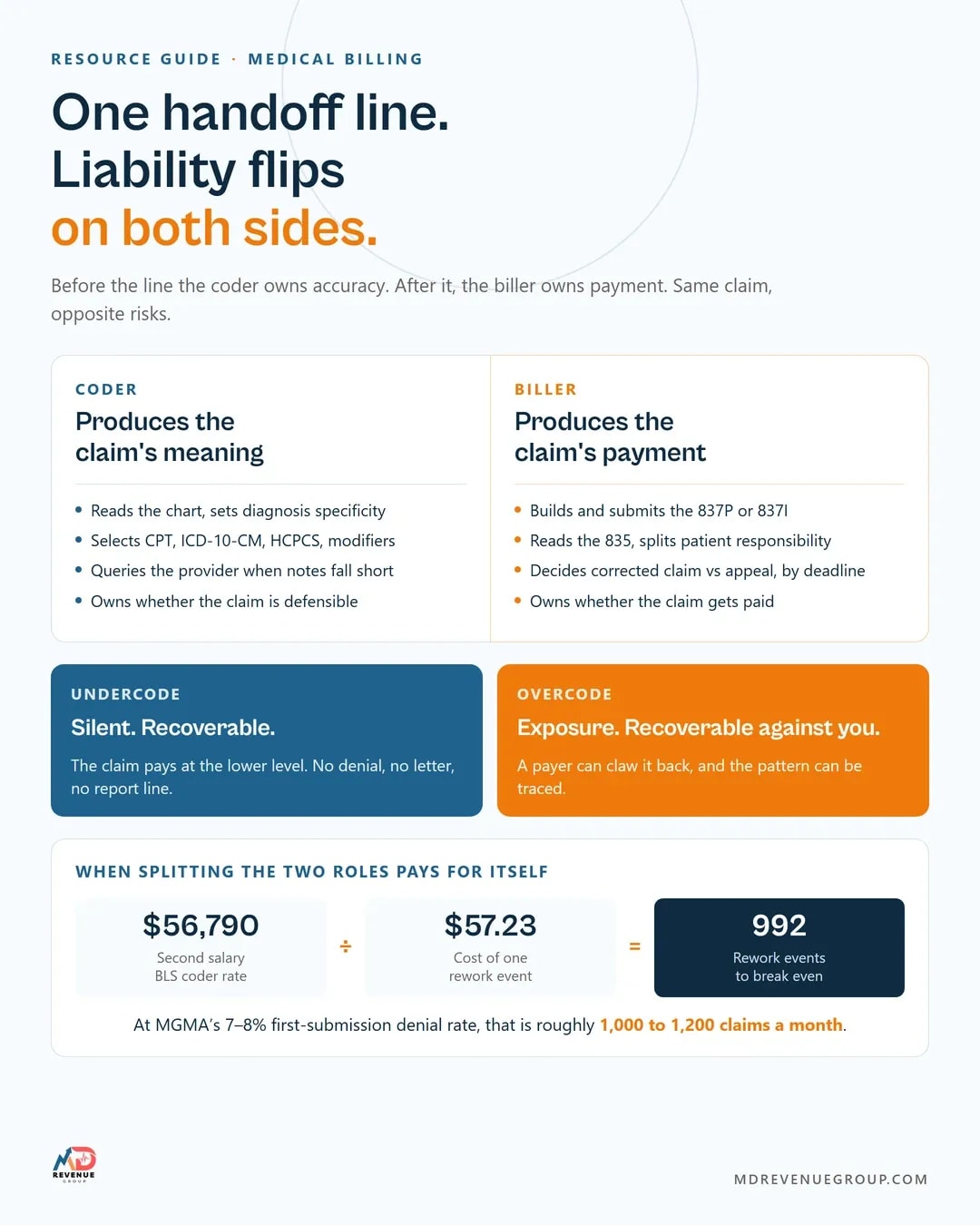
Medical billing vs medical coding is a question about one handoff line. Before it, the coder owns accuracy. After it, the biller owns getting paid. The work overlaps in the middle, and the liability flips direction at that line.
Most explanations of this topic are written for people choosing a career. This one is for the practice manager trying to decide who owns what, and what happens to the money when they get it wrong.
What each job actually produces
Coding produces the claim's meaning. A coder reads the clinical record and converts it into three standardized code sets: ICD-10-CM for diagnoses, CPT for procedures, and HCPCS Level II for supplies, drugs, equipment, and non-physician services. CPT is maintained by the AMA. ICD-10 is maintained through the international WHO classification process and released for US use by the CDC. HCPCS Level II is maintained by CMS.
Billing produces the claim's transmission and its payment. A biller takes those codes, attaches the patient and payer data, builds the 837P or 837I, gets it through scrubbing and submission, reads the 835 remittance, posts the payment, splits patient responsibility, and works the denials.
One produces the words. The other produces the money.
- ✓Reads the chart, decides the specificity of the diagnosis, selects the procedure code, applies modifiers, and sends a query back to the provider when documentation will not support a higher level. Owns whether the claim is defensible.
- ✓Owns the payer relationship after submission. Decides what to work, what to appeal, what to correct and resubmit, and when to write off. Owns whether the claim gets paid.
- ✗Fails quietly. An undercoded claim pays at the lower level and nobody sends a letter.
- ✗Fails loudly. A denial arrives with a code attached and a clock running.
That asymmetry is the most important thing to understand about the difference, and it is the reason the two jobs are hard to combine past a certain size.
What breaks when one person does both
Combining the roles fails in a predictable pattern, and it fails on the coding side first.
The biller is measured on collected revenue and days in AR. Those metrics reward speed and volume. Coding requires slowing down to read a note closely enough to decide whether the documentation supports a higher level, or to write a query back to the provider. The query in particular has no short-term payoff, and it delays the claim.
So the biller-coder skips the query, picks the safer lower code, moves on, and the metric looks good. Three months later the practice has an excellent denial rate and is quietly underbilling.
The second failure runs the other way. A coder who is measured on claims out the door learns that a held claim is a bad claim. Undocumented services get coded from memory of the encounter rather than from the note. That produces a denial, which at least shows up, and it produces compliance exposure, which does not.
Neither failure is a staffing shortage. Both are metric design. Our guide to charge entry errors covers what happens downstream when one of these compounds.
The handoff line, precisely
The handoff happens when codes stop being an interpretation of the record and start being a financial instrument.
Everything before the line is a clinical judgment. What level of service does this note support? Is the diagnosis specific enough to justify the procedure? Does a modifier apply? Get this wrong and you have billed something the documentation does not support.
Everything after the line is a financial process. Has the claim been accepted? What did the payer allow? Is this a corrected claim or an appeal? When does the filing window close? Get this wrong and you have a payment problem, which is a completely different problem with different rules and different deadlines.
A coder who does billing work is spending time on process. A biller who does coding work is making clinical judgments without the training or the documentation review to support them. Both errors are expensive and they are different errors.
Why undercoding and overcoding are not the same risk
This is where a lot of guidance gets vague. The two errors carry opposite consequences, and the one that feels safer is the more dangerous one over time.
Undercoding is recoverable. Bill 99213 when the documentation supports 99214 and the claim pays at the lower level. The payer paid, the claim closed, the balance cleared. No denial, no letter, no report. The revenue you did not capture shows up nowhere in your denial data because there was no denial.
Overcoding is exposure. Bill a higher level than the documentation supports and you have created a claim a payer can recover and a pattern an auditor can trace. Depending on intent and knowledge, that sits in False Claims Act territory. It also survives the claim: payers keep payment history, and recoupment is not limited to the original encounter.
Here is the number that settles it for most practices. If a coder bills conservatively on 5% of encounters and each one is undercoded by one level, a practice can lose a mid-four-figure amount per encounter, per year, with a denial rate of exactly zero.
Practices optimize what they measure. Denial rate is measured. Undercoding is invisible. So undercoding persists, and the practices that suffer most from it are usually the ones with the cleanest denial reports.
Our charge entry errors guide covers the sibling problem, where a charge never reaches the system at all and produces the same kind of silent loss.
What the denial codes tell you which side failed
When a claim comes back, the CARC usually names the stage that broke. The full submission guide covers the codes in detail. The short version for this question:
Code | What it points to | Whose problem |
|---|---|---|
CO-16 | Missing or invalid information | Coding or charge entry |
CO-97 | Procedure bundled into another line | Coding, modifier logic |
CO-22 | Coordination of benefits conflict | Billing, front-end data |
CO-29 | Filing window expired | Billing, process |
CO-50 | Not medically necessary per payer criteria | Coding and clinical documentation |
An Optum denial category breakdown puts missing or invalid claim data at 16% of denials. That bucket is mostly coding and charge entry. When it is large, adding billing staff will not help.
The economics: when splitting the two roles pays
Here is the calculation to run, with the assumptions stated so you can argue with them.
Assume one person currently does both roles. Billing clerks and medical billers fall near $51,070 a year in BLS Occupational Employment figures, as cited by Herzing University. Medical coders sit slightly higher at about $56,790. BLS projects 8% growth for the broader occupation group between 2025 and 2035.
Assume you split into two hires. One coder plus one biller is about $107,860 in base salary against roughly $51,070 for the combined role. The incremental cost of splitting is the second salary, roughly $56,790 a year before benefits, payroll tax, software seats, and workspace.
Price the rework that splitting is meant to prevent. Premier's survey of 280 hospitals across 23 states found the average cost of fighting a denied claim at $57.23 in 2023. MGMA reports first-submission denials at 7% to 8% across four years and says practices can push below 5% with targeted process fixes.
Run the crossover. $56,790 divided by $57.23 is about 992 rework events a year. That is roughly 83 a month.
Now convert to volume. At MGMA's 7% to 8% first-submission denial range, 83 rework events a month implies a practice submitting roughly 1,000 to 1,200 claims a month.
The finding: below about 1,000 claims a month, one person doing both is the cheaper structure. Above it, the second salary is repaid by avoided rework alone, and that is before you count the second-order effects of a coding error reaching a patient bill, a credentialing file, or an audit.
Two honest caveats. Loaded cost is higher than base salary for both roles, so the true crossover sits somewhat lower than 1,000 claims. And this prices rework only. It does not price undercoding, which produces no rework to measure, and undercoding gets worse, not better, as volume rises.
What each role needs to know
The coder needs the full documentation, the current code sets with their effective dates, the NCCI edit structure, the payer-specific modifier rules, and a working physician-query process. The query matters more than the software. A coder who cannot ask the provider a question has to guess, and guessing conservatively is what produces undercoding.
The biller needs the payer contracts and their fee schedules, the timely filing terms, the appeal deadlines, the remittance logic, and the clearinghouse edit rules. Also the clinical vocabulary, well enough to tell whether a coder's query makes sense.
NCCI edits run quarterly and change every cycle. Our Q3 2026 NCCI and modifier update covers the current one, and the CQ and CO modifier guide covers the modifier logic that drives CO-97 denials.
Certifications, briefly
Three credentials matter operationally. CPC from AAPC for coders. CCS from AHIMA, also coder-side. CRCC from HFMA, aimed at revenue cycle professionals working the payer side.
None of them is a legal requirement for billing. For coding, credential requirements are payer- and state-specific, and many payers publish their own standards. If you are checking compliance for a specific payer, that payer's credentialing manual wins over any general statement.
If you are choosing between careers
That is a different question from this one, so here is the short version. Coders read charts and work with clinical detail. Billers work payers and chase money. Billing is more outward-facing and more conversational. Coding is more analytical and works more independently.
BLS Occupational Employment figures put billers near $51,070 and coders near $56,790 on average. That gap is small enough that job fit should decide it.
Frequently asked questions
Coding translates clinical documentation into ICD-10, CPT, and HCPCS codes. Billing uses those codes to build and submit the claim, read the remittance, post payment, and work denials. Coding decides what the claim says. Billing decides whether it gets paid.
It depends on the denial code. CO-16 and CO-97 usually trace to coding or charge entry. CO-22 and CO-29 trace to billing and front-end process. CO-50 points at the clinical documentation behind the code. The CARC names the stage that failed.
Yes, and most small practices run it that way. The crossover in our calculation sits near 1,000 claims a month, above which the second salary is repaid by avoided rework at $57.23 per denial.
Undercoding alone is not an offense. Billing below the documented level wastes revenue silently and no payer sends a letter about it. Overcoding is the direction that creates recovery exposure and False Claims Act risk.
Enough to tell whether a coder's query makes sense and whether a code set is plausible. They do not need to select codes. The risk sits in a biller quietly second-guessing a coder's selection and downgrading it without a query.
CPC from AAPC or CCS from AHIMA are the two credentials employers and payers most often recognize. Many payers publish their own credentialing standards, and those requirements override general guidance.
BLS Occupational Employment figures put billing clerks near $51,070 and medical records technicians, which includes coders, near $56,790. The gap is narrow. Job fit, not pay, should decide between them.
The procedure was bundled into another line on the same claim date. It is usually a modifier issue or an NCCI edit the coder did not account for, which makes it primarily a coding-stage failure.
Where to go next
For the code sets themselves, medical coding resources cover ICD-10, CPT, HCPCS, and modifier rules. What is medical billing covers the terminology this article assumes. For where coding sits in the full chain, read the 10 medical billing process steps.
How our medical billing service splits these roles depends on your volume. Behavioral health practices carry a different coding and authorization profile worth reading separately. For anything payer or state specific, start with New Jersey or the full states directory.
Request a free revenue audit and we will tell you which side of the handoff your revenue is actually leaking from.