
Psychiatry Billing Services and Credentialing: A Directory and CAQH Control System
Optimize psychiatry billing services with a provider credentialing control system for CAQH, payer directories, and enrollment tracking.
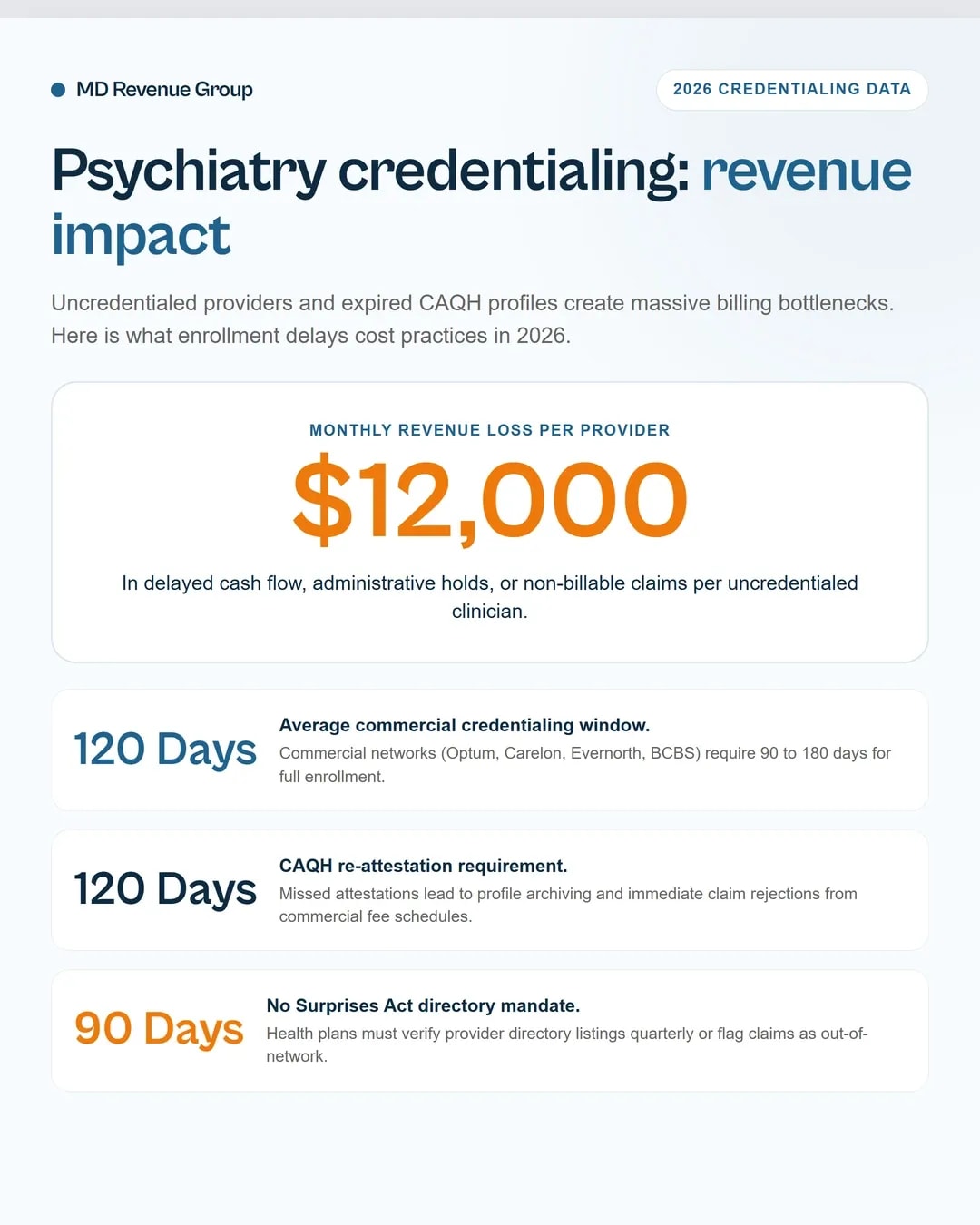
High-performing psychiatry billing services depend on rigorous provider credentialing and automated directory controls across commercial payers. Commercial payer enrollment for psychiatric practices takes between 90 and 180 days, with an industry median of 120 days across major networks like Optum, Carelon, Evernorth, and Blue Cross Blue Shield. When a newly hired psychiatrist or licensed therapist sits uncredentialed, practices experience 12,000 per month in delayed revenue, administrative holds, or out-of-network claim rejections.
Maintaining clean payer enrollment requires strict adherence to CAQH ProView 120-day re-attestation windows and 90-day directory audit mandates under the No Surprises Act. This guide breaks down the payer enrollment lifecycle, highlights common credentialing bottlenecks, and provides a structured control system for managing taxonomy codes, CAQH profiles, group reassignments, and multi-state roster changes.
Key takeaways
- Commercial behavioral health credentialing averages 90 to 180 days, while Medicare PECOS enrollment averages 60 to 90 days.
- Uncredentialed psychiatric providers cost group practices 12,000 per month in delayed cash flow and non-billable claims.
- CAQH ProView profiles require mandatory re-attestation every 120 days to prevent profile archiving and automatic roster purges by commercial payers.
- The No Surprises Act mandates 90-day provider directory verifications; failure to confirm directory details leads to immediate out-of-network claim processing.
- NCQA standards require continuous monthly monitoring of state license boards, OIG exclusion databases, and SAM.gov registries.
Why provider credentialing dictates psychiatric billing performance
Psychiatric practices often treat credentialing as an occasional onboarding chore. In reality, credentialing serves as the primary valve controlling clean claim flow.
Commercial behavioral health networks enforce strict provider specialty criteria. A claim submitted for psychiatric diagnostic evaluation (CPT 90791) or psychotherapy with E/M (CPT 90833 + 99214) will fail if the rendering NPI lacks an active roster linkage to the group contract.
When credentialing stalls, practices make critical billing errors:
- Billing under a supervising psychiatrist's NPI for services rendered by an uncredentialed associate without meeting incident-to criteria.
- Holding claims past timely filing windows while waiting for payer effective dates.
- Submitting claims as out-of-network, triggering unexpected balance bills for patients.
Practices expanding their provider network can speed up payer enrollment by partnering with dedicated credentialing services to track primary source verification before clinical start dates.
Credentialing Impact on Claim Processing:
┌───────────────────────────┐      ┌───────────────────────────┐
│ Active Payer Enrollment   │ ───► │ 98% Clean Claim Rate      │
│ Verified Effective Date   │      │ Paid at Contracted Rate   │
└───────────────────────────┘      └───────────────────────────┘
              ▲
              │ (Credentialing Breakdown)
              ▼
┌───────────────────────────┐      ┌───────────────────────────┐
│ Expired CAQH Profile      │ ───► │ Claim Denial (CO-16/27)   │
│ Unverified Directory Data │      │ Written Off as Bad Debt   │
└───────────────────────────┘      └───────────────────────────┘
Commercial vs. government payer enrollment timelines
Payer enrollment schedules vary by plan type, regional contractor, and specialty scope. Understanding these windows prevents cash flow gaps when onboarding new clinical staff.
Medicare enrollment via PECOS averages 60 to 90 days. CMS contractors review Form CMS-855I for individual practitioners and Form CMS-855B for group practices. Electronic submissions processed through PECOS move 30 days faster than paper applications.
Medicaid enrollment timelines range from 45 to 180 days depending on state agency backlog and managed care organization (MCO) contracting structures.
Commercial behavioral health networks, including Optum, Carelon, Evernorth, Magellan, and regional BCBS plans, average 90 to 180 days. Commercial payers require primary source verification of medical licenses, DEA registrations, board certifications, malpractice coverage history, and hospital privileges.
Payer Network Category | Application Portal | Average Processing Time | Primary Bottleneck |
|---|---|---|---|
Medicare Part B | PECOS | 60 - 90 Days | Form 855B group reassignment signatures |
Medicaid MCOs | State Portal | 45 - 180 Days | State license verification & MCO panel capacity |
Optum / Carelon / Evernorth | CAQH ProView | 90 - 150 Days | Missing 120-day CAQH re-attestation |
Commercial BCBS Plans | Payer Portal | 90 - 180 Days | Outdated directory roster effective dates |
Psychiatric practices managing complex subspecialties can review our overview of medical billing specialties to align provider taxonomy codes with specific payer contract schedules.
Managing CAQH ProView 120-day re-attestation cycles
CAQH ProView is the central database commercial health plans use to pull provider credentials. More than 1.4 million healthcare providers maintain profiles in the CAQH system.
Commercial payers execute automated queries against CAQH every quarter. If a provider fails to complete their 120-day re-attestation, CAQH places the profile in expired status. Payers instantly archive expired profiles and drop the provider from active fee schedules.
Three common CAQH profile errors disrupt claim processing:
- Document Expiration: Attesting to a profile when a medical license, malpractice face sheet, or DEA certificate has expired within the portal.
- Taxonomy Mismatch: Listing a general physician taxonomy rather than specialized psychiatry (2084P0800X) or child psychiatry (2084P0804X) codes.
- Practice Location Discrepancies: Omitting new clinic locations or telehealth home-office addresses from the primary practice location section.
Practices operating across the tri-state area under medical billing New York frameworks must update CAQH locations whenever providers render telehealth across state lines.
CAQH 120-Day Lifecycle Control Loop:
[Day 1: Profile Attested] ──► [Day 90: System Warning Sent] ──► [Day 105: Audit Verification]
                                                                        │
                                                                        ▼
[Day 120: RE-ATTESTATION COMPLETED] ◄── [Update License/Dea/Insurance] ◄┘
No Surprises Act 90-day provider directory compliance
The No Surprises Act introduced strict requirements for health plan provider directory accuracy. Payers must verify provider directory details every 90 days.
If a provider does not confirm their directory information when contacted by a health plan, the insurer must flag the provider as unverified and hide their profile from online directories.
If an unverified provider renders care to a patient who relied on an inaccurate health plan directory listing, the plan must process the claim at the in-network benefit level. The payer then initiates audit inquiries against the medical group to determine why directory updates were withheld.
Group practices operating in high-volume markets like our medical billing Florida partner sites must maintain centralized directory rosters to respond to commercial payer verification checks within 30 days.
Practices should cross-reference our guide on provider directory audit CAQH NPPES to establish monthly data audits across federal and commercial databases.
State-by-state licensing and multi-state telepsychiatry rules
Telepsychiatry expansion requires navigating state-specific medical board licensing rules and payer panel requirements. While multi-state practice expands patient reach, it multiplies credentialing complexity.
For instance, psychiatrists providing virtual care to patients in Texas must hold an active Texas medical license and maintain an active Controlled Substances Registration (CSR) if prescribing Schedule II-V medications. Practices navigating these requirements under medical billing Texas rules must submit separate commercial panel applications for each rendering location.
Similarly, California medical board standards require telepsychiatrists to maintain California medical licenses and complete state-mandated cultural competency coursework. Billing teams must verify that commercial payers have linked the provider's California rendering location to the group's Type 2 NPI before submitting cross-state claims.
Failing to complete state-specific payer enrollment prior to launching virtual care services leads to immediate out-of-network claim rejections and potential state board compliance reviews.
Multi-State Telepsychiatry Enrollment Steps:
┌────────────────────────────────────────────────────────────────────────┐
│ 1. Obtain State Medical License & Local DEA / CSR Registration        │
│ 2. Add New State Practice Location to NPPES (Type 1 NPI)              │
│ 3. Update CAQH ProView Profile with State License & Address           │
│ 4. Submit Group Reassignment & Panel Application to State Payers       │
│ 5. Confirm Written Payer Effective Date BEFORE First Patient Visit     │
└────────────────────────────────────────────────────────────────────────┘
Building a provider data control matrix for group practices
To eliminate credentialing bottlenecks, psychiatric group practices must replace spreadsheet tracking with a structured provider data control system.
A comprehensive control matrix tracks six core data elements for every clinician:
- National Provider Identifier (NPI Type 1 and Type 2)
- Taxonomy codes and state license renewal dates
- CAQH login credentials and 120-day attestation due dates
- PECOS enrollment status and group reassignment effective dates
- Commercial payer contract effective dates and provider ID numbers
- Malpractice policy renewal dates and coverage limits
Provider Data Control Matrix Structure:
┌──────────────────┬──────────────────┬──────────────────┬──────────────────┐
│ Provider Name    │ License Exp Date │ CAQH Due Date    │ Medicare Status  │
├──────────────────┼──────────────────┼──────────────────┼──────────────────┤
│ Dr. A. Smith     │ 2027-06-30       │ 2026-10-15       │ Active PECOS     │
│ Dr. R. Patel     │ 2026-11-30       │ 2026-09-30       │ Pending 855R     │
│ M. Davis, LCSW   │ 2027-03-31       │ 2026-11-01       │ Commercial Only  │
└──────────────────┴──────────────────┴──────────────────┴──────────────────┘
Integrating this matrix with your billing team ensures claims for newly credentialed providers are released on their exact contract effective date, avoiding premature submissions that trigger out-of-network denials.
Reviewing your practice's mental health workflows alongside our complete mental health billing guide helps align clinical documentation with payer-specific authorization guidelines.
Real-world case study: Recovering $144,000 in uncredentialed holds
A 14-provider behavioral health group in the Northeast hired two adult psychiatrists and three licensed clinical social workers to meet growing patient demand.
The practice allowed the new clinicians to begin seeing patients immediately. However, administrative staff submitted commercial claims before receiving formal payer approval letters.
Over 5 months, the group accumulated significant billing issues:
- $144,000 in claims were denied under code CO-27 (expenses incurred after coverage terminated or before coverage effective).
- CAQH profiles for two existing psychiatrists expired due to missed 120-day attestations, causing an Optum fee schedule drop.
- 62 claims were rejected because NPI taxonomy codes did not match the credentialed specialty on file.
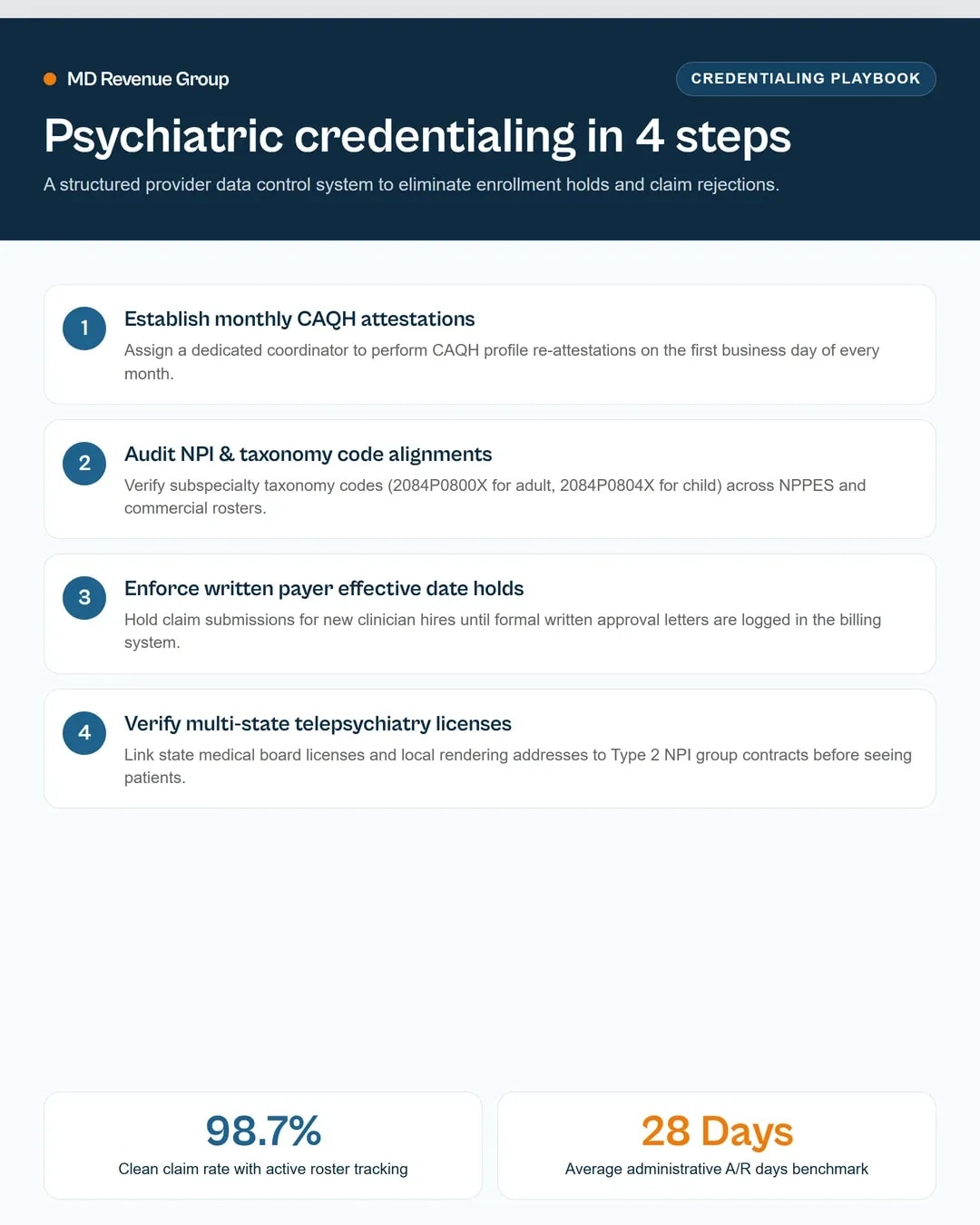
The practice overhauled its enrollment operations by deploying a 4-step control protocol:
- Instituted a hard policy prohibiting non-emergency patient scheduling until written payer effective dates were logged in the billing system.
- Assigned a dedicated coordinator to perform CAQH attestations on the first business day of every month.
- Updated NPPES and CAQH profiles with correct subspecialty taxonomy codes.
- Resubmitted $144,000 in held claims following retroactive enrollment approvals.
Within 120 days, the practice recovered $128,000 of the denied claims. Their clean claim rate for psychiatric services stabilized at 98.7%, and administrative A/R days dropped from 64 to 28 days.
Action checklist for practice managers and billers
Establishing a structured credentialing control system prevents uncollectible claims and keeps provider directory records fully compliant.
Use this operational checklist to protect your practice:
If credentialing delays or payer enrollment backlogs are slowing your practice's cash flow, request a free audit from MD Revenue Group today.