
Medical Billing and Collection for Virtual Check-Ins and E-Visits: Lessons from the 2026 OIG Audit
Master medical billing and collection for virtual check-ins and e-visits using findings from the 2026 HHS-OIG audit report.
Proper medical billing and collection for virtual check-ins and e-visits requires strict compliance with time-based rules and 7-day bundling limits. In April 2026, the U.S. Department of Health and Human Services Office of Inspector General (HHS-OIG) released audit report Project A-05-23-00001, uncovering $2.26 million in improper Medicare payments for communication technology-based services. The audit revealed that 94% of improper virtual check-in payments stemmed from billing services within 7 days after or 24 hours prior to a related evaluation and management (E/M) visit.
Medical practices frequently trigger automated claim edits or audit clawbacks by applying modifier -25 incorrectly to bypass payer safeguards. To protect revenue, practices must enforce 7-day cumulative time tracking for online digital E/M services (CPT 99421–99423) and hard-stop 24-hour booking rules for brief virtual check-ins (HCPCS G2012). This guide breaks down the OIG audit findings, coding boundaries, and front-end workflow edits needed to maintain clean claim submissions.
Key takeaways
- The HHS-OIG April 2026 audit (Project A-05-23-00001) reviewed 2.26 million in non-compliant virtual check-in and e-visit payments.
- Virtual check-ins (HCPCS G2012) cannot be billed if they originate from an E/M visit provided within the previous 7 days or lead to an E/M visit within 24 hours.
- E-visits (CPT 99421–99423) require cumulative time tracking over a 7-day period; billing multiple single-day portal interactions for the same episode violates CMS rules.
- Misusing modifier -25 on E/M claims to override automated virtual check-in edits is a primary focus for OIG recoupments and Medicare Administrative Contractor (MAC) audits.
- Automated pre-submission claim scrubbers and EHR scheduling locks prevent 98% of preventable virtual care denials.
What the April 2026 OIG audit revealed about virtual care claims
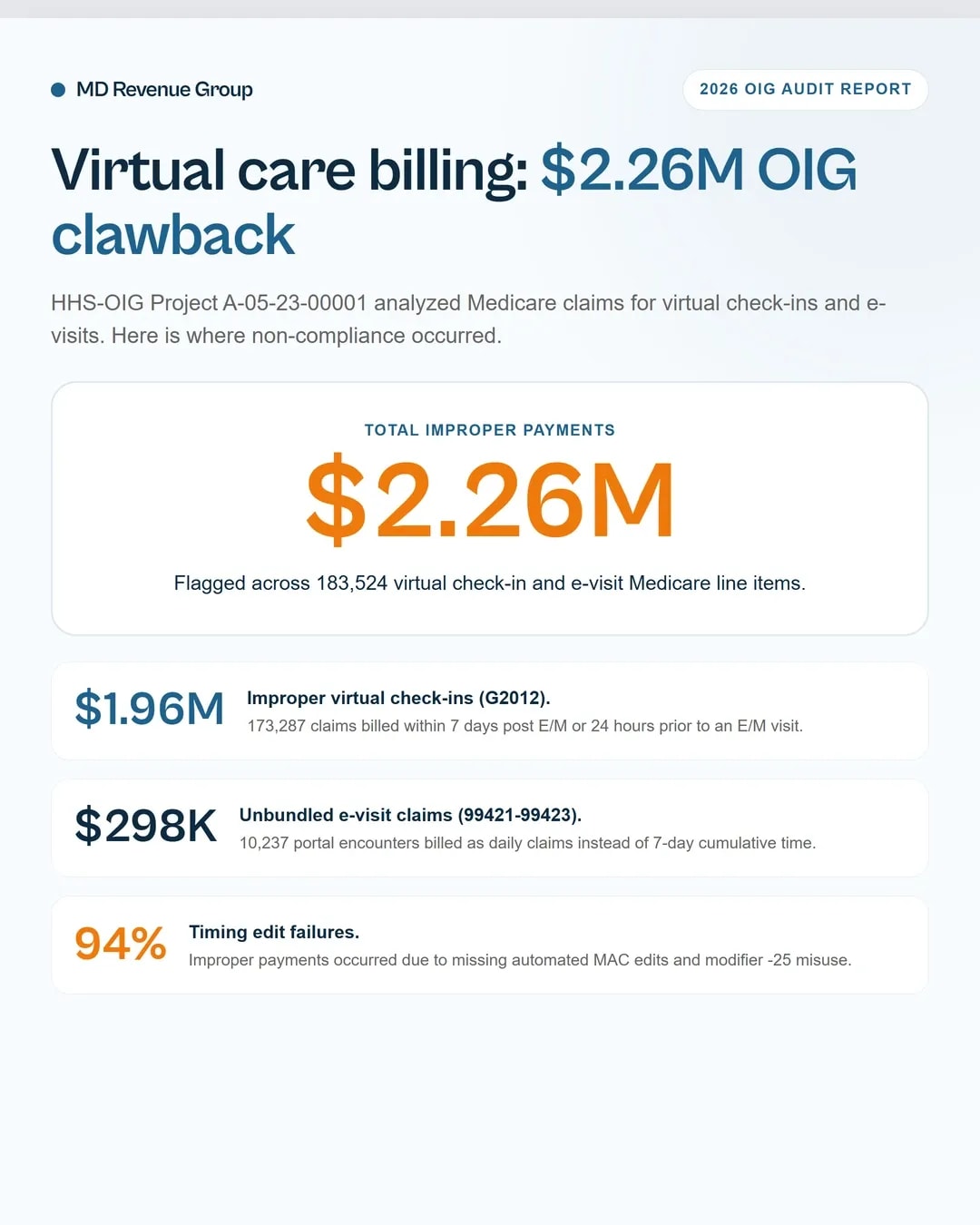
The HHS-OIG audit report Project A-05-23-00001 examined Medicare Part B claims for communication technology-based services submitted between 2019 and 2022. Investigators audited 2.26 million in non-compliant claims across 183,524 line items.
The audit split the improper payments into two distinct categories:
- Virtual Check-Ins (HCPCS G2012 and G2010): OIG flagged $1.96 million across 173,287 services. Providers submitted these brief communications for patients who had an E/M visit for the same diagnosis within the previous 7 days or who were scheduled for an E/M visit within the next 24 hours.
- E-Visits (CPT 99421–99423): OIG identified $298,200 in improper payments across 10,237 claims. Physicians billed portal exchanges as separate daily encounters rather than accumulating the total time over 7 days.
OIG concluded that Medicare Administrative Contractors (MACs) lacked automated system edits to block non-compliant code combinations. As a result, CMS instructed MACs to establish post-payment recovery audits and implement pre-payment logic edits.
Practices managing complex specialty claims must review their full revenue cycle management architecture to ensure pre-bill scrubbers catch these timing overlaps before claims reach the clearinghouse.
Audit Category | Reviewed Volume | Improper Payment Total | Flagged Claim Units | Primary Non-Compliance Reason |
|---|---|---|---|---|
Virtual Check-Ins (G2012/G2010) | $21.4M | $1.96M | 173,287 | E/M visit within 7 days prior or 24 hours post |
E-Visits (CPT 99421-99423) | $2.8M | $298,200 | 10,237 | Daily unbundled billing vs. 7-day cumulative time |
Total Audit Scope | $24.2M | $2.26M | 183,524 | Lack of MAC automated system edits |
Virtual check-ins vs. e-visits: CPT and HCPCS coding rules
Virtual check-ins and e-visits are non-face-to-face services, but their billing mechanics, time windows, and communication channels differ completely.
HCPCS G2012 covers a 5 to 10 minute brief check-in via audio telephone or synchronous video. The provider uses this service to evaluate whether an in-person or full telehealth visit is clinically necessary. HCPCS G2010 applies to remote evaluations of recorded video or images sent by an established patient.
E-visits use CPT codes 99421, 99422, and 99423. These codes represent online digital evaluation and management conducted through an EHR patient portal or secure messaging system.
- CPT 99421: Online digital E/M service for an established patient, cumulative time 5 to 10 minutes over 7 days.
- CPT 99422: Online digital E/M service for an established patient, cumulative time 11 to 20 minutes over 7 days.
- CPT 99423: Online digital E/M service for an established patient, cumulative time 21 or more minutes over 7 days.
Both service types require an established patient relationship and documented verbal or written patient consent obtained annually.
Practices conducting routine billing reviews through a medical billing audit often discover that clinical staff record portal messages under generic advice notes without capturing exact cumulative time.
The 7-day and 24-hour time boundaries explained
The timing restrictions governing G2012 and 99421–99423 are absolute under CMS billing guidelines.
For HCPCS G2012, two time rules apply:
- The 7-Day Look-Back Rule: If the virtual check-in relates to an E/M service provided by the same physician or group practice within the previous 7 days, the check-in is bundled into the previous E/M visit. It cannot be billed separately.
- The 24-Hour Look-Ahead Rule: If the check-in results in an E/M visit within 24 hours (or the next available appointment), the check-in is bundled into the resulting E/M visit as pre-encounter work.
For CPT 99421–99423, the 7-day window begins on the day the provider conducts the initial review of the patient's digital inquiry. All portal exchanges, record reviews, physician discussions, and response drafting over the next 7 calendar days pool into a single code selection based on total time.
Billing CPT 99421 on Tuesday and CPT 99421 again on Thursday for the same patient portal thread violates CPT instructions. Only one code from the 99421–99423 series may be billed per 7-day period.
Groups operating in high-volume regions like our medical billing New Jersey partner practices frequently update EHR billing templates to prevent providers from generating multiple claim lines during an open 7-day portal thread.
Why modifier -25 triggers OIG audit clawbacks
Modifier -25 indicates a significant, separately identifiable evaluation and management service by the same physician on the same day of a procedure or other service.
During the 2019 to 2022 audit period, the OIG discovered that billing departments routinely appended modifier -25 to E/M claims when a virtual check-in occurred within the 7-day window. Billing staff applied the modifier to bypass clearinghouse edits designed to block duplicate payments.
OIG noted that appending modifier -25 without distinct clinical documentation showing a completely unrelated clinical condition constitutes improper billing. When a patient calls with worsening symptoms 4 days after an office visit for hypertension, a 6-minute phone call regarding those same symptoms is bundled into the initial visit charge.
Overusing modifier -25 to bypass billing edits accounts for millions in payer clawbacks nationwide. Practices that review historical audits through our analysis of 2026 OIG work plan medical billing audits recognize that modifier misuse remains a top indicator for CMS RAC audits.
Multi-state medical groups operating under medical billing California regulations face additional state-level audits when commercial plans align their claim scrubbers with federal OIG guidelines.
Building front-end claim edits for virtual care workflows
Preventing virtual care denials requires automated claim scrubbers rather than manual biller reviews. Modern practice management systems can enforce three mandatory front-end edits.
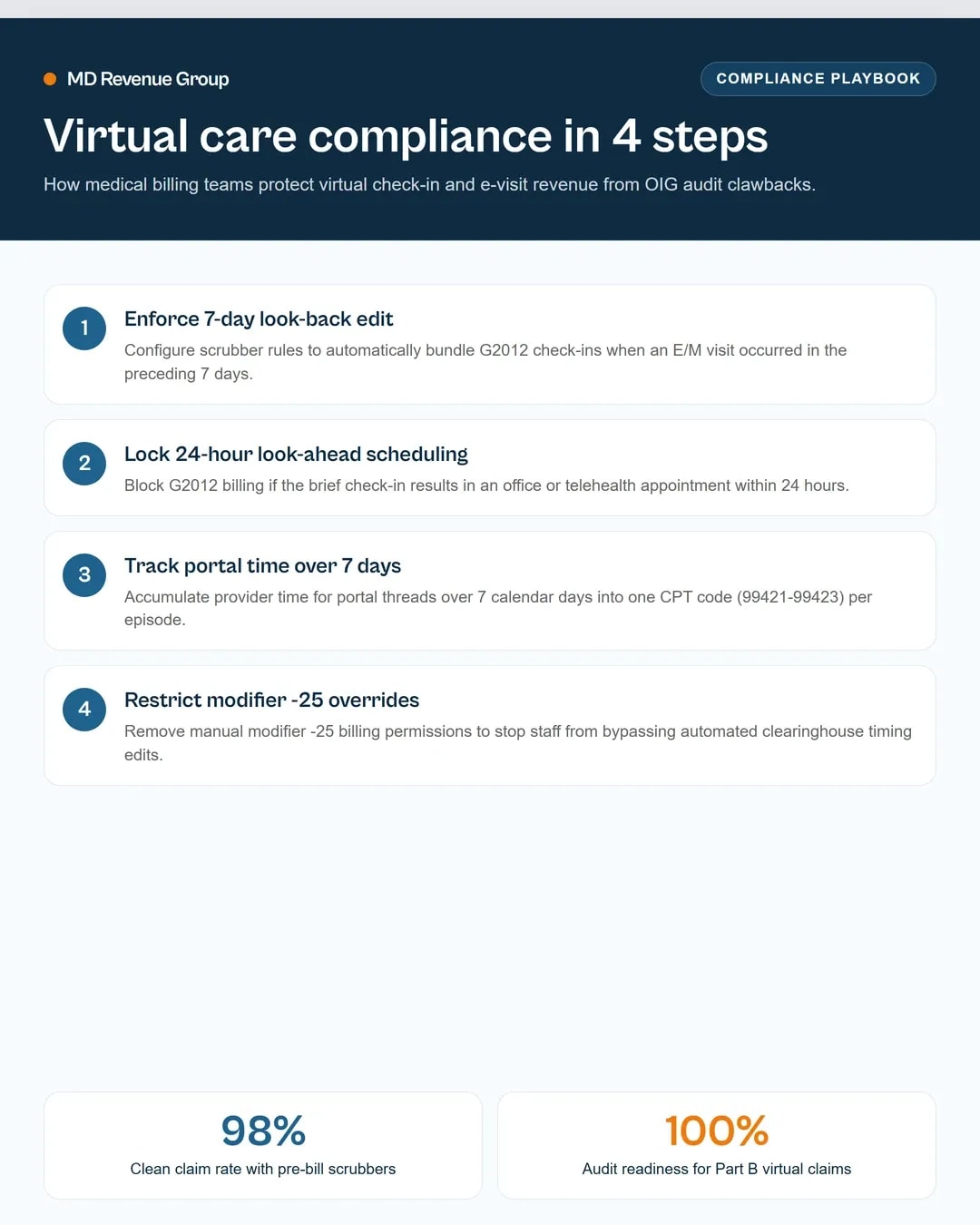
First, configure your scheduling software to cross-reference encounter dates. If a G2012 charge is entered for a patient who had a 99213 or 99214 encounter within the past 7 days under the same provider taxonomy, the software must flag the charge for manual review.
Second, build a 7-day accumulator for digital portal encounters. When a clinical provider opens a portal message, the EHR should track cumulative minutes. The system must prevent charge generation until the 7-day clock expires, then automatically output the single appropriate CPT code (99421, 99422, or 99423).
Third, enforce documented patient consent verification. CMS requires that patient consent for communication technology-based services be obtained and documented in the medical record prior to billing.
Front-End Claim Scrubber Workflow:
[Provider Enters Charge: G2012]
              │
              ▼
[Scrubber Checks Patient History] ──(E/M in past 7 days?)──► YES ──► [Hard Stop: Bundle Charge]
              │
             NO
              ▼
[Scrubber Checks Appointment Book] ──(E/M in next 24 hrs?)──► YES ──► [Hard Stop: Bundle Charge]
              │
             NO
              ▼
[Consent Verified in EHR?] ──► NO ──► [Hold for Billing Staff Action]
              │
             YES
              ▼
[Clean Claim Released to Clearinghouse]
Implementing systematic claim rules aligns directly with our guide on how to reduce claim denials, cutting administrative rework while protecting clinical cash flow.
Real-world case study: Resolving a 180-day virtual care denial pattern
A 12-physician internal medicine group in the Mid-Atlantic experienced a spike in Medicare denial code CO-236 (procedure code not compatible with another procedure code on same day or within post-op period).
An audit of 450 virtual care claims submitted over 6 months revealed:
- 112 claims for G2012 were billed within 3 days of a routine chronic care follow-up visit for the same condition.
- 68 claims for CPT 99421 were billed as daily individual charges during 5-day portal medication adjustment episodes.
- Billing staff had manually appended modifier -25 to 44 denied claims to force clearinghouse transmission.
The practice faced $18,400 in potential Medicare audit recoupments. The billing team implemented three corrective controls:
- Installed a 7-day look-back edit in their practice management software, automatically holding G2012 charges matching prior E/M dates.
- Trained clinical staff to use an EHR time tracker for portal messages, auto-populating one 99422 code at the end of a 7-day medication adjustment thread.
- Removed manual modifier -25 overrides from the billing team's permissions.
Within 90 days, the practice's clean claim rate for virtual care services rose from 62% to 99.4%. Total monthly virtual care revenue increased by 31% because legitimate, fully documented e-visits were billed accurately under correct cumulative time codes.
Summary and action checklist for billing teams
The 2026 OIG audit demonstrates that federal regulators actively scrutinize virtual care billing patterns. Practices must audit their virtual check-in and e-visit workflows to ensure compliance.
Use this checklist to evaluate your billing operations:
If your practice needs a comprehensive review of claim edits and billing compliance, request a free audit from MD Revenue Group today.