
Mental Health Billing Services: The Complete 2026 Guide
Mental health billing services explained: CPT codes, denial rates, payer rules, and when to outsource. Built for therapists and psychiatrists in 2026.
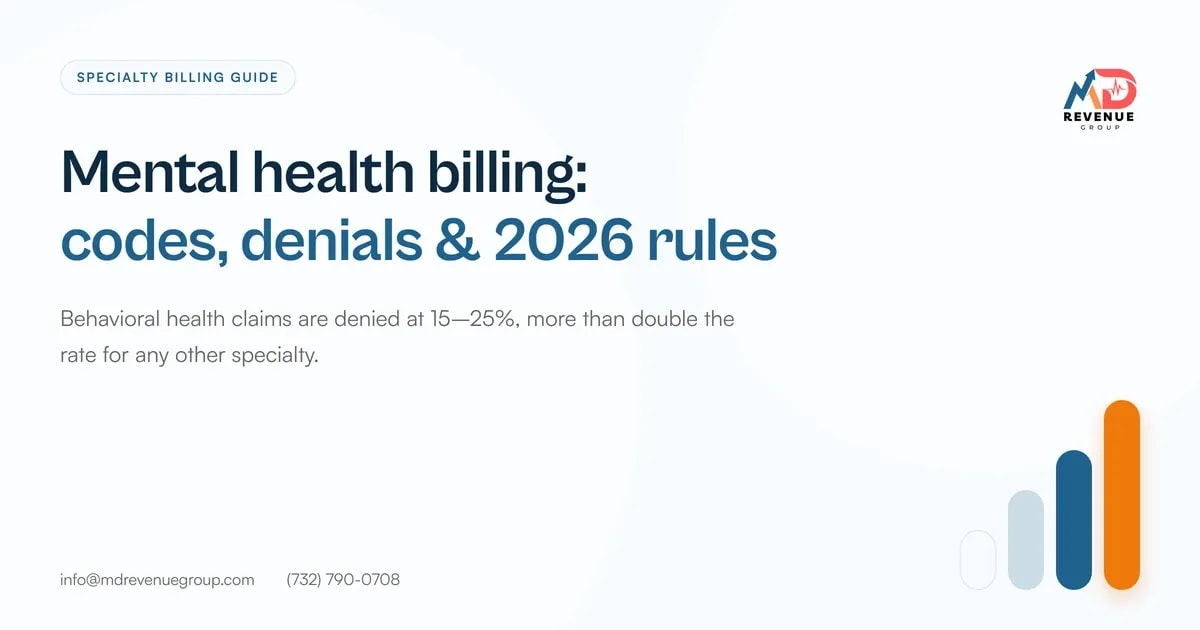
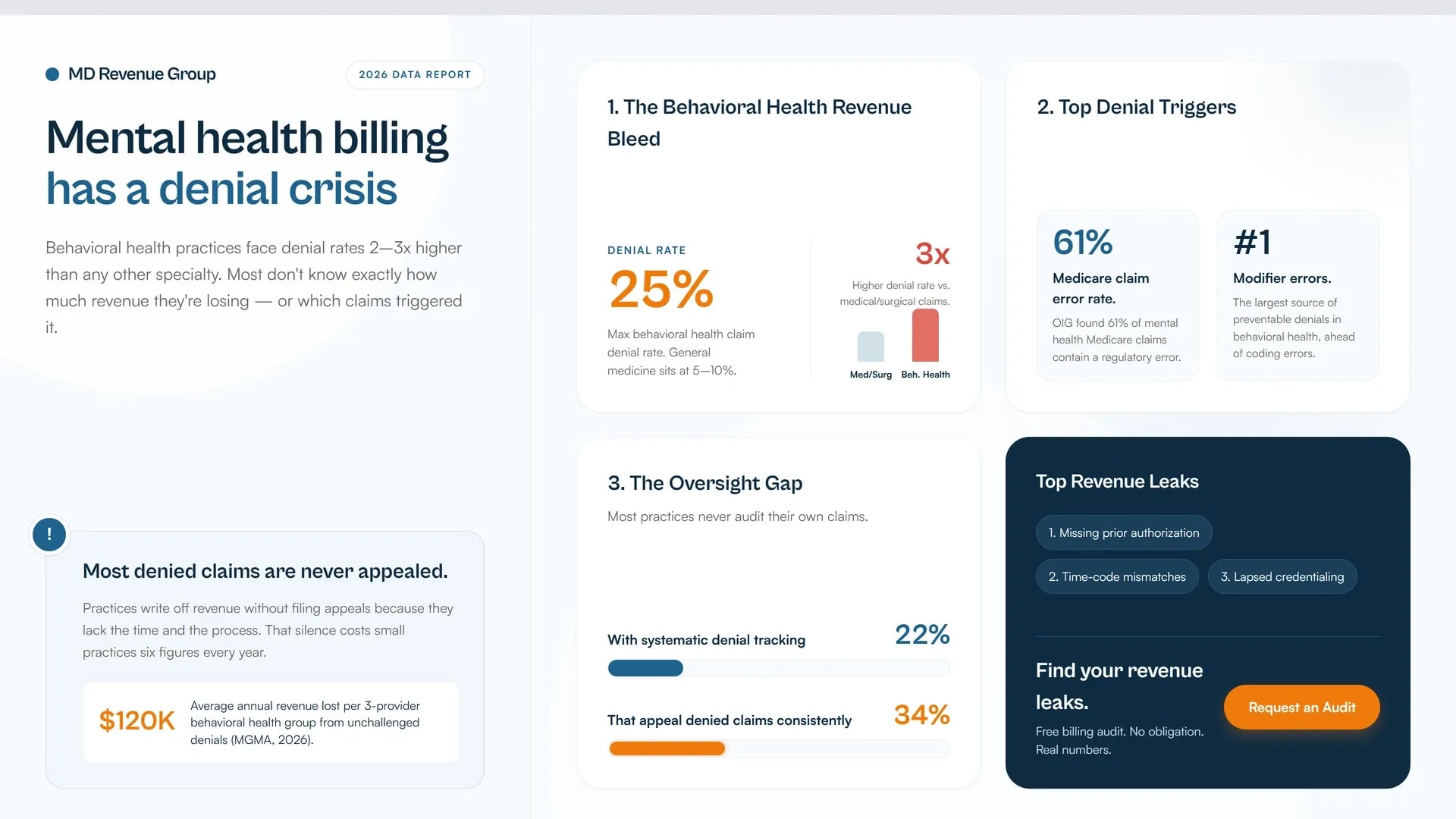
Behavioral health claims get denied at 15–25%. General medical practices sit at 5–10% (MGMA, 2026). That gap doesn't exist because mental health billing is harder to understand. It exists because the rules are specific, payers enforce them strictly, and most practices never build a real system around them.
For a 3-therapist group, a 20% denial rate translates to $85,000–$120,000 in lost revenue every year. The OIG has found that roughly 61% of mental health Medicare claims contain a regulatory error. Most of those errors come from the same 5 or 6 mistakes, repeated across every billing cycle, never caught because nobody audited the claims.
This guide covers what your practice actually needs in 2026: the right CPT codes, the modifier rules payers care about most, the denial patterns to stop before they start, and how to decide whether to keep billing in-house or hand it off.
Key takeaways
- Behavioral health denial rates run 15–25%, more than double the rate for general medical practices (MGMA, 2026).
- The OIG found approximately 61% of mental health Medicare claims contain a regulatory error, mostly from coding and documentation mistakes.
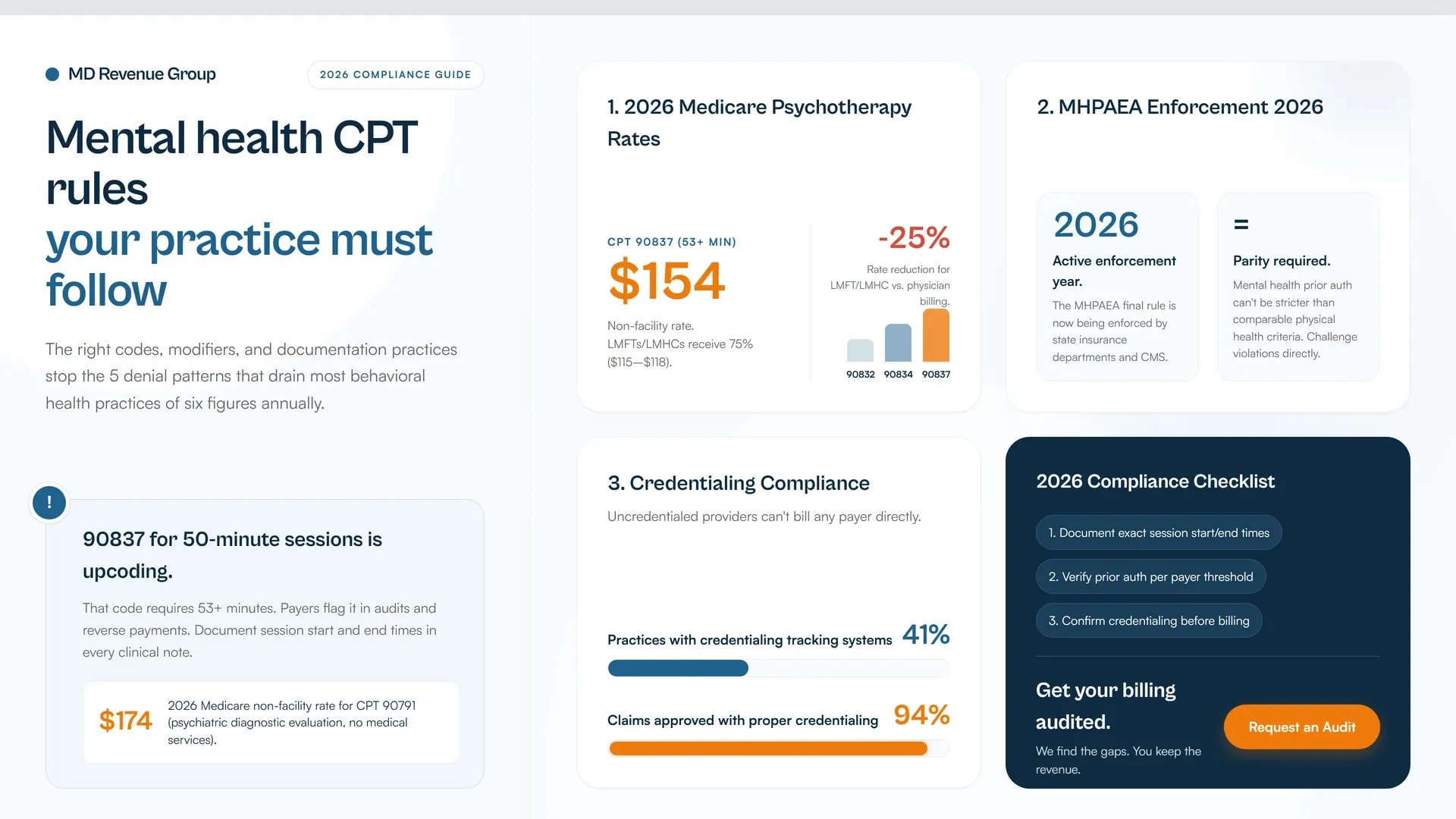
- Billing 90837 for a standard 50-minute session is upcoding. That code requires 53 minutes or more. Payers flag it.
- The MHPAEA final rule is being actively enforced in 2026. Insurers can no longer apply stricter prior authorization criteria to mental health than to comparable physical health services.
- LMFTs and LMHCs bill Medicare at 75% of the Physician Fee Schedule, not the full physician rate. Know this before you set revenue targets.
What mental health billing actually involves
Mental health billing covers professional services from psychiatrists, psychologists, licensed clinical social workers (LCSWs), licensed professional counselors (LPCs), and licensed marriage and family therapists (LMFTs). Each credential level carries different billing rules, different reimbursement rates, and different payer credentialing requirements. A solo psychologist and a psychiatry group practice are not filing the same type of claims, even when they see the same diagnosis.
The core challenge is that mental health services are time-based. You're not billing a procedure with a clear start and end. You're billing documented time in a clinical encounter, and every minute matters. A therapist who sees a patient for 50 minutes and bills the wrong code loses money or triggers a payer audit.
Payers audit mental health claims more aggressively than almost any other specialty. The OIG's data shows 61% of Medicare mental health claims have a regulatory error. Most of those errors aren't fraud. They're documentation gaps, code selection mistakes, and modifier omissions that repeat across every billing cycle because nobody ever built a system to catch them.
The CPT codes every mental health practice must know
Diagnostic evaluation codes
CPT 90791 is a psychiatric diagnostic evaluation without medical services. Non-prescribing providers, including LCSWs, LPCs, LMFTs, and psychologists, use this code for comprehensive intake assessments. The 2026 Medicare non-facility rate is $174.
CPT 90792 includes medical services: medication review, prescribing, physical exam elements. Only psychiatrists and psychiatric nurse practitioners (PMHNPs) bill this code. If an LCSW bills 90792, that's a credentialing violation, and the claim will be denied.
One rule you can't miss: 90791 and 90792 cannot be billed on the same date as individual psychotherapy codes for the same patient. Bill the diagnostic evaluation on intake day only. Start psychotherapy billing on the next visit.
Individual psychotherapy codes
These 3 codes cover the vast majority of outpatient mental health billing:
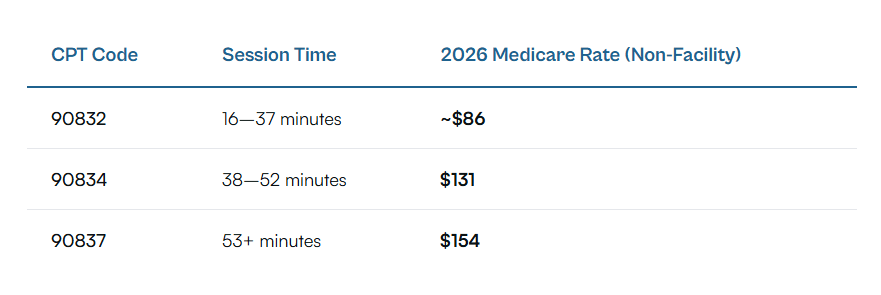
You must hit the lower threshold of each range to bill that code. A 50-minute session is CPT 90834, not 90837. Billing 90837 for sessions that run 48 to 52 minutes is upcoding. Payers flag it in audits, and the correction comes with repayment demands and sometimes extrapolation to past claims.
Document session start and end time in every note, not approximate session length. "Session ran approximately 50 minutes" gives a payer room to question your code selection. "Session 2:00–2:52 PM" doesn't.
Add-on codes for psychiatrists
CPT 90833, 90836, and 90838 are add-on codes for psychotherapy provided during the same visit as an evaluation and management (E/M) service. These apply only when a physician or PMHNP documents both a medical management component and a psychotherapy component in the same encounter. The add-on code supplements the E/M, it doesn't replace it.
CPT 90853 covers group psychotherapy with 2 or more patients. You bill 90853 separately for each participating patient. If you run a group of 8, that's 8 individual claims for the same session time.
Credential-based rate differences
LMFTs and LMHCs bill Medicare at 75% of the Physician Fee Schedule. For CPT 90837, that's approximately $115–$118 rather than the full $154 physician rate. This isn't negotiable and it doesn't change with experience or years in practice.
If your practice relies primarily on LMFT or LMHC providers and you've been projecting revenue at physician rates, your financial model is wrong. Recalculate before your next budget cycle.
Modifiers and same-day billing rules
Modifier errors are the largest source of preventable denials in behavioral health. That finding shows up consistently across claim audit data from major clearinghouses. It's not a close second.
Telehealth: Modifier 95 vs. GT
For telehealth services, Medicare uses Modifier 95 for real-time audio-visual encounters. Some commercial payers still require the older GT modifier. These are not interchangeable. Submitting 95 to a payer that requires GT gets your claim rejected, and the fix requires a corrected claim, not just a resubmission.
Before billing any telehealth session, confirm which modifier the specific payer requires for behavioral health services. Medicare Advantage plans often run their own modifier requirements, separate from traditional Medicare.
Modifier 59 for same-day services
When 2 services are billed on the same date, payers often bundle them and pay only one. Modifier 59 tells the payer these are separate, distinct, and medically necessary services. The most common mental health application: a psychiatrist who provides both a medication management E/M and a psychotherapy add-on in the same visit.
CMS prefers the X modifier family (XE, XS, XP, XU) over Modifier 59 for Medicare claims. Many commercial payers don't recognize the X modifiers. Know which system each payer uses before you submit.
Top denial reasons and how to prevent them
1. Time-based code mismatches
A therapist documents a 45-minute session and bills 90837 (which requires 53+ minutes). The payer downcodes to 90834 or denies outright. This is the most common and most avoidable denial in outpatient mental health.
Fix: audit a random sample of claims monthly. Compare documented session times against the CPT codes billed. Two hours of auditing per month catches this pattern before it becomes a payer takedown.
2. Missing or lapsed prior authorization
Several major commercial payers, including Aetna and UnitedHealthcare, require prior authorization for ongoing psychotherapy after a threshold number of sessions, typically 8 to 12. Practices get the initial authorization, see the patient for 15 sessions, and then find out sessions 9 through 15 were never authorized. Those claims come back denied.
Build a tracking system that shows, for each payer and each active patient, how many authorized sessions remain and when re-authorization is due. A spreadsheet works. The key is ownership: someone on your team must own the renewal process, not just the intake authorization.
3. Diagnosis not supporting medical necessity
Using Z63.0 (Relationship distress with spouse or intimate partner) as the primary ICD-10 code for ongoing individual therapy triggers PR-49 denials from most payers. That diagnosis doesn't establish medical necessity for sustained psychotherapy.
Your primary diagnosis must reflect a clinical condition that requires treatment. F32.1 (Major depressive disorder, single episode, moderate), F41.1 (Generalized anxiety disorder), and F43.10 (Post-traumatic stress disorder, unspecified) are workhorses for most outpatient practices. If your clinical notes don't clearly document the treating diagnosis, your billing won't hold up on review.
Not sure what is draining your practice?
Our free 90 days claim audit finds what is
Get my free audit →4. Credentialing gaps for new providers
A therapist who isn't credentialed with a specific payer can't bill that payer directly. Claims submitted under an uncredentialed provider come back denied, often weeks after the service date. Practices that add a new clinician without verifying credentialing approval first end up with a stack of unbillable sessions and a credentialing application still in process.
Confirm credentialing approval before any new provider sees insurance patients. "Application submitted" is not the same as credentialed. "Provisionally paneled" may or may not translate to billable claims depending on the payer. Get it in writing.
Real example: A 4-provider behavioral health group in Texas added a new LCSW in March 2025. The credentialing application with one major commercial payer was pending. The practice assumed provisional status covered billing. It didn't. 11 weeks of sessions across 34 patients came back denied when the credentialing was finally processed under a different NPI than expected. Total write-off: $41,000. The fix required resubmission under a corrected billing structure, and several patients had already hit their plan deductibles, making collection even harder.
5. 42 CFR Part 2 documentation errors
Practices treating substance use disorders face confidentiality rules under 42 CFR Part 2 that are stricter than standard HIPAA. In 2026, enforcement has tightened alongside MHPAEA implementation. A claim or a records request that reveals protected substance use disorder information without proper patient consent is a compliance violation, not just a billing error.
If your practice treats comorbid mental health and substance use, you need a clear protocol for separating and protecting Part 2 records. This affects what you can include in prior authorization requests and what you share with payers during claims review. See how our team handles behavioral health billing compliance for practices across these exact scenarios.
Payer rules to know before you submit a single claim
The MHPAEA final rule is being enforced now
The Mental Health Parity and Addiction Equity Act final rule took full effect and is being actively enforced by state insurance departments in 2026. Commercial insurers must now prove their prior authorization and coverage criteria for mental health aren't more restrictive than comparable physical health services.
What this means for your practice: if a payer is denying mental health claims on medical necessity grounds while approving comparable physical health services with less documentation, that's potentially a parity violation. Document your appeals citing MHPAEA when applicable. Several state insurance departments have added parity complaint hotlines specifically for this.
Medicare telehealth for behavioral health
CMS extended telehealth flexibilities for behavioral health through 2026 under the Consolidated Appropriations Act. Audio-only telehealth remains covered for established patients with a documented clinical rationale for why video isn't appropriate. This matters for rural practices and patients with limited technology access.
The 2026 CMS conversion factor is $33.57 for qualifying participants. Telehealth rates follow the same fee schedule as in-person services for most behavioral health codes.
Medicaid variation by state
Medicaid mental health billing rules aren't uniform. Reimbursement rates, covered CPT codes, prior authorization thresholds, and even covered service types vary by state. A billing protocol that works for Texas Medicaid will have gaps when applied to Illinois Medicaid or California's Medi-Cal.
If your practice sees significant Medicaid volume, you need payer-specific rules for each state plan, not a single mental health billing protocol applied across the board. Our revenue cycle management team builds payer-specific denial prevention workflows for behavioral health practices.
When to outsource mental health billing
The math for most practices
A solo therapist or small group practice rarely has the bandwidth to stay current on payer rule changes, manage prior authorizations, track denials, and file appeals while running a full clinical caseload. The administrative weight compounds with each new payer you credential with.
If your practice is seeing denial rates above 10%, writing off claims without appealing, or missing prior auth renewals, those aren't administrative inefficiencies. They're revenue leaks with a specific dollar value attached.
A billing service typically charges 5–8% of collected revenue for mental health practices. Against an 18% denial rate with no appeals process, that fee pays for itself. What matters is your current denial rate and whether you're actually filing appeals, because most practices aren't doing either.
What to ask any prospective billing service
The mental health billing market has a lot of general medical billing companies that don't understand behavioral health's specific rules. Before you sign a contract, ask:
- Do you have credentialing experience with behavioral health-specific payers like Magellan, Beacon, and Optum Behavioral Health?
- How do you handle 42 CFR Part 2 documentation requirements for substance use disorder claims?
- What's your average denial rate across your behavioral health clients?
- Do you file appeals on denied claims, or do you resubmit and move on?
The difference between a billing company that resubmits denials and one that actually appeals them is usually 3–5% of total collections. At any real practice volume, that's a material number. For more on evaluating billing costs against in-house options, see our pricing page or request a call to walk through your specific payer mix.
What to keep in-house regardless
Even with an outsourced billing service, your practice should own 3 things: prior authorization tracking (because no billing company has real-time visibility into your patient schedule), clinical documentation quality (because clean notes are where good billing starts), and payer contracting decisions (because billing companies don't always optimize for your specific payer mix and specialty needs).
Get your mental health billing audited
If your practice has never gone through an independent billing audit, start there. An audit will show you your actual denial rate by payer and code, how much you're writing off without appealing, and whether your documentation supports the CPT codes you're billing.
Most behavioral health practices that go through a billing audit find $30,000–$60,000 in recoverable revenue in the first 90 days. That's not a projection. It's a consistent pattern across practices that have never had a systematic denial management process.
Request a free RCM audit. We'll show you exactly where your revenue is going. Talk to our team at mdrevenuegroup.com