
Credentialing as a Revenue Strategy: Why 'Physician Enrollment' Is the New RCM Bottleneck
Solve the physician credentialing revenue bottleneck. Learn turnaround benchmarks, cost-of-delay calculations, and preventive enrollment models.
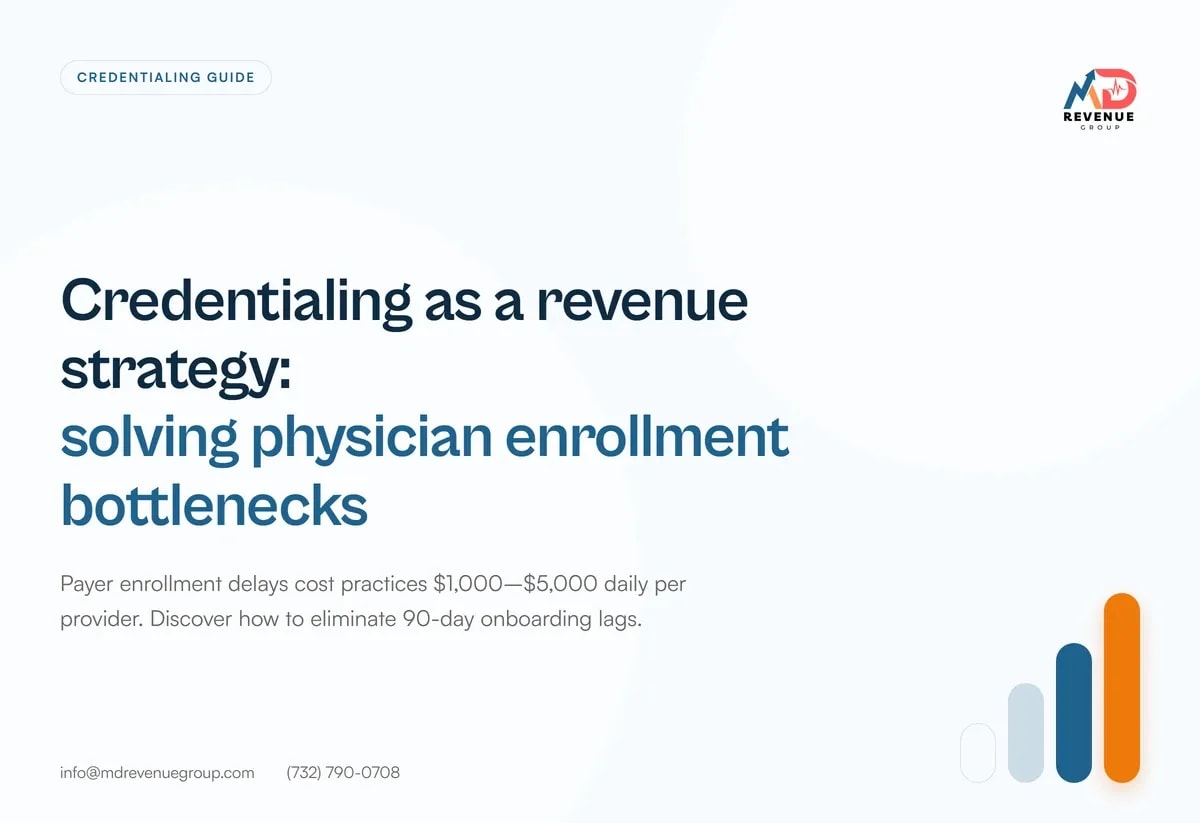
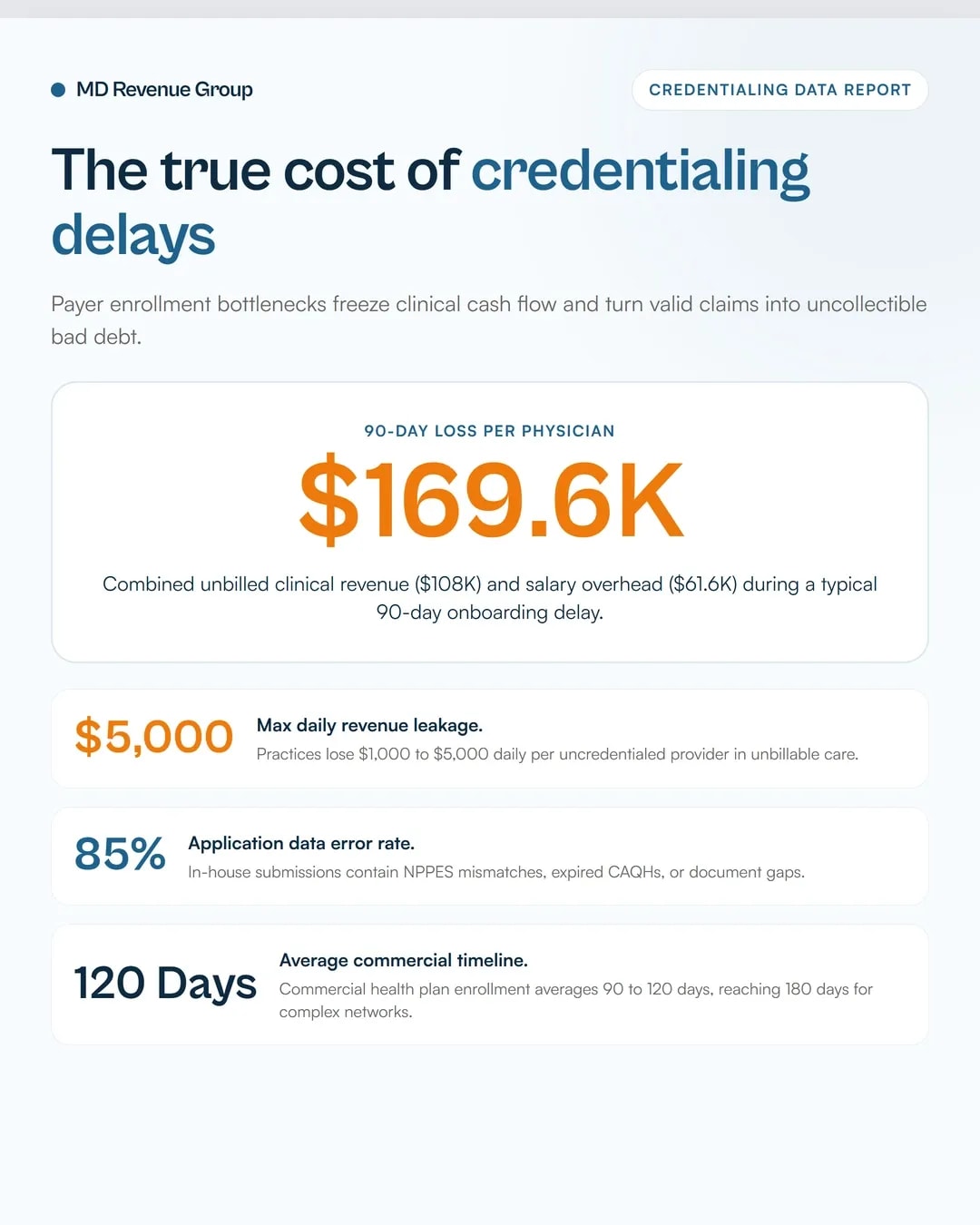
Provider credentialing shifted from a back-office administrative task to a primary financial bottleneck for healthcare practices in 2026. Commercial payer enrollment timelines now average 90 to 120 days, during which newly hired physicians cannot bill in-network. This delay causes practices to lose between 5,000 per provider per day in uncollectible patient revenue. Across a standard 120-day onboarding window, a full-time specialist represents over $122,000 in lost income while carrying full base salary and overhead costs.
Medical groups relying on manual in-house credentialing face severe processing friction. According to industry surveys, 85% of credentialing applications submitted to commercial health plans contain data errors, missing attestations, or NPPES registry mismatches that trigger extended manual review queues. Practice administrators who treat enrollment as an active revenue protection strategy resolve payer bottlenecks faster, preventing clean claims from being rejected for non-credentialed provider status.
Key Takeaways
- Daily Financial Exposure: Credentialing delays cost practices 5,000 per provider per day in unbillable clinical revenue.
- Turnaround Realities: Commercial payer enrollment takes 90 to 120 days on average, stretching to 180 days for high-complexity health plan networks.
- Application Error Rate: 85% of in-house credentialing applications contain missing data, expired CAQH attestations, or malformed NPI records.
- Primary Delay Point: Primary Source Verification (PSV) and health plan committee reviews represent the longest non-clinical wait times in provider onboarding.
- Continuous Oversight: Transitioning from reactive application filings to 30-day continuous license and exclusion monitoring protects ongoing claim flows.
The Financial Mechanics of the Credentialing Bottleneck
Healthcare revenue cycles depend on verified provider eligibility before billing claims. When a practice hires a new physician, physician assistant, or nurse practitioner, clinical encounters generated before final payer enrollment approval cannot be billed in-network.
Submitting claims under a credentialed colleague's NPI during enrollment transitions violates federal compliance rules and commercial payer contracts. This leaves practices with two unacceptable choices: hold claims until enrollment completes or bill out-of-network, triggering high patient co-insurance and balance billing disputes.
Practices seeking to eliminate enrollment friction rely on specialized physician credentialing and provider enrollment services to track health plan applications through every verification stage.
Onboarding Phase | Traditional In-House Timeline | Optimized Workflow Timeline | Financial Risk Exposure |
|---|---|---|---|
Primary Source Verification (PSV) | 30–45 Days | 10–14 Days | High (Unbilled Encounters) |
CAQH Attestation & Data Sync | 14–21 Days | 2–3 Days | Moderate (Application Rejection) |
Payer Credentialing Committee | 30–60 Days | 15–30 Days | Severe (Claim Holding Window) |
Network Contracting & Fee Schedule | 15–30 Days | 7–10 Days | Moderate (Out-of-Network Rates) |
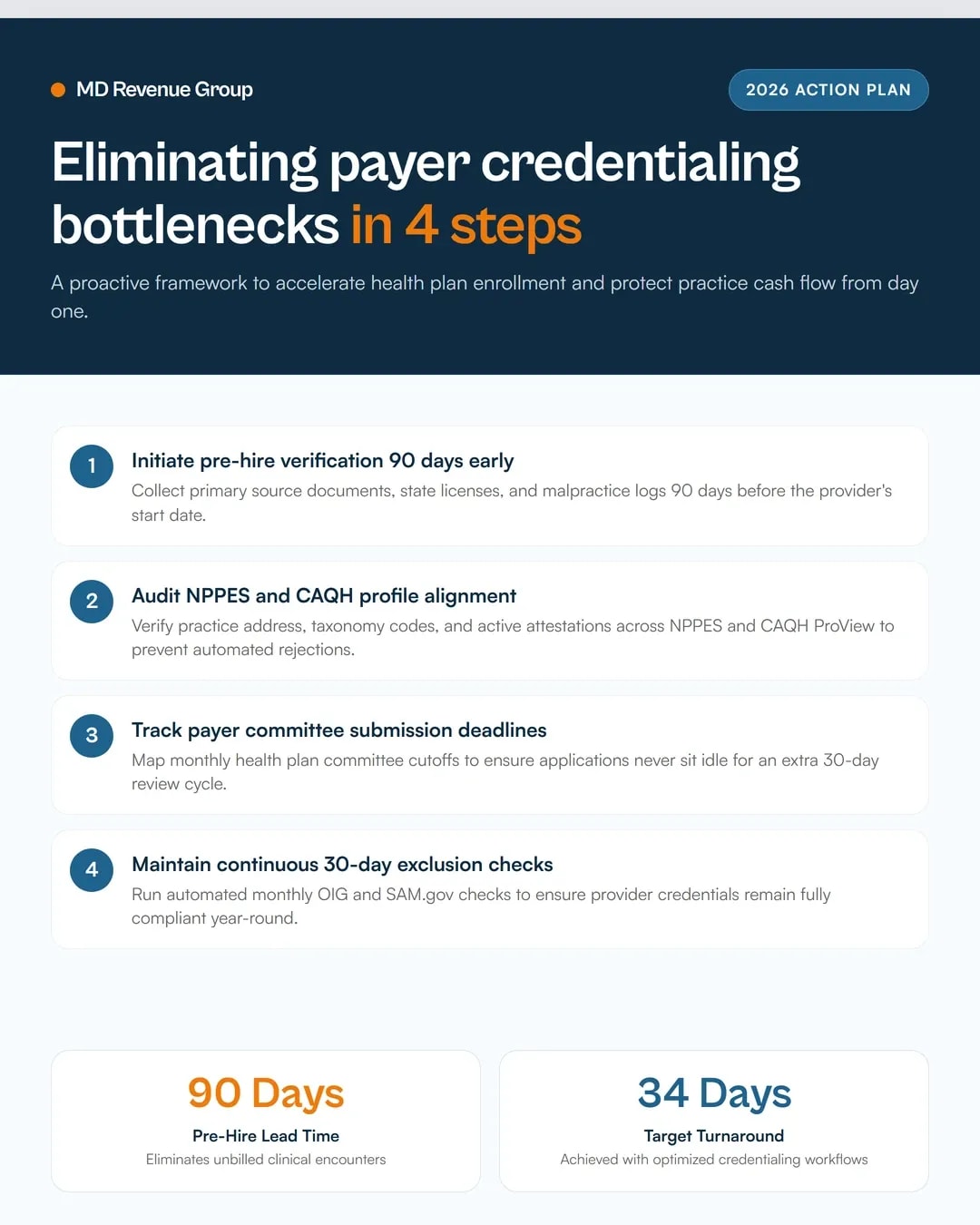
Total Turnaround Time | 89–156 Days | 34–57 Days | 180,000 / Provider |
Medical practices expanding clinical capacity must align provider start dates with payer enrollment lead times. Delaying credentialing preparation until a provider's first day guarantees months of unbillable clinical overhead.
Industry Benchmarks: Payer-by-Payer Enrollment Timelines
Payer processing speeds vary by coverage type, regional contract complexity, and verification standards. Medical Group Management Association (MGMA) benchmarks indicate that commercial insurance carriers maintain the longest enrollment queues.
Understanding specific payer turnaround targets allows billing managers to set accurate financial projections:
- Medicare (PECOS): Averages 60 to 90 days following electronic submission. Applications requiring manual signature re-verification can extend past 100 days.
- Commercial Payers (Aetna, BCBS, Cigna, UnitedHealthcare): Require 90 to 150 days. Complex specialty networks or Medicare Advantage panels frequently reach 180 days.
- Medicaid State Programs: Vary between 45 and 90 days, depending on state administrative portals and background check processing speeds.
To understand detailed timing benchmarks across individual insurance carriers, review our comprehensive breakdown on how long provider credentialing takes for a complete analysis.
Payer delays directly increase Accounts Receivable (A/R) days. Claims held past 90 days face heightened timely filing rejection risks, turning valid clinical work into uncollectible bad debt.
Provider Type Variations: MDs, APPs, and Locum Tenens
Enrollment protocols differ substantially depending on the provider's clinical license level and employment relationship with the practice.
- Physicians (MD / DO): Require full primary source verification, including residency verification, hospital privilege confirmation, and medical board sanction history. Commercial payers require individual credentialing before issuing network billing effective dates.
- Advanced Practice Providers (PA / NP): Advanced practice providers face variable supervision rules. In states requiring collaborative practice agreements, payers will not process NP or PA enrollment until the supervising physician's credentialing is active.
- Locum Tenens Physicians: Practices utilizing temporary locum tenens coverage can bill under Medicare's Q6 modifier rules for up to 60 continuous days, provided the regular physician is unavailable due to illness, vacation, or CME leave.
MD / DO Enrollment: Full PSV + Board Verification (90–120 Days)
↓
PA / NP Enrollment: Requires Active Supervising MD Linkage (60–90 Days)
↓
Locum Tenens: Q6 Modifier Billing (Valid up to 60 Days max)
Failing to properly link a nurse practitioner to a credentialed supervising physician causes immediate claim rejections across both commercial and Medicaid managed care lines.
The $169,650 Cost of Inaction: Worked Financial Model
To evaluate the true financial impact of an enrollment bottleneck, practices must calculate both unbilled clinical revenue and provider carrying overhead during the onboarding window.
Consider a full-time specialist (such as an orthopedic surgeon or cardiologist) generating 250,000 ($685 per day in direct payroll overhead).
Unbilled Daily Clinical Revenue: $1,200 / day
Daily Physician Salary Overhead: $685 / day
---------------------------------------------
Total Daily Financial Exposure: $1,885 / day
If credentialing stalls for 90 days, the practice incurs a total financial loss:
90 Days × 108,000 Gross Revenue Exposure
90 Days × 61,650 Unearned Salary Overhead
-------------------------------------------------------------------
Total 90-Day Credentialing Loss = $169,650 per Physician
Financial Category | Daily Impact | 60-Day Delay | 90-Day Delay | 120-Day Delay |
|---|---|---|---|---|
Gross Unbilled Collections | $1,200.00 | $72,000.00 | $108,000.00 | $144,000.00 |
Physician Salary Carrying Cost | $685.00 | $41,100.00 | $61,650.00 | $82,200.00 |
Combined Practice Loss | $1,885.00 | $113,100.00 | $169,650.00 | $226,200.00 |
This calculation demonstrates why credentialing is a revenue generation variable. Shortening turnaround times by 30 days preserves over $56,000 in net cash flow per provider.
Practices facing revenue collection bottlenecks should schedule a complimentary practice revenue audit to evaluate their overall billing health and identify hidden cash leakage.
Primary Sources of Application Friction and Data Errors
The primary cause of credentialing delays is incomplete or mismatched application data. Health plan credentialing software automatically rejects submissions containing minor formatting discrepancies.
Industry audit reports reveal that 85% of in-house submissions contain at least one of five common data errors:
- NPPES Registry Mismatches: Differences between the provider's practice address in the National Plan and Provider Enumeration System (NPPES) and the address listed on commercial payer forms.
- Expired CAQH Attestations: Allowing Council for Affordable Quality Healthcare (CAQH) ProView profiles to lapse past the mandatory 120-day re-attestation window.
- Malpractice History Gaps: Missing explanations for past claims, policy transfers, or carrier changes within the last 10 years.
- Unverifiable Medical Education Credentials: Failure to attach primary source transcripts or foreign medical graduate certification documents.
- Hospital Privileges Gaps: Incomplete documentation of active admitting privileges or cross-coverage agreements.
Application Submission
↓
Data Discrepancy Flagged (NPPES / CAQH / License mismatch)
↓
Manual Review Queue (+30 to +45 Days Delay)
↓
Payer Rejection Notice
To audit your internal directory data before submitting payer applications, download our provider directory audit checklist to maintain compliant provider profiles.
Medicare PECOS 855I vs 855R Submission Protocols
Enrolling physicians in Medicare requires navigating the Provider Enrollment, Chain, and Ownership System (PECOS). Practices must understand the distinction between individual enrollment and reassignment of benefits.
- CMS-855I (Individual Enrollment): Establishes the provider's individual Medicare billing record and verifies National Provider Identifier (NPI) details, medical licensure, and specialty taxonomy.
- CMS-855R (Reassignment of Benefits): Reassigns the provider's right to bill Medicare to the group practice's Tax Identification Number (TIN) and Organizational NPI (Type 2).
CMS-855I: Individual Provider Profile (Type 1 NPI)
↓
CMS-855R: Reassigns Billing Rights to Practice (Type 2 NPI / TIN)
↓
Active Medicare Billing Effective Date
Submitting an 855R reassignment before the provider's 855I individual profile is fully active in PECOS results in immediate application rejection by your regional Medicare Administrative Contractor (MAC).
Committee Review Waits: The Hidden 30-Day Delay
Even after Primary Source Verification is complete, applications must pass formal health plan credentialing committee reviews. Most commercial insurance plans convene credentialing committees only once or twice per month.
If an application misses a committee submission deadline by a single day, processing automatically pauses until the following monthly cycle. Industry survey data shows that 30% of medical practices wait over 8 days, and 17% wait over 30 days, just for committee scheduling.
Application Submission → Primary Source Verification (30 Days)
↓
Missed Committee Cutoff
↓
+30 Days Wait for Next Board
↓
Final Network Approval Issued
Managing committee schedules requires active tracking of payer submission cutoffs. Establishing automated tracking alerts prevents applications from sitting idle between committee review windows.
Practices seeking to coordinate enrollment workflows with broader billing operations can integrate their tracking within end-to-end revenue cycle management frameworks to prevent administrative gaps.
State-Specific Credentialing Regulations and Regional Rules
State insurance mandates govern payer turnaround times and temporary billing privileges. While federal programs follow PECOS guidelines, state insurance commissions set statutory limits on how long commercial plans can hold applications.
Regional medical groups must tailor their enrollment workflows to state-specific regulations:
- New Jersey: The NJ Health Care Professional Credentials Application Act mandates standard application forms across all state-regulated health plans. Practices operating locally should consult our New Jersey provider credentialing guidelines to fast-track local plan enrollments.
- Florida: Florida statutes mandate that commercial insurers approve or deny credentialing applications within 60 days of receiving a complete submission. Medical groups can review Florida medical billing and credentialing for state-specific compliance steps.
- Texas: Texas Senate Bill 809 establishes standardized credentialing timelines and mandates temporary billing privileges for physicians joining existing medical groups. Practices in the state can consult Texas physician revenue cycle management to navigate state insurance board rules.
Medical administrators expanding practices across state borders can review state regulations to ensure enrollment filings comply with regional insurance board mandates.
Building a Preventive Credentialing Workflow
Transitioning from reactive enrollment filings to a preventive credentialing system requires three operational changes:
- Pre-Hire Data Collection: Initiate primary source verification and CAQH data entry 90 days prior to a physician's official start date.
- Continuous Sanction Monitoring: Implement automated 30-day checks against OIG Exclusion databases, SAM.gov, and state licensing boards to prevent sudden status lapses.
- Dedicated Payer Escalation: Assign dedicated enrollment specialists to follow up weekly with health plan contracting officers, resolving missing document requests within 24 hours.
Pre-Hire Onboarding (-90 Days)
↓
Continuous CAQH & License Sync (-60 Days)
↓
Weekly Payer Escalation (-30 Days)
↓
Day 1 In-Network Billing Active
Practices that treat credentialing as a core revenue strategy eliminate processing delays, protect provider cash flow, and ensure every clinical encounter is billed in-network from day one.
Eliminate Your Credentialing Bottlenecks Today
Don't let health plan enrollment delays freeze your practice cash flow. MD Revenue Group manages primary source verification, CAQH attestations, and payer follow-up to get your providers credentialed faster.