
Medicare Reimbursement for MFTs, MHCs, and Psychologists: How to Compare the Billing Workflow
Compare Medicare Part B reimbursement rates, CPT codes, and billing workflows for MFTs, MHCs, and clinical psychologists under 2026 CMS rules.
Medicare Reimbursement for MFTs, MHCs, and Psychologists: How to Compare the Billing Workflow
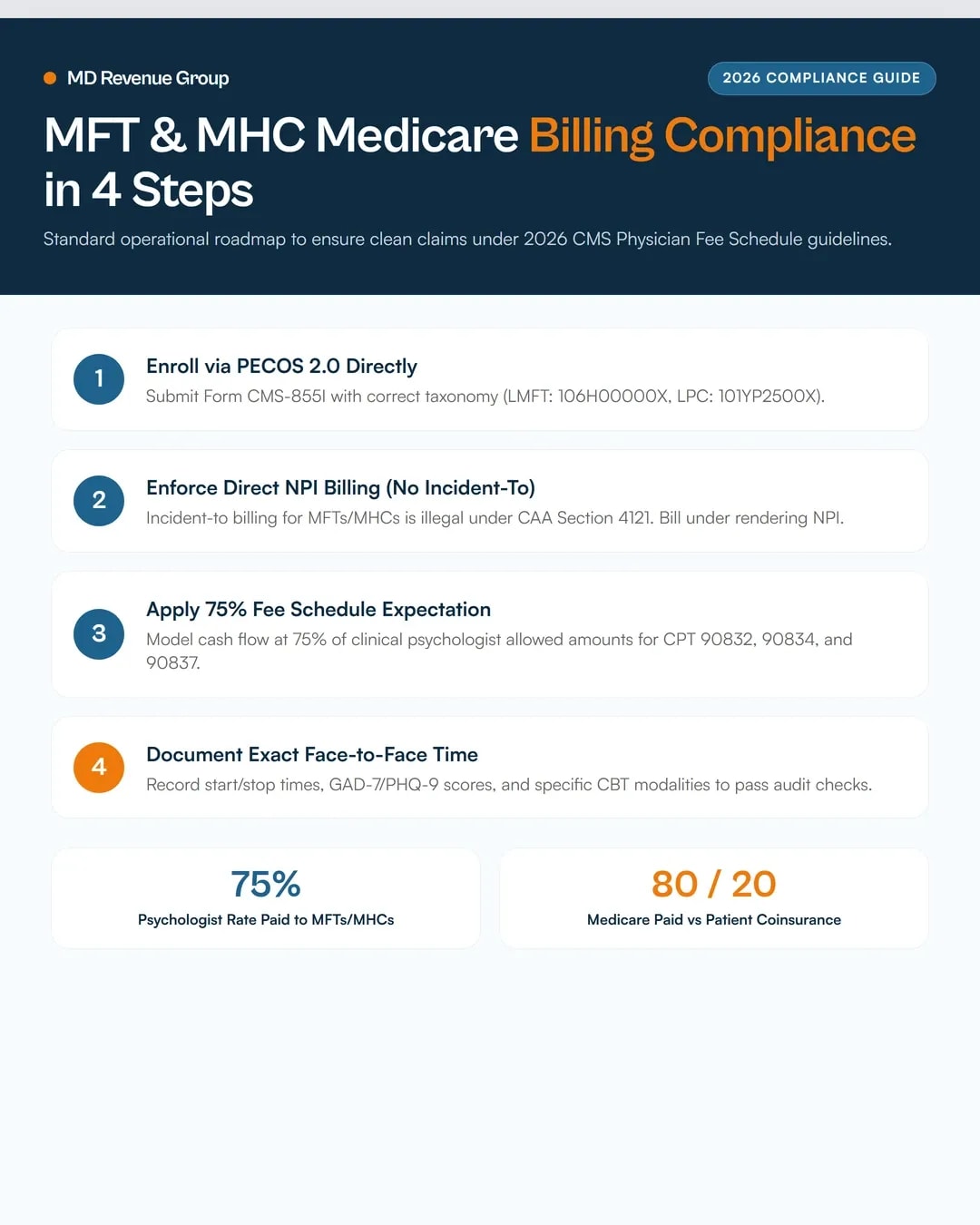
Under Section 4121 of the Consolidated Appropriations Act of 2023 and Medicare Physician Fee Schedule rules, Marriage and Family Therapists (MFTs) and Mental Health Counselors (MHCs) bill Medicare Part B directly. Clinical Psychologists receive 100% of the Medicare Physician Fee Schedule (PFS) rate for diagnostic and therapeutic services. MFTs and MHCs receive 75% of the Clinical Psychologist rate (effectively 75% of the PFS allowed fee).
Incident-to billing for MFTs and MHCs under a physician or psychologist credential is strictly prohibited by CMS. Every non-physician behavioral health practitioner must complete PECOS enrollment and bill under their own NPI.
Navigating these distinct fee structures requires clear operational workflows. Below is the complete breakdown of Medicare enrollment, CPT code selections, financial models, and claim submission controls for behavioral health practices.
Executive Key Takeaways
- The 75% Rate Rule: MFTs and MHCs (including Licensed Professional Clinical Counselors) are paid 75% of the Clinical Psychologist fee schedule rate, while Psychologists receive 100%.
- Zero Incident-To Tolerance: CMS requires all MFTs and MHCs to bill Medicare directly under their own NPI. Billing MFT services under a supervising physician triggers false claim liability.
- 80/20 Coinsurance Split: Medicare pays 80% of the allowed fee schedule amount after the annual Part B deductible. The remaining 20% must be billed to supplemental insurance or collected from the patient.
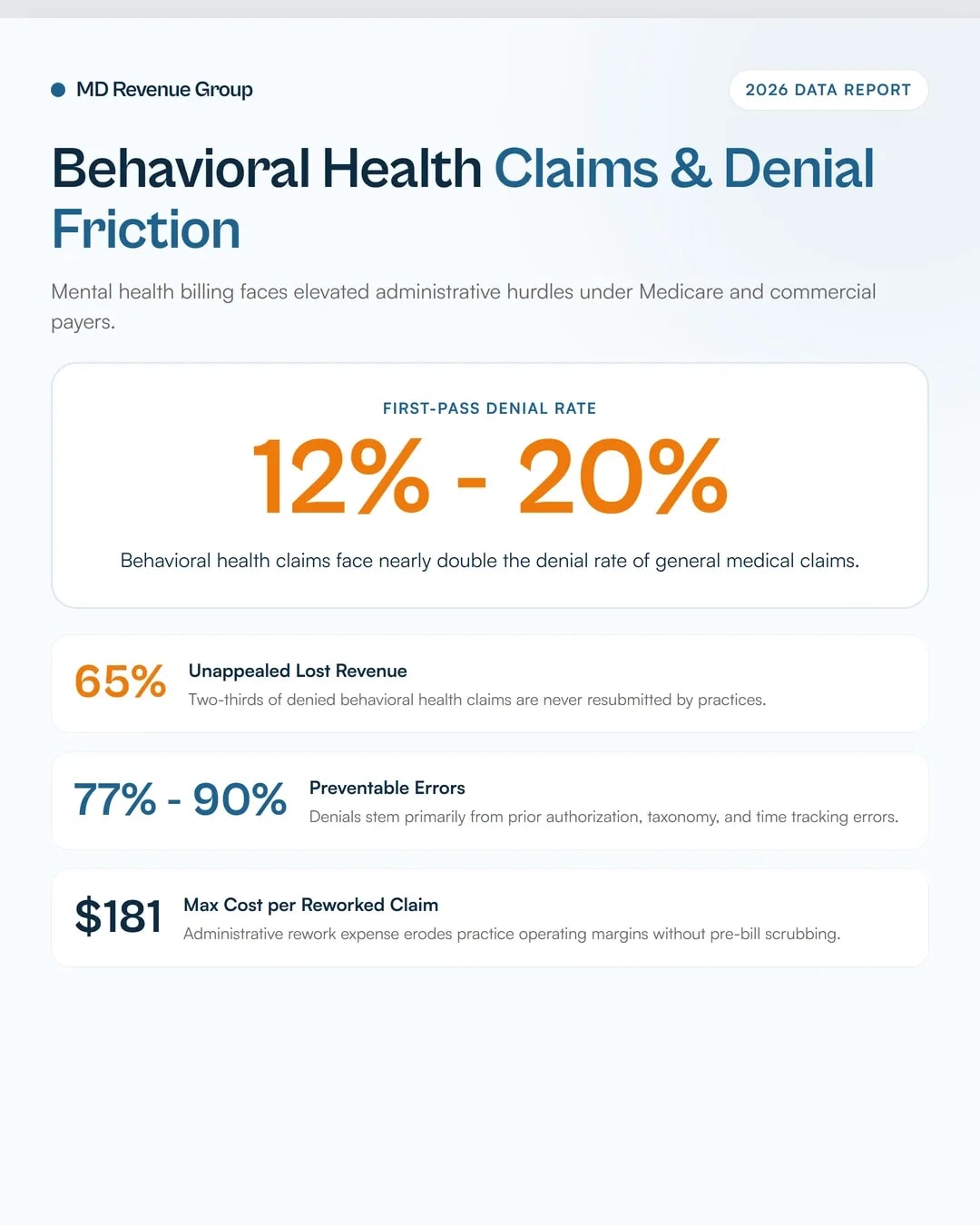
- Behavioral Health Denial Benchmark: Industry data indicates behavioral health claims experience first-pass denial rates of 12% to 20%, compared to 9% for general medical services.
- Unappealed Loss Risk: Approximately 65% of denied behavioral health claims are never resubmitted, causing severe revenue leakage for growing therapy groups.
Rate Differential: How Medicare Pays Each Provider Type
Medicare distinguishes payment tiers based on practitioner license, degree level, and statutory inclusion under Title XVIII of the Social Security Act.
See your practice reimbursement variance before rule changes impact cash flow.
We model your practice's historical code utilization against the updated conversion factors and regional GPCIs.
Calculate Practice Variance →Psychiatrists (MD/DO) are reimbursed at 100% of the physician fee schedule. They bill evaluation and management (E/M) codes (99202-99215) alongside psychotherapy add-on codes (90833, 90836, 90838).
Clinical Psychologists (PhD/PsyD) bill independent diagnostic testing, psychological testing (96130, 96136), and psychotherapy (90832, 90834, 90837). They receive 100% of the Clinical Psychologist fee schedule rate, which is set at 100% of the physician rate for mental health codes.
MFTs and MHCs hold master's or doctoral degrees in family therapy or professional counseling. CMS pays MFTs and MHCs 75% of the Clinical Psychologist allowed rate.
Practices optimizing their behavioral health revenue cycle must align scheduling with these payment variations. Managing complex multi-specialty practices requires structured revenue cycle management controls that prevent claim processing delays across commercial and government payers.
Provider Type | Degree / License | Medicare Fee Schedule Rate | Incident-To Allowed? | Core Code Sets |
|---|---|---|---|---|
Psychiatrist | MD / DO | 100% of Physician Rate | Yes (for NPPs) | E/M + Psychotherapy Add-ons, 90792 |
Clinical Psychologist | PhD / PsyD | 100% of Psychologist Rate | No (Must bill direct) | 90791, 90832-90837, Testing (96130) |
Licensed Clinical Social Worker (LCSW) | MSW / LCSW | 75% of Psychologist Rate | No (Must bill direct) | 90791, 90832-90837, Psychosocial |
Mental Health Counselor (MHC/LPCC) | MA / MS / LPC | 75% of Psychologist Rate | No (Must bill direct) | 90791, 90832-90837, Family Therapy |
Marriage & Family Therapist (MFT) | MA / MS / LMFT | 75% of Psychologist Rate | No (Must bill direct) | 90791, 90832-90837, 90846, 90847 |
The Worked Financial Model: 100-Patient Cash Flow Comparison
To evaluate practice revenue, model expected collections across 100 outpatient psychotherapy sessions (CPT 90834, 45-minute individual psychotherapy).
Assume an illustrative Medicare Physician Fee Schedule base allowed amount of $110.00 for CPT 90834 for a Clinical Psychologist.
Worked Revenue Calculation Table
- Clinical Psychologist Allowed Rate: $110.00 per session
- MFT / MHC Allowed Rate (75%): $82.50 per session
- Medicare Payment Share (80%): Paid by MAC directly
- Patient Coinsurance Share (20%): Paid by secondary payer or patient
Session Metric | Clinical Psychologist (100% Base) | MFT / MHC Practitioner (75% Base) | Financial Variance per 100 Encounters |
|---|---|---|---|
Allowed Amount per Session | $110.00 | $82.50 | -$27.50 (-25.0%) |
Medicare Paid Share (80%) | $88.00 | $66.00 | -$22.00 per session |
Patient Coinsurance (20%) | $22.00 | $16.50 | -$5.50 per session |
Gross Allowed (100 Encounters) | $11,000.00 | $8,250.00 | -$2,750.00 |
Expected Medicare Payment | $8,800.00 | $6,600.00 | -$2,200.00 |
Expected Coinsurance Collections | $2,200.00 | $1,650.00 | -$550.00 |
For group practices operating across regional markets like medical billing in New Jersey or expanding into medical billing in Texas, tracking fee differentials prevents budgeting shortfalls.
Knowing exact allowed rates per provider license ensures accurate forecasts for monthly payroll, billing service fees, and cash flow expectations.
The Incident-To Trap: Why MFTs and MHCs Must Bill Direct
A frequent compliance violation in multi-provider clinics involves billing MFT or MHC services under a supervising psychiatrist or psychologist NPI using "incident to" guidelines.
CMS explicitly prohibits incident-to billing for MFTs and MHCs under Medicare Part B.
Section 4121 of the CAA 2023 created an independent benefit category for MFTs and MHCs under Section 1861(s)(2)(II) of the Social Security Act. Because Congress established direct statutory coverage for these disciplines, services performed by an MFT or MHC cannot be billed as incident to a physician's service.
What Happens If You Bill Incident-To?
Billing an MFT's service under a physician NPI to receive 100% reimbursement instead of 75% constitutes improper billing under 42 CFR § 424.535. This practice triggers:
- Overpayment Recoupment: Medicare Administrative Contractors (MACs) audit claim history and demand refund of the 25% payment differential for all past encounters.
- False Claims Act Liability: Intentional submission of non-physician services under a physician NPI creates treble damages and civil monetary penalties per claim line.
- Billing Privilege Revocation: Repeated misrepresentation of rendering providers results in NPI deactivation or enrollment revocation.
To protect clinic operations, implement dedicated psychiatric billing services workflows that route each rendered claim to the exact NPI of the practitioner who conducted the session.
Core CPT Codes and Time-Based Billing Rules
Behavioral health billing relies on strict time documentation under CPT coding guidelines.
When billing individual psychotherapy, select the code that accurately represents the time spent directly with the patient.
Standard Outpatient CPT Codes
- 90791: Psychiatric diagnostic evaluation (integrated biopsychosocial assessment, no medical services).
- 90792: Psychiatric diagnostic evaluation with medical services (billed by psychiatrists or psychiatric APRNs).
- 90832: Psychotherapy, 30 minutes with patient (time range: 16 to 37 minutes).
- 90834: Psychotherapy, 45 minutes with patient (time range: 38 to 52 minutes).
- 90837: Psychotherapy, 60 minutes with patient (time range: 53 minutes or more).
- 90846: Family psychotherapy without patient present (50 minutes).
- 90847: Family psychotherapy with patient present (50 minutes).
CPT Time Range Decision Matrix
CMS enforces the CPT midpoint rule for time-based behavioral health services. Document start and stop times or total direct face-to-face time in the progress note.
Rendered Time Duration | Correct CPT Code Selection | Billing Rule & Documentation Requirement |
|---|---|---|
0 to 15 Minutes | Unbillable | Does not meet 16-minute minimum threshold for 90832. |
16 to 37 Minutes | CPT 90832 (30 min) | Document exact minutes. Billed at 30-minute rate. |
38 to 52 Minutes | CPT 90834 (45 min) | Standard individual session. Midpoint is 38 minutes. |
53+ Minutes | CPT 90837 (60 min) | High-scrutiny code. Requires explicit medical necessity documentation. |
Proper code selection is essential when managing comprehensive behavioral health billing programs. Audits frequently target claims where 90837 is billed repeatedly without documented clinical complexity.
PECOS 2.0 Enrollment and State Taxonomy Checklist
Before an MFT or MHC can submit claims to Medicare, they must complete initial provider enrollment through PECOS 2.0 or submit Form CMS-855I.
Qualification Criteria
To qualify for Medicare Part B enrollment, an MFT or MHC must meet three national criteria:
- Master's or Doctoral Degree: Graduation from an accredited institution in marriage and family therapy, mental health counseling, or professional counseling.
- Clinical Hours: Completion of at least 2 years or 3,000 hours of post-master's clinically supervised mental health practice.
- State Licensure: Active, unrestricted license as an LMFT, LMHC, LPC, or LPCC in the state where services are delivered.
Recommended NUCC Provider Taxonomy Codes
Entering the wrong National Uniform Claim Committee (NUCC) taxonomy code on Form CMS-855I causes PECOS rejection or claim edit failures.
- Marriage & Family Therapist: 106H00000X
- Mental Health Counselor: 101YM0800X
- Professional Counselor: 101YP2500X
- Clinical Psychologist: 103T00000X
Practices updating provider rosters should cross-reference enrollment protocols with established guidelines on 42 CFR Part 2 mental health billing rules to maintain privacy compliance during consent verification.
Literal Clinical Documentation Examples
Commercial payers and Medicare Administrative Contractors perform random post-payment audits of psychotherapy notes. Vague entries such as "patient discussed stress, therapy provided" result in immediate claim denials and recoupment.
Clinical documentation must prove medical necessity, capture direct face-to-face time, and establish a clear treatment plan progression.
Non-Compliant Documentation Example (Audit Risk)
"Patient presented for therapy. Discussed anxiety regarding work and relationship problems. Offered supportive counseling. Patient responded well. Session lasted 45 minutes. Plan to continue weekly."
Why this fails: Lacks target symptoms, specific therapeutic modalities used, functional impairment assessment, progress measurement, and explicit start/stop timestamps.
Compliant Clinical Documentation Example (Audit-Proof)
Session Details: Date: 08/26/2026 | Start Time: 10:00 AM | Stop Time: 10:48 AM (Total Face-to-Face Time: 48 Minutes) | CPT Code: 90834 >Diagnosis: Generalized Anxiety Disorder (ICD-10 F41.1) >Clinical Presentation & Target Symptoms: Patient reports persistent muscle tension, sleep disruption (4 hours/night), and excessive worry regarding occupational performance. GAD-7 score: 14 (Moderate Anxiety). >Therapeutic Interventions Applied: Utilized Cognitive Behavioral Therapy (CBT) techniques. Guided patient through cognitive restructuring to identify catastrophic automatic thoughts regarding workload. Practiced diaphragmatic breathing exercises for physiological arousal reduction. >Patient Response & Progress: Patient successfully identified 2 cognitive distortions (overgeneralization, black-and-white thinking) and articulated a revised self-statement. GAD-7 score decreased from 16 to 14 over 4 weeks. >Treatment Plan & Medical Necessity: Continue CBT weekly to achieve target GAD-7 score under 8 and restore normal sleep architecture. Individual therapy required due to severe functional impairment in work task completion.
Providing precise documentation ensures your practice is audit-ready. If your clinic faces recurring payer rejections, utilizing a free revenue audit helps identify clinical documentation gaps before auditors issue recoupment letters.
Overcoming Denial Patterns in Behavioral Health Claims
Behavioral health claims face higher administrative friction than general medical claims. According to MGMA industry benchmarks, behavioral health first-pass denial rates hover between 12% and 20%.
Furthermore, industry data shows that 65% of denied claims are never resubmitted due to staff bandwidth constraints.
Behavioral Health Claim Denial & Recovery Lifecycle
[ Claim Submission ]
        │
        ▼
[ First-Pass Denial Rate: 12% - 20% ]
        │
        ├──────────────────────────────────────────┐
        ▼                                          ▼
[ 65% Abandoned / Unappealed ]            [ 35% Resubmitted / Appealed ]
  (Permanent Revenue Leakage)                      │
                                                   ▼
                                          [ 40% - 70% Overturned ]
                                            (Cash Recovered)
Top 4 Behavioral Health Denial Reasons and Prevention Workflows
- CO-50: Non-Covered Service / Lack of Medical Necessity
- Root Cause: Billed 90837 without documenting clinical rationale for extended session length.
- Fix: Require secondary clinical review before submitting 60-minute therapy claims for routine maintenance.
- PR-27: Coverage Terminated / Plan Ineligible
- Root Cause: Patient changed secondary or Medicare Advantage plan without front-desk verification.
- Fix: Implement electronic real-time eligibility (RTE) scrubbing prior to every scheduled appointment.
- CO-16: Missing / Incomplete Authorization
- Root Cause: Exceeded approved session unit limits under commercial managed care plans.
- Fix: Track authorization balances inside your EHR and initiate re-authorization 3 sessions before expiration.
- CO-185: Rendering Provider Taxonomy Mismatch
- Root Cause: MFT or MHC taxonomy code on claim line does not match PECOS enrollment record.
- Fix: Scrub claim Box 24J and Box 33b NPI/taxonomy fields against active MAC provider files prior to clearinghouse transmission.
Practices seeking to eliminate structural billing errors can leverage our interactive revenue integrity tool to calculate hidden revenue loss and clean claim performance.
Frequently Asked Questions
1. Can MFTs and MHCs bill Medicare Part B for telehealth sessions?
Yes. MFTs and MHCs are permanently recognized as eligible telehealth distant site practitioners for mental health services under Medicare Part B. Services delivered via audio-visual or audio-only modalities (where permitted) are reimbursable when matching place-of-service codes (POS 10 for home, POS 02 for tele-facility) and appropriate modifiers are appended.
2. What is the Medicare allowed rate for an MFT compared to a Clinical Psychologist?
MFTs and MHCs receive 75% of the fee schedule rate established for Clinical Psychologists. If the Clinical Psychologist allowed amount for CPT 90834 is $110.00, the allowed amount for an MFT or MHC for the same service is $82.50.
3. Is incident-to billing allowed for MFTs or MHCs working under a Psychiatrist?
No. CMS regulations strictly prohibit incident-to billing for MFTs and MHCs. Because MFTs and MHCs have a direct Medicare benefit category established under Section 4121 of the CAA 2023, all services provided by MFTs and MHCs must be billed directly under their own NPI.
4. What taxonomy codes should an MHC use when enrolling via PECOS?
Mental Health Counselors should enroll using NUCC taxonomy code 101YM0800X (Mental Health Counselor) or 101YP2500X (Professional Counselor). Marriage and Family Therapists must use taxonomy code 106H00000X.
5. How many hours of clinical supervision are required to enroll an MFT in Medicare?
CMS requires MFTs and MHCs to have completed at least 2 years or 3,000 hours of post-master's degree clinically supervised mental health practice in addition to holding an active state license.
Need help optimizing your practice's Medicare enrollment or billing workflows? Contact our billing experts at MD Revenue Group to schedule a practice-specific fee schedule analysis.
Protect your Medicare & fee schedule revenue.
Get a custom code-by-code reimbursement impact analysis for your practice. Measure your financial variance in 48 hours.