
Charge Lag Days: What Good Looks Like and What It Costs You
Charge lag days benchmarks from HFMA award winners, the 90-to-365-day filing windows behind them, and a calculator for what delay costs.
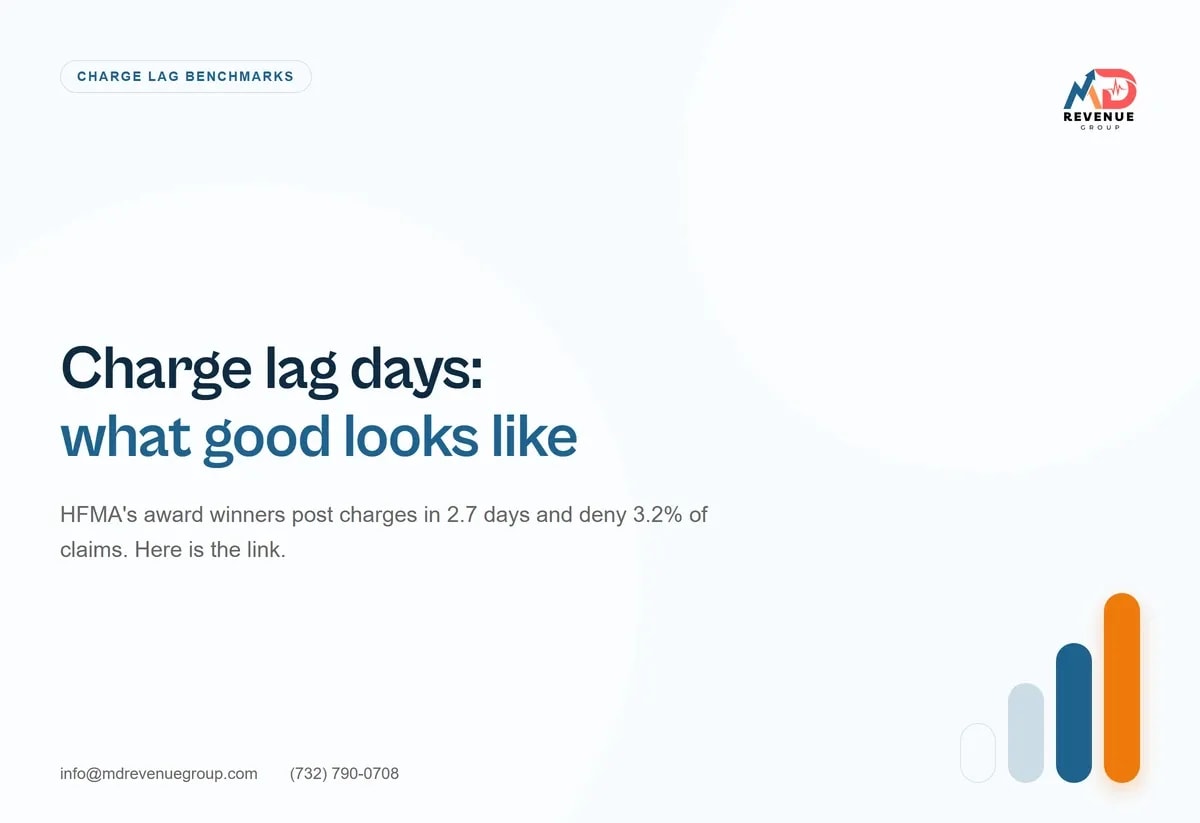
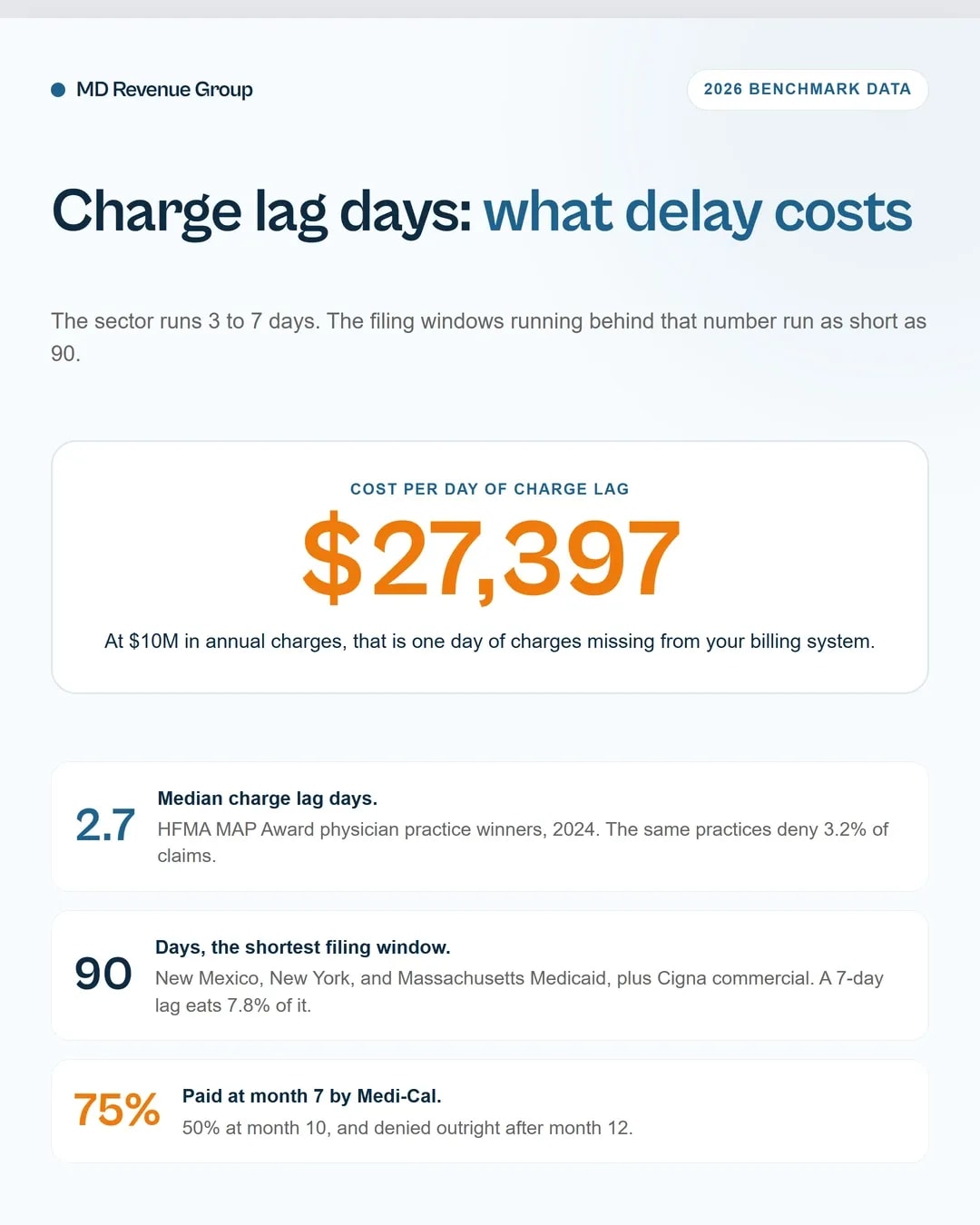
Charge lag days run from the date of service to the date the charge posts into your billing system. The sector publishes at least 5 different targets for that number, and the only real-world distribution of it anywhere comes from HFMA's MAP Award winners: a median of 2.7 charge lag days for physician practices in 2024, with the 25th percentile at 3.2 and the 75th at 2.2.
What makes charge lag expensive is timing, and the timing that matters is the payer's filing window. Medicare gives you 1 calendar year from the date of service. Cigna gives participating commercial providers 90 days. New York's Medicaid program gives 90 days. Illinois gives 180 days.
California pays a claim filed in the 7th month after service at 75% and one filed in the 10th month at 50%. The same 7 days of charge lag is a rounding error against Medicare's clock and a real slice of a 90-day payer's runway.
This guide covers what charge lag days actually measure, the one benchmark distribution that exists, the filing windows running behind it, two calculators that turn the numbers into a deadline, and the 3 things charge lag breaks that a slow claim never tells you about.
Key takeaways
- The only real-world charge lag distribution comes from HFMA's MAP Award winners. Physician practice winners posted a median of 2.7 charge lag days in 2024, 2.4 in 2023, and 1.9 in 2022.
- Those same practices ran 3.2% claim denial rates and 21.9 net days in A/R. The co-movement between charge lag and denial rate is sitting right there in HFMA's data.
- MGMA says close encounters within 72 hours and post charges within 2 days, against a 3-to-7-day lag across the sector.
- Medicare gives you 365 days. New Mexico Medicaid gives you 90. Cigna commercial gives participating providers 90. A 7-day charge lag consumes 7.8% of a 90-day window and 1.9% of Medicare's.
- Each day of charge lag costs a $10 million practice about $27,400 in charges that aren't in the system yet.
What charge lag days actually measure
HFMA publishes the metric definitions in the MAP Keys, and the language is stricter than most vendors use.
35 days in AR is the benchmark. Anything over 50 is uncollected revenue.
We conduct a forensic 90-day cash flow audit to identify unworked claims, fee schedule underpayments, and clearinghouse leaks.
Audit My Cash Flow Leaks →PB-4, Total Charge Lag Days. The equation sums the days between revenue recognition, meaning the posting date, and the date of service for each charge code, then divides by the count of charge codes billed. HFMA spells out two things people get wrong. It is "not a total of the charges but rather a count of days." And the denominator is "a count of the number of charge codes billed, not a summation of dollars billed."
CL-2, Late Charges as a Percentage of Total Charges. Gross charges with a post date more than 3 days after the service date, divided by total gross charges. The clarifications matter more than the formula:
Posting window is service date + 3 days; ... if post date minus service date is greater than 3 days, then it is a late charge; late charges begin on the 4th day after service date. "Service Date" is defined as the date a specific service is performed, not the account date or discharge date.
So under HFMA's definition, a charge posted on day 4 is already late. And a credit posted late does not offset a debit posted late. HFMA's own words: "total late charges are not 'net' of late charge credits."
Get these right internally and your number becomes comparable to benchmark data. Get them wrong and you end up comparing a charge-weighted average to someone's encounter-weighted average and arguing about nothing. The medical billing process steps matter here because charge capture is the step that creates the lag.
The benchmark: HFMA award winners post charges in under 3 days
HFMA publishes aggregate statistics for the practices and hospitals that won its MAP Award for High Performance in Revenue Cycle. The physician practice winners are the only real-world charge lag distribution that exists anywhere.
Year | Winners | Charge lag days P75 | P50 | P25 |
|---|---|---|---|---|
2024 | 3 | 2.2 | 2.7 | 3.2 |
2023 | 5 | 1.9 | 2.4 | 2.5 |
2022 | 7 | 1.4 | 1.9 | 2.7 |
The same table shows what those practices did with the rest of the revenue cycle in 2024: net days in A/R of 21.6 at the 75th percentile and 22.1 at the 25th, A/R over 90 days between 7.9% and 14.8%, point of service cash collection above 99%, and claim denial rates of 2.4%, 3.2%, and 3.5%.
Those numbers belong together. Practices that post charges in about 2.7 days also deny 3.2% of claims. Compare that to the 7% to 8% first-submission denial rate MGMA says has held across the sector for 4 straight years, a rate MGMA says targeted process fixes can push below 5%.
The benchmark spread is wider than you'd guess. MGMA's own recommendation, published in a July 2026 poll with 203 responses, is to "set expectations for clinicians to close encounters within 72 hours and for staff to post charges within two days, compared with the three- to seven-day lag seen across the sector."
A peer-reviewed review of revenue cycle KPIs in Plastic and Reconstructive Surgery Global Open puts the days-to-bill benchmark at 2 days or less.
So here is the honest picture: 2 days or less for charge capture, 3 to 7 days for what most practices actually run, and 2.7 days as the measured median for high performers. If a vendor tells you the industry standard is 24 to 48 hours, ask for the source, because no primary source publishes it.
The distribution data most often quoted comes from an Ingenious Med survey run by Sage Growth Partners in July 2018, with 104 self-reported RCM leaders across 35 states. It found 32% of charges captured within 24 hours, 25% within 1 to 2 days, 35% taking 3 to 7 days, and 6% taking more than a week. Useful, and 8 years old. Treat it as a snapshot.
The filing window running behind your charge lag
Charge lag only becomes money because of deadlines.
Payer | Initial claim deadline from date of service | Source |
|---|---|---|
Medicare fee for service | 1 calendar year | 42 CFR 424.44(a)(1) |
Medicaid, federal ceiling | 12 months | 42 CFR 447.45(d)(1) |
New Mexico Medicaid | 90 calendar days | 8.302.2.11 NMAC |
New York Medicaid | 90 days | eMedNY, Information for All Providers, General Billing |
Massachusetts Medicaid | 90 days | 130 CMR 450.309(A) |
Illinois Medicaid | 180 days | Illinois HFS, Timely Filing Claim Submittal for Non-Institutional Providers |
Indiana Medicaid | 180 calendar days | IHCP Provider Reference Manual, Section 11 |
Nevada Medicaid | 180 days for in-state providers with no other coverage, 365 days otherwise | Nevada Medicaid Billing Manual, Chapter 7 |
North Dakota Medicaid | 180 days for an original primary claim, 365 days for secondary and tertiary | ND Medicaid Billing and Policy Manual |
Pennsylvania Medicaid | 180 days | 55 Pa. Code Section 1101.68 |
Arizona Medicaid | 6 months | AHCCCS FFS Provider Billing Manual, Chapter 4 |
Nebraska Medicaid | 6 months | Nebraska Medicaid Provider Manual, Section 5.1.1 |
Oklahoma Medicaid | 6 months | OAC 317:30-3-11 |
South Dakota Medicaid | 6 months following the month of service | ARSD 67:16:35:04 |
California Medi-Cal | 6 months following the month of service | Medi-Cal Provider Manual, Claim Submission and Timeliness Overview |
Georgia Medicaid | 6 months after the month of service | GA Medicaid Part 1 Policies and Procedures, Section 203.1.3 |
Louisiana Medicaid | 12 months, but 60 days for KIDMED Title IV-E child welfare claims | Louisiana Medicaid Timely Filing Guidelines |
Iowa Medicaid | 365 days | Iowa Medicaid Enterprise, Billing Iowa Medicaid |
Maryland Medicaid | 12 months | COMAR 10.09.36.06 |
New Jersey Medicaid | 1 year | N.J. Admin. Code 10:49-7.2 |
Colorado Medicaid | At least 365 days, then resubmit every 60 days to stay timely | Colorado HCPF Timely Filing FAQ |
Oregon Medicaid | 365 days, plus 180 more to resolve a claim filed on time | OHA General Rules Provider Guide |
Cigna, participating commercial provider | 90 days | Cigna CHCP reimbursement policy |
Cigna, out of network | 180 days | Cigna CHCP reimbursement policy |
Medicare Advantage | No provider filing deadline is set in 42 CFR 422.520, timing comes from the provider contract | 42 CFR 422.520(b) |
Three state Medicaid programs set 90-day windows. If you bill in New Mexico, the Medicaid clock is New Mexico's 90 days. New York is the same length (New York Medicaid billing), and Massachusetts matches it, with a waiver process built into 130 CMR 450.309(B) for claims delayed outside the provider's control.
Illinois, Indiana, and Pennsylvania run 180 days, which is more room than most practices realize they have (Illinois billing rules, Pennsylvania billing rules).
California runs a 6-month window and then starts paying less. Medi-Cal's own manual calls it the six-month billing limit: original claims must be received within six months following the month in which services were rendered. Claims received during the 7th through 9th month after the month of service "will be reimbursed at 75 percent of the payable amount," the 10th through 12th month at 50 percent, and anything after the 12th month gets denied, unless a delay reason code applies. California billing rules break down the rest of the state program.
Two outliers sit at opposite ends. Louisiana gives straight Medicaid claims 12 months, but KIDMED Title IV-E child welfare claims "must be filed within 60 days from the date of service." A pediatric bill that slips past 60 days is gone. Colorado goes the other way and hands you a way to stay alive: providers must submit the initial claim within 365 days, then "resubmit claims every 60 days after the initial timely filing period," referencing the previous Internal Control Number from a remittance advice dated within the last 60 days.
Oregon gives you 365 days to file, and then 180 more days to resolve the claim if you filed it on time. Oregon Health Authority's provider guide states it directly: submit within 365 days, and "If a claim is still unresolved after 365 days, but has been submitted within 365 days, you have an additional 180 days to resolve the claim."
Commercial payers publish no uniform number, and every one of them has exceptions. Cigna's CHCP policy says participating provider claims go in within three months (90 days) and out-of-network claims within six months (180 days), then adds its own carve-outs: a hospital confinement is measured from the last date of service, and there is a separate exceptions and appeals process. Any table showing one confident commercial filing limit is claiming more precision than the payer offers.
Calculate your filing runway
This takes 5 minutes.
Filing runway = the payer's deadline from date of service, minus charge lag, minus claim submission lag, minus the rejection and correction cycle.
The rejection and correction cycle is the part people forget. If your clearinghouse rejects 3% of claims and those take 4 days to fix and resubmit, those claims burn 4 extra days of runway.
Worked example. Charge lag of 3 days, submission lag of 4 days, 7 days total before a claim reaches the payer.
Payer | Deadline | Runway left |
|---|---|---|
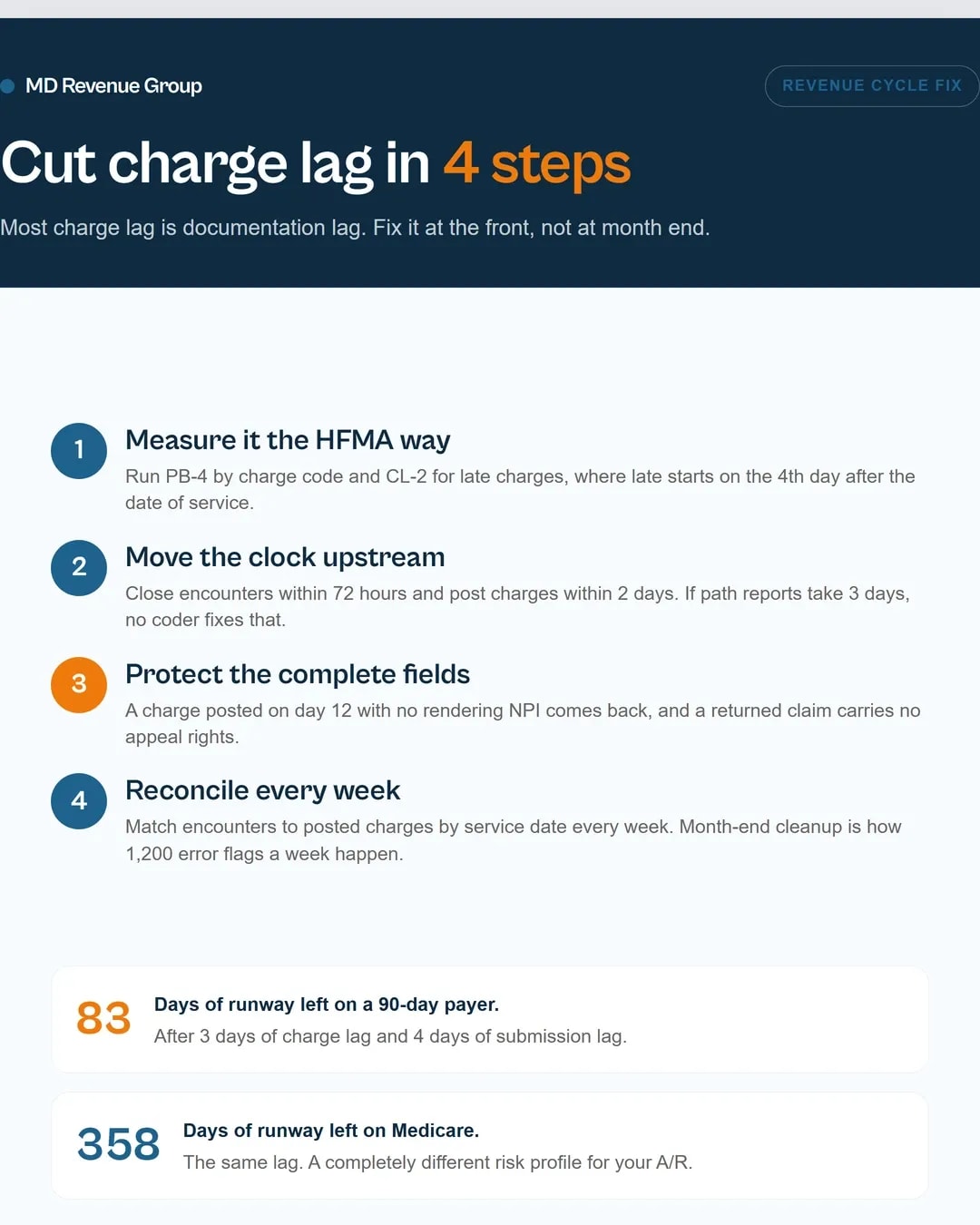
Medicare fee for service | 365 days | 358 days |
Iowa, Maryland, New Jersey, Oregon Medicaid | 365 days | 358 days |
Illinois, Indiana, Pennsylvania Medicaid | 180 days | 173 days |
California Medi-Cal | 180 days | 173 days |
New Mexico, New York, Massachusetts Medicaid | 90 days | 83 days |
Cigna commercial, in network | 90 days | 83 days |
Now push the charge lag to 30 days. Same submission lag, same correction cycle, 34 days consumed.
Payer | Deadline | Runway left |
|---|---|---|
Medicare fee for service | 365 days | 331 days |
Illinois, Indiana, Pennsylvania Medicaid | 180 days | 146 days |
New Mexico, New York, Massachusetts Medicaid | 90 days | 56 days |
Cigna commercial, in network | 90 days | 56 days |
Those 34 consumed days are a 9% hit against Medicare's window and a 38% hit against a 90-day payer's. That is why charge lag shows up as a write-off in Medicaid and commercial books while it stays a cash-flow complaint in Medicare books.
What charge lag days cost in cash
Here is the second calculator, and it is the simplest one.
Dollars parked outside your billing system = (annual charges ÷ 365) × charge lag days.
At $10 million in annual charges, each day of charge lag is $27,397 of charges that don't exist yet in your system.
Charge lag days | Charges not in the system | At a 7% first-submission denial rate |
|---|---|---|
2 days | $54,795 | $3,836 in denial exposure |
3 days | $82,192 | $5,753 |
7 days | $191,781 | $13,425 |
30 days | $821,918 | $57,534 |
The third column is the part that hurts. Charges that sit longer sit in a bigger backlog, get worked in a worse batch, and lose the documentation that supports them. The peer-reviewed revenue cycle review names the causes plainly: late or missing dictation and reports, unaddressed coding queries, overwhelmed or undertrained billing personnel, and clerical delays.
The scale of what's at stake in charge capture is documented. HFMA's revenue cycle coverage cites research from The Claro Group finding hospitals lose as much as 1% of potential annual net revenue to charge capture issues, which is $5 million on a hospital doing $500 million in net revenue.
Novant Health recovered $7.5 million in 15 months by fixing capture. Its charge integrity system had been flagging upwards of 1,200 missing-charge errors a week, and the weekly false-positive review volume it generated came down from more than 1,200 items to fewer than 100.
Days-to-pay benchmarks sit on the other side of the ledger. The same peer-reviewed source puts payment timing at 12 to 20 days for private insurance, 18 to 30 days for Medicare, and 55 to 75 days for workers' compensation.
Medicaid has its own floor. 42 CFR 447.45(d)(2) requires the agency to pay 90% of clean claims from practitioners within 30 days of receipt, and 99% within 90 days. Every day you add to charge lag adds a day to those numbers, and then adds a day to the patient statement that comes after.
If your practice wants the cash side measured rather than estimated, an RCM audit can separate the days you control from the days the payer controls.
3 things charge lag breaks
Denial and A/R analysis treats charge lag as a cash flow issue. It is worse than that, because of what it does to three clocks most practices don't measure.
1. The claim never existed. CMS Pub. 100-04, Chapter 1, section 70.2 is explicit that a claim must be filed with the appropriate Medicare contractor, on the form prescribed by CMS, and in accordance with all pertinent CMS instructions. A charge sitting in your practice management system is not a claim. Section 70.2.1 adds that re-routed claims "are not considered claims under Medicare regulations until received by the appropriate Medicare contractor." And section 70.2.3 says services submitted in a manner "not complete and consistent" with CMS instructions "will not be considered filed for purposes of determining timely filing." Every day of charge lag is a day of that window spent before the claim reaches the MAC.
2. Your appeal rights shrink before you know it. Section 70.4 says a denial for untimely filing is not an initial determination and is not appealable. Charge lag delays the payer's initial determination, which delays the start of the 120-day Medicare redetermination window under 42 CFR 405.942. Then the 180-day QIC reconsideration window under 405.962, then 60 days to request an ALJ hearing under 405.1002, 60 days to request Medicare Appeals Council review under 405.1102, and 60 days to file an action in federal district court under 405.1130.
The amount in controversy thresholds for 2026 are $200 for an ALJ hearing and $1,960 for judicial review, effective January 1, 2026. A claim that takes 30 extra days to reach the payer also takes 30 fewer days to appeal it.
42 CFR 424.44(b) opens 4 narrow doors out of that trap: CMS or contractor error, retroactive Medicare entitlement, retroactive entitlement plus a Medicaid recoupment 6 months or more after service, and retroactive disenrollment from Medicare Advantage or PACE plus a recoupment 6 months or more after service.
3. Your self-pay patients lose rights. Under 45 CFR 149.620, an uninsured or self-pay patient has to postmark a patient-provider dispute resolution notice within 120 calendar days of receiving the initial bill. While the dispute is pending, you cannot move the bill into collections and you must suspend late fee accrual. The SDR entity has 30 business days after receiving your submission to make a determination. And if a new item or service shows up on the bill that was not on the good faith estimate, and you cannot show credible information, the amount the patient has to pay is $0.
Every one of those 120 days starts when the patient gets a bill. Charge lag pushes the bill out. A patient who receives their statement 20 days later has 20 fewer days to dispute it.
Cut charge lag days in 5 steps
Measure it the HFMA way before you fix it. Run PB-4, charge-code weighted, by service date and posting date. Run CL-2 for late charges, where late starts on day 4. If you have never computed either, your current number is a guess, and you can't improve a guess.
Move the clock upstream. Charge lag is mostly documentation lag. The peer-reviewed review calls for prompt documentation, under 24 hours, and says to identify missing documents early and submit them within 48 hours. If your path reports take 3 days, no amount of coder efficiency fixes the lag.
Set the encounter close target and enforce it. MGMA says close encounters within 72 hours and post charges within 2 days. That is the operating standard, and the 3-to-7-day sector lag means most practices have 2 to 5 days of slack to take back.
Protect the fields that make a claim complete. Charge lag and incomplete claims compound each other. A charge posted on day 12 that is missing its rendering NPI comes back, and a returned claim has no appeal rights. If you want one operational habit that pays for itself, make the superbill complete on first entry. The CMS billing rules every practice needs are a good checklist for what "complete" means.
Run a reconciliation report, not a monthly surprise. Compare encounters to posted charges by service date. Look for services with no matching charge, charges with no matching encounter, and codes sitting past the 4-day line. Novant Health's charge integrity system was reporting upwards of 1,200 missing-charge errors every week before it moved to weekly exception review. The clean claim rate benchmark tells you what the payoff looks like.
One more thing about your own numbers. CMS reported $28.83 billion in Medicare fee for service improper payments for FY2025, or 6.55% of payments, and $37.39 billion in Medicaid improper payments, where 77.17% of the errors traced to insufficient documentation. How CMS categorizes improper payments breaks down the error mix.
Frequently asked questions
What is charge lag? The number of days between the date of service and the date the charge posts to the billing system. HFMA's MAP Key PB-4 measures it by charge code, and MAP Key CL-2 counts the share of charges posted more than 3 days after service.
What is a good charge lag benchmark? 2 days or less for charge capture, per the peer-reviewed revenue cycle review. HFMA's MAP Award physician practice winners posted a median of 2.7 charge lag days in 2024, 2.4 in 2023, and 1.9 in 2022. MGMA's 2026 target is encounters closed within 72 hours and charges posted within 2 days.
How many days of my filing window does a 7-day charge lag leave? Against Medicare's 365-day window, 358 days. Against a 90-day window like New Mexico Medicaid, New York Medicaid, Massachusetts Medicaid, or Cigna commercial, 83 days. That assumes 4 days of submission lag and no rejection cycle, so add those.
Does charge lag affect my appeal deadline? Yes. The Medicare redetermination window is 120 days from receipt of the initial determination, and charge lag delays the determination. Section 70.4 also says a denial for untimely filing is not appealable at all.
Does charge lag get a claim denied or just paid less? Both, depending on the payer. California Medi-Cal pays a 7th through 9th month claim at 75%, a 10th through 12th month claim at 50%, and denies past the 12th month. Other payers deny outright.
Is charge lag measured in calendar days or business days? HFMA's metric is a count of days between two dates, and most practices calculate it in business days without saying so. Medicare's filing clock in 42 CFR 424.44 is calendar days, as is the 120-day dispute window in 45 CFR 149.620. A 3 business day charge lag is 5 calendar days.
How much cash does each day of charge lag cost? At $10 million in annual charges, $27,397 per day. At $2 million a year, $5,479 per day. The formula is annual charges divided by 365, multiplied by charge lag days.
See your charge lag in dollars
Charge lag is measurable, and most practices find out their real number in the first 15 minutes of a review. Send us your service dates and posting dates and we'll calculate your PB-4 charge lag, your late charge percentage, and how much of your filing runway you've already spent. Request a free revenue audit.
See your revenue leaks in dollars.
Get a forensic 90-day cash flow audit of your practice. 100% confidential, 48-hour delivery, zero obligation.