
Superbill Template: What to Capture and Why It Drives Payment
Charge lag days benchmarks from HFMA award winners, the 90-to-365-day filing windows behind them, and a calculator for what delay costs.
A superbill template is the document that turns a completed visit into a payable claim. It carries the date of service, the place of service, the diagnosis code, the procedure code, the modifiers, the units, the charge, and the identifiers for the patient, the rendering provider, and the billing entity.
CMS has already written down the fields you need. Twice. In the Medicare Claims Processing Manual, Chapter 1, section 80.3.2, contractors decide whether a claim is complete using a fixed list of what an itemized bill must contain. The CMS-1490S that a patient files with Medicare carries the same list in its own instructions. So the field spec exists. Most of the templates you can download miss parts of it.
This guide covers the CMS field list line by line, the map from each superbill field to its CMS-1500 box, what makes a claim come back unprocessable instead of denied, and what a single wrong field costs your practice. The field list below is the one your team should be building against.
Key takeaways
- CMS writes down the field list twice, and the two lists differ. The completeness test in Pub. 100-04, Chapter 1, section 80.3.2 adds diagnosis code, procedure code, and the ordering provider's name. The patient-facing CMS-1490S instructions never mention them.
- "Superbill" is an industry term. The word appears nowhere in the Medicare Claims Processing Manual, Chapter 1 or Chapter 26, or in the NUCC's 1500 instruction manual. CMS calls the same artifact an itemized bill.
- A missing required field gets a claim returned, and a returned claim has no appeal rights. Pub. 100-04, Chapter 1: a claim returned as unprocessable "does not meet the criteria to be considered as a claim, is not denied, and, as such, is not afforded appeal rights."
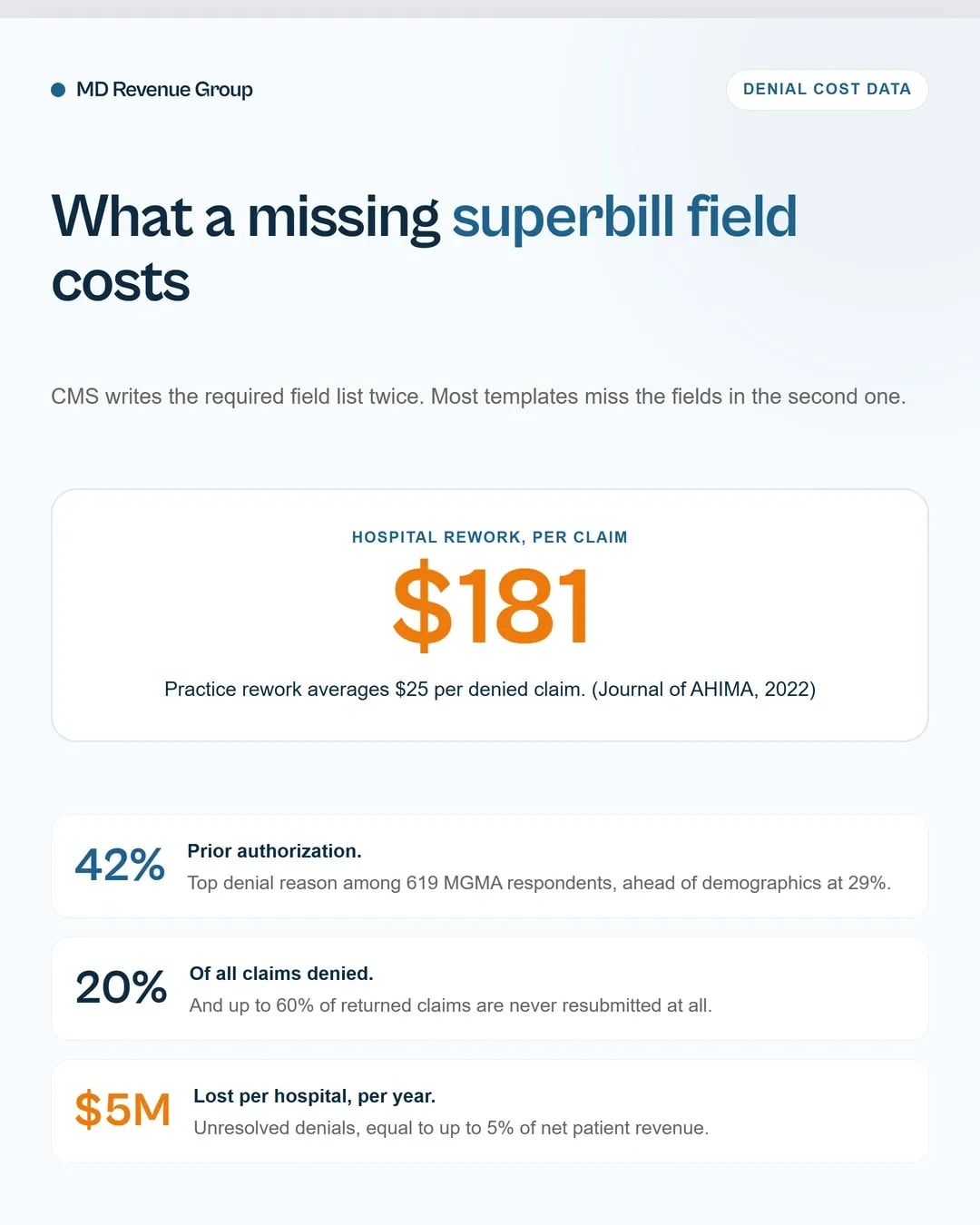
- Reworking a denial costs $25 per claim at a practice and $181 per claim at a hospital. Journal of AHIMA, April 2022.
- One superbill schema can feed a payer claim and a federal good faith estimate. 45 CFR 149.610 demands diagnosis codes, service codes, expected charges, NPI, TIN, and location.
What CMS actually calls a superbill
The word "superbill" is an industry term. It appears nowhere in the Medicare Claims Processing Manual, Chapter 1 (324 pages), Chapter 26 (78 pages), or the NUCC's 1500 (02/12) instruction manual (65 pages). Full-text search on all three returns zero hits.
35 days in AR is the benchmark. Anything over 50 is uncollected revenue.
We conduct a forensic 90-day cash flow audit to identify unworked claims, fee schedule underpayments, and clearinghouse leaks.
Audit My Cash Flow Leaks →CMS uses a different word for the same artifact: itemized bill. It shows up 12 times in Chapter 1 and 3 times in Chapter 26, and twice it comes with a mandatory field list.
That matters more than a naming quibble. When a patient files with a health plan, the plan decides what to accept by looking at the claim form. When a patient files with Medicare, the Medicare Administrative Contractor decides by looking at the CMS-1490S plus an itemized bill. The fields on that bill are a federal requirement, not a vendor preference.
Two different superbills are in circulation. The internal superbill is a charge-capture document your team builds from the encounter, and it feeds both the claim you transmit and the patient statement. The patient superbill is the document a patient hands to a health plan when the provider is out of network.
UnitedHealthcare's Medical Claim Form for out-of-network claims requires the patient to attach a Superbill or Invoice carrying, per date of service: patient name, provider tax ID, diagnosis codes, CPT or HCPCS with applicable modifiers, units per procedure code, billed amount per procedure code, and place of service code.
If your practice already runs a detailed medical billing process and knows where charge capture sits inside it, you have most of the raw data.
The field list CMS requires
Here is the list from the CMS-1490S itself, Section 2, "Information About Services Furnished." Every patient filing a Medicare claim has to attach an itemized bill with these items:
# | Field CMS requires |
|---|---|
1 | Date of service |
2 | Place of service |
3 | Description of illness or injury |
4 | Description of each surgical or medical service or supply furnished |
5 | Charge for each service |
6 | The doctor's or supplier's name and address |
7 | The provider or supplier's National Provider Identifier, if known |
Then comes the rule that catches most practices. If the itemized bill comes from a clinical laboratory for ordered tests, an independent diagnostic imaging center for ordered imaging procedures, or a supplier of Durable Medical Equipment, Prosthetics, Orthotics and Supplies for ordered DMEPOS, the ordering and referring provider's legal name must be on the itemized bill, along with the NPI if known.
Now the second list, from Pub. 100-04, Chapter 1, section 80.3.2, which is the test contractors use to decide whether a claim is complete:
Contractors shall consider a complete claim to have all items on the Form CMS-1490S completed along with an itemized bill with the following information: date of service, place of service, description of each surgical or medical service or supply furnished; charge for each service; treating doctor's or supplier's name and address; diagnosis code; procedure code and the provider or supplier's NPI.
Three fields separate the two lists: diagnosis code, procedure code, and the ordering provider's name. A superbill built to the patient instructions can still fail the completeness test.
The manual closes that section with a line worth memorizing: "Required information on a claim must be valid for the claim to be considered as complete." The CMS billing rules every practice needs covers the rest of the compliance picture around this.
Superbill field to CMS-1500 box map
The CMS-1500 (02/12) has 33 numbered boxes, and the 837P electronic claim mirrors the same field logic. The NUCC, an AMA body, maintains the form. CMS does not.
Your superbill needs a home for every one of these fields, paper or electronic:
Superbill field | CMS-1500 box | Rule that trips people up |
|---|---|---|
Member ID | 1a | 29 characters. UnitedHealthcare caps member IDs at 11 digits |
Patient name | 2 | 28 characters |
Patient DOB and sex | 3 | 8-digit date |
Patient address | 5 | 5- or 9-digit ZIP, no punctuation |
Relationship to insured | 6 | Self, Spouse, Child, Other |
Group number | 11 | Chapter 26 states this item must be completed, it is a required field |
Referring provider NPI | 17a | 10-digit NPI |
Narrative for unlisted or NOC codes | 19 | Required here or an attachment, or the claim is returned |
Diagnosis codes | 21 | Indicator 0 for ICD-10-CM, up to 12 codes, no decimal point, lines A through L |
Prior authorization number | 23 | Only one condition per claim: prior auth, IDE number, PMA number, HHA or hospice NPI for G0181 and G0182, CLIA number, or ambulance pickup ZIP |
Date of service per line | 24A | 6- or 8-digit MMDDCCYY. Returned if the date spans more than 1 day with no valid "to" date |
Place of service code | 24B | 2 digits. POS 02 means telehealth outside the patient's home, POS 10 means telehealth in the patient's home |
CPT or HCPCS plus modifiers | 24D | Up to 4 modifiers per line |
Diagnosis pointer | 24E | A through L pointers, one per line. This is the field most superbills drop |
Charge per line | 24F | 6 characters plus 2 |
Units | 24G | 3 digits. Enter 1 for a single service. Anesthesia goes in as elapsed minutes |
Rendering provider NPI | 24J | Lower unshaded portion. For incident-to services, enter the supervising provider's NPI |
Tax ID | 25 | 15 characters |
Patient account number | 26 | 14 characters |
Total charges | 28 | 7 characters plus 2 |
Amount paid | 29 | 6 characters plus 2 |
Provider signature | 31 | "Signature on File" is accepted |
Service facility location and NPI | 32, 32a | Box 32b has not been reported since May 23, 2008 |
Billing provider name, address, phone, NPI | 33, 33a | 33a is required for Medicare |
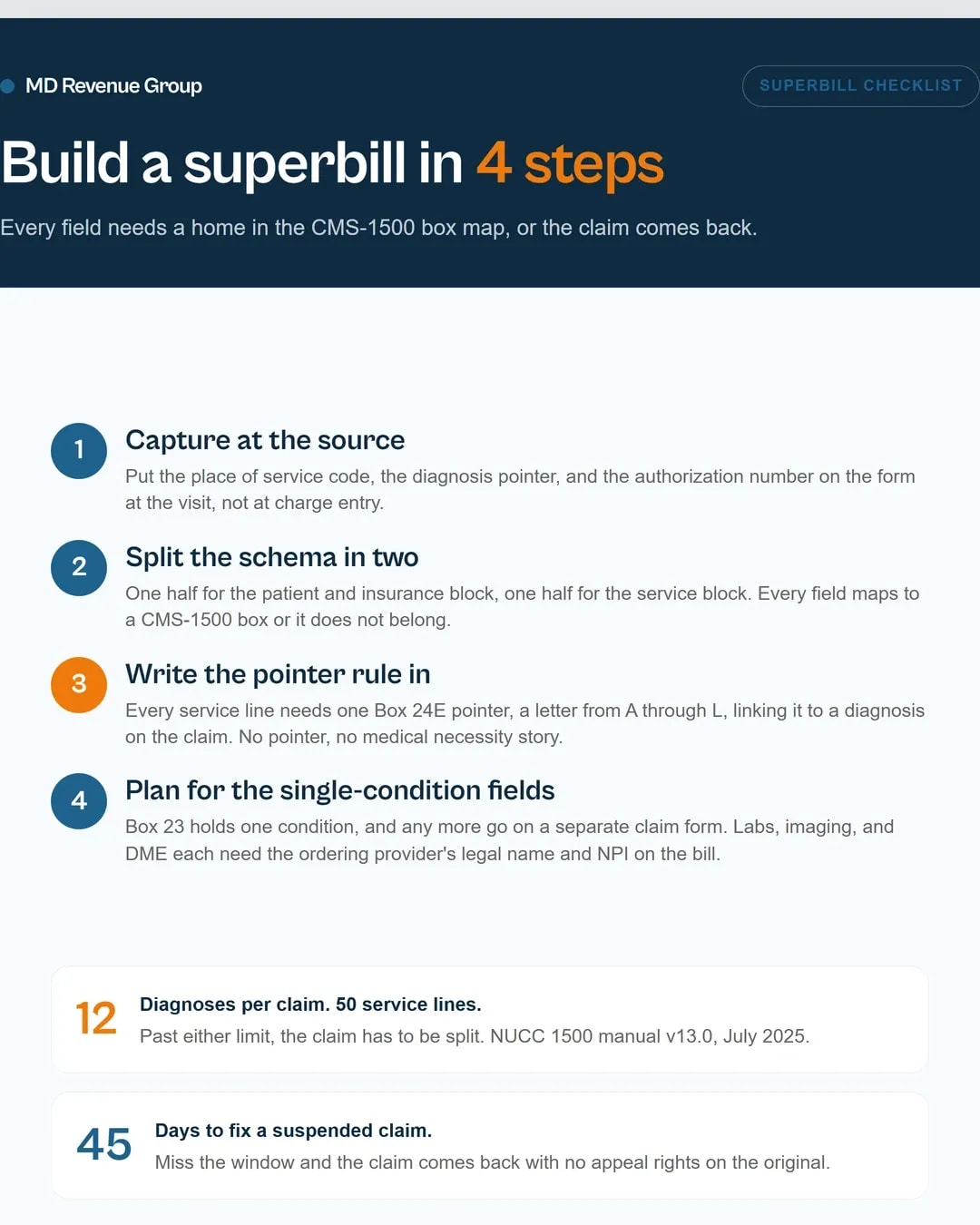
Two structural limits come from the NUCC's 1500 Reference Instruction Manual, version 13.0, July 2025. If you need more than 12 diagnoses, the claim has to be split, and the services tied to the additional diagnoses get billed on a separate claim. If you have more than 50 service lines, the claim has to be split too.
On multi-page claims, only the diagnosis codes reported on the first page may be used, and they must be repeated on every later page.
The diagnosis pointer in Box 24E is worth slowing down on. It links each charge to the diagnosis that supports it. Older paper superbill forms used a "Rank" column to do exactly this job, and mapping a modern superbill back to the CMS-1500 box is a step most teams skip. For how codes get selected and how that differs from billing, see how billing and coding connect.
What gets a claim returned instead of denied
This is the part practices get wrong, because the words sound similar and the consequences are completely different.
CMS Pub. 100-04, Chapter 1, section 80.3.1 draws the line. A claim returned as unprocessable for incomplete or invalid information "does not meet the criteria to be considered as a claim, is not denied, and, as such, is not afforded appeal rights." No appeal rights. No denial reason. No remittance advice trail on a front-end return.
Three mechanics follow.
A 45-day window, then it's gone. When a claim is suspended for development because information is missing, the provider has 45 days to send corrections and documentation. Miss that and the claim is returned.
Clean lines get paid. If all claim-level information is complete but some service lines are dirty, the contractor processes the clean lines to payment and returns only the dirty ones. One bad line on a 30-line claim can hold up the whole file.
The contractor may fill in blanks. If a conditional data element is missing but the contractor can pull it from its own files, the contractor shall not return the claim. The NPI is the exception. A missing rendering NPI gets the claim returned every time.
Here is the practical version. A claim with a missing modifier comes back, gets fixed, gets resubmitted, and you absorb the rework. A claim with a missing rendering NPI does the same, except you have no appeal rights on the original.
The difference is invisible on the surface and expensive underneath. Getting the right data into the claim the first time is the cheapest revenue protection there is.
What one wrong field costs
The Journal of AHIMA put a number on this in April 2022. The cost to rework or appeal a denial averages $25 per claim for practices and $181 per claim for hospitals.
Unresolved denials represent an average annual loss of $5 million for a hospital, up to 5% of net patient revenue. Industry averages report nearly 20% of all claims are denied, and as many as 60% of returned claims are never resubmitted. The good news in the same article: as many as two-thirds of rejected claims are recoverable.
Where the leaks sit matters too. MGMA Stat's December 1, 2020 poll, with 619 responses, asked practice leaders for the top reason for denials:
Denial root cause | Share of respondents |
|---|---|
Prior authorization | 42% |
Demographic issues | 29% |
Timely filing | 7% |
Coding issues, including wrong modifier and improper bundling | 23% of the "other" group |
Payer requirement inconsistencies | 14% of the "other" group |
Medical necessity requirements | 14% of the "other" group |
Missing information or documentation | 11% of the "other" group |
Coordination of benefits | 9% of the "other" group |
Read the top two rows again. Prior authorization and demographics are 71% of the top reason, and both are superbill fields. A missing authorization number goes in Box 23. A wrong member ID goes in Box 1a.
MGMA's own polling in January 2026 put the full leak breakdown this way: denials and appeals 48%, front end 23%, billing and collections 14%, coding 13%, charge posting 2%, across 288 responses. And first-submission denial rates have held at 7% to 8% for four straight years, which MGMA says targeted process fixes can push below 5%.
Two real cases show what fixing this looks like. The Graves Gilbert Clinic in Bowling Green, Kentucky runs about 700 authorizations a day and got denials down to an average of seven per day. Novant Health, 14 hospitals and $4.3 billion in net patient revenue, recovered $7.5 million in 15 months by fixing charge capture.
If you want a third-party read on where your own numbers fall, an RCM audit that measures first-pass resolution against clean claim rate finds what a template review can't.
The superbill fields a self-pay patient can demand
The No Surprises Act quietly wrote a second field spec, and it looks a lot like the first one.
45 CFR 149.610 governs the good faith estimate an uninsured or self-pay patient can request. The content requirements under 149.610(c)(1) include:
- Patient name and date of birth
- Description of the primary item or service in clear language, and the scheduled date
- An itemized list of items and services, grouped by each provider or facility, for the period of care
- Applicable diagnosis codes, expected service codes, and expected charges for each listed item
- Name, NPI, and TIN for each provider or facility, plus the State and office or facility location
- Required disclaimers, including the patient's right to start the patient-provider dispute resolution process
The clocks are tight. Scheduled at least 3 business days out, the estimate goes out within 1 business day of scheduling. Scheduled at least 10 business days out, within 3 business days. On request, within 3 business days. Co-provider information comes back to the convening provider within 1 business day. And the estimate counts as part of the patient's medical record, so it gets retained for 6 years.
Every field on that list already exists on a working superbill: diagnosis codes, service codes, charges, NPI, TIN, service location. Build the schema once and it serves both the payer claim and the patient estimate.
That matters more in some states than others, and the filing windows are wildly uneven. New York's Medicaid program requires claims within 90 days of the date of service, and New Mexico's is also 90 days. New Jersey gives providers a year.
If a patient hands a superbill to a plan and that plan turns out to be their state's Medicaid program, the clock you're racing is the state's window. Our New York medical billing guide covers the state program, and New Jersey's rules run the other direction entirely.
California shows how the penalty escalates. Medi-Cal has a six-month billing limit: original claims must be received within six months following the month in which services were rendered. Claims received during the 7th through 9th month after the month of service "will be reimbursed at 75 percent of the payable amount," the 10th through 12th month at 50 percent, and anything after the 12th month gets denied. A late superbill does not just risk the claim. It shrinks the payment on a schedule. More on that in California billing rules.
Build a superbill that survives an audit
Capture at the source. Put the place of service code, the diagnosis pointer, and the authorization number on the superbill template at the moment of service, not weeks later during charge entry. AAPC's guidance on superbill forms says forms must list only current and correct codes, must be updated at least once per year, and must not abbreviate code descriptions, because abbreviated descriptors lead to wrong code assignment. A separate AAPC write-up on charge capture recommends giving each provider a set of sequentially numbered charge tickets with a daily log, so a missing ticket can be identified the same day.
Split the schema into two halves. One half is the patient and insurance block, the other is the service block. Every field needs a home in the CMS-1500 map or it does not belong on the form.
Write the dx pointer rule into the form. Every line needs one pointer, a letter from A through L, linking it to a diagnosis on the claim. No pointer means no medical necessity story.
Handle the single-condition problem. Box 23 holds one condition, and any additional conditions go on a separate CMS-1500. Box 19 holds 71 characters of narrative. A practice doing labs, imaging, and DME in the same week needs somewhere to keep the ordering provider's legal name and NPI for each. CMS requires it on the itemized bill for all three categories.
Know what the superbill cannot do. A superbill or encounter form is not part of the patient's medical record, and it cannot substantiate that a service occurred. That is the guidance AAPC community forum members and AAPC experts repeat, and the point comes up in every audit. The American Society of Anesthesiologists, quoted in an AAPC coding alert, is more direct: "Billing slips or superbills do not replace the anesthesia record," and using billing slips or superbills alone to bill for anesthesia services "is not recommended," because the check-offs that are the essential elements of a billing slip "can lead to inaccurate coding."
Your superbill feeds claims. The chart is what defends the code.
Keep the code list current. CPT changes every January 1, with 418 changes in the 2026 set, 288 new codes, 84 deletions, and 46 revisions. ICD-10-CM updates twice a year. A superbill still printing last year's codes produces wrong claims.
One last trap. The patient-submitted superbill is a different document from your internal one. AAPC's guidance on emergency-department superbills points out that to "do double duty as a claim form," a superbill must carry the group's tax ID and the performing provider's number.
Frequently asked questions
What is a superbill template? A document listing the services a patient received with the codes, charges, and identifiers a payer needs to adjudicate them. Medicare publishes the required field list in the CMS-1490S instructions and again in Pub. 100-04, Chapter 1, section 80.3.2.
Is a superbill the same as a CMS-1500 claim form? No. The CMS-1500 is the claim form submitted to the payer, with 33 numbered boxes. The superbill is the internal charge document and the patient-submitted bill. The 837P electronic claim follows the same field logic as the CMS-1500.
How many diagnoses and service lines can one superbill carry? Up to 12 ICD-10-CM diagnosis codes and up to 50 service lines on one claim. More than 12 diagnoses means splitting the claim and billing the services tied to the extra diagnoses separately, per the NUCC's 1500 Reference Instruction Manual v13.0, July 2025.
Does a superbill need a place of service code? Yes, and it is one of the fields most often left off. Box 24B takes a 2-digit POS code. POS 02 means telehealth provided somewhere other than the patient's home. POS 10 means telehealth in the patient's home, and that code took effect January 1, 2022.
What is the diagnosis pointer, and do I need it on the superbill? It is Box 24E, a letter from A through L that links each service line to a diagnosis on the claim. It is a required field. Older paper superbill forms called the same column "Rank."
Can I bill from a superbill alone? No. A superbill or encounter form is not considered part of the patient's medical record and cannot be used to substantiate that a service occurred. The American Society of Anesthesiologists says billing slips and superbills do not replace the anesthesia record, and that billing from them alone is not recommended. Billing from a superbill without the underlying documentation can mean sending money back to the payer.
What does it cost when a superbill field is wrong? The Journal of AHIMA puts rework and appeal of a denial at $25 per claim for practices and $181 per claim for hospitals. Unresolved denials run about $5 million a year for a hospital, up to 5% of net patient revenue.
Can I backdate a superbill? The date of service on the form has to be the date the service actually happened. Pub. 100-04, Chapter 26 returns a claim as unprocessable when the date of service spans more than 1 day without a valid "to" date, and the timely filing clock in 42 CFR 424.44 runs from the date of service, not from the date you enter it.
Get the fields right once
Every field your superbill misses becomes rework, a returned claim, or a denied one. Send us your current form and we'll tell you which boxes it can't feed and what it would take to close the gaps. Request a free revenue audit.
See your revenue leaks in dollars.
Get a forensic 90-day cash flow audit of your practice. 100% confidential, 48-hour delivery, zero obligation.