
G2211 & APCM: The 2026 'Hidden Revenue' Codes Most Independent Practices Are Missing
Learn exactly how to implement G2211 and APCM billing codes in 2026. Stop leaving money on the table for complex patient care. Read our complete guide.
You are likely leaving thousands of dollars on the table every single month. If you treat complex patients and you are not billing the G2211 or APCM codes, your practice is losing money. This guide is built for practice owners and billers who want to capture the revenue they already earned. It cuts through the CMS jargon and gives you the exact blueprint to deploy these codes correctly.
Most billing resources just copy and paste the CMS definitions. You already know what a fee schedule is. What you need is a practical framework to stop denials and increase your clean claim rate. The 2026 rules have shifted. The payers are heavily auditing these codes. If you use them wrong, you will trigger an audit. If you use them right, you will stabilize your bottom line.
This guide is different because it focuses on execution. It gives you the exact logic to decide when to append the code and when to leave it off. It breaks down the technical data into simple steps. It shows you how to train your providers to document the visit correctly the first time.
Key Takeaways
- G2211 is not a primary code. It is an add-on code for visit complexity.
- You cannot bill G2211 with modifier 25 for minor procedures, but you can for preventive services.
- APCM models require a dedicated revenue cycle management strategy to track care coordination.
- Smart practices automate their code suggestions within the EHR.
Fast Decision-Making: How to Implement the Codes
You have three options to roll out these new codes in your clinic. Pick the one that matches your current operational bandwidth.
Find the unbundled units and modifier downcodes payers are stripping.
Payers process high-volume specialty codes differently by region. We review 50 encounters to uncover hidden downcoding and uncollected units.
Audit My Specialty Encounters →If you are a beginner to complex billing, start small. Focus entirely on G2211 for your established Medicare patients. Do not touch commercial payers yet. Train your providers to document the longitudinal care relationship. Add the code manually to the superbill. Measure the denial rate after thirty days.
If you have a high-potency billing team, turn on automated EHR alerts. Program your software to flag any level four or five visit for a potential G2211 addition. Your team should cross-reference the diagnosis codes to ensure medical necessity. This approach captures the revenue without slowing down the provider.
If you manage a daily high-volume clinic, outsource the logic. You cannot afford to slow down a provider seeing forty patients a day. Let a medical billing services team review the charts on the back end. They will append the correct codes and handle the appeals. This keeps your doctors focused on patients.
The Practical Buyer Checklist for RCM Tools
If you want software to catch these missing codes, use this checklist to avoid bad investments.
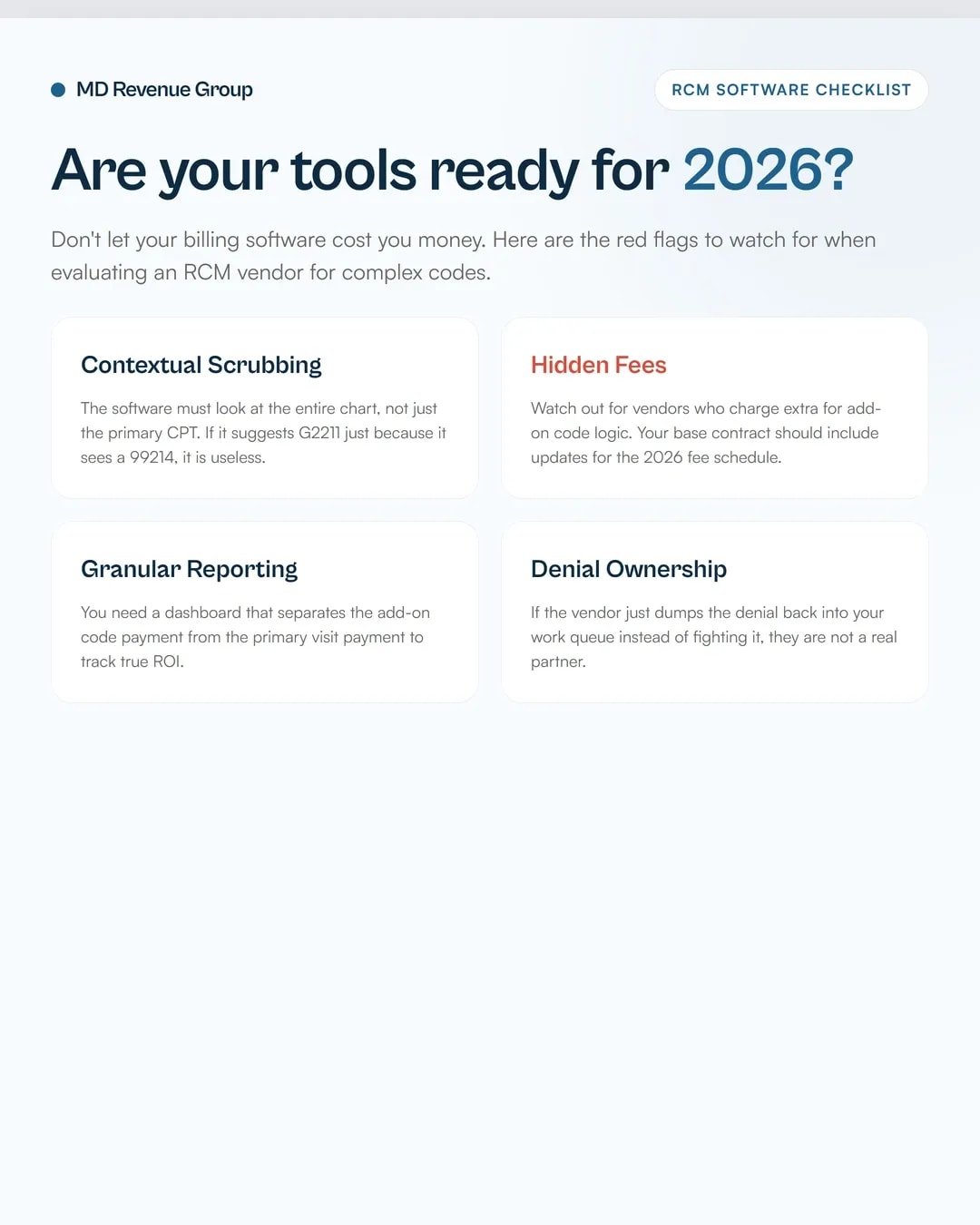
Look for contextual code scrubbing. The software must look at the entire chart, not just the primary CPT. If it suggests G2211 just because it sees a 99214, it is useless. It must verify the primary care relationship.
Watch out for vendors who charge extra for add-on code logic. Your base contract should include updates for the 2026 fee schedule. This is a massive red flag. Do not sign a contract that penalizes you for regulatory changes.
Check their reporting features. You need a dashboard that shows exactly how many times G2211 was billed and how many times it was paid. If the tool cannot separate the add-on code payment from the primary visit payment, do not buy it.
Ask about their denial management process. When a payer incorrectly denies APCM billing, who fights it? If the vendor just dumps the denial back into your work queue, they are not a real partner. They are just a software layer.
The Real Cost of Misusing G2211 (Reimbursement Data)
The financial impact of G2211 is too large to ignore. In 2026, the Medicare reimbursement for G2211 sits at approximately $16.40 to $16.45 per visit (depending on the conversion factor and your locality's GPCI adjustment). It carries a total non-facility RVU of 0.33 (work RVU) leading to roughly a 0.49 total RVU.
While $16 may seem small, it scales aggressively. If a provider sees 20 eligible Medicare patients a day, that is an extra $328 daily, or roughly $80,000 annually per provider. The OIG and CMS are heavily monitoring this code because of its massive impact on the Medicare trust fund. Effective January 1, 2026, CMS expanded the use of G2211 to include home or residence E/M visit codes (99341–99350), opening a massive new revenue channel for mobile providers.
The Modifier 25 Trap: How to Guarantee a Denial
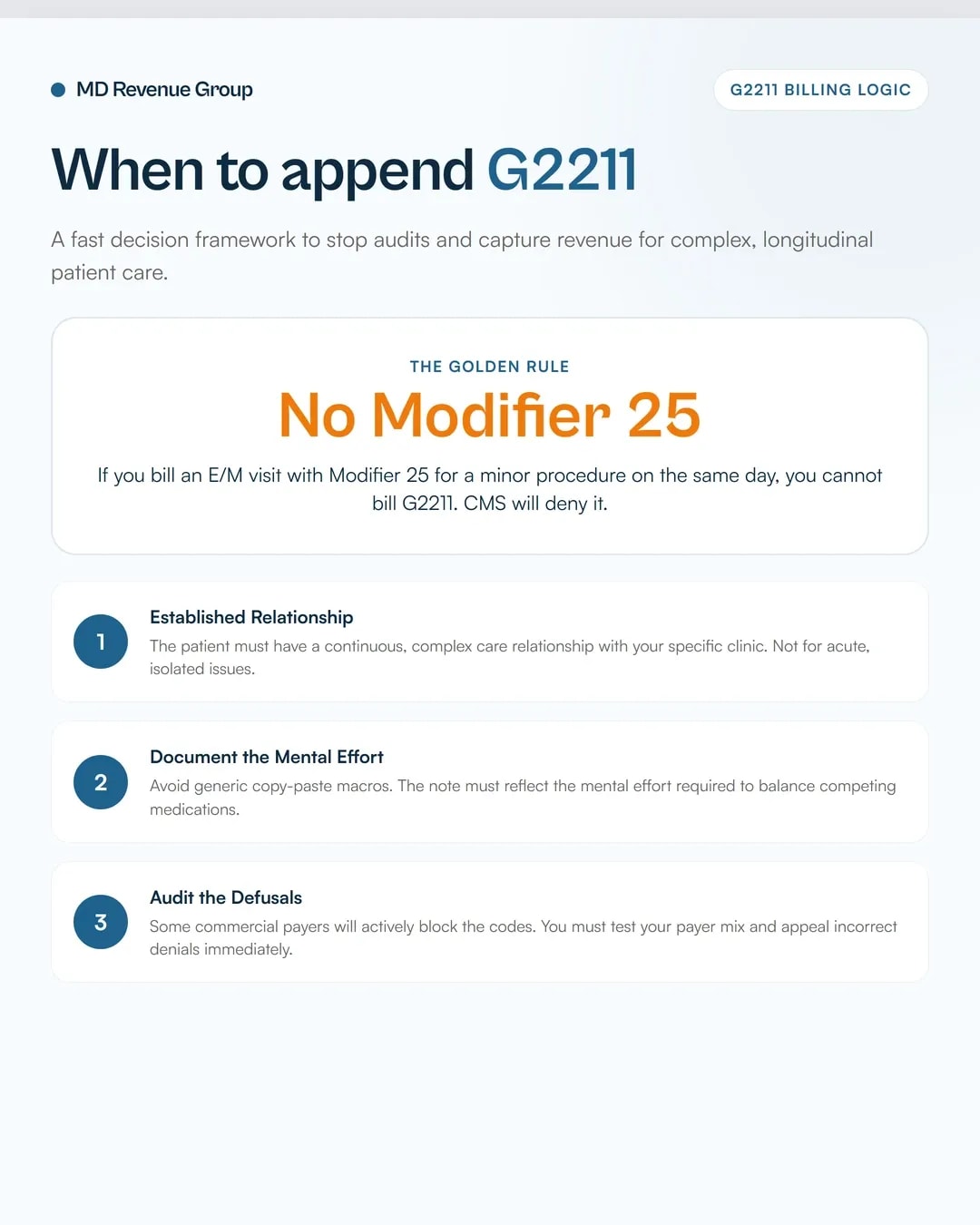
If your claims are getting denied, you are likely falling into the Modifier 25 trap. The rules are absolute: you cannot bill G2211 on the same claim as an office/outpatient E/M visit that is appended with Modifier 25 for a minor procedure.
If you bill a minor 0- or 10-day global procedure (like a skin biopsy or joint injection) and try to append Modifier 25 to the E/M code along with G2211, the clearinghouse or CMS will automatically deny the add-on code. CMS explicitly views the practice expense for the procedure as overlapping with the complexity code.
The Modifier 25 Lookup Grid:
- Same-day procedure (0-day global): E/M + 25 (Skip G2211)
- Same-day AWV / Preventive Service: E/M + AWV + G2211 + 25
- Pure continuity visit: E/M + G2211
The sole scenario where CMS permits G2211 with Modifier 25 is when the practitioner furnishes a qualifying Part B preventive service, vaccine administration, or an Annual Wellness Visit (AWV) on the exact same date of service.
Documentation Requirements That Survive an Audit
An audit is inevitable. When CMS pulls your charts, your documentation cannot just list chronic diseases. The core requirement for G2211 is establishing that you are the "continuing focal point" for all needed health care services.
Your documentation must explicitly state the longitudinal nature of the relationship. A single, isolated visit for an ankle sprain does not qualify. The chart note must reflect the mental effort required to manage the patient's ongoing, complex care. If your providers are copying and pasting generic macros like "managing chronic conditions," an auditor will claw back the payments.
Instead, train your providers to use this specific documentation macro: "I am serving as the continuing focal point for this patient's health care. Today's visit involved the ongoing management of [Specific Chronic Condition], adjusting the care plan established on [Prior Visit Date]."
You must prove the complexity of the specific visit. Use a forensic RCM audit to validate your assumptions and ensure your templates are compliant before an external auditor does.
APCM Tiers Explained: G0556, G0557, and G0558
The new Advanced Primary Care Management (APCM) codes radically shift how practices bill for care coordination. Unlike traditional Chronic Care Management (CCM) or Principal Care Management (PCM), APCM eliminates the tedious, error-prone minute-tracking.
Instead of tracking time, APCM is billed monthly based on patient complexity tiers:
Code | Chronic conditions | 2026 rate/month |
|---|---|---|
G0556 | 0-1 | ~$16 |
G0557 | 2+ | ~$54 |
G0558 | 2+ AND QMB status | ~$117 |
The CCM Comparison Trap: Many practices compare G0557 directly to the old CCM codes (99490 + 99439) and miscalculate the financial impact. A patient generating 40 minutes of CCM contact time collected around $106 per month under the old system, versus about $54 under APCM's flat rate. If you blindly switch without analyzing your staff's actual time tracking, you could be giving up revenue. This level of complexity is exactly why smart practices rely on expert billing partners to run the numbers.
In 2026, CMS expanded this program further by introducing Behavioral Health Integration (BHI) add-on codes (G0568, G0569, G0570), allowing practices to layer behavioral health services directly on top of the APCM framework.
The Stacking Math: Calculating the Revenue Lift
APCM is not time-based. To bill it, your practice must demonstrate capacity across 13 core service elements (e.g., providing 24/7 access to care, comprehensive care plan development, and active care coordination). You cannot bill APCM concurrently with CCM, PCM, or Transitional Care Management (TCM) in the same month. However, it can be billed alongside Remote Patient Monitoring (RPM).
Consider the stacking math for a realistic primary care panel. A practice with 500 Medicare patients on the standard APCM tier (G0557) generates roughly $27,000 monthly, or about $324,000 annually. Layering RPM on 200 of those patients adds close to $19,800 more per month. That is a massive revenue lift that completely bypasses the traditional fee-for-service grind.
Top Recommendations for Your Practice
For the independent primary care clinic, you must own these codes. Your entire business model is based on longitudinal care. Train your front desk to verify Medicare status. Train your providers on the documentation. Use these codes on every single eligible visit.
For the specialized surgeon, ignore G2211. Your care is episodic. You fix the problem and discharge the patient back to their primary doctor. Attempting to force these codes into a surgical practice will trigger an immediate compliance audit. Do not risk your license for a tiny add-on fee.
For the busy internal medicine group, consider outsourcing. The rules change too fast. You need experts who do nothing but track payer policy updates. Average practices read an article about new billing codes and send a mass email to their staff. Smart practices rely on systems. Calculate your potential lift using our revenue integrity calculator to see if outsourcing makes financial sense for your specific patient panel.
Why Your Documentation Strategy Fails
Your documentation fails because it sounds robotic. Providers often copy and paste the same macro for every single patient. They write a generic sentence about managing chronic conditions. Auditors spot this immediately.
You must prove the complexity of the specific visit. The note must reflect the mental effort required to balance three competing medications. It must mention the time spent coordinating care with a cardiologist. It must show actual human thought.
If the chart note looks identical to a note from six months ago, the payer will deny the higher-level code. They use algorithms to detect copy-and-paste behavior. You have to write fresh, patient-specific updates.
Handling Audits and Payer Pushback
Payers will automatically deny these claims at first. They want to see if you will appeal. They assume most practices will just write off the balance.
You must appeal every single incorrect denial. Build an appeal template that quotes the exact CMS policy manual. Attach the progress note highlighting the longitudinal care statement. Send it back immediately.
Track your success rate by payer. If a specific commercial payer denies 100% of these codes, stop billing them to that payer. Focus your energy on the payers who actually follow the federal guidelines. Use data to drive your billing strategy.
G2211 and APCM Billing FAQs
What exactly is the G2211 code? It is a Medicare add-on code for evaluation and management visits. It pays you for the extra complexity of acting as the continuing focal point for a patient's care.
Can I bill G2211 with an AWV? Yes. This is the primary exception to the Modifier 25 rule. You can bill an E/M code, append Modifier 25, and include both the AWV code and the G2211 add-on.
What is the difference between G0557 and G0558? Both codes are for Advanced Primary Care Management for patients with two or more chronic conditions. However, G0558 is specifically billed when the patient is also a Qualified Medicare Beneficiary (QMB). Because QMB patients often require more intense care coordination, G0558 reimburses at a significantly higher rate (approx $117 vs $54).
Can specialists use this code? Yes. If a specialist is treating a complex, ongoing condition like rheumatoid arthritis, they can use it. The key is the ongoing, continuous relationship, not the specific medical degree.
Why does Medicare deny G2211 with Modifier 25? CMS believes the practice expense is already covered in the minor procedure fee. They will not pay twice for the same overhead cost.
Do commercial payers accept these codes? It varies widely. Some adopt the Medicare rules immediately. Others actively block the codes. You must test your specific payer mix to find out.
How much does G2211 pay? In 2026, the national reimbursement rate for G2211 is approximately $16.40 to $16.45 per visit, carrying a non-facility RVU of roughly 0.49. While the exact rate depends on your geographic location (GPCI), it adds up to significant revenue. It averages $80,000 annually for a busy primary care provider.
What documentation is required to avoid an audit? You must document the continuous nature of the patient relationship. The note must explicitly state how you are managing their comprehensive care over time.
Should we update our EHR templates? Yes. You should build prompts that remind providers to document the longitudinal care elements. Do not automate the code assignment without provider verification.
What is the biggest mistake practices make with these codes? They apply the code to every single visit automatically. This is a massive compliance risk. You must evaluate each visit for medical necessity.
See your specialty billing leaks in dollars.
Get a free 50-claim forensic specialty audit with your exact regional MAC and commercial payer policies applied.