
The CY 2027 Medicare Physician Fee Schedule Proposed Rule: Action Plan for Practices
CMS just released the CY 2027 Medicare Physician Fee Schedule proposed rule. Learn about the conversion factor cuts, same-day E/M cuts, and G2211 modifier.
On July 14, 2026, the Centers for Medicare & Medicaid Services (CMS) released the CY 2027 Medicare Physician Fee Schedule proposed rule, proposing significant reimbursement cuts and sweeping policy changes. If finalized, these policies will take effect on January 1, 2027, forcing independent medical practices to restructure their billing workflows to avoid massive revenue losses.
This update introduces a compounding conversion factor reduction alongside a structural overhaul of how modifier 25 same-day procedures and the G2211 complexity code are reimbursed. Practices must act during the 60-day public comment window, which closes on September 14, 2026, to protect their bottom line.
This guide breaks down the core proposals in the CY 2027 Medicare Physician Fee Schedule proposed rule. You will find specific calculations of the financial impacts, step-by-step action plans to prepare, and literal clinical documentation templates to survive upcoming audits.
Key takeaways
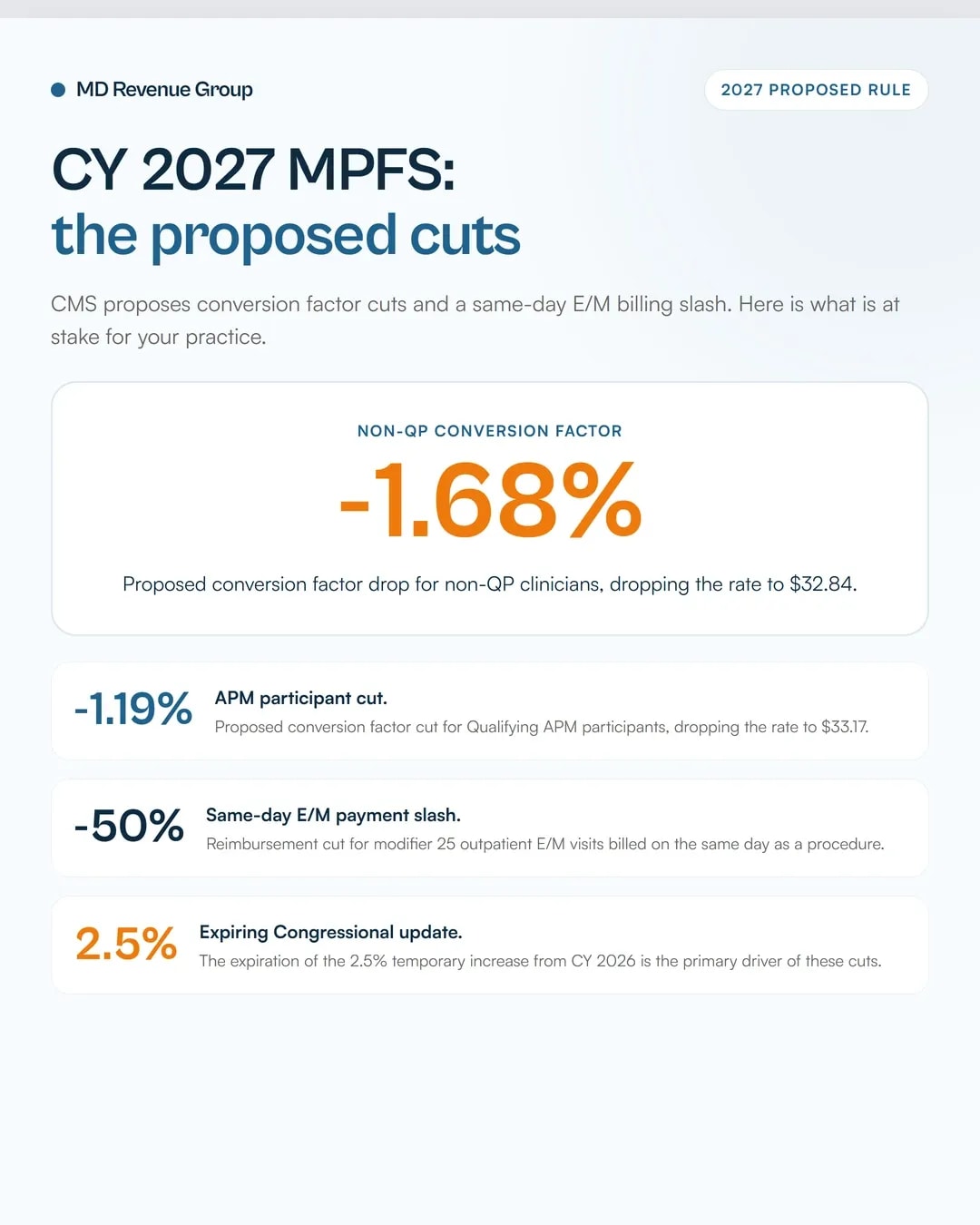
- Conversion Factor Cuts: Non-Qualifying APM clinicians face a proposed 1.68% conversion factor reduction to 33.17.
- Modifier 25 Slash: CMS proposes reducing payment by 50% for the lower-valued service when a separately identifiable outpatient E/M visit is billed on the same day as a procedure with a global period.
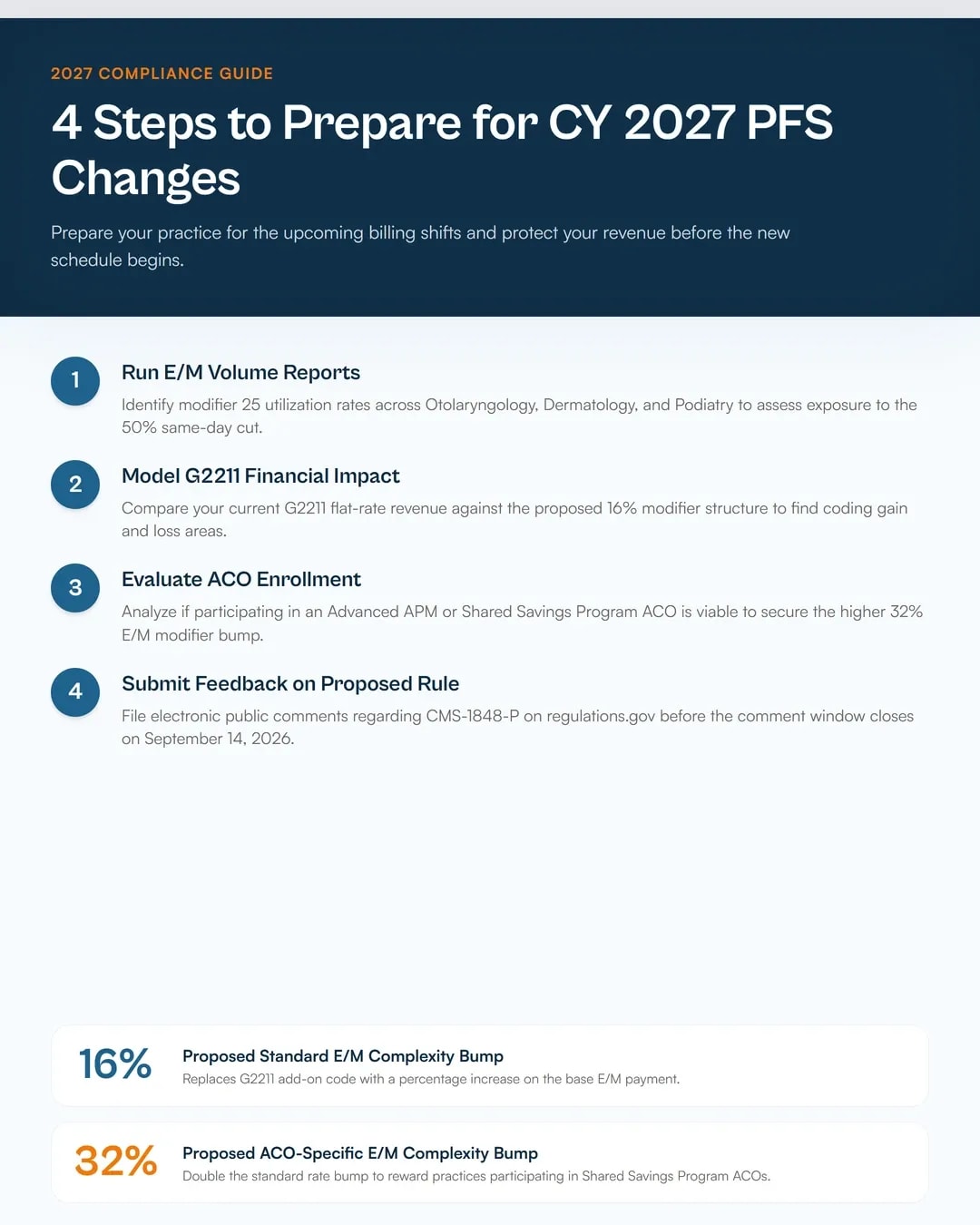
- G2211 to Modifier: The standalone G2211 add-on code is scheduled for deletion, replaced by a 16% modifier bump on the E/M base code (increasing to a 32% bump for ACO-enrolled practices).
- Wound Care Pricing: Non-sheet skin substitutes transition from local contractor pricing to national standardized rates billed strictly by treated wound surface area in square centimeters.
- New Imaging Code: A new Category I CPT code, 976XX, will establish national Medicare valuation for real-time fluorescence wound imaging services.
What is the proposed conversion factor for CY 2027?
The primary driver of the proposed payment drop is the expiration of a 2.5% temporary physician payment increase enacted by Congress for CY 2026. While the statutory formula includes small positive updates required by the Medicare Access and CHIP Reauthorization Act (MACRA), these updates fail to cover the loss of the temporary adjustment.
CMS is required by statute to establish two separate conversion factors based on participation in Advanced Alternative Payment Models (APMs). The proposed rates for 2027 are:
- Qualifying APM Participants (QPs): A proposed conversion factor of 33.5675.
- Non-Qualifying APM Participants: A proposed conversion factor of 33.4009.
These reductions do not happen in a vacuum. They accumulate on top of multiple years of statutory cuts and rising practice inflation. The American Medical Association (AMA) has repeatedly warned that the current Medicare physician payment system is financially unsustainable for independent practices, as inflation-adjusted Medicare payment rates fell 29% between 2001 and 2026.
If your practice does not actively manage its billing, these base rate reductions will quietly erode your margins. Securing expert revenue cycle management is the first step to ensuring your workflows capture every dollar you are legally owed.
How does the proposed 50% same-day E/M and global procedure rule work?
CMS proposes a policy that directly targets office or outpatient E/M visits billed with modifier 25 on the same day as a minor procedure. The proposal covers any procedure with a 0-, 10-, or 90-day global period when performed by the same physician or a physician in the same group practice.
Under the new rule, the highest-valued service (the procedure or the E/M visit) is reimbursed at 100% of the Medicare Physician Fee Schedule rate. The lower-valued service is reduced by 50%.
CMS argues that this policy eliminates payment duplication. They claim that performing an E/M and a procedure in the same visit creates natural operational efficiencies. However, this policy is not new; CMS introduced a similar proposal in the CY 2019 proposed rule but did not finalize it due to industry pushback.
Specialties that routinely perform minor procedures during office visits will bear the brunt of this cut. Specifically, dermatology, otolaryngology, and podiatry are the most vulnerable.
For example, a dermatologist who evaluates a patient's rash and performs a minor skin biopsy during the same visit will see their E/M payment cut in half. To mitigate this exposure, you should consider partnering with a specialized dermatology billing services provider who knows how to structure complex same-day claims. Similarly, foot and ankle specialists will need to work with podiatry medical billing experts to adapt their templates.
The G2211 modifier transition: Flat-rate to percentage bump
In a major structural shift, CMS proposes deleting the standalone HCPCS code G2211. Introduced in 2024, G2211 was a flat-rate add-on code meant to reimburse providers for the additional resources needed to manage complex or longitudinal patient care during outpatient visits.
In CY 2026, billing G2211 added approximately $16.37 to a qualifying E/M visit. CMS now proposes converting G2211 into a percentage-based modifier. This transition alters the billing math:
- Standard Modifier: Appending the new complexity modifier will add a 16% payment bump to the base E/M code.
- ACO-Specific Modifier: Clinicians participating in a Shared Savings Program ACO or the LEAD Model get a special modifier that adds a 32% payment bump to the E/M base code.
CMS designed the ACO-specific modifier to reward practices for participating in value-based care models. The 32% increase reflects the higher time and intensity required to manage longitudinal care within an ACO.
This percentage structure means your revenue depends directly on the level of E/M service you document. High-complexity visits yield more revenue under the modifier system, while low-level visits yield less than the historical flat-rate code.
To maximize this structure, your providers must document accurately to support higher-level codes when appropriate. Relying on professional medical billing services ensures your coding team applies these percentage bumps correctly without triggering audits.
The G2211 Revenue Transition Model: Who wins and who loses?
Because the G2211 payment shifts from a flat fee to a percentage-based modifier, your E/M code distribution will determine if your practice gains or loses revenue. The table below compares 2026 national average payments (flat G2211) against the proposed 2027 standard (16% modifier) and ACO (32% modifier) structures for non-facility (office) settings, using the proposed non-QP conversion factor of $32.8409.
Outpatient E/M Code | 2026 Base + G2211 | Proposed 2027 Base | 2027 Standard (16% Bump) | Net Change (Standard vs 2026) | 2027 ACO (32% Bump) | Net Change (ACO vs 2026) |
|---|---|---|---|---|---|---|
99213 (Level 3) | $106.46 | $88.01 | $102.09 | -$4.37 (-4.1%) | $116.17 | +$9.71 (+9.1%) |
99214 (Level 4) | $151.98 | $133.33 | $154.66 | +$2.68 (+1.8%) | $176.00 | +$24.02 (+15.8%) |
99215 (Level 5) | $198.40 | $178.98 | $207.62 | +$9.22 (+4.6%) | $236.25 | +$37.85 (+19.1%) |
To see how this works in practice, let us model a real-world scenario. Consider an independent family medicine physician who bills 3,000 Medicare outpatient E/M visits per year. Their typical code distribution is:
- 99213 (Level 3): 30% of visits (900 claims)
- 99214 (Level 4): 60% of visits (1,800 claims)
- 99215 (Level 5): 10% of visits (300 claims)
Let us calculate the annual revenue difference for this physician across three payment structures:
- CY 2026 Payment Structure:
- 900 Level 3 visits: 900 * 95,814
- 1,800 Level 4 visits: 1,800 * 273,564
- 300 Level 5 visits: 300 * 59,520
- Total Annual Revenue: $428,898
- Proposed CY 2027 Standard (16% Modifier) Structure:
- 900 Level 3 visits: 900 * 91,881
- 1,800 Level 4 visits: 1,800 * 278,388
- 300 Level 5 visits: 300 * 62,286
- Total Annual Revenue: $432,555
- Net Impact: An increase of $3,657 (a minor 0.85% gain).
- Proposed CY 2027 ACO (32% Modifier) Structure:
- 900 Level 3 visits: 900 * 104,553
- 1,800 Level 4 visits: 1,800 * 316,800
- 300 Level 5 visits: 300 * 70,875
- Total Annual Revenue: $492,228
- Net Impact: An increase of $63,330 (a massive 14.76% gain).
The calculation proves that standard practices billing mostly Level 3 visits will lose money under the proposed rule. However, practices that transition to value-based care or join an ACO stand to gain significantly. If you need to evaluate your credentialing status for ACO participation, professional physician credentialing services can expedite your enrollment before the new fee schedule begins.
What are the proposed updates for skin substitutes and wound care?
CMS is introducing major changes to wound care reimbursement. For skin substitutes, CMS proposes moving non-sheet products from local Medicare Administrative Contractor (MAC) pricing to a standardized national pricing methodology.
Under this proposal, non-sheet products will be reimbursed at the same per-square-centimeter rate as traditional sheet-form products. CMS states that its analysis shows the direct resource costs for both types are comparable. CMS also proposes that billable units must reflect the actual surface area of the treated wound, rather than the total size of the opened product.
In addition to skin substitute changes, CMS proposed a national payment rate for a new Category I CPT code, 976XX, to represent real-time fluorescence wound imaging. This technology allows clinicians to visualize bacterial load and make immediate treatment decisions during debridement.
Wound care clinics must adjust their billing codes and documentation to reflect these changes. Relying on a specialized wound care medical billing partner is the best way to handle these shifting rules and secure accurate reimbursement for advanced treatments.
How to audit your billing and prepare for CY 2027 compliance
Because the proposed rule introduces multiple payment cuts, your practice must perform an audit to identify and mitigate financial risk. The table below shows a decision framework for evaluating your same-day procedure billing under the proposed 50% modifier 25 rule.
Scenario | Modifier 25 Requirement | Proposed CY 2027 Payment Impact | Compliance Action Plan |
|---|---|---|---|
E/M and minor procedure are related to the same clinical issue | Modifier 25 is not allowed. Do not bill E/M. | Only the procedure is paid. E/M is denied. | Bill only the procedure. Do not submit an E/M code. |
E/M is significant and separately identifiable from the minor procedure | Append Modifier 25 to the E/M code. | The lower-valued service is cut by 50%. | Ensure E/M documentation stands completely alone. |
Patient receives E/M and a major surgery (90-day global) on the same day | Append Modifier 25 to the E/M code. | The lower-valued service is cut by 50%. | Doc must prove the E/M decided the need for surgery. |
To defend your modifier 25 billing in an audit, your clinical notes must be literal and distinct. Do not use copied templates. The clinical documentation template below shows the level of detail required:
[CLINICAL ENCOUNTER DATE]
CHIEF COMPLAINT: Patient presents for evaluation of a new, changing lesion on the left forearm.
HISTORY OF PRESENT ILLNESS: Patient reports the lesion appeared 3 months ago, has doubled in size, and bleeds occasionally.
PHYSICAL EXAMINATION: Visual inspection reveals a 6mm asymmetrical plaque with irregular borders and color variation on the left volar forearm.
ASSESSMENT: Suspected atypical nevus vs. malignant melanoma.
DECISION: E/M evaluation completed. Discussed risks of biopsy vs. observation. Patient consented to immediate shave biopsy.
--- PROCEDURAL NOTE (DOCUMENTED SEPARATELY) ---
PROCEDURE: Shave biopsy of left volar forearm lesion (6mm).
METHOD: Sterile prep, local anesthesia with 1% lidocaine with epinephrine (1.0 cc). Shave excision performed to obtain deep specimen. Hemostasis achieved via aluminum chloride. Sterile dressing applied.
SPECIMEN: Sent to pathology for histologic diagnosis.
By keeping your procedural notes physically separate from your E/M documentation, you provide clear proof to auditors that the evaluation was significant and separately identifiable.
Submit comments on CMS-1848-P before the deadline
The CY 2027 Medicare Physician Fee Schedule proposed rule is open for public comment until September 14, 2026. This is your chance to voice your concerns to CMS before these proposals are finalized in November. Independent practices should submit detailed feedback, particularly regarding the financial burden of the 50% modifier 25 same-day procedure reduction.
You can submit comments electronically through the Federal Regulations portal at regulations.gov by searching for docket number CMS-1848-P. Make sure to reference specific proposed sections and provide data on how these changes will impact patient access to care in your community.