
Behavioral Health Integration Billing: New CMS Codes That Most Practices Aren't Using
BHI billing explained: CPT 99484, 99492-99494, 2026 reimbursement rates, and why most practices leave this revenue on the table.
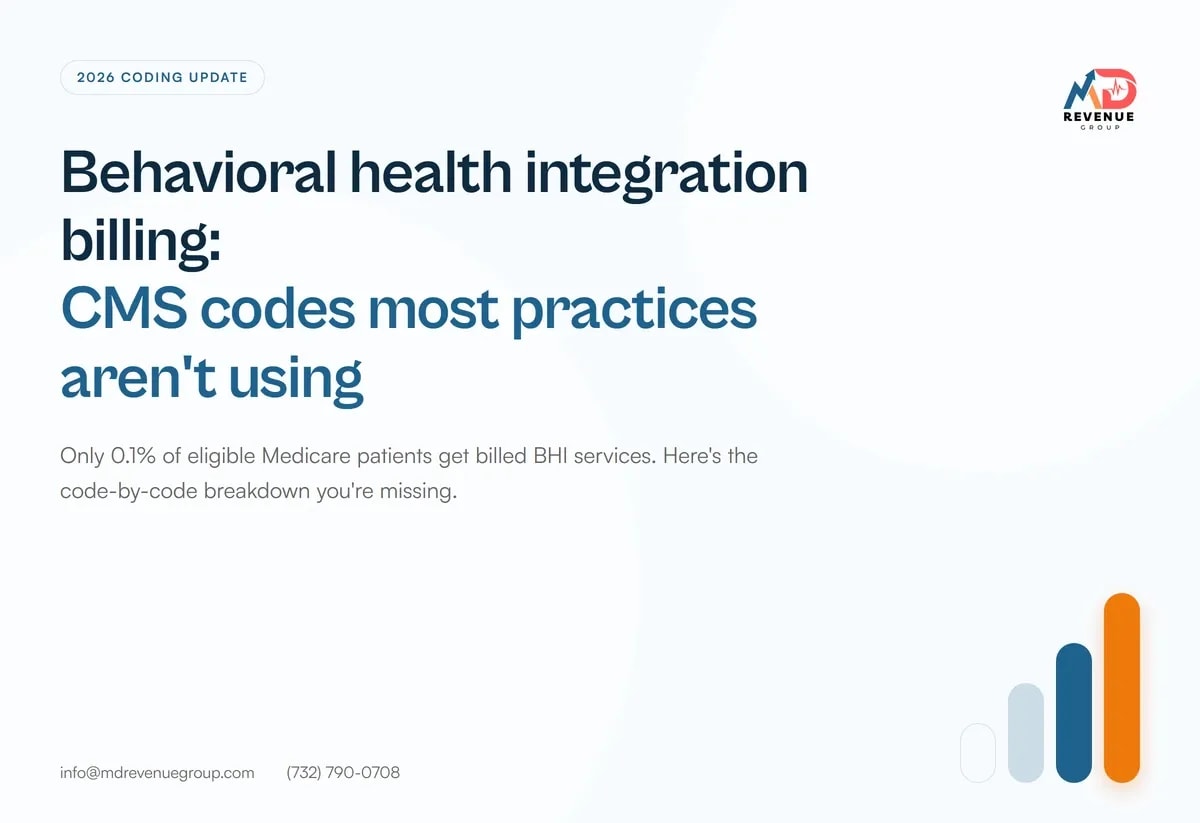
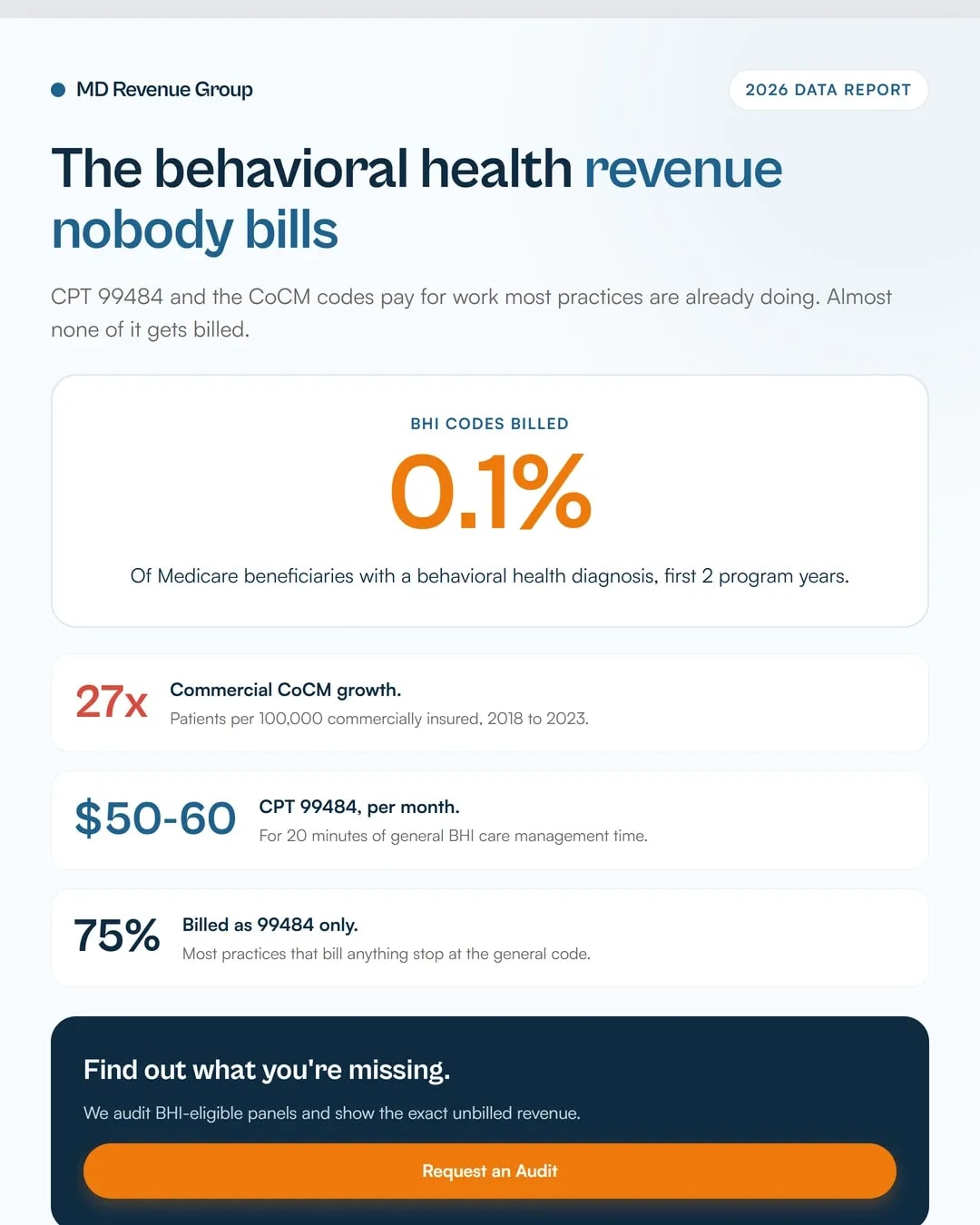
The core codes are CPT 99484 (General BHI) and CPT 99492/99493/99494 (Psychiatric Collaborative Care), each with distinct time requirements and reimbursement rates. General BHI pays roughly $50-60 per patient per month for 20 minutes of care management. CoCM pays $140-160 for the first 70 minutes, then $120-140 for subsequent months, plus $65 per additional 30-minute unit.
Almost nobody bills them. A peer-reviewed observational study of Medicare claims found that only 0.1% of beneficiaries with a documented behavioral health diagnosis received a billed BHI service in the program's first 2 years. If your practice screens for depression or anxiety, refers patients to a therapist, or has a nurse checking in on psychiatric medication compliance, you're already doing the clinical work these codes pay for. You're just not billing it.
This guide breaks down what changed for 2026, who qualifies, exactly how to bill each code, and what happens if you bill them wrong.
Key takeaways
- CPT 99484 pays $50-60/month for 20 minutes of behavioral health care management. CoCM (99492/99493/99494) pays $140-160 for the initial month and $120-140 for subsequent months.
- Only 0.1% of Medicare beneficiaries with a behavioral health diagnosis received a billed BHI service in the program's first 2 years, per a peer-reviewed claims study published in PMC.
- CMS raised 99484 reimbursement roughly 12% in 2025 and opened BHI billing to Rural Health Clinics and FQHCs for the first time.
- Starting January 1, 2026, FQHCs must report individual CoCM service codes, including every add-on unit, instead of a single bundled rate.
- CoCM is the most frequently clawed-back behavioral health service in audit engagements because practices bill it without a time-stamped registry or a named psychiatric consultant.
What changed for 2026
CMS finalized a 3.85% increase to overall physician reimbursement for CY 2026, the first increase after 5 straight years of cuts. Behavioral health integration codes got specific attention beyond that base bump.
CMS created new G-codes that function as add-ons to Advanced Primary Care Management (APCM) services, letting practices bill BHI or CoCM work alongside APCM in the same month when the same practitioner performs both. That's a direct response to primary care practices already doing chronic care management and behavioral health work but billing only one of the two.
FQHCs and RHCs picked up a real change too. As of January 1, 2026, they must report individual CoCM service codes, including add-on units, instead of billing a bundled encounter rate. That's more administrative work up front, but it also means FQHCs can now capture revenue for the add-on time (99494) that the old bundled rate never accounted for.
None of this changes the core code set. 99484, 99492, 99493, and 99494 are unchanged in structure. What changed is who can bill them, how much they pay, and how precisely they need to be reported.
Who can bill behavioral health integration codes
General BHI (99484) can be billed by physicians, nurse practitioners, physician assistants, and clinical psychologists, using clinical staff time under general supervision. There's no psychiatrist requirement. The requirements are a documented care plan, a behavioral health condition, and 20 minutes of qualifying staff time in a calendar month.
CoCM (99492-99494) requires 3 specific roles: a treating provider (usually primary care), a behavioral health care manager, and a designated psychiatric consultant who reviews the caseload on a regular cadence, even without seeing the patient directly. That third role is where most practices stall out. It doesn't have to be a full-time hire. Many practices contract a psychiatric consultant for a few hours a month specifically to support CoCM caseload review.
As of 2025, both code sets are billable by Rural Health Clinics and Federally Qualified Health Centers, which previously couldn't capture this revenue under Medicare's payment structure. If you run a RHC or FQHC and haven't updated your fee schedule since that change, you're leaving money on the table right now.
The code-by-code breakdown
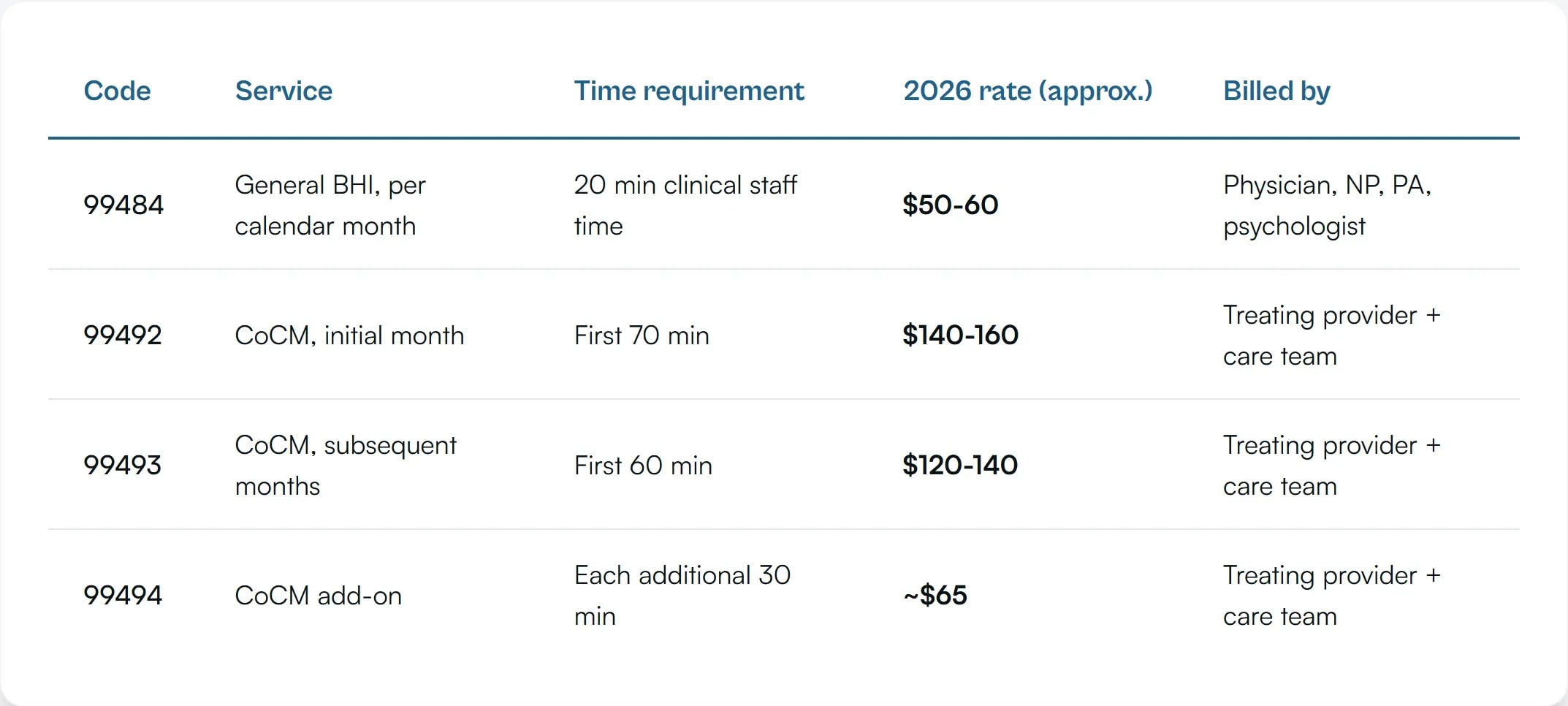
99484 is a monthly code, not a per-visit code. You bill it once per calendar month regardless of how many contacts happened, as long as the cumulative staff time hits 20 minutes and the care plan is documented.
CoCM time is cumulative across the whole care team, not just the psychiatric consultant. A behavioral health care manager's phone calls, chart reviews, and care coordination all count toward the 70-minute or 60-minute threshold. Most practices under-bill CoCM because they only track the psychiatrist's time, not the care manager's.
99494 is where the real revenue sits for high-acuity patients. A patient in an active CoCM episode with a medication change or crisis contact easily generates 2-3 units of 99494 in a single month. Practices that don't track time granularly miss this every time.
What practices must do before billing these codes
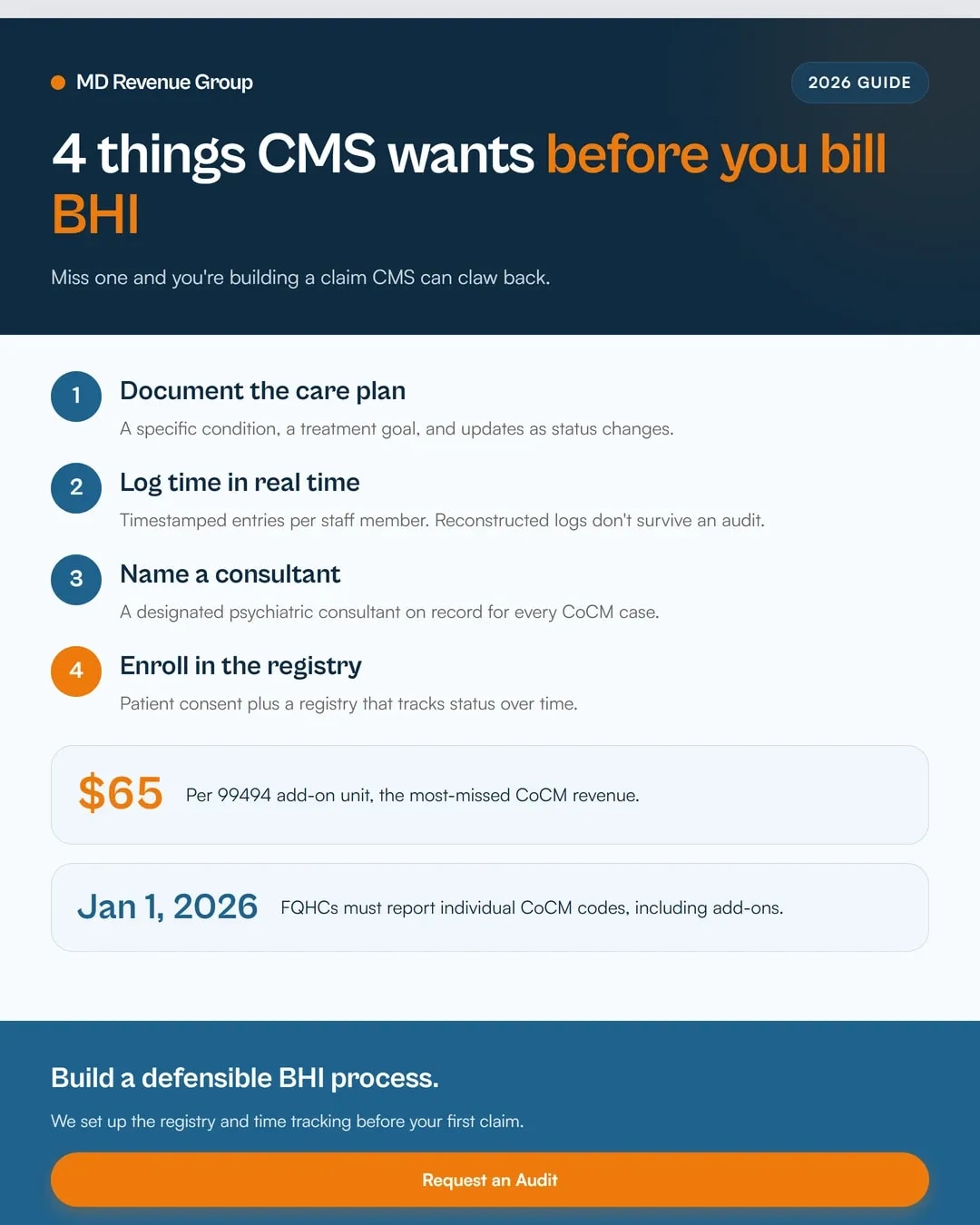
You need 4 things in place before your first BHI or CoCM claim goes out, and CMS will ask for all 4 if you're ever audited.
A documented care plan. This isn't a note that says "patient has anxiety, discussed treatment." CMS wants a specific behavioral health condition, a treatment goal, and a plan that gets updated as the patient's status changes.
A time log, not an estimate. Every minute billed under 99484 or the CoCM codes needs to trace back to a specific staff member, a specific date, and a specific activity. "Approximately 25 minutes this month" doesn't hold up. A timestamped entry for each phone call, chart review, or care coordination task does.
A designated psychiatric consultant on record for CoCM. Name them in your documentation. If you rotate consultants, document the handoff. Auditors specifically look for whether the consultant relationship is real and ongoing, not a name on a contract nobody talks to.
Patient consent and a registry. CoCM requires patients be entered into a registry that tracks their status over time, and CMS requires documented consent for the care management relationship, including any applicable cost-sharing.
Audit risk: why CoCM gets clawed back more than any other behavioral health code
CoCM has a real evidence base behind it. Commercial CoCM adoption grew roughly 27-fold between 2018 and 2023, from 2.2 to 58.8 patients per 100,000 commercially insured individuals, according to a study published in Psychiatric Services. Payers believe in this model. That's not the problem.
The problem is documentation. CoCM is consistently flagged as the single most frequently miscoded, under-documented, and clawed-back behavioral health service in audit engagements. If a practice bills CoCM without a time-stamped registry, a named psychiatric consultant, and a defensible monthly time log, that's not a technicality an auditor overlooks. It's a full recoupment.
Here's what that looks like in practice. A primary care group in the Midwest started billing 99492 and 99493 in 2024 after a behavioral health care manager joined their staff. They had the clinical relationship right: a psychiatrist reviewed cases monthly, a care manager tracked patients, and outcomes improved. What they didn't have was a consistent time log tied to individual staff members. When a commercial payer audited a sample of claims, they couldn't produce minute-by-minute documentation for about a third of the billed months. The payer clawed back those claims and put the practice on a documentation improvement plan before allowing future CoCM billing.
The fix isn't complicated. It's a shared tracking sheet or your EHR's care management module, updated in real time instead of reconstructed at month-end.
Action steps to start billing BHI this quarter
Start with a chart review, not a policy change. Pull 20 charts from patients with a behavioral health diagnosis on file and check whether your staff is already doing 20 minutes of qualifying work monthly. Most primary care practices find they're already doing the clinical work for 99484 on a meaningful chunk of their panel.
If you have or can contract a psychiatric consultant for even a few hours a month, evaluate CoCM for your highest-acuity behavioral health patients first. Those are the patients generating the most 99494 add-on units and the clearest documentation trail.
Build the time log before you bill the first claim, not after. Retrofitting documentation after a payer audit request is where practices lose the appeal.
If your practice bills medical claims but doesn't have a clean process for tracking behavioral health integration time, a mdrevenuegroup.com/medical-billing-audit will show you exactly how much BHI and CoCM revenue you're leaving unbilled right now. For practices building out full behavioral health service lines, mdrevenuegroup.com/behavioral-health-billing handles CoCM registry setup and time tracking from day one. If you're a psychiatric practice specifically weighing where CoCM fits into your existing billing, see mdrevenuegroup.com/psychiatry-medical-billing.
You're already doing the clinical work. Start billing for it.
If your practice screens for behavioral health conditions but isn't billing 99484 or CoCM, you're funding this work out of your existing E/M revenue instead of getting paid for it directly. We'll audit your current behavioral health workflow and show you exactly which patients qualify. Request a free audit at mdrevenuegroup.com/free-audit.