
AI Codes: Can You Actually Bill for Algorithmic Diagnosis?
Learn how to bill CPT 2026 AI codes 75577 0992T 0993T. Understand reimbursement rates, CPT Appendix S rules, and MAC documentation.
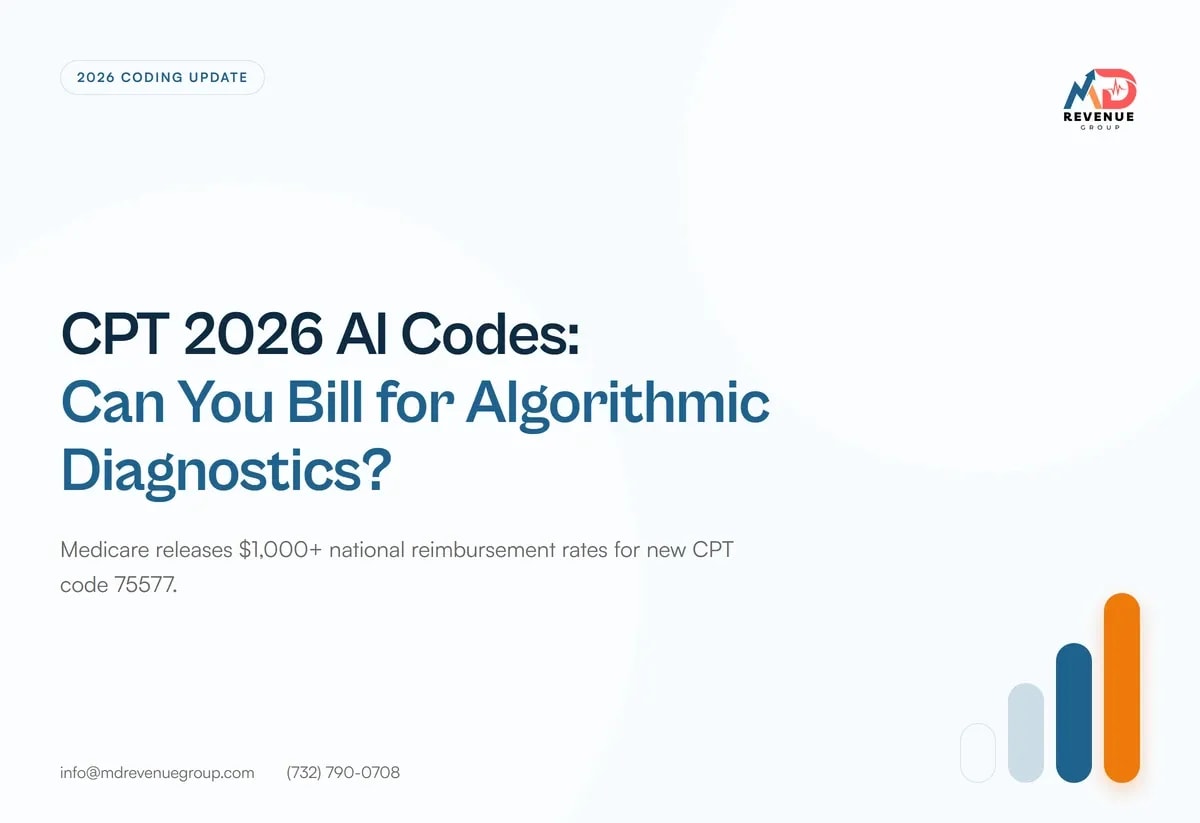
Understanding the reimbursement pathways for CPT 2026 AI codes 75577 0992T 0993T is essential for practices adopting automated diagnostic software. Practices can successfully bill for these advanced cardiac diagnostic algorithms if they follow strict documentation guidelines. The Centers for Medicare & Medicaid Services (CMS) has established a national average payment rate of 1,012 for the Category I code 75577, which covers artificial intelligence based plaque analysis. Conversely, Category III codes 0992T and 0993T cover perivascular fat analysis and remain subject to local contractor pricing. This guide explains how to document these services and structure your billing claims to ensure full compliance.
Key Takeaways
- Category I code transition: CPT 75577 replaces previous temporary Category III codes (0623T–0626T) for plaque quantification.
- Category III risk tracking: Codes 0992T and 0993T track emerging perivascular fat analysis and are priced locally by carriers.
- CPT Appendix S compliance: Both technologies fall under Augmentative AI, requiring active physician interpretation and a signed diagnostic report.
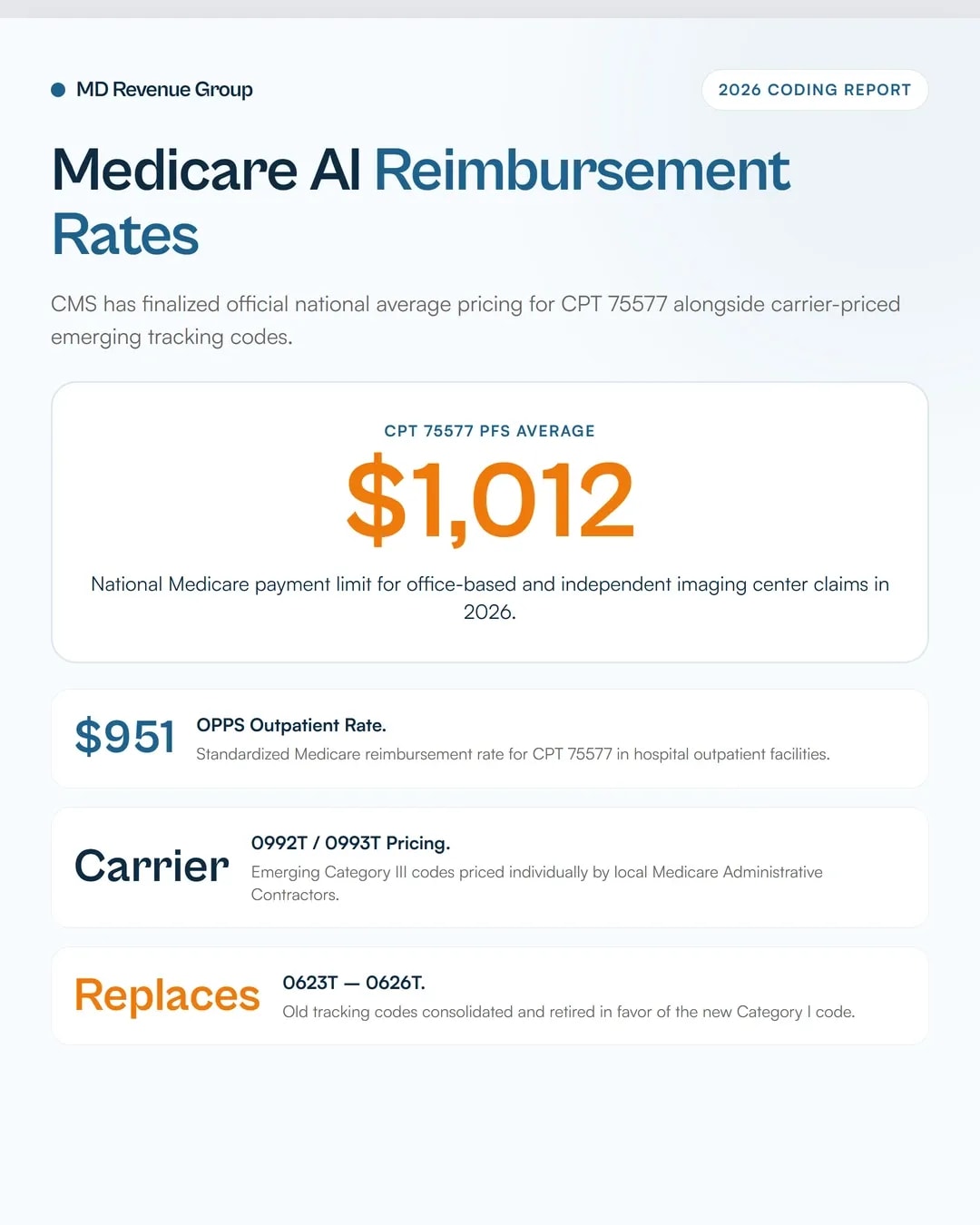
- National payment rates: CPT 75577 has established Medicare rates of approximately 1,012 for offices and $950.50 for outpatient hospitals.
What Are the New CPT 2026 AI Cardiac Codes?
Medical coding is adapting to the use of machine learning algorithms in diagnostic workflows. The AMA CPT Editorial Panel added new codes to capture these services. These codes differentiate between standard imaging and AI-based analysis.
In the cardiac space, the new codes target coronary plaque characterization and perivascular fat analysis. These tools process datasets from coronary computed tomographic angiography (CCTA).
CPT 75577 is the new Category I code for AI-based quantification of coronary atherosclerotic plaque. This code represents a major shift, transitioning the service from temporary tracking status to permanent status.
Category III codes 0992T and 0993T track perivascular fat analysis, which measures cardiac inflammation. These codes remain temporary, allowing payers to evaluate their clinical utility before assigning national pricing.
For practices utilizing these tools, partnering with specialized cardiology medical billing specialty solutions ensures claims are billed correctly from day one.
How to Report CPT 75577 for Plaque Quantification
CPT 75577 represents a significant coding update. This Category I code covers the automated quantification and characterization of plaque using CCTA datasets. The code description includes the software processing, physician interpretation, and final report.
This code replaces the older Category III codes 0623T, 0624T, 0625T, and 0626T. Previously, billers reported these separate codes for the technical and professional components of plaque analysis.
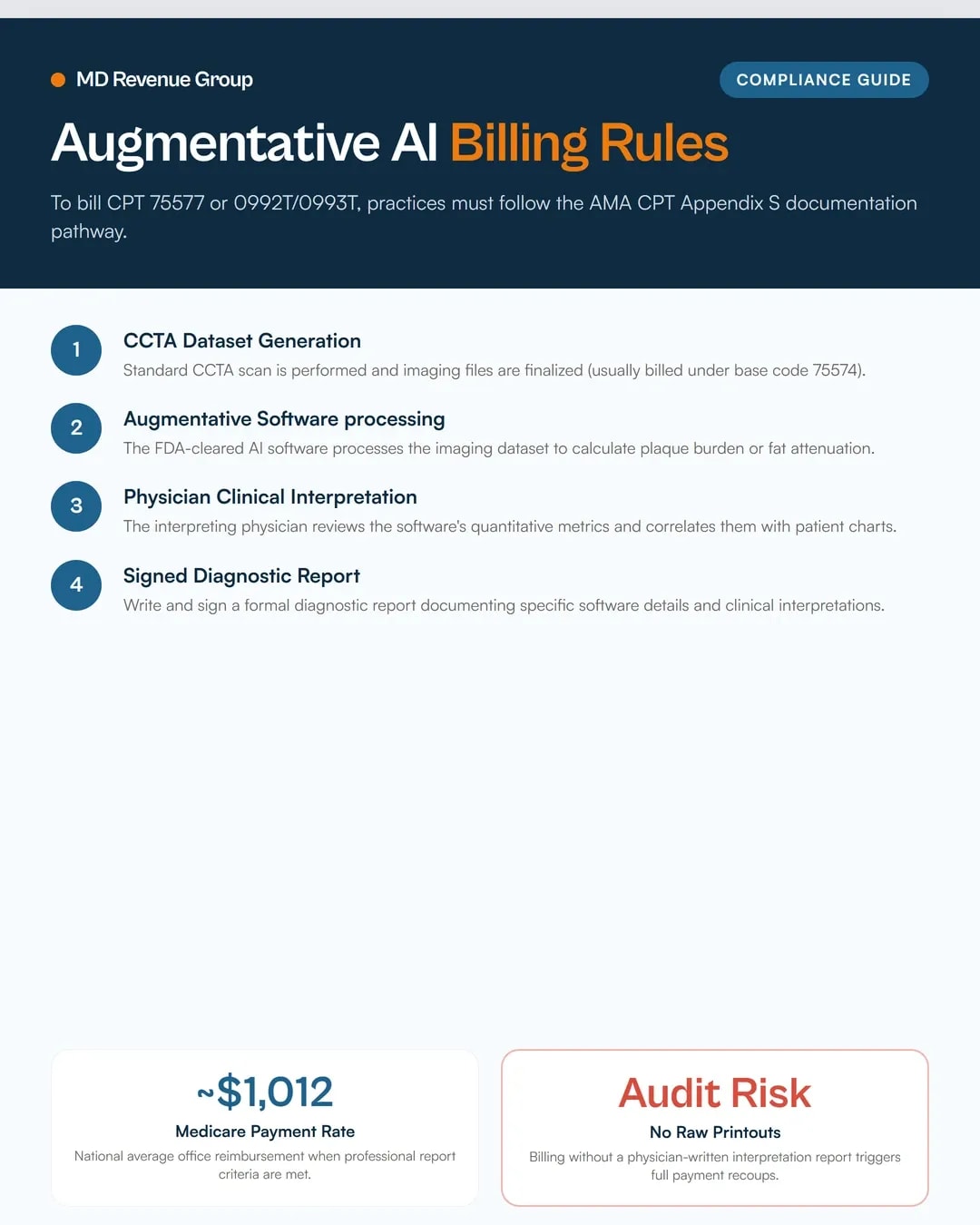
Now, CPT 75577 consolidates these services. When reporting this code, billing teams must ensure that the base CCTA scan (typically CPT 75574) is also documented.
Practices must verify National Correct Coding Initiative (NCCI) edit tables. CMS packages some technical components when the scan and the AI analysis are performed in the same facility. Correctly applying modifiers, such as modifier 26 for professional services, is required to prevent rejections.
Reviewing historical changes, such as the CMS physician fee schedule changes, helps billing departments stay compliant with bundling edits.
Category III Codes: Billing 0992T and 0993T for Perivascular Fat Analysis
Category III codes are temporary tracking codes for emerging technologies. In 2026, CMS introduced codes 0992T and 0993T for perivascular fat analysis. This software uses CCTA data to measure inflammation around the coronary arteries.
The billing team must select the correct code based on the clinical service:
- CPT 0992T: Reported when the perivascular fat analysis is performed without a concurrent cardiac CT scan. This occurs when analyzing a historical scan.
- CPT 0993T: Reported when the analysis is performed in conjunction with a concurrent cardiac CT scan.
Because these are Category III codes, they do not have national relative value units (RVUs). Reimbursement is carrier-priced. This means your local Medicare Administrative Contractor (MAC) determines the allowed amount.
Commercial payers often require prior authorization for Category III codes. Practices must verify coverage policies for each payer before scheduling the service. Billing these codes requires detailed documentation of medical necessity.
Referencing other diagnostic coding workflows, like the G2211 and APCM billing codes guidelines, can help staff manage the transition of emerging codes.
Compliance and the CPT Appendix S Taxonomy for Augmentative AI
The AMA CPT code set includes Appendix S, which establishes the official taxonomy for classifying medical artificial intelligence. This framework classifies AI applications based on their clinical function.
Appendix S defines three distinct categories:
- Assistive: The software assists the physician but does not perform independent analysis.
- Augmentative: The software analyzes data to produce clinically meaningful output, which the physician must interpret.
- Autonomous: The software performs the diagnostic service independently with minimal physician involvement.
Under this taxonomy, CPT 75577 and codes 0992T/0993T are classified as Augmentative AI. The software processes the imaging data, but the physician must review the output, draw clinical conclusions, and write a diagnostic report.
This classification has direct compliance implications. Practices cannot bill for these codes if the physician only signs off on the software printout. The medical record must contain a documented interpretation.
Practices must follow these rules to avoid audits. Understanding the legal distinctions of automated systems is a major focus of modern artificial intelligence in medical billing compliance frameworks.
Reimbursement Rates and Payer Coverage Rules
Reimbursement rates for AI services vary based on the place of service. CMS has established national pricing for CPT 75577, but Category III codes remain variable.
Under the 2026 Physician Fee Schedule, CPT 75577 has a national average payment rate of 1,012 for services performed in physician offices and independent imaging centers.
For hospital outpatient departments, CMS reimburses the service under the Outpatient Prospective Payment System (OPPS) at a rate of $950.50.
Code | Service Type | Setting | Average Medicare Payment |
|---|---|---|---|
CPT 75577 | Plaque Quantification | Office / Imaging Center | 1,012 |
CPT 75577 | Plaque Quantification | Hospital Outpatient | $950.50 |
CPT 0992T | Fat Analysis (No CT) | Office / Hospital | Carrier Priced (MAC) |
CPT 0993T | Fat Analysis (With CT) | Office / Hospital | Carrier Priced (MAC) |
Category III codes 0992T and 0993T do not have standard national rates. Some MACs cover these services for specific clinical indications, while others deny them as investigational.
Billing teams must submit these claims with detailed clinical documentation. Invoices, FDA clearance letters, and clinical studies may be required to appeal denials.
Understanding MAC coverage policies requires constant monitoring, similar to tracking counter-AI appeal strategies for denial recovery.
Avoid Denials: Documentation Requirements for AI Reporting
Payer audits for AI services target documentation compliance. Because these codes carry high reimbursement rates, payers audit claims to ensure the physician performed the required interpretation.
To prevent denials, the medical record must include a detailed diagnostic report. This report must document:
- The specific FDA-cleared AI software used.
- The quantitative measurements (e.g., plaque volume, burden, or fat attenuation index).
- The physician's clinical correlation and diagnostic findings.
- The signature of the interpreting physician.
Real-World Audit Scenario
A multi-specialty group practice billed CPT 75577 in conjunction with CCTA scans for 120 patients. The billing department submitted the claims using the clinic's standard CCTA diagnostic template. The template noted that the plaque analysis software was run but did not include the specific plaque measurements or the physician's interpretation of those findings.
A major commercial payer audited the claims. The payer noted that the medical records contained the automated PDF printout from the AI software but lacked any written analysis by the physician.
The payer denied all 120 claims and demanded a recoupment of $120,000. The clinic had to return the payments because their documentation did not support the professional interpretation requirement of Augmentative AI.
To protect your practice from similar losses, ensure that your clinicians receive proper training on documentation standards. Practices can benefit from a radiology billing guides review to verify their documentation templates match current billing rules.
Frequently Asked Questions
Is CPT 75577 subject to prior authorization?
Yes. Most commercial payers require prior authorization for CPT 75577. The billing team must obtain authorization for both the base CCTA scan (75574) and the plaque analysis code (75577) before the services are performed.
How do we bill for AI services if the software is autonomous?
Autonomous AI services have separate CPT codes. If the software is autonomous, it does not require physician interpretation for billing. However, CPT 75577 is augmentative, meaning a physician must perform the interpretation and write the report to bill the code.
What modifiers should we use for CPT 75577?
If the plaque analysis is performed by an outside imaging center, the center bills the technical component, and the physician bills the professional component using modifier 26. If the practice owns the equipment and performs the entire service, bill the global code without modifiers.
Can we bill CPT 0993T with any CT scan?
No. CPT 0993T is specific to perivascular fat analysis performed in conjunction with a coronary computed tomographic angiography (CCTA). You cannot report this code with non-cardiac chest CT scans.