FY2027 IPF PPS Final Rule: What Inpatient Psychiatric Facilities Must Do Before October 1, 2026
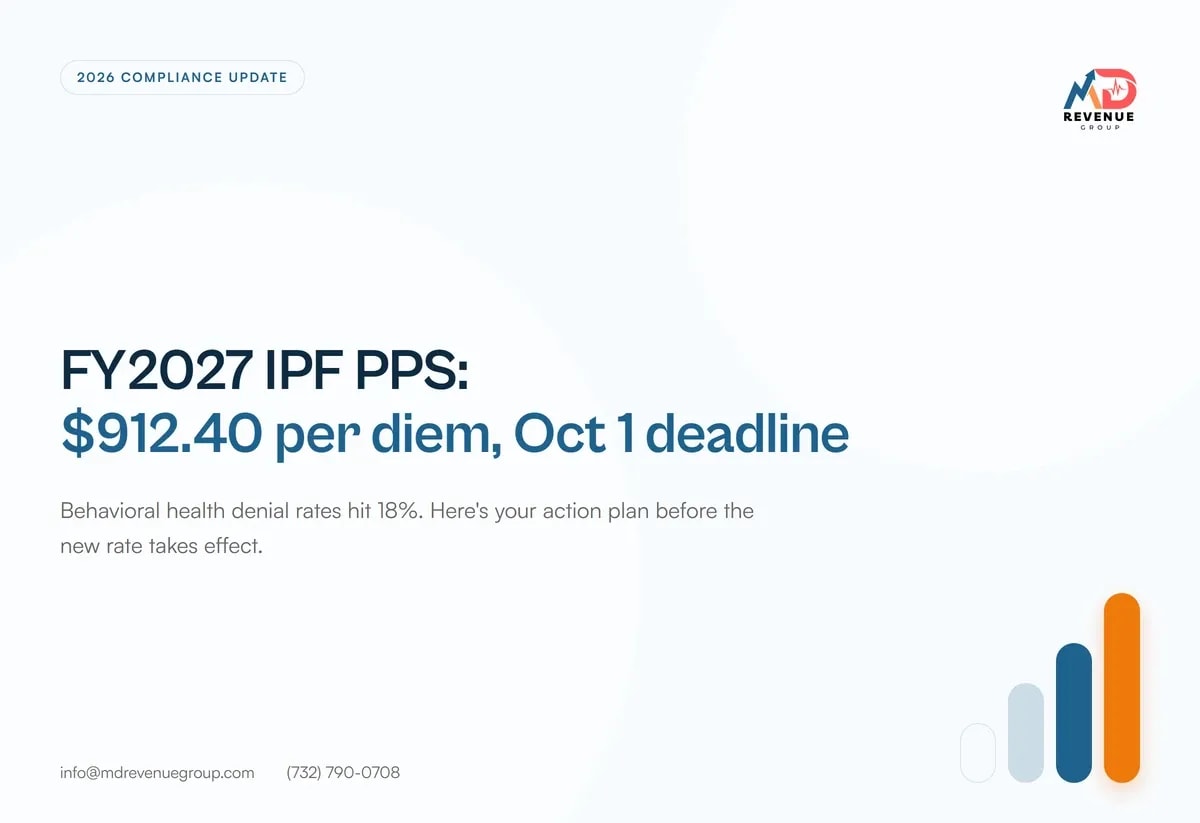
CMS finalized FY2027 IPF PPS on July 29, 2026. New per diem rate $912.40, ECT at $688.59, outlier threshold $40,750. Here's what to do before Oct 1.
FY2027 IPF PPS Final Rule: What Inpatient Psychiatric Facilities Must Do Before October 1, 2026
Inpatient psychiatric facility billing is operating under a new payment framework starting October 1, 2026. CMS issued the FY2027 Inpatient Psychiatric Facility Prospective Payment System final rule (CMS-1847-F) on July 29, 2026, and the changes go live in 63 days.
The headline number: a 2.3% net payment increase, putting the federal per diem base rate at 892.87. The ECT payment rises to 40,750.
Those rate updates matter. But the revenue risk buried in this rule is not the rate change. It's the quality reporting penalty, the IPF-PAI rollout timeline, and what happens to your outlier payments in FY2028 if you're not tracking volume now.
This article walks through every change in plain terms, with a pre-October 1 action checklist for billing and compliance teams.
Key takeaways
- Federal per diem base rate increases to $912.40 (from $892.87) for IPFQR-compliant facilities, effective October 1, 2026.
- Facilities that fail quality reporting receive $894.56 instead, a 2-percentage-point penalty on their annual update.
- ECT payment rises to $688.59 per treatment for reporting facilities, up from $673.85.
- Outlier threshold increases to $40,750, and a 20% facility-level outlier cap is finalized but deferred to FY2028.
- CMS is removing 2 quality measures (alcohol use brief intervention, tobacco use treatment at discharge), effective CY2026 reporting.
- The new IPF-PAI begins mandatory data collection October 1, 2027 for FY2029 payment determination.
What changed: the FY2027 payment rate breakdown
The FY2027 update uses the standard market basket formula. CMS finalized a 3.2% market basket increase, then cut it by a 0.9 percentage point productivity adjustment, landing at the 2.3% net increase.
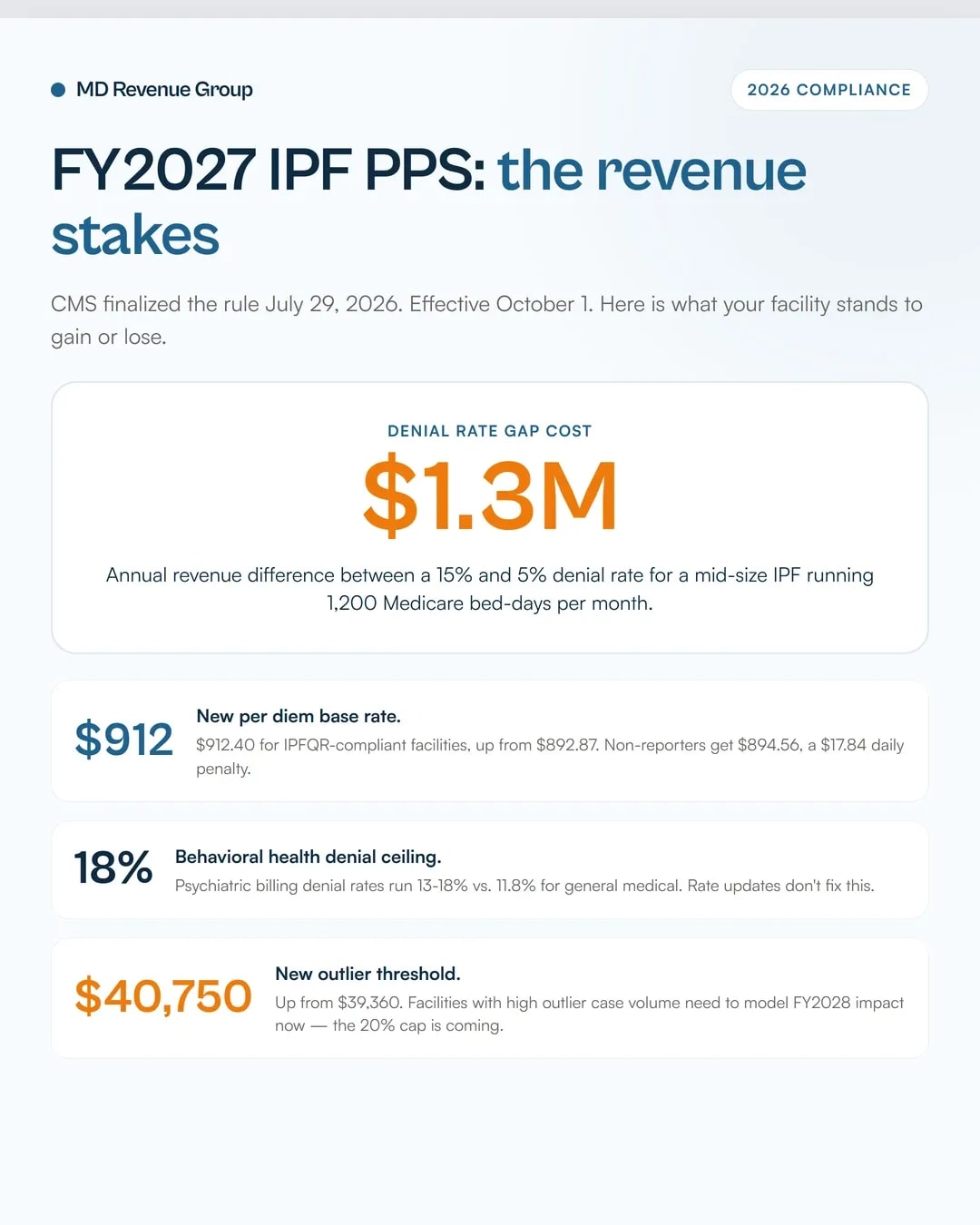
For a facility running 500 Medicare inpatient psychiatric bed-days per month, the rate change from 912.40 adds roughly 117,180 in incremental Medicare reimbursement from the rate alone.
The adjustment factors applied on top of the base rate, including patient and facility adjustments, stay consistent with prior methodology. CMS is not restructuring the adjustment architecture in this rule.
Here is the full rate table for FY2027:
Payment type | IPFQR compliant | Non-reporting |
|---|---|---|
Federal per diem base rate | $912.40 | $894.56 |
ECT per treatment | $688.59 | $675.13 |
Previous base rate (FY2026) | $892.87 | n/a |
Previous ECT rate (FY2026) | $673.85 | n/a |
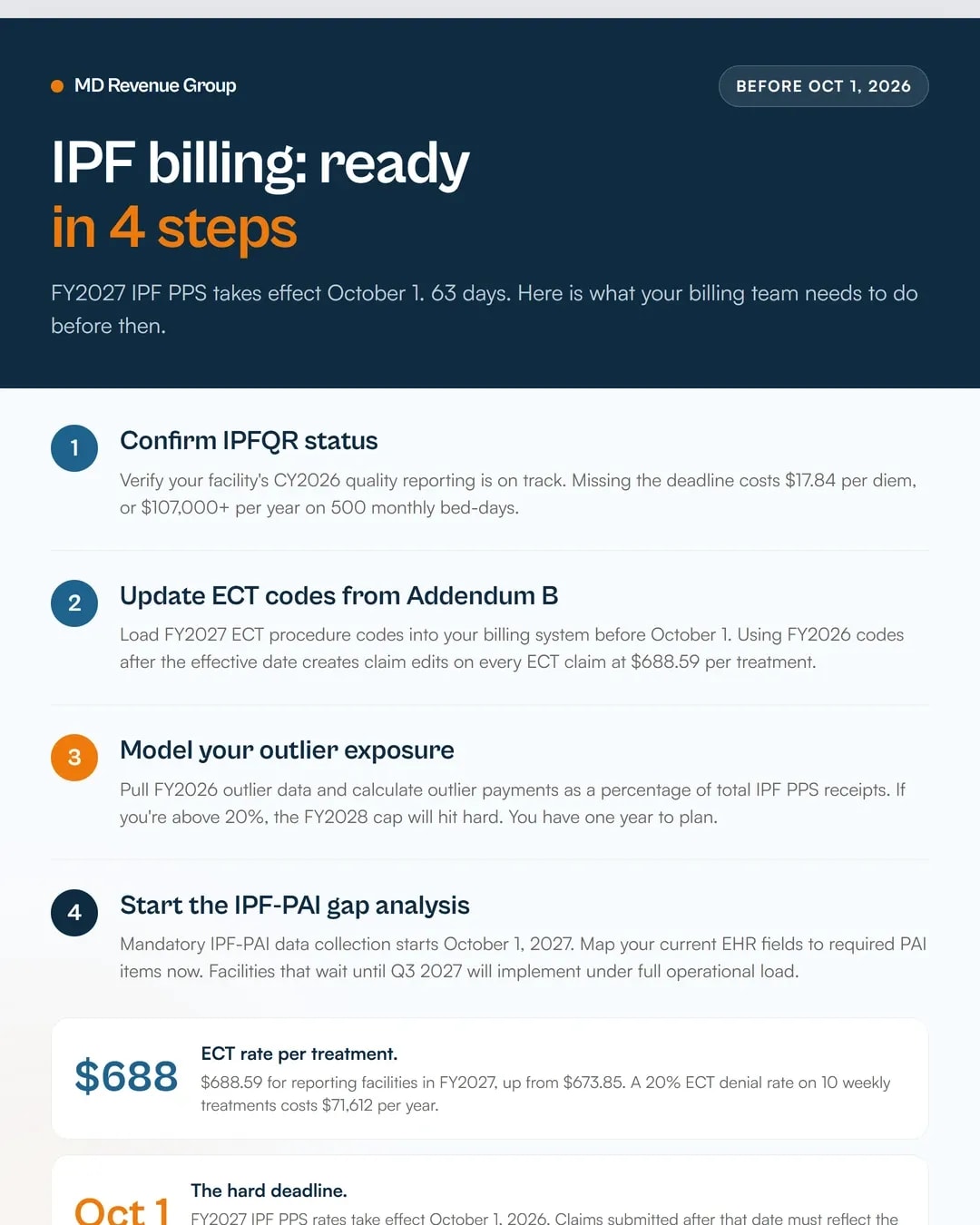
The gap between the compliant and non-compliant rate is 8,920 monthly penalty for missing quality reporting, or $107,040 annually. No facility should be absorbing that cost.
For psychiatric billing teams managing Medicare claims in New Jersey, New York, or other high-volume states, confirming your facility's IPFQR submission status before October 1 is the single highest-priority item on this checklist.
ECT billing: new rate and documentation requirements
The ECT payment increase from 688.59 is a 2.2% gain, consistent with the overall rule update. CMS did not change ECT billing methodology in this rule. It remains billed per treatment, not per diem.
What does change: CMS updated Addendum B to the final rule with the FY2027 ECT procedure code list. Facilities need to confirm their billing software reflects the updated codes before October 1. Using the FY2026 code set after the effective date creates a mismatch that will trigger claim edits.
The documentation requirement that still trips facilities up: ECT claims require both the procedure code and supporting clinical documentation linking medical necessity to the diagnosis code. Payer reviewers specifically look for the physician order, the pre-ECT psychiatric evaluation, and the consent documentation. Missing any one of the 3 pieces results in a denial that often gets written off rather than appealed.
For a facility doing 10 ECT treatments per week at 1,377 per week, or $71,612 per year in lost revenue. That's recoverable money. It requires documentation discipline, not new technology.
Facilities working with an RCM partner with behavioral health expertise can run a targeted ECT claim audit to identify the denial pattern before it compounds through Q4.
Outlier payment threshold: what $40,750 means for your facility
CMS raised the cost outlier threshold from 40,750, a 3.5% increase. The threshold is calibrated to keep outlier payments at 2% of total IPF PPS payments.
When a patient's costs exceed the threshold, the facility receives 80% of the amount above it as an outlier payment. That structure doesn't change. What changes is the dollar level a patient's costs must reach before outlier status triggers.
The practical impact: if your facility has patients with high-acuity psychiatric episodes whose costs were just crossing the FY2026 threshold, some of those cases may fall below the new $40,750 line. Review your FY2026 outlier cases and model how many would still qualify under the updated threshold.
The FY2028 outlier cap: what to track now. CMS finalized a policy that caps outlier payments at 20% of a facility's total annual IPF PPS payments, effective FY2028. Facilities with fewer than 50 stays per year are exempt.
If your facility's outlier payments currently exceed 20% of total IPF PPS receipts, you have one year to address it. That means either reducing high-acuity case concentration, improving cost documentation to capture costs more accurately within standard payment, or building a financial model for what the cap does to net revenue. Don't wait for the FY2028 rule to surface this.
A forensic look at your current outlier payment percentage is worth running now. Our revenue integrity tool can model the FY2028 cap impact against your actual case mix.
Quality reporting: the 2-point penalty and the measures CMS removed
The IPFQR penalty structure stays the same: facilities that don't submit required quality data lose 2 percentage points from their annual payment update. In FY2027, that means 912.40 per diem.
CMS removed 2 measures from the IPFQR program effective for the CY2026 reporting period, which affects FY2028 payment determinations:
- Alcohol Use Brief Intervention Provided or Offered (measure removed)
- Tobacco Use Treatment Provided or Offered at Discharge (measure removed)
The removal reduces administrative burden for those measures. But it doesn't reduce the penalty for non-reporting overall. Facilities still need to submit all remaining required measures to avoid the penalty.
The operational trap with measure removals: when a measure gets removed, billing teams sometimes interpret it as a reduction in total reporting obligations and drop the measure from their submission workflow early. Confirm the exact effective date for each removal with your IPFQR coordinator. Dropping a measure before it officially exits the program can create a reporting gap that triggers a penalty.
The remaining IPFQR measures cover areas including follow-up care coordination, readmission rates, and patient experience. Facilities should verify their reporting workflow reflects only the current active measure set.
For facilities across Pennsylvania, Connecticut, and New Jersey that manage IPFQR submissions through third-party billing partners, confirm your partner's reporting workflow reflects the FY2027 changes and not the prior year's measure set.
IPF-PAI: the new patient assessment instrument and your October 2027 deadline
CMS is rolling out the standardized IPF Patient Assessment Instrument. The final rule includes a modified, more gradual timeline than originally proposed, responding to concerns from the American Psychiatric Association and other stakeholders about EHR integration and manual documentation burden.
The timeline:
Milestone | Date |
|---|---|
Final rule effective date | October 1, 2026 |
IPF-PAI mandatory data collection begins | October 1, 2027 |
First IPF-PAI FY payment determination | FY2029 |
Data collected at admission includes mobility assessment (chair/bed-to-chair transfer). Data at discharge includes special services, treatments, and interventions in the inpatient psychiatric setting.
The APA expressed concern about the disconnect between IPF-PAI data fields and existing EHR documentation structures. Many facilities currently document these elements in narrative format, not in structured data fields. Mapping narrative documentation to standardized IPF-PAI fields will require workflow changes before October 2027.
What to do now, not next year: Start a gap analysis between your current EHR documentation fields and the IPF-PAI required items. Identify which fields are captured in structured data and which require manual transcription. Budget the IT and training resources for the mapping work. Facilities that wait until Q3 2027 will face parallel burdens: implementing the new assessment instrument while simultaneously managing FY2027 ongoing quality reporting.
Behavioral health denial benchmarks: where most facilities bleed revenue
The FY2027 rate update adds money. Denial management keeps it.
Behavioral health billing denials run at 13% to 18% in 2026, compared to 11.8% for general medical claims (per industry benchmarking data). Inpatient psychiatric facilities specifically face higher rates because of 3 converging problems: medical necessity documentation requirements, prior authorization complexity, and carved-out payer arrangements.
Proprietary calculation: what a 15% denial rate costs a mid-size IPF
A facility with 1,200 inpatient psychiatric bed-days per month at the new 1,094,880 monthly in Medicare base revenue before adjustments.
At a 15% denial rate: 109,488 in claims denied each month. At a 5% denial rate (best-in-class target): $54,744 in claims denied each month.
The gap between a 15% and a 5% denial rate on this volume: 1,313,856 per year.
That's not money the rate update can recover. Closing that denial gap is worth 11x more than the FY2027 rate increase at this facility size.
The top 3 denial drivers for inpatient psychiatric claims in 2026:
- Medical necessity disputes. Payers are deploying AI-based review tools that challenge inpatient level-of-care determinations. The defense is clinical documentation that explicitly links functional impairment to the medical necessity criteria in the payer's behavioral health coverage policy. Vague progress notes don't hold up under automated review.
- Prior authorization gaps. Inpatient psychiatric stays require authorization, and for carved-out payers (Optum Behavioral, Carelon, Magellan), the authorization must come from the behavioral health administrator, not the medical insurer. Routing auth requests to the wrong entity is a common, fully preventable source of denials.
- Time-based coding errors. CPT codes for psychiatric services are time-based. Start and stop times must be documented and must match what's billed. Discrepancies between the clinical note and the billed time trigger automatic rejections.
Facilities running more than 10% denial rates on inpatient psychiatric claims should request a targeted billing audit focused on these 3 areas before Q1 2027.
Pre-October 1 action checklist
With 63 days to the effective date, here's the specific task list for billing and compliance teams:
By August 15:
By September 1:
By September 15:
By October 1:
For facilities in New Jersey managing multiple payers across Medicaid, Medicare, and commercial plans, our medical billing services team can run a pre-October audit and configure your billing system for the FY2027 updates.
FAQ
What is the FY2027 IPF PPS per diem rate? The federal per diem base rate is 894.56.
What is the ECT payment rate for FY2027? CMS set the ECT payment at 673.85 in FY2026. Non-reporting facilities receive $675.13.
What is the FY2027 outlier payment threshold? The cost outlier threshold is 39,360. When a patient's costs exceed this threshold, the facility receives 80% of the excess as an outlier payment.
What measures did CMS remove from IPFQR in FY2027? CMS removed the Alcohol Use Brief Intervention Provided or Offered measure and the Tobacco Use Treatment Provided or Offered at Discharge measure, effective for CY2026 reporting, which affects FY2028 payment determinations.
When does the IPF-PAI become mandatory? Mandatory IPF-PAI data collection begins October 1, 2027. The data will be used for the FY2029 payment determination. CMS adopted a more gradual rollout timeline than originally proposed in response to stakeholder concerns about EHR integration burden.
What is the IPF quality reporting penalty? Facilities that do not submit required IPFQR data lose 2 percentage points from their annual payment update. In FY2027, that means receiving 912.40 per diem, a difference of $17.84 per bed-day.
Make sure you capture every dollar the FY2027 rule adds
The rate increase is real money. So is the quality reporting penalty, the outlier exposure, and the denial rate dragging down your net collection rate.
The facilities that gain ground in FY2027 are the ones running tight billing operations, not just updated fee schedules.
MD Revenue Group works with inpatient psychiatric facilities on full-cycle billing, IPFQR tracking, and denial recovery. If you want to know exactly where your current operation stands before October 1, request a free Revenue Audit. We'll identify your current denial rate, outlier payment percentage, and quality reporting status in one session.