
Oncology's ASP Crisis: How Drug Cost Inflation Is Breaking the 2026 Revenue Cycle
Navigate oncology ASP reporting drug cost billing 2026. Manage the 2-quarter price lag, sequestration cuts, and Medicare drug inflation rules.
Managing oncology ASP reporting drug cost billing 2026 requires understanding the structural lag between drug price increases and Medicare reimbursement adjustments. When pharmaceutical manufacturers raise list prices, your practice's acquisition costs rise instantly. However, Medicare allowed amounts remain tied to the Average Sales Price (ASP) from two quarters prior, creating a severe margin squeeze. This pricing timing gap, coupled with federal sequestration, reduces the nominal ASP plus 6% reimbursement rate to a net 4.3% margin. Practices must reconcile drug purchasing invoices with quarterly CMS pricing files to prevent severe cash flow deficits. This guide outlines how to audit acquisition data, manage waste documentation, and prevent RCM leaks.
Key Takeaways
- Two-quarter timing lag: Medicare updates Part B drug allowed rates quarterly using sales numbers from six months ago, creating immediate financial deficits when prices spike.
- Inflation program rebates: Under the Inflation Reduction Act, CMS adjusts coinsurance for select Part B therapies if manufacturers raise prices faster than general inflation.
- Sequestration reduction: The nominal 6% add-on payment is reduced to a net 4.3% by the 2% federal sequestration cut applied to the total reimbursement.
- Wastage compliance: Payer audits focus heavily on JW and JZ modifiers, making complete waste documentation mandatory.
What Is the Medicare ASP Reporting Lag?
Medicare Part B covers office-administered cancer therapies through a system based on manufacturer-reported pricing. Under federal rules, manufacturers report their national Average Sales Price each quarter. CMS processes this pricing data to establish the allowed reimbursement limit.
The federal pricing update system operates with a fixed two-quarter reporting lag. When a pharmaceutical company changes its wholesale acquisition price, the change does not immediately appear in the Medicare fee schedule. Instead, CMS takes six months to calculate and publish the adjusted rate.
For example, pricing data from the first quarter of the year determines the reimbursement rates for the third quarter. Pricing data from the second quarter dictates the rates for the fourth quarter.
CMS also uses a four-quarter rolling average to smooth out pricing changes. This smoothing calculation means that a price increase can take up to six quarters to be fully reflected in the published ASP file. During this time, the practice pays the higher acquisition price but receives reimbursement based on older, lower rates.
This structural mismatch shifts the financial risk directly to the oncology practice. Practices that use a buy-and-bill model must absorb the price differential during the adjustment period. If a practice cannot purchase the medication at or below the lagged ASP, it incurs a direct financial loss on every dose administered.
Specialists seeking to secure practice stability often benefit from structured healthcare revenue cycle management workflows that track these pricing shifts in real time.
How Drug Cost Inflation Squeezes Oncology Practice Margins
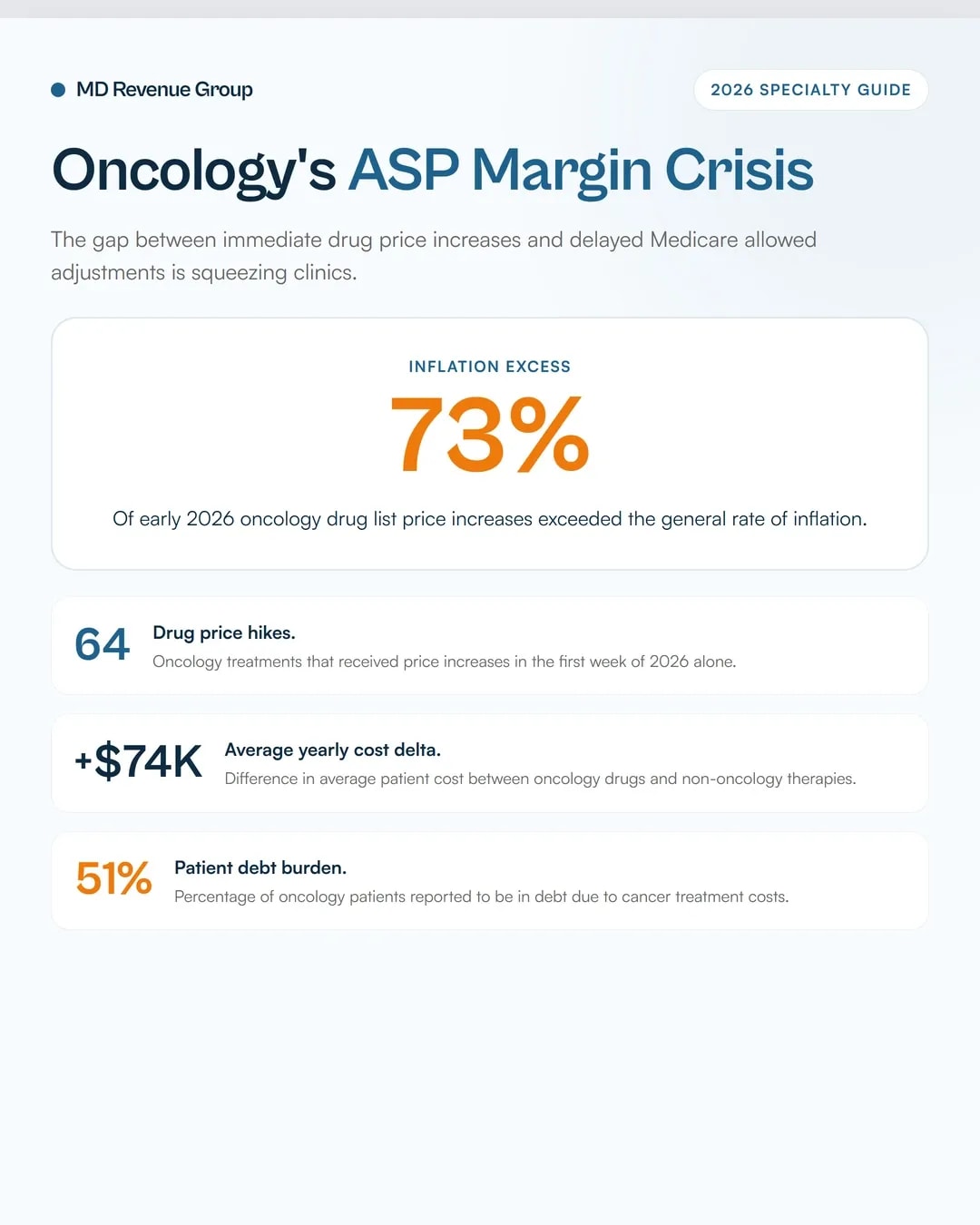
Oncology drug costs are rising faster than general healthcare inflation. In the first week of 2026, manufacturers raised list prices on 64 oncology drugs. A report from Patients for Affordable Drugs showed that 73% of these price increases exceeded the general rate of inflation.
Oncology drugs cost an average of $74,000 more per year than non-oncology drugs. These high costs place a significant burden on practices and patients. Currently, 51% of American cancer patients are in debt due to treatment costs.
When list prices rise, distributor acquisition costs rise immediately for practices. A community oncology clinic purchasing a high-cost biologic must pay the invoice within 30 days. However, the clinic's Medicare reimbursement will not reflect this price increase for at least six months.
This delay creates the margin squeeze. The clinic pays the new, higher price but is reimbursed based on the lower, historical ASP. For a drug costing 500 to the acquisition cost. If the reimbursement rate remains unchanged, the clinic's profit margin is eliminated.
The Inflation Reduction Act introduces Medicare price negotiations for certain high-expenditure drugs. Under the Medicare Prescription Drug Inflation Rebate Program, manufacturers must pay a rebate to Medicare if they raise prices faster than inflation. For these rebatable drugs, CMS reduces the patient coinsurance portion.
Practices must monitor these quarterly changes to prevent billing errors. Incorrect coinsurance billing leads to immediate claim denials and compliance audits. Keeping track of these details is critical for protecting the practice's bottom line.
A detailed forensic revenue cycle audit can identify where a practice is losing money due to these pricing mismatches and billing errors.
The Sequestration Cut: Net Allowed Add-On Margins
Medicare Part B reimbursements are calculated using a formula of ASP plus 6%. This add-on payment is intended to cover the costs of drug storage, complex handling, clinical mixing, and administrative overhead.
However, the actual payment received by the practice is lower due to federal sequestration. The Budget Control Act requires a mandatory 2% reduction on all Medicare payments. This reduction is applied to the total reimbursement amount, not just the add-on portion.
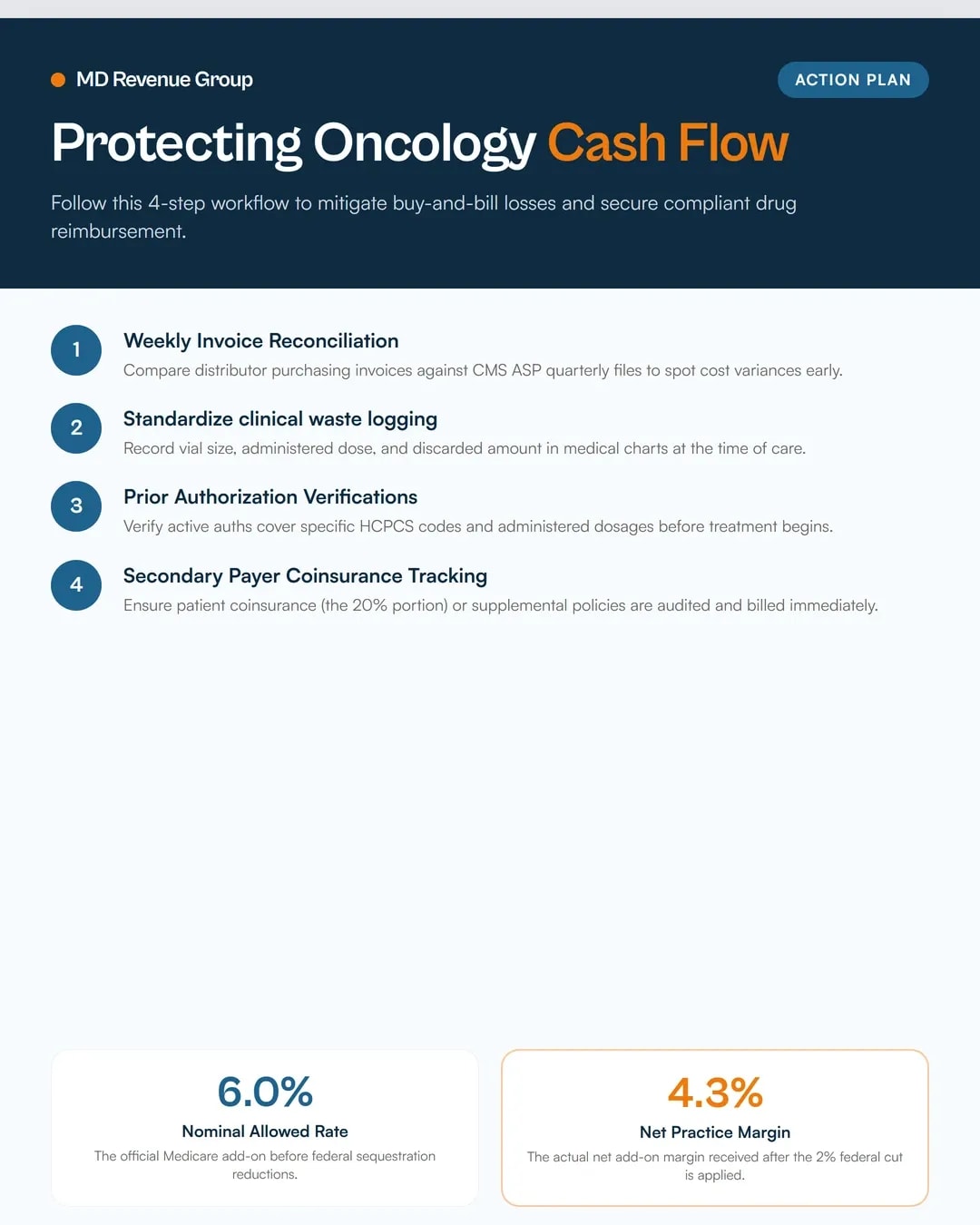
This calculation reduces the effective add-on margin. Instead of receiving ASP plus 6%, the practice receives an effective rate of ASP plus 4.3%.
Calculation Step | Nominal Rate | Sequestration Adjusted Rate |
|---|---|---|
Medicare Allowed Amount | 106.00% of ASP | 106.00% of ASP |
Medicare Payment (80%) | 84.80% of ASP | 83.10% of ASP (2% reduction) |
Patient Coinsurance (20%) | 21.20% of ASP | 21.20% of ASP (unaffected) |
Total Received by Practice | 106.00% of ASP | 104.30% of ASP |
Net Practice Add-On Margin | 6.00% | 4.30% |
This narrow 4.3% margin leaves little room for error. If the practice's acquisition cost rises by even 2% during the ASP reporting lag, the net margin drops to 2.3%. When administrative overhead and drug wastage are factored in, the practice can easily lose money on the service.
Practices must also manage secondary payer collections. While Medicare pays 80% of the allowed amount, the remaining 20% must be collected from patient coinsurance or supplemental policies. Failing to collect this 20% means the practice loses money, as the drug's acquisition cost alone exceeds the Medicare payment.
Understanding these calculations is essential for managing a viable oncology practice. Navigating these rules requires constant monitoring of federal policy updates, such as the latest Medicare Physician Fee Schedule updates.
2026 Payer Compliance and Waste Documentation Rules
Payer audits in 2026 are focusing heavily on drug wastage documentation. Because oncology drugs are high-cost and dosed based on patient weight or body surface area, single-dose vials often contain leftover medication that must be discarded.
Medicare requires practices to document discarded drug amounts using two specific modifiers:
- JW Modifier: Reported on a separate claim line to identify the amount of drug discarded from a single-dose vial.
- JZ Modifier: Reported on the claim to certify that no drug amount was wasted or discarded.
Payer audits frequently target claims that lack these modifiers. If a practice bills for a single-dose vial but fails to report either a JW or JZ modifier, the claim is denied. The Office of Inspector General lists drug wastage reporting as a primary audit focus, as detailed in the 2026 OIG work plan audit triggers.
Real-World Audit Scenario
Consider a community oncology practice administering a biologic drug supplied in a single-dose 100 mg vial. The patient's prescribed dose is 85 mg. The clinic administers 85 mg and discards the remaining 15 mg.
To bill correctly, the clinic must submit two line items on the claim:
- Line 1: Drug code with 85 units (administered amount).
- Line 2: Drug code with 15 units and the JW modifier (discarded amount).
During an internal review, the practice found that billers were submitting a single line for 100 units without the JW modifier. The clinic's documentation recorded the administration of 85 mg but did not document the disposal of the leftover 15 mg in the medical record.
A commercial payer audited these claims and demanded a recoupment of $150,000. The payer ruled that the undocumented 15 mg was not medically necessary and clawed back the payment for the entire vial. The practice had to pay the recoupment because they lacked the required waste documentation in the patient chart.
To avoid these recoupments, practices must ensure that clinical records match the billed J-codes and modifiers. Every discarded dose must be documented with the exact volume, date, time, and reason for disposal in the patient's chart.
Tactical Steps to Protect Oncology Cash Flow
Oncology practices must implement specific operational controls to protect their financial health from rising drug costs and ASP timing mismatches.
First, establish a weekly reconciliation process. The billing team must compare distributor drug purchase invoices against the current CMS ASP quarterly pricing files. If the acquisition cost of a drug exceeds the current Medicare allowed rate, notify the clinical team. The practice may need to negotiate pricing with the distributor or evaluate alternative therapies.
Second, standardize drug wastage workflows. The clinical staff must record the exact vial size, administered dose, and discarded amount in the electronic health record at the time of administration. The billing team must verify that every single-dose vial claim contains either a JW or JZ modifier before submission.
Third, verify patient enrollment and benefits. Because oncology drugs are high-cost, prior authorization is mandatory for almost every administration. The practice must confirm that the authorization is active and covers the specific HCPCS code and dosage before the patient therapy begins.
Practices facing high denial rates or administrative bottlenecks should consider partner solutions. Working with specialized oncology medical billing services ensures that billing teams have the expertise required to manage complex oncology claims.
Finally, conduct regular internal audits. An internal compliance review identifies coding errors, modifier omissions, and documentation gaps before payers conduct external audits. Identifying these issues early prevents costly recoupments and claim denials.
Practices can start by scheduling a complimentary medical billing audit to evaluate their current RCM performance and locate hidden revenue leaks.
Frequently Asked Questions
How often does CMS update the ASP pricing files?
CMS updates the ASP pricing files quarterly. The updates take effect on January 1, April 1, July 1, and October 1 of each year. Practices must download and load these files into their billing systems immediately to ensure accurate payment calculations.
Can we bill for discarded drugs from multi-dose vials?
No. Medicare rules state that JW and JZ modifiers apply only to single-dose vials or single-use packages. You cannot bill for discarded drug amounts from multi-dose vials, as these vials are designed to be used for multiple doses or patients.
What happens if we omit the JZ modifier when no drug was wasted?
Medicare will deny claims for single-dose vials that do not report either the JW modifier (for waste) or the JZ modifier (for zero waste). Omitting the modifier leads to immediate claim rejections and delays payment.
How does the 2% sequestration cut affect commercial payer contracts?
Sequestration is a federal policy that applies to Medicare Part B payments. However, some commercial payers and Medicare Advantage plans include sequestration language in their provider contracts. Review your commercial contracts to verify if the payer is applying similar payment reductions.