
CMS FY 2027 IPPS Impact Files: How Hospitals Can Read Wage Index, DSH, and Outlier Data
Learn how hospital RCM teams read CMS IPPS impact files to model wage index reclassifications, DSH payments, and outlier thresholds for medical billing and practice management services.
CMS FY 2027 IPPS Impact Files: How Hospitals Can Read Wage Index, DSH, and Outlier Data
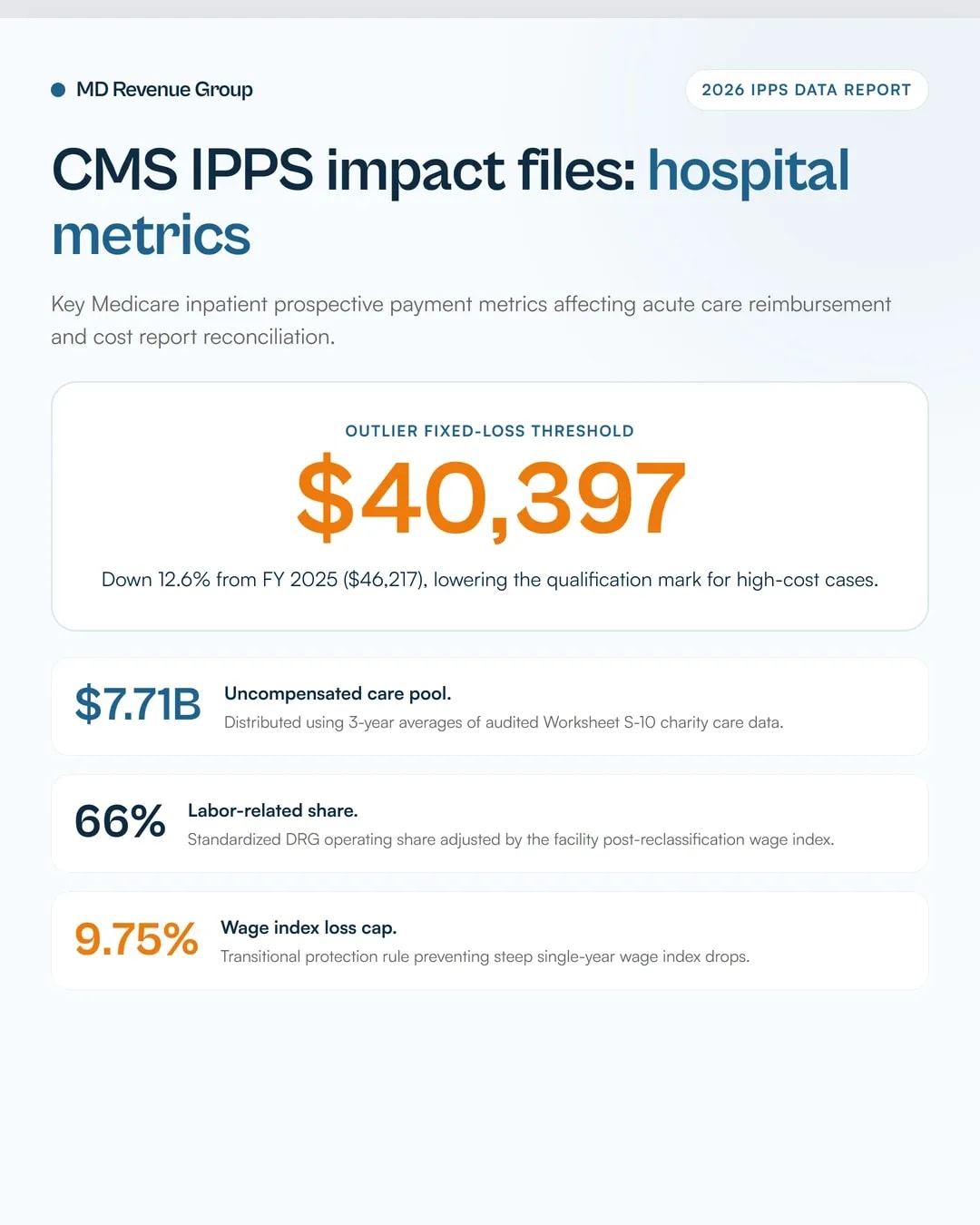
Hospital finance teams relying on medical billing and practice management services look to the annual Centers for Medicare & Medicaid Services (CMS) Inpatient Prospective Payment System (IPPS) Impact Files to forecast Medicare reimbursement shifts. Released alongside proposed and final rules each summer, these raw datasets contain provider-level metrics including geographic wage index adjustments, Disproportionate Share Hospital (DSH) uncompensated care pools, and outlier payment thresholds. For FY 2026, CMS established a fixed-loss outlier threshold of $40,397 (a 12.6% drop from FY 2025's $46,217) and allocated $7.71 billion in total uncompensated care payments across acute care facilities nationwide.
Key Takeaways for Revenue Cycle Leadership
- Outlier Threshold Shift: The FY 2026 outlier fixed-loss threshold dropped to $40,397, lowering the barrier for high-cost inpatient cases to qualify for supplemental Medicare payments.
- Uncompensated Care Allocation: CMS distributed $7.71 billion in uncompensated care payments using a three-year average of audited Form CMS-2552-10 Worksheet S-10 data (FY 2020 through FY 2022).
- Wage Index Policy Changes: CMS phased out the low-wage index policy while applying a 9.75% cap on annual wage index reductions to protect transitioning health systems.
- Reclassification Deadline: Hospitals seeking geographic reclassification through the Medicare Geographic Classification Review Board (MGCRB) must submit Form MGCRB-1 by September 1 annually.
- Data Source Grounding: All provider-level values originate from the official CMS IPPS Final Rule Public Use Files (PUFs) published every August.
Why IPPS Impact Files Drive Hospital Revenue Cycle Modeling
Hospital inpatient reimbursement under Medicare Part A depends on facility-specific multipliers applied to Diagnosis-Related Group (DRG) relative weights. When CMS publishes the IPPS proposed and final rulemaking files in July and August, revenue cycle leaders extract provider-level variables to update internal claim scrubbers and contract management systems.
See your practice reimbursement variance before rule changes impact cash flow.
We model your practice's historical code utilization against the updated conversion factors and regional GPCIs.
Calculate Practice Variance →Without accurate impact file parsing, health systems risk miscalculating prospective payments, underestimating outlier reserves, or miscalculating commercial payer contracts tied to Medicare rates. Integrating these data points into comprehensive revenue cycle management workflows protects operating margins across inpatient service lines.
CMS IPPS ANNUAL RULEMAKING PIPELINE |
|---|
April: Proposed Rule & Initial Impact File (Public Inspection)<br>August 1: Final Rule Display & Final Provider-Level Impact File<br>September 1: MGCRB Reclassification Application Deadline<br>October 1: Federal Fiscal Year Implementation (New Rates Active) |
Every acute care facility must track these updates annually. Misinterpreting a single wage index decimal point distorts base payment rates across thousands of inpatient admissions.
Understanding the Core Data Fields in CMS Impact Files
The CMS IPPS Impact File is distributed as a compressed data archive containing provider-specific rows for over 3,100 acute care hospitals. Understanding the key column headers allows billing analysts to extract actionable data without manual spreadsheet errors.
Field Name | Variable Description | Operational Relevance |
|---|---|---|
PROVIDER_ID | 6-digit CMS Certification Number (CCN) | Unique identifier for hospital data mapping |
WAGE_INDEX | Final post-reclassification wage index | Adjusts the 66% labor-related share of DRG payments |
DSH_PCT | Empirically justified DSH percentage | Determines baseline 25% DSH payment eligibility |
UCC_PAYMENT | Uncompensated Care Pool allocation | Factor 3 distribution based on Worksheet S-10 audit data |
OUTLIER_PCT | Estimated outlier payment percentage | Tracks projected high-cost case supplemental revenue |
OPERATING_CCR | Operating Cost-to-Charge Ratio | Converts total covered charges to estimated operating cost |
CAPITAL_CCR | Capital Cost-to-Charge Ratio | Determines capital outlier payment qualification |
Each variable directly impacts claims processing logic. Hospitals evaluating hospital price transparency enforcement must maintain alignment between chargemaster rates, cost-to-charge ratios, and published machine-readable files.
When downloading files from the CMS acute inpatient portal, analysts should inspect both the pre-reclassification and post-reclassification tables. The pre-reclassification index reflects raw wage data submitted on Medicare cost reports, while post-reclassification reflects adjustments granted by the MGCRB or statutory mandates.
How to Model Wage Index Changes and MGCRB Reclassifications
The hospital wage index adjusts the labor-related portion of standard DRG payment rates to reflect local labor market costs. For hospitals with a wage index exceeding 1.0, CMS sets the labor-related share at 66%, with the remaining 34% designated as non-labor.
Operating DRG Payment = (Base Rate x 66% x Final Wage Index) + (Base Rate x 34%)Geographic reclassification through the MGCRB allows rural or lower-wage hospitals to adopt the wage index of a neighboring Core-Based Statistical Area (CBSA). Successful reclassification requires meeting strict average hourly wage (AHW) comparison thresholds.
Submitting accurate Form CMS-2552-10 Worksheet S-3 Part II wage data remains critical. Inaccurate payroll hours or unallowable benefit costs permanently lower the regional wage index baseline. Regional health systems, including those tracking revenue recovery for New Jersey hospital systems, must audit wage data three years prior to rule publication.
WAGE INDEX RECLASSIFICATION EVALUATION CYCLE |
|---|
Year 1 (CY 2023): Cost Report Filed (Worksheet S-3 Part II Payroll)<br>Year 2 (CY 2024): CMS Desk Review & Wage Data PUF Verification<br>Year 3 (CY 2025): MGCRB Application Submission (Sept 1 Deadline)<br>Year 4 (FY 2027): Reclassified Wage Index Applied to Claims |
A hospital seeking reclassification must demonstrate that its average hourly wage is at least 108% of the average hourly wage of hospitals in its own geographic area, and at least 84% of the average hourly wage of hospitals in the target area. Meeting these benchmarks requires detailed accounting of contract labor, executive pay caps, and home office allocations.
Calculating Disproportionate Share (DSH) and Uncompensated Care Pools
Section 3133 of the Affordable Care Act restructured Medicare DSH into two distinct components: empirically justified DSH payments and uncompensated care (UCC) pool distributions.
- Empirically Justified DSH: Hospitals receive 25% of the traditional statutory DSH payment amount based on Medicaid days and SSI patient percentages.
- Uncompensated Care Pool (Factor 3): The remaining 75% pool is distributed based on each hospital's ratio of uncompensated care relative to all qualifying DSH hospitals nationwide.
Hospital UCC Payment = Total UCC Pool x Factor 3 Ratio
Factor 3 = Hospital Uncompensated Care Cost / Total National DSH Uncompensated Care Cost
CMS calculates Factor 3 using a three-year average of line 30 from Worksheet S-10 (charity care costs plus uncollectible bad debt). Hospitals failing to maintain rigorous charity care documentation face downward adjustments during Medicare Administrative Contractor (MAC) audits.
WORKSHEET S-10 AUDIT RECONCILIATION LOGIC |
|---|
Line 20: Total Initial Uncompensated Care Charges<br>Subtract Line 22: Payments Received from Patients<br>Subtract Line 25: Insured Patient Discounts & Co-Pay Writes-Offs<br>Equals Line 30: Total Allowable Uncompensated Care Cost |
Hospital billers must confirm that charity care write-offs strictly comply with written financial assistance policies (FAPs) required under Internal Revenue Code Section 501(r). Disallowed charity care charges directly reduce the facility's Factor 3 percentage, decreasing annual lump-sum Medicare DSH distributions.
Navigating the Outlier Fixed-Loss Threshold and Reconciliation
Outlier payments protect hospitals from catastrophic financial losses on extraordinarily high-cost cases. Under 42 CFR 412.80, an inpatient claim qualifies for an outlier payment when the estimated cost exceeds the sum of the standard prospective payment rate, mandatory indirect medical education (IME) payments, DSH adjustments, and the federal fixed-loss threshold.
CMS set the FY 2026 fixed-loss threshold at $40,397. When a claim triggers outlier status, Medicare reimburses 80% of the cost exceeding the combined threshold.
Qualifying Cost = Total Covered Charges x Hospital Operating CCR
Outlier Threshold = Standard DRG Payment + IME + DSH + $40,397
Outlier Payment = (Qualifying Cost - Outlier Threshold) x 80%
Capital outlier payments follow a parallel logic using the capital cost-to-charge ratio (CAPITAL_CCR) and the federal capital standardized rate. Revenue cycle managers should model operating and capital outlier yields separately to track overall inpatient margin stability.
Hospitals experiencing significant CCR fluctuations face financial risk during post-payment MAC audits. If actual cost-to-charge ratios fall below historical estimates, CMS performs outlier reconciliation, clawing back excess payments plus interest. Combining outlier tracking with a No Surprises Act IDR dispute workflow ensures comprehensive revenue protection for high-acuity admissions.
Under 42 CFR 412.84, MACs automatically trigger outlier reconciliation if a hospital's operating CCR changes by more than 10 percentage points year-over-year, or if total annual outlier payments exceed $500,000. Facilities undergoing significant charge adjustments must proactively request interim CCR updates to prevent massive post-audit clawbacks.
Proprietary IPPS Revenue Impact Sensitivity Calculation
To demonstrate how IPPS impact file variables affect hospital cash flow, consider a 250-bed acute care facility processing 4,500 annual Medicare inpatient discharges with a baseline MS-DRG case mix index (CMI) of 1.85.
Facility Baseline Parameters
- Annual Medicare Discharges: 4,500
- Average MS-DRG Weight: 1.85
- Federal Standardized Base Rate: $6,500.00
- Base DRG Revenue: 4,500 x 1.85 x 54,112,500.00
- Labor Share (66%): $35,714,250.00
- Non-Labor Share (34%): $18,398,250.00
Sensitivity Scenario: 0.04 Wage Index Adjustment & Threshold Drop
PROPRIETARY IPPS FINANCIAL SENSITIVITY MODEL
Metric | Baseline (WI: 1.02) | Updated (WI: 1.06) |
|---|---|---|
Labor Revenue (WI Adjusted)<br>Non-Labor Revenue<br>Subtotal DRG Revenue<br>Wage Index Net Impact | $36,428,535.00<br>$18,398,250.00<br>$54,826,785.00<br>Baseline | $37,857,105.00<br>$18,398,250.00<br>$56,255,355.00<br>+$1,428,570.00 |
Outlier Threshold<br>Qualifying Outlier Cases (Est.)<br>Outlier Revenue Yield<br>Outlier Net Impact | $46,217.00 (FY 2025)<br>120 cases<br>$1,180,000.00<br>Baseline | $40,397.00 (FY 2026)<br>152 cases<br>$1,545,000.00<br>+$365,000.00 |
TOTAL ANNUAL NET CHANGE | BASELINE | +$1,793,570.00 |
A 0.04 increase in the final wage index combined with the lower $40,397 outlier threshold generates $1,793,570.00 in additional annual net revenue for this mid-sized facility.
Calculating this variance allows health system CFOs to adjust operational budgets, evaluate service line expansions, and negotiate commercial managed care contracts tied to Medicare baseline multiples.
Step-by-Step Action Plan Before the Federal Fiscal Year Close
Hospital finance teams must execute a structured review protocol upon publication of the IPPS Final Rule files:
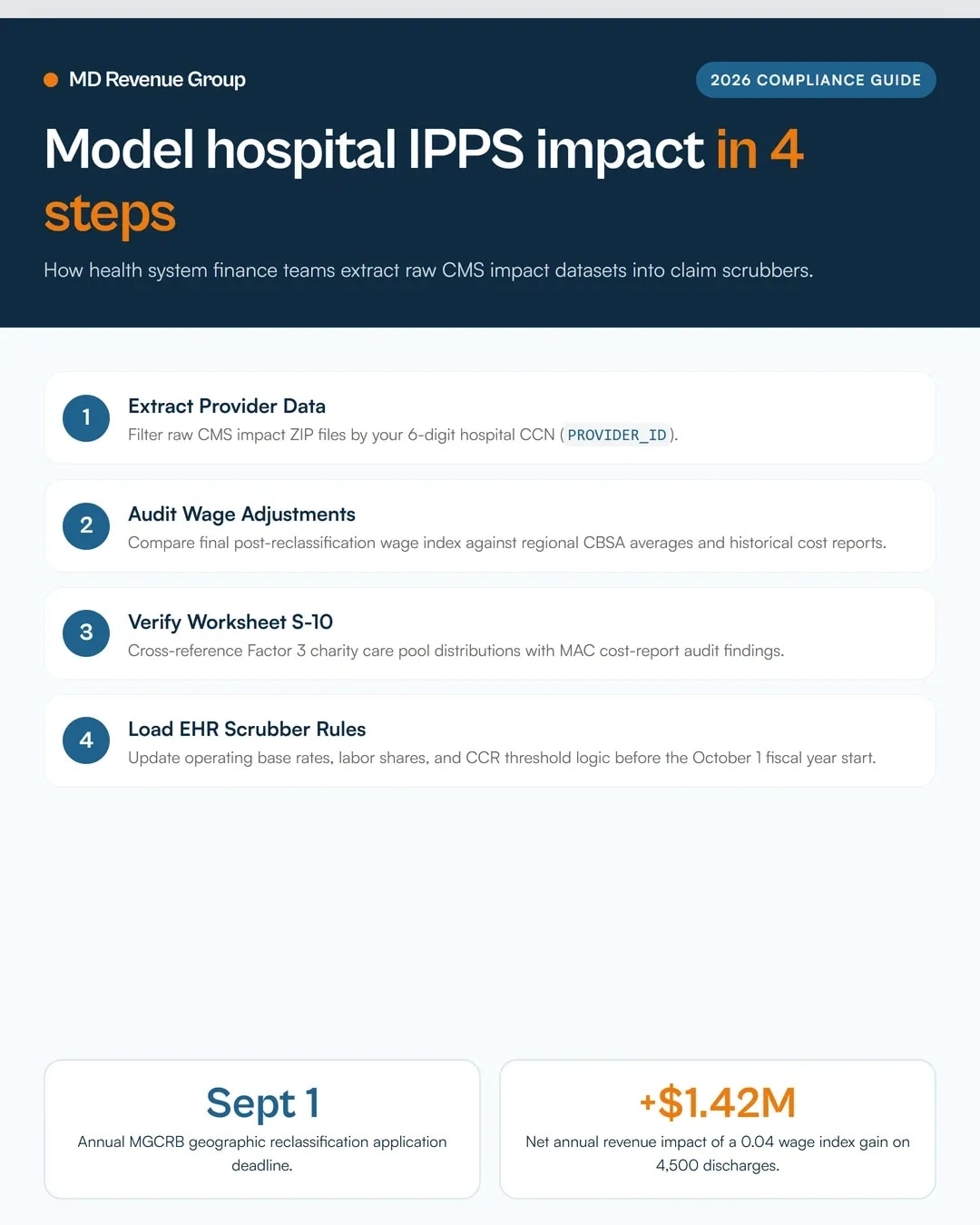
- Extract Provider Data: Download the raw IPPS Impact File and filter by facility CCN (PROVIDER_ID).
- Audit Wage Index Adjustments: Compare the published final wage index against pre-reclassification estimates and historical geographic CBSA averages.
- Verify Worksheet S-10 Factor 3: Cross-reference published UCC pool allocations with internal MAC audit reports.
- Update Contract Management Rules: Load updated base rates, wage index multipliers, and outlier thresholds into EHR billing systems prior to October 1.
- Review High-Cost Inpatient Claims: Re-evaluate high-cost surgical stays to identify cases newly eligible for outlier reimbursement under the lower threshold.
- Audit Chargemaster Files: Verify that total covered charges reflect actual hospital cost structures to maintain accurate cost-to-charge ratios.
Performing an annual forensic medical billing audit verifies that health system billing logic matches CMS final rule parameters.
Audit Compliance and Operational Governance
Maintaining compliance requires aligning clinical documentation with billing codes. Payers increase scrutiny on inpatient medical necessity, short-stay admissions under the Two-Midnight Rule, and high-cost DRG assignments.
Facility compliance teams should monitor the OIG work plan for hospital billing to anticipate targeted audit areas, including kwashiorkor coding, severe malnutrition, and unbundled cardiac procedures.
Ensuring your practice management and billing systems maintain accurate cost reporting structures prevents unexpected audit repayments during fiscal year-end reconciliations.
Optimize Your Hospital Revenue Cycle Operations
If your health system faces inpatient payment variances, wage index reclassification challenges, or complex cost-report reconciliations, expert support protects your financial health. Request a free revenue audit with MD Revenue Group to pinpoint billing leakage and secure your reimbursement.
Protect your Medicare & fee schedule revenue.
Get a custom code-by-code reimbursement impact analysis for your practice. Measure your financial variance in 48 hours.