
MHPAEA in 2026: What Billing Services for Mental Health Providers Must Document While the 2024 Rule Is Reconsidered
Learn what billing services for mental health providers must document while the 2024 MHPAEA rule is paused. Step-by-step NQTL compliance guide.
MHPAEA in 2026: What Billing Services for Mental Health Providers Must Document While the 2024 Rule Is Reconsidered
The legal pause on enforcing the 2024 Mental Health Parity and Addiction Equity Act (MHPAEA) Final Rule has created widespread confusion across group practices and billing services for mental health providers.
In May 2025, federal agencies paused enforcement of the 2024 regulations following employer litigation. In March 2026, the Department of Labor (DOL), Department of Health and Human Services (HHS), and the Treasury announced they will not defend the 2024 rule in court, committing to issue a revised Notice of Proposed Rulemaking (NPRM) by December 31, 2026.
However, pausing the 2024 rule does not suspend parity enforcement. Statutory MHPAEA obligations, the 2013 final regulations, and the Nonquantitative Treatment Limitation (NQTL) comparative analysis mandates under the Consolidated Appropriations Act of 2021 remain 100% active. This article details the exact documentation pack required to protect practice revenue during this transition period.
Key Takeaways
- 2024 Rule Paused, Statute Active: The 2024 MHPAEA Final Rule enforcement is paused, but underlying 2008 statutory requirements and CAA 2021 NQTL mandates remain fully enforced by EBSA and CMS.
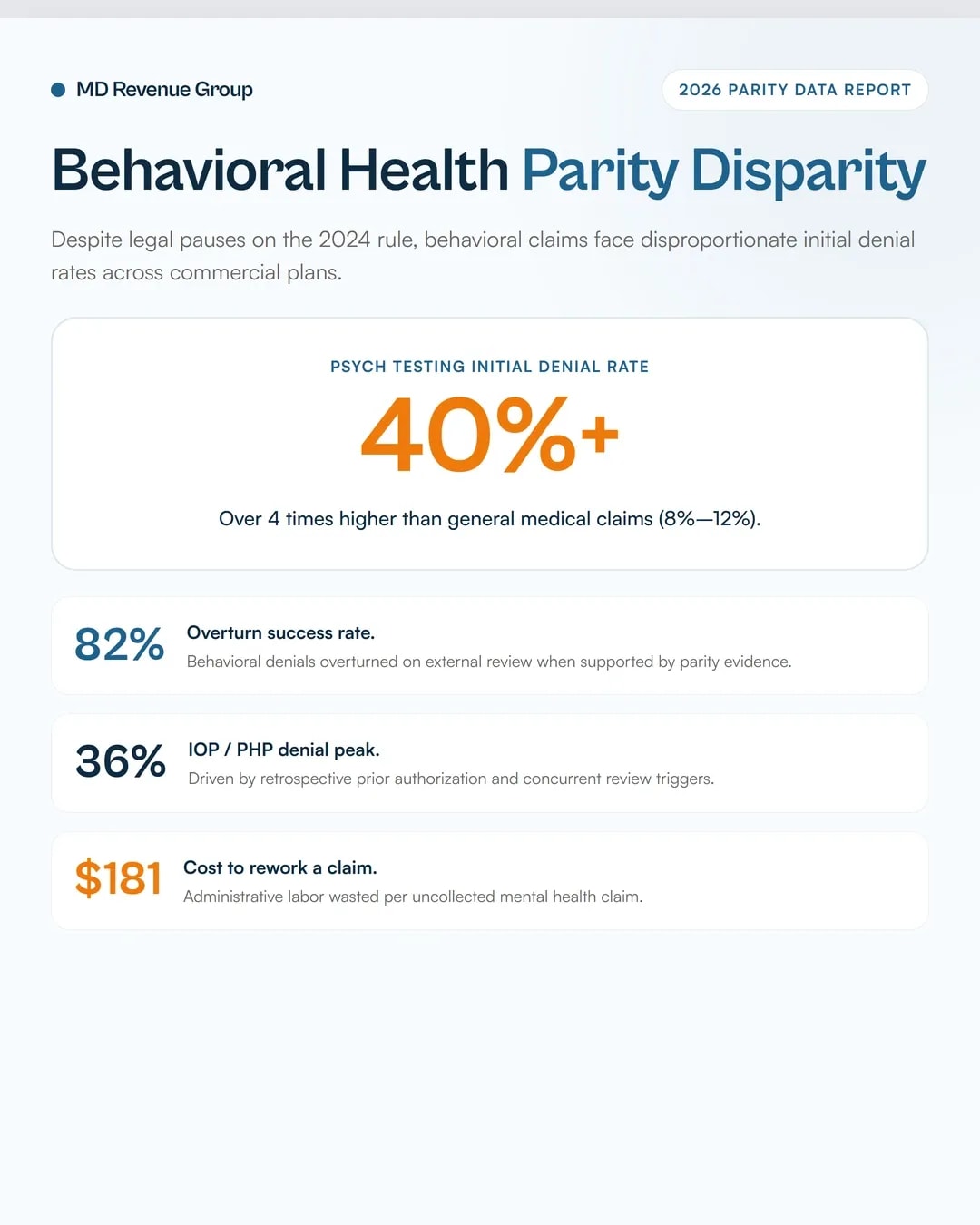
- Higher Denial Disparity: Initial claim denial rates for behavioral health run between 16% and 36%, compared to 8% to 12% for general medical claims.
- 57% to 82% Overturn Success: External reviews overturn up to 82% of behavioral health denials when supported by structured parity documentation.
- New Rule Coming Dec 2026: Federal agencies will publish a replacement MHPAEA proposed rule no later than December 31, 2026.
- $25 to $181 Rework Cost: Reworking a single denied therapy claim costs up to $181 in administrative staff time.
Legal Status: 2024 Rule Pause vs. Statutory MHPAEA Obligations
Understanding which parity rules apply today prevents compliance missteps. In January 2025, the ERISA Industry Committee (ERIC) filed suit challenging the 2024 Final Rule. By May 2025, federal regulators issued an administrative stay.
Find the unbundled units and modifier downcodes payers are stripping.
Payers process high-volume specialty codes differently by region. We review 50 encounters to uncover hidden downcoding and uncollected units.
Audit My Specialty Encounters →[2008: MHPAEA Statute Passed]
│
▼
[2013: Final Regulations Released] ──► (FULLY IN EFFECT TODAY)
│
▼
[2021: CAA NQTL Comparative Analysis Mandate] ──► (FULLY IN EFFECT TODAY)
│
▼
[May 2025: 2024 Final Rule Paused by Agencies]
│
▼
[Dec 31, 2026: Replacement NPRM Scheduled]Despite the stay on the 2024 rule additions (such as mandatory outcome data evaluation), the Employee Benefits Security Administration (EBSA) continues active enforcement audits under the 2013 rules. In the 2025 MHPAEA Report to Congress, regulators issued dozens of corrective action notices for noncompliant NQTL comparative analyses.
Practices utilizing specialized medical billing services must maintain detailed clinical records because commercial health plans continue to apply aggressive utilization controls across all outpatient care settings.
Financial Impact: Disparity Numbers for Behavioral Claims
Commercial insurance payers continue to restrict mental health coverage through Nonquantitative Treatment Limitations. Data collected from industry benchmarks reveals a persistent gap between medical/surgical and behavioral claim processing.
Claim Category | Initial Denial Rate Range | Common Denial Triggers | Appeal Overturn Rate |
|---|---|---|---|
General Medical / Surgical | 8% – 12% | Eligibility, basic coding errors | 35% – 45% |
Outpatient Psychotherapy (CPT 90834/90837) | 16% – 21% | Medical necessity, arbitrary session limits | 57% – 72% |
Intensive Outpatient (IOP) / PHP Programs | 28% – 36% | Retrospective prior authorization reviews | 62% – 78% |
Psychological & Neuropsych Testing | 40% – 48% | Pre-authorization requirement hurdles | 65% – 82% |
While initial denial rates for outpatient therapy sit twice as high as general medical claims, the 82% external review overturn rate demonstrates that most denials stem from improper payer restrictions.
For California behavioral health providers facing heavy commercial plan scrutiny, establishing clear documentation protocols turns written-off claims into collectible cash.
The 4 Core NQTL Categories Under Regulator Scrutiny
Federal auditors evaluate Nonquantitative Treatment Limitations across four operational areas. Health plans cannot impose stricter requirements in these four categories on mental health services than on medical or surgical services.
1. Prior Authorization & Pre-Service Reviews
Plans often force pre-authorization on 60-minute therapy sessions (CPT 90837) or outpatient psychiatric evaluations while allowing 45-minute medical evaluation visits without prior approval. Documenting every pre-service approval hurdle establishes concrete evidence of unequal plan administration.
2. Concurrent Review & Continuing Care Triggers
Payers frequently demand clinical review notes every 3 to 5 therapy sessions. By contrast, physical therapy or outpatient medical care often receives 12 to 20 visits before triggering a concurrent review. Billing teams should track the exact visit threshold where reviewers request treatment plan updates.
3. Provider Network Admission & Credentialing Standards
Regulators inspect whether insurance networks impose longer application processing times or stricter panel closures on Marriage and Family Therapists (LMFTs), Licensed Professional Counselors (LPCs), and Psychologists compared to medical specialists.
4. Out-of-Network Reimbursement Schedules & Tiering
Payers sometimes apply steeper fee reductions to out-of-network behavioral health specialists than out-of-network medical physicians. Keeping copies of fee schedules and unexpected plan allowances supports formal parity appeals.
The 5-Part MHPAEA Documentation Pack
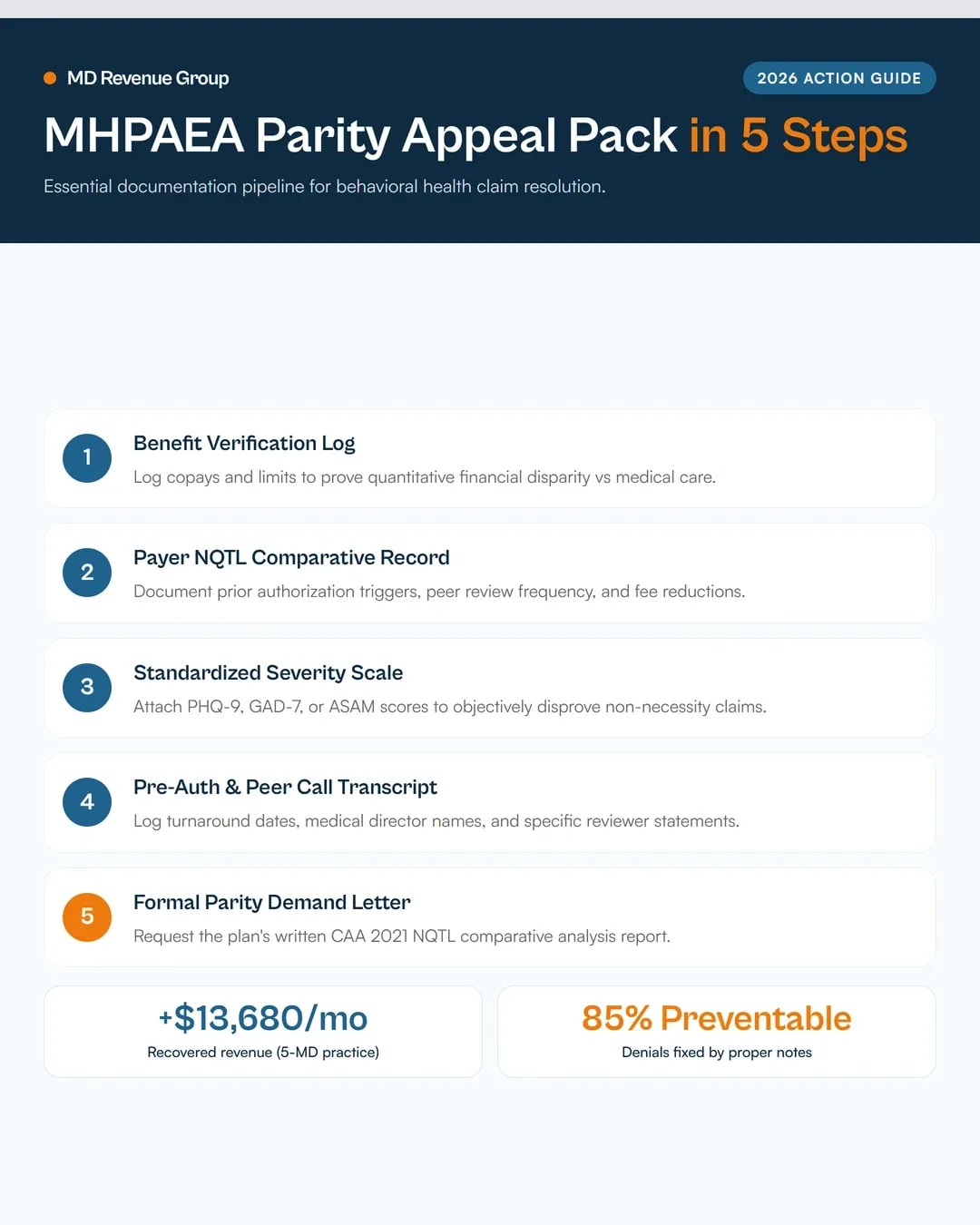
Billing teams cannot challenge parity violations without objective evidence. Every behavioral health practice should assemble a standard 5-part documentation pack for high-dollar or recurring service denials.
Benefit Verification Log (Limits & Copays)
               │
               ▼Payer NQTL Comparative Record
               │
               ▼Standardized Clinical Assessment (DSM-5-TR / ASAM)
               │
               ▼Prior Authorization & Peer-to-Peer Log
               │
               ▼Written Denial & Appeal Response Package
Part 1: Benefit Verification Log
Record exact copay, coinsurance, and deductible requirements. Verify whether financial requirements for mental health services exceed those of medical/surgical visits in the same classification (e.g., outpatient in-network).
Part 2: Payer NQTL Comparative Record
Document any nonquantitative restriction imposed by the payer, including prior authorization rules, concurrent review frequency, and step-therapy requirements.
Part 3: Standardized Clinical Assessment
Include objective severity ratings (e.g., PHQ-9 for depression, GAD-7 for anxiety, or ASAM criteria for substance use disorders). Objective clinical scoring disproves subjective "lack of medical necessity" claims.
Part 4: Prior Authorization & Peer-to-Peer Communication Log
Maintain written records of authorization request dates, turnaround times, peer-to-peer reviewer names, and exact clinical rationale cited during calls.
Part 5: Written Denial & Appeal Package
Attach the original 835 ERA denial code, relevant clinical progress notes, and a formal MHPAEA parity challenge letter requesting the payer's written NQTL comparative analysis.
When managing complex privacy requirements, practices must also ensure compliance with 42 CFR Part 2 privacy consent rules before sharing substance use disorder records during appeals.
Worked Calculation: Cost of Inaction on Preventable Parity Denials
Failing to appeal illegal parity denials creates direct financial losses. Reworking a claim costs between $25 and $181 depending on staff involvement and appeal tiers.
Here is a worked calculation for a 5-provider psychiatric group practice seeing 600 outpatient visits per month with an average allowed rate of $180 per visit.
Practice Baseline Metrics
- Monthly Billing Volume: 600 claims × 108,000 gross allowed revenue.
- Initial Denial Rate: 18% (108 denied claims per month).
- Average Administrative Rework Cost: $45 per claim.
Metric / Scenario | Baseline: No Parity Appeals (Accepting Denials) | Active Parity Appeal Protocol (70% Overturn) | Monthly Financial Impact |
|---|---|---|---|
Denied Claims per Month | 108 claims | 108 claims | 0 |
Gross Revenue at Risk | $19,440 | $19,440 | $0 |
Claims Overturned & Recovered | 0 claims ($0) | 76 claims ($13,680) | +$13,680 cash collected |
Rework Administrative Cost | 108 × 4,860 | 108 × 4,860 | $0 |
Lost Uncollected Revenue | $19,440 | $5,760 | +$13,680 revenue saved |
Net Monthly Practice Gain | -$4,860 | +$8,820 | +$13,680 net cash flow boost |
By establishing a parity appeal workflow, the practice recovers $13,680 in monthly revenue that would otherwise be written off, adding $164,160 in annual revenue.
Group practices can evaluate their existing denial benchmarks by requesting a free revenue cycle audit to isolate uncollected claims.
Decision Matrix: When to File Parity Appeals vs. Standard Claims
Not every rejection requires an MHPAEA parity appeal. Use this matrix to route claims to the correct billing resolution track.
Denial Cause & Payer Rationale | Recommended Billing Track | Required Documentation | Primary Objective |
|---|---|---|---|
Arbitrary session cap (e.g., plan caps therapy at 20 visits while medical visits are uncapped) | MHPAEA Parity Appeal Track | Plan benefit disclosure, NQTL comparative analysis request | Challenge illegal quantitative limit under 2008 MHPAEA statute. |
Missing modifier or incorrect CPT code (e.g., missing 95/GT for telehealth) | Standard Coding Correction | Corrected 837P claim line, modifier documentation | Resubmit clean claim line; no clinical review required. |
Payer requires prior auth for psychotherapy (Medical services do not require pre-auth) | NQTL Parity Appeal Track | Prior auth submission log, peer-to-peer transcript | Request payer's written parity analysis for unequal pre-authorization rules. |
Lack of clinical progress details in note | Clinical Progress Addendum | Standardized rating scales (PHQ-9/GAD-7), treatment plan update | Provide objective evidence of medical necessity to satisfy coverage guidelines. |
Literal Documentation Examples for Clinical Notes
To withstand payer medical necessity audits, clinical progress notes must replace vague descriptions with objective measurement.
Ineffective Note Phrasing (Triggers Medical Necessity Denials)
"Patient presented for session. Discussed anxiety and stress. Patient is making progress. Continue weekly 60-minute therapy sessions."
Compliant Note Structure (Withstands Parity & Audit Scrutiny)
Diagnostic & Severity Score: Major Depressive Disorder (F33.1). Baseline PHQ-9 score: 18 (Severe). Current PHQ-9 score: 14 (Moderate).Functional Impairment: Patient exhibits persistent inability to maintain work concentration (>3 workplace absences in past 14 days) and severe sleep disturbance (3 hours per night).Intervention & Modality: 53-minute individual cognitive behavioral therapy (CPT 90837). Utilized thought records to identify catastrophic cognitive distortions regarding employment security.Treatment Goal & Plan: Goal: Reduce PHQ-9 score below 10 within 6 weeks and restore 6+ hours of nightly sleep. Frequency: 1x weekly for 4 weeks, transitioning to 2x monthly upon achieving PHQ-9 < 10.
Practices seeking to improve their clinical documentation workflows can reference our detailed mental health billing guide for specialty-specific code specifications and reporting rules.
Frequently Asked Questions
Did the court ruling eliminate the requirement to submit NQTL comparative analyses?
No. The legal pause applies only to the new provisions added in the 2024 Final Rule. Employers and health plans remain legally obligated under the Consolidated Appropriations Act of 2021 to produce NQTL comparative analyses upon regulator request.
What should a practice do if a commercial payer imposes an arbitrary 20-visit cap on psychotherapy?
File an immediate MHPAEA parity appeal. Under the 2008 statute, plans cannot place hard visit caps on mental health benefits unless identical quantitative limits apply to medical/surgical benefits in the same classification.
How do provider credentialing delays intersect with MHPAEA enforcement?
Inadequate provider networks are a primary indicator of parity violations. If a payer maintains slow credentialing turnaround times for mental health clinicians while processing medical providers faster, this represents an illegal NQTL. Practices experiencing enrollment stalls can utilize dedicated provider credentialing services to speed up payer panel entry.
See your specialty billing leaks in dollars.
Get a free 50-claim forensic specialty audit with your exact regional MAC and commercial payer policies applied.