
RHC and FQHC Behavioral-Health Billing in 2026: From Encounter Reporting to Code-Level Controls
Master 2026 RHC and FQHC behavioral health billing. Learn component CPT codes, AIR caps, Revenue Code 0900 telehealth rules, and how to eliminate claim denials.
RHC and FQHC Behavioral-Health Billing in 2026: From Encounter Reporting to Code-Level Controls
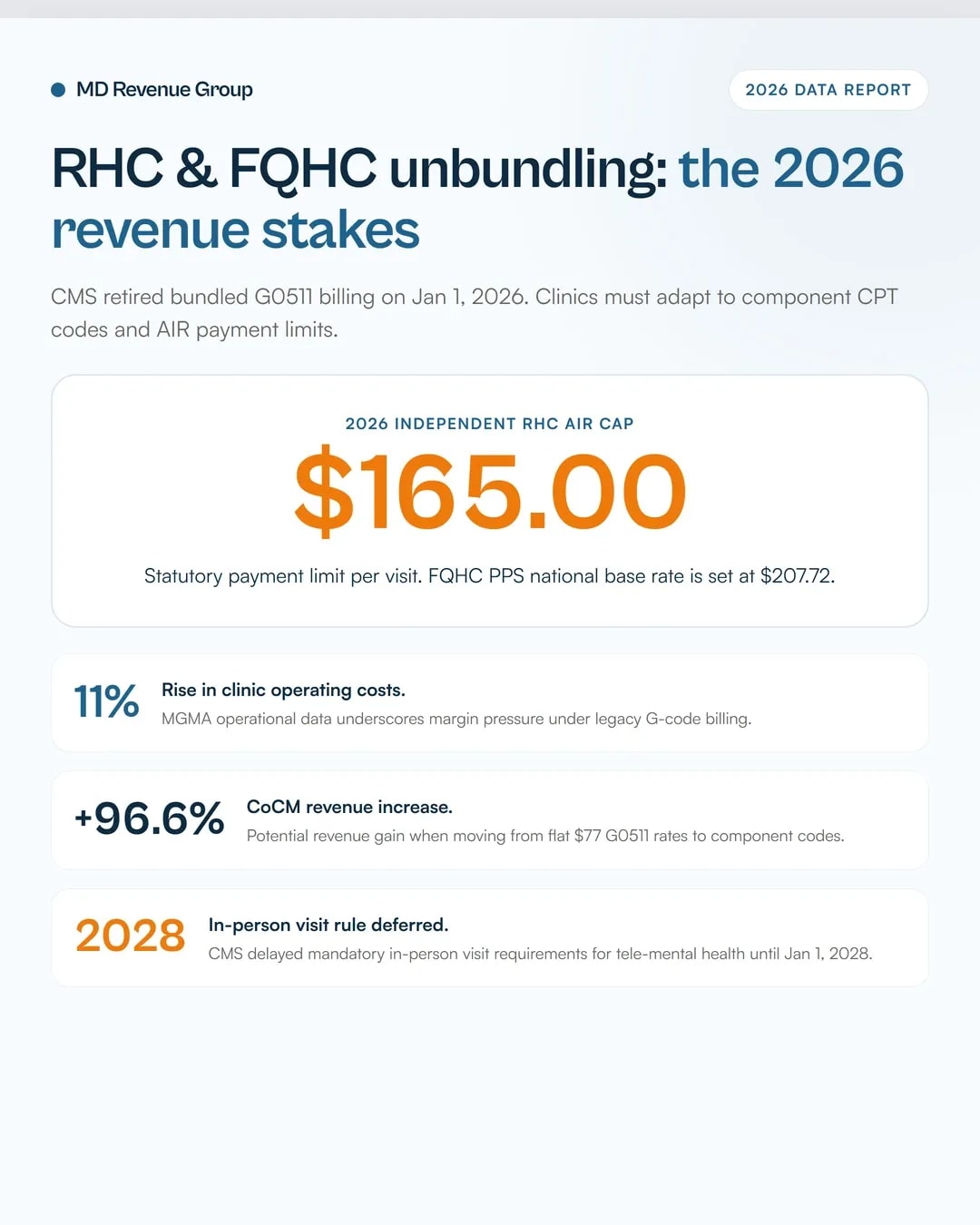
Effective January 1, 2026, Rural Health Clinics (RHCs) and Federally Qualified Health Centers (FQHCs) face a fundamental shift in behavioral health billing. CMS discontinued the bundled HCPCS G-codes (G0511, G0512, and G0071), requiring clinics to report specific, unbundled CPT and HCPCS component codes for care management and behavioral health integration. For 2026, RHC All-Inclusive Rate (AIR) payments are capped at $165.00 per visit for independent facilities, while the FQHC Prospective Payment System (PPS) base rate stands at $207.72 per visit. Under Change Request 14468, distant-site tele-mental health services billed under Revenue Code 0900 retain full AIR and PPS per-visit reimbursement using Modifier 95 for audio-video and Modifier 93 for audio-only care, while the mandatory in-person visit rule remains deferred until January 1, 2028.
Key Takeaways
- G0511 Is Discontinued: CMS terminated bundled HCPCS code G0511 on January 1, 2026. Clinics must itemize component CPT codes for behavioral health care management.
- 2026 Base Rates: Independent RHCs receive an AIR cap of $165.00 per visit. FQHCs receive an national PPS base rate of $207.72 per visit.
- Telehealth Revenue Code 0900: Distant-site tele-mental health visits billed under Revenue Code 0900 qualify for full AIR/PPS payment using Modifier 95 or 93.
- In-Person Requirement Delayed: The mandatory in-person visit requirement for tele-mental health care is postponed until January 1, 2028.
- APCM Add-On Options: Advanced Primary Care Management codes (G0568, G0569, G0570) offer new revenue pathways alongside Collaborative Care Model (CoCM) services.
Why CMS Unbundled RHC and FQHC Behavioral Health Billing in 2026
For years, RHCs and FQHCs operated under a simplified single-code structure for care management. Billed under HCPCS G0511, clinics received an average national fee schedule rate for general care management, regardless of clinical intensity.
Stop writing off 4.8% of your billing to preventable payer edits.
We review 50 of your recent denied claims against commercial & Medicare payer rules to show exactly which write-offs are legally recoverable.
Find My Recoverable Dollars →That simplicity created a data blackout for CMS. Payer algorithms could not distinguish between a 20-minute monthly check-in and an intensive 70-minute Psychiatric Collaborative Care session.
To restore transparency, CMS eliminated G0511, G0512, and G0071 on January 1, 2026. Clinics must now submit exact component CPT codes matching the Physician Fee Schedule (PFS).
This change forces health centers to update their EHR templates and charge masters immediately. According to MGMA benchmark data, clinic operating expenses rose 11% heading into 2026. Failing to capture granular behavioral health time units directly erodes clinical margins. Our specialized behavioral health billing services help practices configure compliant EHR templates to prevent unbundling denials.
Billing Parameter | Legacy System (Pre-2026) | 2026 Rule Requirement |
|---|---|---|
Care Management Code | HCPCS G0511 (Bundled) | Discontinued (Itemized CPTs) |
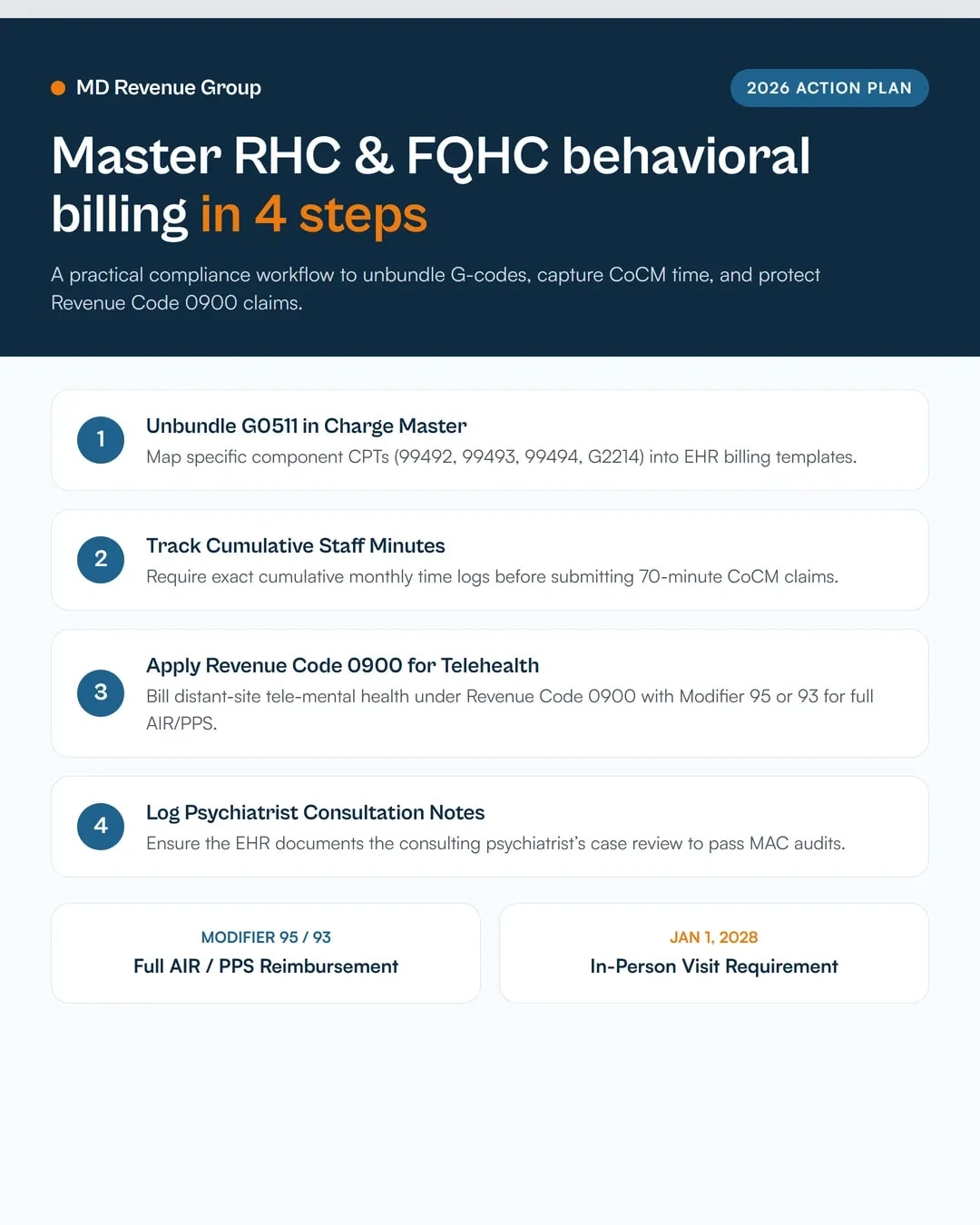
Psychiatric CoCM | HCPCS G0512 | CPT 99492, 99493, 99494, G2214 |
Virtual Check-Ins | HCPCS G0071 | Specific CTBS / CPT Codes |
RHC AIR Payment Limit | $139.00 (2024 Benchmark) | $165.00 / visit statutory cap |
FQHC PPS Base Rate | $187.19 (2024 Benchmark) | $207.72 / visit base rate |
Key CPT and HCPCS Codes for 2026 RHC and FQHC Behavioral Services
Component reporting requires precise code selection based on clinical staff time, behavioral health care manager involvement, and psychiatric consultant review.
When billing Medicare, RHCs submit claims on Form CMS-1450 (UB-04) using Type of Bill 0711. FQHCs use Type of Bill 0771.
General Behavioral Health Integration (BHI)
General BHI covers care management services directed by a physician or advanced practice provider for patients with established behavioral health conditions.
- CPT 99484: Care management services for behavioral health conditions, requiring at least 20 minutes of clinical staff time per calendar month.
Psychiatric Collaborative Care Model (CoCM)
CoCM involves a primary care team, a behavioral health care manager, and a consulting psychiatrist. Time tracking is cumulative per calendar month.
- CPT 99492: Initial Psychiatric Collaborative Care Management, first 70 minutes in a calendar month.
- CPT 99493: Subsequent Psychiatric Collaborative Care Management, first 60 minutes in a calendar month.
- CPT 99494: Each additional 30 minutes of Psychiatric Collaborative Care Management (list separately in addition to primary code).
- HCPCS G2214: Initial or subsequent Psychiatric Collaborative Care Management, first 30 minutes in a calendar month.
Advanced Primary Care Management (APCM) Add-Ons
Starting in 2026, CMS introduced optional APCM codes for primary care practices and safety-net clinics integrating behavioral health:
- HCPCS G0568: APCM services for low-complexity patients (level 1).
- HCPCS G0569: APCM services for moderate-complexity patients (level 2).
- HCPCS G0570: APCM services for high-complexity patients (level 3).
Clinics transitioning to these codes should review our detailed behavioral health integration billing guide to verify clinical documentation rules across Medicare Administrative Contractors (MACs).
Reimbursement Math: Bundled G0511 vs. 2026 Component Code Billing
To understand the financial impact of unbundling, consider an FQHC managing 100 active behavioral health patients per month under Psychiatric Collaborative Care.
Under the retired G0511 code, the clinic received a flat rate of approximately $77.00 per patient per month, regardless of whether staff spent 20 minutes or 90 minutes with the patient.
Here is the exact revenue comparison for a panel of 100 patients under 2026 component reporting:
Legacy G0511 Billing (100 Patients):
100 claims x $77.00 flat rate = $7,700 monthly revenue
2026 Component Billing (100 Patients):
60 Patients (Initial CoCM, CPT 99492 @ $156.00):     $9,360.0030 Patients (Subsequent CoCM, CPT 99493 @ $128.00):  $3,840.0010 Patients (Intensive CoCM, 99493 + 99494 @ $194.00): $1,940.00
Total 2026 Monthly Revenue: $15,140.00
Monthly Net Revenue Increase: +$7,440.00 (+96.6%)
Itemized reporting nearly doubles potential revenue for high-acuity behavioral health programs. However, if your staff fails to log exact minute counts, claims face automatic downcoding.
Practices evaluating their monthly close workflows can refer to our guide on BHI and CoCM revenue workflow comparison for step-by-step registry reconciliation strategies.
Telehealth and Revenue Code 0900 Rules Through October 2026
CMS extended safety-net telehealth flexibilities, but billing mechanics split into two distinct tracks starting in late 2026.
Under Change Request 14468, the blanket telehealth HCPCS code G2025 (paid at $97.53 in 2026) is discontinued for non-behavioral medical services effective October 1, 2026. Medical visits must then be billed using standard office visit CPT codes.
The Behavioral Health Telehealth Exception
Distant-site behavioral health services billed under Revenue Code 0900 are exempt from the G2025 retirement.
When an RHC or FQHC practitioner provides tele-mental health from a distant site:
- Submit the claim under Revenue Code 0900.
- Report the qualifying face-to-face mental health CPT code (e.g., 90834, 90837).
- Append Modifier 95 for synchronous audio-video sessions.
- Append Modifier 93 for synchronous audio-only sessions.
Mental health visits billed under Revenue Code 0900 qualify for the full AIR rate ($165.00 cap for independent RHCs) or the FQHC PPS rate ($207.72 base rate).
Congress deferred the requirement for an in-person visit within 6 months prior to initiating tele-mental health services until January 1, 2028.
Clinics providing hybrid mental health across state lines can review our tele-mental health billing rules for MAC-specific modifier guidelines.
For multi-state operators, staying aligned with regional rules is essential. Review our guides for Texas behavioral health billing services and California medical billing services to prevent regional claim holds.
Decision Matrix: Choosing Between BHI, CoCM, and APCM Workflows
Safety-net clinics frequently struggle to determine which behavioral health framework matches their clinical staffing. Using the wrong care management code leads to immediate audit recoupments.
Use this decision table to establish billing protocols across your care team:
Clinical Scenario | Required Care Team | Minimum Time Threshold | Correct 2026 Billing Code |
|---|---|---|---|
General depression monitoring led by clinical staff | PCP + Clinical Staff | 20 mins / calendar month | CPT 99484 |
Structured CoCM with psychiatric consultant review | PCP + Behavioral Care Manager + Psychiatrist | 30 mins / calendar month | HCPCS G2214 |
Initial CoCM enrollment and treatment plan build | PCP + Behavioral Care Manager + Psychiatrist | 70 mins / calendar month | CPT 99492 |
Ongoing monthly CoCM maintenance | PCP + Behavioral Care Manager + Psychiatrist | 60 mins / calendar month | CPT 99493 |
High-acuity CoCM requiring extended care manager time | PCP + Behavioral Care Manager + Psychiatrist | 90+ mins / calendar month | CPT 99493 + 99494 |
Comprehensive primary care & behavioral risk management | PCP + Care Coordinator | Monthly ongoing management | HCPCS G0568 - G0570 |
Literal EHR Documentation Examples to Pass MAC Audits
Medical Administrative Contractors (MACs) strictly audit behavioral health care management. Vague notes like "spoke to patient regarding mood" will trigger payment recoupments.
Your clinical staff must document exact time, specific interventions, and registry updates directly in the progress note.
Compliant CoCM Progress Note Template
Date: August 28, 2026 Patient: John Doe (DOB: 04/12/1968) Cumulative Monthly Time: 75 minutes (CPT 99492) Behavioral Health Care Manager: Sarah Jenkins, LCSW Attending Provider: Dr. Robert Vance, MD Psychiatric Consultant Review Date: August 26, 2026 (Dr. Ellen Smith, MD)
>Clinical Summary: Administered PHQ-9 (Score: 16, Moderate-Severe Depression; baseline was 21). Conducted 35-minute behavioral activation session via telephone. Reviewed medication adherence for Sertraline 50mg daily. Patient reports mild insomnia.
>Psychiatric Consultation & Registry Action: Reviewed case with consulting psychiatrist Dr. Smith on 08/26/2026. Consultant recommended increasing Sertraline to 100mg daily and adding sleep hygiene protocol. Updated clinical registry status and communicated treatment adjustments to Dr. Vance for prescription order. Plan: Follow-up scheduled in 14 days. Next registry audit on 09/10/2026.
Frequently Asked Questions
Can an RHC or FQHC bill CPT 99492 and an office visit on the same day?
Yes. If the patient has a separate, medically necessary face-to-face medical or mental health visit on the same day, the clinic bills the encounter for the face-to-face visit under AIR or PPS. The CoCM time is accumulated across the calendar month and billed upon reaching the 70-minute threshold.
How does audio-only tele-mental health billing work in 2026?
Audio-only mental health services remain billable for established patients who lack video capability. Report the appropriate mental health CPT code under Revenue Code 0900 and append Modifier 93. Audio-only medical (non-mental) services do not qualify for full AIR/PPS per-visit reimbursement.
What happens if clinical staff spend 45 minutes on initial CoCM?
If staff spend between 30 and 69 minutes during the initial month, you cannot bill CPT 99492 (which requires 70 minutes). Instead, report HCPCS code G2214, which covers the initial or subsequent 30 minutes of Collaborative Care management.
Do we need a written consent form for BHI or CoCM?
CMS requires advance patient consent for all care management services. Consent can be verbal or written but must be documented in the EHR. The note must confirm that the patient was informed of co-pay responsibilities and granted permission for consulting team access.
Struggling to configure 2026 component codes or tele-mental health revenue rules in your clinic? Our team audits safety-net RCM workflows to stop claim leaks. Request a free revenue audit today.
Recover your denied claims in dollars.
Send us 50 of your recent denied claims. Our certified AAPC/AHIMA billing team will identify every recoverable dollar within 48 hours.