
AMA Prior-Authorization Survey: How to Calculate the Cost of 13 Hours of Weekly Staff Time
Calculate the real labor cost of 13 weekly hours of prior authorization per physician using AMA & CAQH benchmarks. Learn when hiring a medical billing service pays off.
AMA Prior-Authorization Survey: How to Calculate the Cost of 13 Hours of Weekly Staff Time
According to annual survey findings from the American Medical Association (AMA), physicians and clinical staff spend an average of 13 hours per week per physician managing prior authorization (PA) requests. That administrative burden translates to 1.5 workdays per week lost to payer paperwork for every provider in your clinic. Data from the CAQH Index shows that manual prior authorizations consume 24 minutes of staff time and cost $10.97 per transaction in direct labor, while all-in economic costs (including physician peer-to-peer reviews and denial appeals) reach $50 to $150 per request. For a 5-physician practice processing 10,000 authorizations per year, PA labor burns over $220,000 annually. Partnering with a specialized medical billing service automates submission queues, cuts authorization turnaround, and restores clinical focus.
Key Takeaways
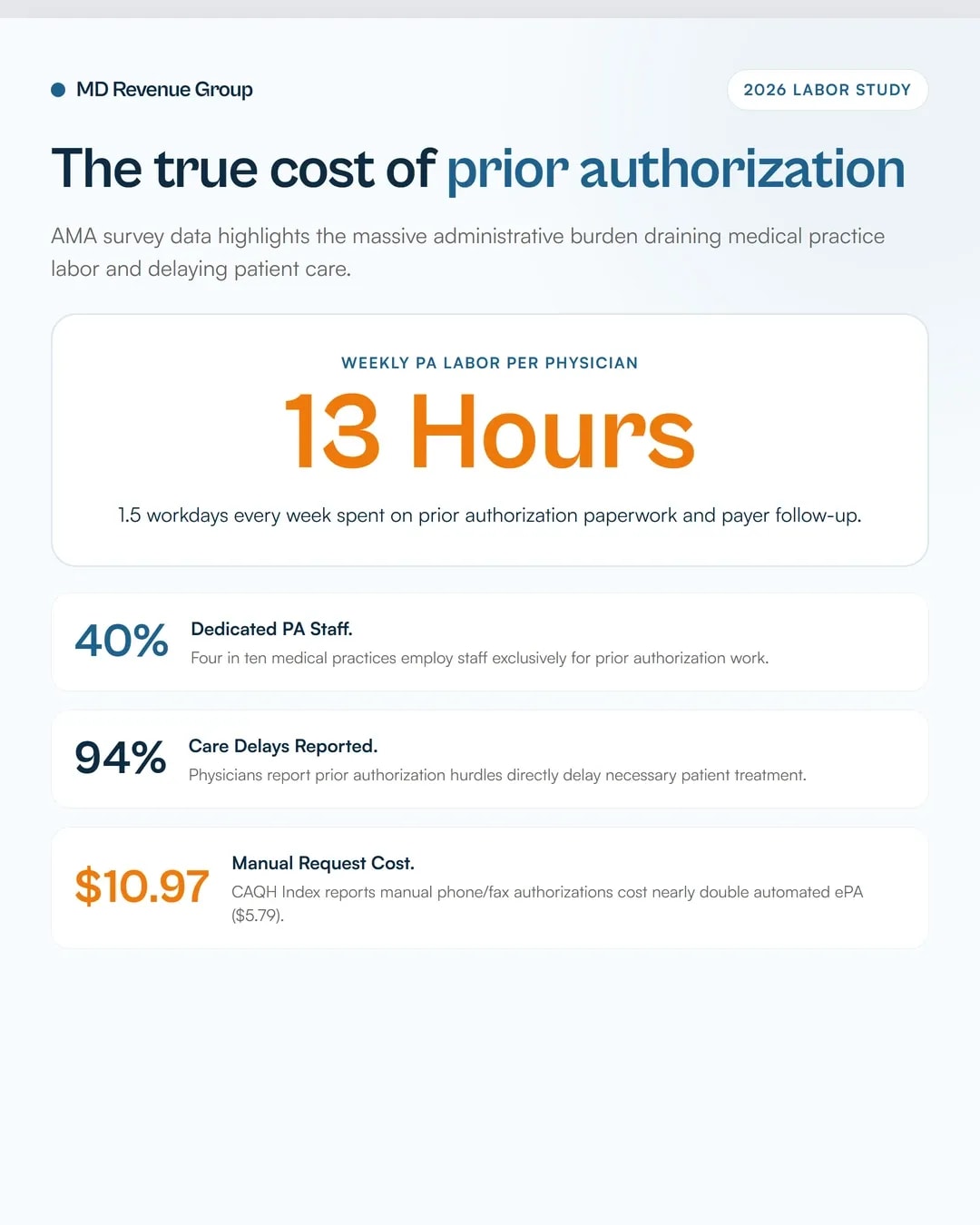
- 13 Hours Weekly Burden: AMA surveys confirm physicians and staff spend 13 hours per physician every week completing prior authorizations.
- 40% Dedicated Staffing: Four out of ten medical practices now employ staff whose sole job responsibility is managing prior authorizations.
- $10.97 vs. $5.79 Per Request: CAQH Index data shows manual authorizations cost $10.97 per transaction compared to $5.79 for electronic workflows.
- 94% Care Delays: 94% of physicians report that prior authorization rules create patient care delays, while 78% report treatment abandonment.
- $393,000 Annual Impact: MGMA benchmarks indicate high-volume practices spend up to $393,000 annually on cumulative authorization overhead.
What the Latest AMA Prior Authorization Survey Reveals
Prior authorization was originally designed as a safety check for high-cost experimental procedures. Today, it operates as a widespread claims bottleneck across commercial and Medicare Advantage plans.
35 days in AR is the benchmark. Anything over 50 is uncollected revenue.
We conduct a forensic 90-day cash flow audit to identify unworked claims, fee schedule underpayments, and clearinghouse leaks.
Audit My Cash Flow Leaks →The AMA’s nationwide survey of practicing physicians exposes the scope of this administrative drain:
- Physicians and clinical staff complete an average of 39 to 43 prior authorization requests per physician every week.
- Practices spend 13 hours per week per physician on PA administrative work.
- 40% of practices employ staff who work exclusively on prior authorization requests.
- 94% of physicians report that PA processes cause delays in necessary medical care.
- 78% of physicians state that PA hurdles lead patients to abandon their prescribed treatment entirely.
These numbers reflect a severe productivity tax on healthcare providers. When clinical staff spend 13 hours chasing faxed authorizations, patient scheduling bogs down and clean claim submission slows.
Many practices attempt to absorb this burden by hiring additional front-office staff. However, as operating costs rise, maintaining in-house authorization teams becomes unsustainable. Evaluating transparent medical billing service cost structures offers practices a clear path to outsource authorization tracking while capping labor overhead.
Metric | AMA Survey Benchmark | Operational Real-World Impact |
|---|---|---|
Weekly PA Hours per Physician | 13 hours | 1.5 full workdays per week lost |
Weekly Requests per Physician | 39–43 requests | 2,000+ requests per physician annually |
Dedicated PA Staff | 40% of practices | High overhead, vulnerable to staff turnover |
Patient Treatment Abandonment | 78% of practices | Revenue loss from cancelled procedures |
Care Delay Impact | 94% of practices | Extended days in A/R and patient dissatisfaction |
CAQH Benchmarks: Manual vs. Automated Prior Authorization Costs
The CAQH Index tracks transaction costs across healthcare administrative workflows. Their data highlights a massive cost gap between manual and electronic processing methods.
Processing a single prior authorization manually via phone, fax, or email takes an average of 24 minutes of staff time and costs $10.97 in direct administrative labor.
Using payer web portals reduces processing time to 16 minutes per request. Fully electronic prior authorization (ePA) integrated into practice workflows drops labor time to under 4 minutes and cuts direct transaction costs to $5.79.
Transaction Type      Average Time      Direct Cost per Unit
------------------------------------------------------------
Manual (Phone/Fax)    24 minutes        $10.97
Payer Web Portal      16 minutes        $8.15
Automated ePA         < 4 minutes       $5.79
The All-In Economic Cost of Authorization Bottlenecks
Direct transaction costs represent only a fraction of the true financial loss. When an authorization is delayed or denied, your practice incurs secondary expenses:
- Physician peer-to-peer review calls (15 to 30 minutes of uncompensated doctor time).
- Appeal letter writing and clinical chart extraction.
- Rescheduled surgical suites and unused diagnostic slots.
Factoring in physician time and denial rework, industry analyses show the true economic cost ranges between $50 and $150 per authorization.
For mid-sized practices struggling with payer friction, deploying an experienced team for outsourcing medical billing eliminates manual fax follow-ups and enforces electronic authorization tracking across all commercial payers.
Proprietary Calculation: Calculating Your Practice's 13-Hour PA Waste
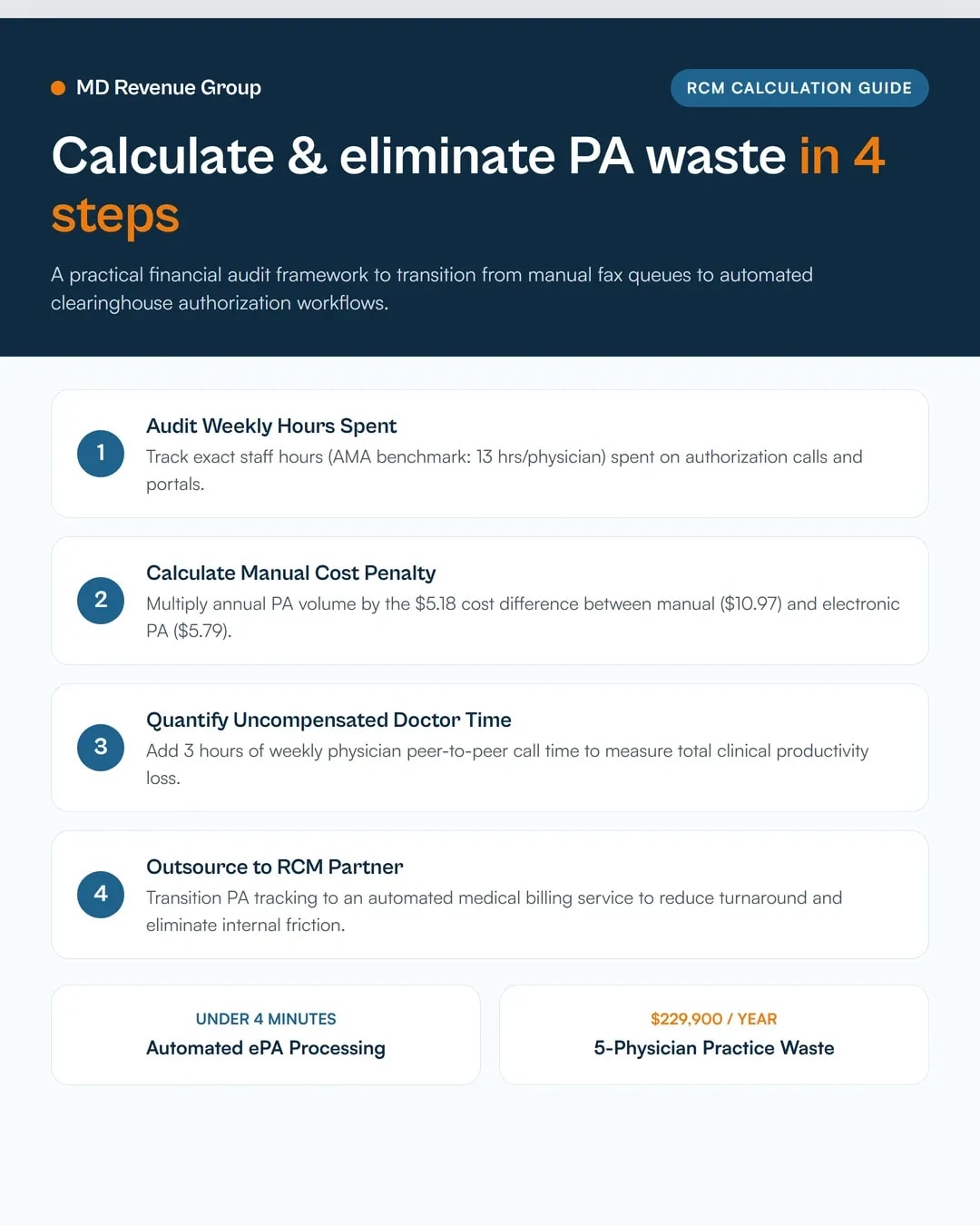
To help practice managers quantify their authorization loss, we developed the PA Labor Waste Formula.
This calculation combines direct staff wage costs, physician opportunity costs, and manual transaction inefficiency.
The PA Labor Waste Formula
Annual PA Labor Waste = (N x 13 hrs x W_staff x 52 weeks) + (N x 3 hrs x W_doc x 52 weeks) + (N x R_annual x C_manual)- N = Number of full-time physicians in your practice
- 13 hrs = Weekly staff hours spent on PA per physician (AMA benchmark)
- W_staff = Hourly wage + benefits of authorization staff ($25.00/hr average)
- 3 hrs = Weekly physician hours spent on peer-to-peer/notes ($120.00/hr uncompensated clinical value)
- R_annual = Annual PA volume per physician (2,000 requests average)
- C_manual = Incremental cost penalty of manual vs. automated PA ($5.18 difference)
Worked Example: 5-Physician Medical Group
Consider a 5-physician specialty practice processing 10,000 prior authorizations per year:
Staff Labor Cost:
   5 physicians x 13 hrs/week x $25/hr x 52 weeks = $84,500.00Uncompensated Physician Time:
   5 physicians x 3 hrs/week x $120/hr x 52 weeks = $93,600.00Manual Processing Friction:
   10,000 requests x $5.18 manual cost penalty = $51,800.00
Total Annual Prior Authorization Waste: $229,900.00
This 5-physician practice loses nearly $230,000 every year to prior authorization friction.
Practices facing high denial rates due to missed authorization deadlines can review our prior authorization automation failure guide to identify where internal workflows break down.
Operational Bottlenecks: How Authorization Delays Destroy Medical Cash Flow
The financial drain of prior authorization extends far beyond staff hourly wages. When authorization requests stall in payer queues, the entire revenue cycle suffers from delayed collections and increased denial rates.
First, delayed authorizations lead directly to appointment cancellations and empty schedule slots. When a patient arrives for an MRI or specialized procedure without an approved authorization number on file, the practice must either turn the patient away or risk performing an uncollectible service.
Second, retrospective authorization denials are among the most difficult claims to recover. When a claim is submitted without an active authorization number on line 23 of Form CMS-1500, commercial payers issue immediate CO-197 denials (pre-certification/authorization absent). These denials carry an initial appeal success rate of under 30% unless supported by clinical medical necessity records.
Third, staff burnout in authorization departments leads to severe turnover. Training a new authorization clerk takes 6 to 8 weeks. During that training window, authorization backlogs double, causing clean claim rates to drop sharply.
By auditing internal workflows, practices can eliminate backlogs. Review our analysis of CMS-0057-F prior authorization deadline breakdown to prepare your front office for mandated electronic turnaround standards.
Decision Matrix: In-House PA Labor vs. Outsourced Medical Billing Service
When authorization volume surges, practices face a strategic choice: hire more in-house authorization clerks or outsource revenue cycle operations to a professional partner.
Meeting 72-hour expedited decision deadlines requires continuous queue management and instant clinical attachment delivery.
Use this decision table to compare operational models:
Operational Factor | In-House Authorization Team | Professional Medical Billing Service |
|---|---|---|
Primary Labor Focus | Mixed front-desk & billing duties | Dedicated revenue cycle specialists |
System Integration | Manual faxing & disparate portals | Automated clearinghouse & ePA API |
Staff Turnover Risk | High; requires ongoing retraining | Zero downtime; covered by vendor SLA |
Cost Structure | Fixed payroll + benefits ($45k-$60k/FTE) | Variable % of collected revenue |
Peer-to-Peer Support | Minimal; doctor manages solo | Pre-formatted clinical packets prepared |
Denial Prevention | Reactive after initial rejection | Pre-submission authorization verification |
Practices adopting advanced automation should also review our guidelines on AI in denial management governance to ensure machine learning tools comply with HIPAA privacy standards.
Whether operating in high-density regions like our New Jersey medical billing services network or expanding across state lines through Texas medical billing services, establishing a streamlined authorization process directly protects your cash flow.
Literal PA Queue Documentation Template for Medical Teams
To prevent authorization denials, your staff must maintain a standardized tracking log directly in your practice management system. Vague notes like "called insurance" fail during audit reviews.
Compliant Prior Authorization Queue Log Entry
Date Initiated: August 28, 2026 Patient Name: Jane Smith (DOB: 09/15/1974) | Policy ID: BCBS-99482103 Ordering Provider: Dr. Marcus Vance, MD Target Procedure/Drug: CPT 73721 (MRI Lower Extremity Joint w/o Contrast) Payer Authorization Tracking #: PA-2026-884920
>Clinical Attachment Verification: Attached 6 weeks conservative therapy notes (PT evaluation from 07/10/2026), failed NSAID trial documentation (Meloxicam 15mg x 45 days), and physician exam note detailing antalgic gait.
>Status Timeline: - 08/28/2026 09:15 AM: Submitted via Availity Portal. Status: Pending Medical Review. - 08/29/2026 02:30 PM: Payer representative (ID: Agent 4419) confirmed clinical packet received. - 08/30/2026 11:00 AM: APPROVED. Auth # 9948201. Effective: 08/30/2026 to 11/30/2026. Approved Units: 1 encounter. Action: Linked Auth # 9948201 to appointment scheduling module and cleared for procedure.
Frequently Asked Questions
What is the average turnaround time for prior authorizations in 2026?
According to a September 2026 MGMA survey, 44% of practice leaders report prior authorization turnaround times have slowed. Standard elective authorizations take 5 to 10 business days, while urgent requests average 48 to 72 hours.
How many hours a week do doctors spend on prior authorization?
The AMA reports that physicians and clinical staff spend an average of 13 hours per physician per week completing prior authorization forms, submitting attachments, and conducting peer-to-peer reviews.
Does CMS-0057-F apply to all commercial insurance plans?
No. CMS-0057-F impacts Medicare Advantage, state Medicaid fee-for-service, Medicaid managed care, and Qualified Health Plans (QHPs) on federal exchanges. It imposes electronic API requirements and 72-hour expedited decision deadlines starting in 2026 and 2027.
How does outsourcing prior authorization work with a medical billing service?
A medical billing service takes over patient eligibility verification, clinical document gathering, portal submission, authorization tracking, and denial appeals. Your clinical team simply uploads doctor notes, and the billing service manages the administrative workflow to approval.
Is your staff spending 13+ hours a week chasing faxes and authorization portals? We audit RCM bottlenecks and take prior authorization off your plate. Schedule a revenue-cycle consultation today.
See your revenue leaks in dollars.
Get a forensic 90-day cash flow audit of your practice. 100% confidential, 48-hour delivery, zero obligation.