
Digital Mental-Health Claims After the 2026 CMS Expansion: Coverage Verification Before the First Submission
Master medical billing for mental health services in 2026. Learn CMS digital therapeutic codes G0552-G0554, CoCM rules, and front-end verification.
The 2026 Centers for Medicare & Medicaid Services (CMS) Physician Fee Schedule expanded reimbursement for digital mental health treatment (DMHT) devices under HCPCS codes G0552, G0553, and G0554. Medical billing for mental health services now covers FDA-cleared digital therapeutics for ADHD (under 21 CFR § 882.5803) alongside established coverage for depression, anxiety, insomnia, and substance use disorders. However, Medicare Administrative Contractors (MACs) reject up to 28% of initial digital behavioral health claims due to missing front-end coverage verification, unverified carve-out benefits, and incomplete in-person visit documentation. To secure full reimbursement, practices must verify commercial and Medicare Advantage coverage prior to treatment initiation, maintain time-stamped software logs, and enforce strict 6-month in-person visit rules.
Key Takeaways
- New DMHT Billing Codes: HCPCS G0552 covers initial supply and onboarding for FDA-cleared digital mental health devices, while G0553 and G0554 cover 20-minute monthly management blocks.
- RHC and FQHC Code Retirement: CMS retired bundled HCPCS G0512 for Rural Health Clinics and FQHCs on January 1, 2026. Facilities must bill standalone CPT codes 99492, 99493, 99494, and G2214.
- Strict In-Person Mandate: Tele-mental health claims require a documented in-person encounter within 6 months prior to initial remote therapy, followed by an in-person visit every 12 months.
- Audio-Only Billing: Modifier FQ is mandatory for audio-only sessions when video capability is unavailable, backed by explicit medical record justification.
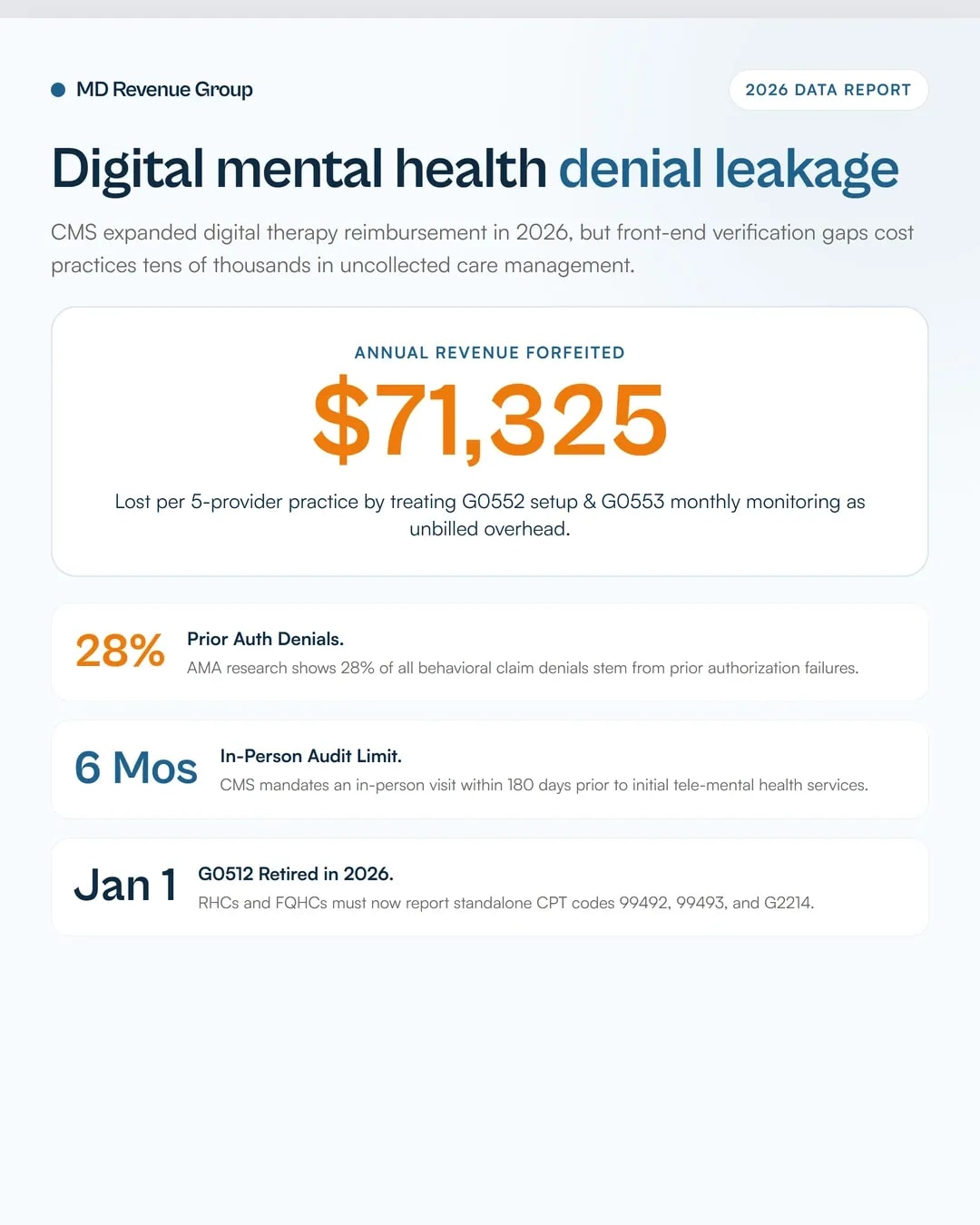
- Prior Authorization Burden: American Medical Association (AMA) survey data shows prior authorization accounts for 28% of administrative claim denials across behavioral health practices.
What Changed for Digital Mental Health Billing in 2026
The 2026 CMS Physician Fee Schedule final rule transformed how outpatient psychiatry clinics, therapy groups, and integrated health systems handle software-driven behavioral therapy. CMS formally recognized FDA-cleared digital therapeutics as billable medical interventions rather than non-covered administrative tools.
Stop writing off 4.8% of your billing to preventable payer edits.
We review 50 of your recent denied claims against commercial & Medicare payer rules to show exactly which write-offs are legally recoverable.
Find My Recoverable Dollars →This policy shift expands coverage beyond major depressive disorder and generalized anxiety. Clinicians prescribing FDA-authorized digital therapeutics for pediatric and adult ADHD can submit claims under the new DMHT code set. Licensed Marriage and Family Therapists (LMFTs) and Licensed Professional Counselors (LPCs) can bill these codes under direct Medicare enrollment.
Commercial payers have responded by updating their behavioral health fee schedules. However, commercial adoption varies by state and payer contract. Many private insurers route digital therapy claims through third-party behavioral health carve-out vendors, creating claim routing traps for unprepared front-office staff. Practices relying on standard medical billing workflows face high initial rejection rates when carve-out clearinghouse IDs are omitted.
Our specialized medical billing services clean up these front-end routing errors before claims reach the payer, protecting your monthly cash flow.
FDA-Cleared Digital Therapeutics: Coding G0552, G0553, and G0554
Reimbursement for digital mental health software hinges on selecting the exact HCPCS G-code based on service timing and clinical staff involvement. You cannot bill these codes for general wellness apps, meditation software, or unapproved patient portals. The device must hold explicit FDA clearance under 21 CFR § 882.5803 or equivalent medical device designations.
- HCPCS G0552: Supply of digital mental health treatment software, including initial setup and patient onboarding, prescribed by a qualified healthcare professional. (Billed once per treatment course).
- HCPCS G0553: First 20 minutes of clinical staff time per calendar month spent reviewing patient data, modifying treatment protocols, and consulting with the patient.
- HCPCS G0554: Each additional 20 minutes of clinical staff time per calendar month. (Report in conjunction with G0553).
The billing clinician must maintain direct oversight of the digital intervention. Clinical staff time reported under G0553 must represent actual non-face-to-face time spent reviewing system analytics, assessing patient compliance logs, or conducting clinical check-ins.
If a patient logs fewer than the manufacturer-specified minimum active treatment days during the calendar month, payers treat the service as incomplete and deny G0553. Your billing team must verify monthly software compliance reports before dropping the claim.
BHI and CoCM Rule Updates: RHC and FQHC Coding Changes
Rural Health Clinics (RHCs) and Federally Qualified Health Centers (FQHCs) experienced a major billing shift on January 1, 2026. CMS retired code G0512, which previously bundled Psychiatric Collaborative Care Model (CoCM) services into a single general all-inclusive payment.
RHCs and FQHCs now report the exact same detailed CPT and HCPCS codes used by physician offices:
- CPT 99492: Initial CoCM month, first 70 minutes of clinical staff time with psychiatric consultant involvement.
- CPT 99493: Subsequent CoCM month, first 60 minutes.
- CPT 99494: Each additional 30 minutes of CoCM staff time.
- HCPCS G2214: Initial or subsequent CoCM month, short-term 30-minute block.
This transition allows safety-net clinics to capture reimbursement matching their true clinical effort. However, it requires RHC and FQHC billing teams to institute precise monthly time tracking across primary care providers, behavioral health managers, and consulting psychiatrists.
Reviewing your monthly care management logs against our Behavioral Health Integration revenue workflow guide ensures your practice captures every billable minute without triggering audit recovery claims.
Tele-Mental Health Compliance: The 6-Month Rule and Modifier FQ
Medicare requires an established in-person relationship for remote mental health services delivered to patients in their homes. MAC auditors actively target tele-mental health claims that lack a documented face-to-face encounter.
The compliance requirements mandate:
- An initial in-person visit within 6 months prior to the start of telehealth or digital mental health services.
- A subsequent in-person follow-up visit at least once every 12 months thereafter.
- An explicit medical record exemption note if an in-person visit is clinically inadvisable or geographically unfeasible.
When providing audio-only teletherapy, billers must append Modifier FQ (behavioral health service furnished using audio-only technology). Payers routinely reject audio-only claims submitted without Modifier FQ or when billed with standard office visit codes.
Practices operating across state lines face compound compliance checks. For instance, clinicians seeing patients in the tri-state area must align Medicare MAC rules with state-level telehealth consent mandates.
Outsourcing to our certified New Jersey medical billing specialists ensures your telehealth claims meet both local MAC standards and state board regulations.
Proprietary Calculation: Revenue Impact of Unbilled DMHT Setup
Many behavioral health practices prescribe digital therapeutics but fail to capture the initial onboarding and monthly monitoring revenue. The calculation below demonstrates the financial cost of unbilled G0552 and G0553 codes for a 5-clinician psychiatric group.
Financial Baseline Assumptions
- Active Patient Volume: 250 patients prescribed FDA-cleared digital therapeutics annually.
- National Average Medicare / Payer Reimbursement (2026 Fee Schedule):
- HCPCS G0552 (Initial setup): $68.50 per patient.
- HCPCS G0553 (Monthly 20-min management): $54.20 per patient per month.
- Average Patient Duration on Digital Therapeutic: 4 months.
Revenue Projection Math
- Unbilled Setup Revenue (G0552):
- Unbilled Monthly Monitoring Revenue (G0553):
- Total Annual Uncollected Revenue:
A 5-provider practice forfeits $71,325 per year simply by treating digital therapeutic setup as free administrative overhead rather than a billable medical service.
Front-End Coverage Verification: A 5-Step Billing Workflow
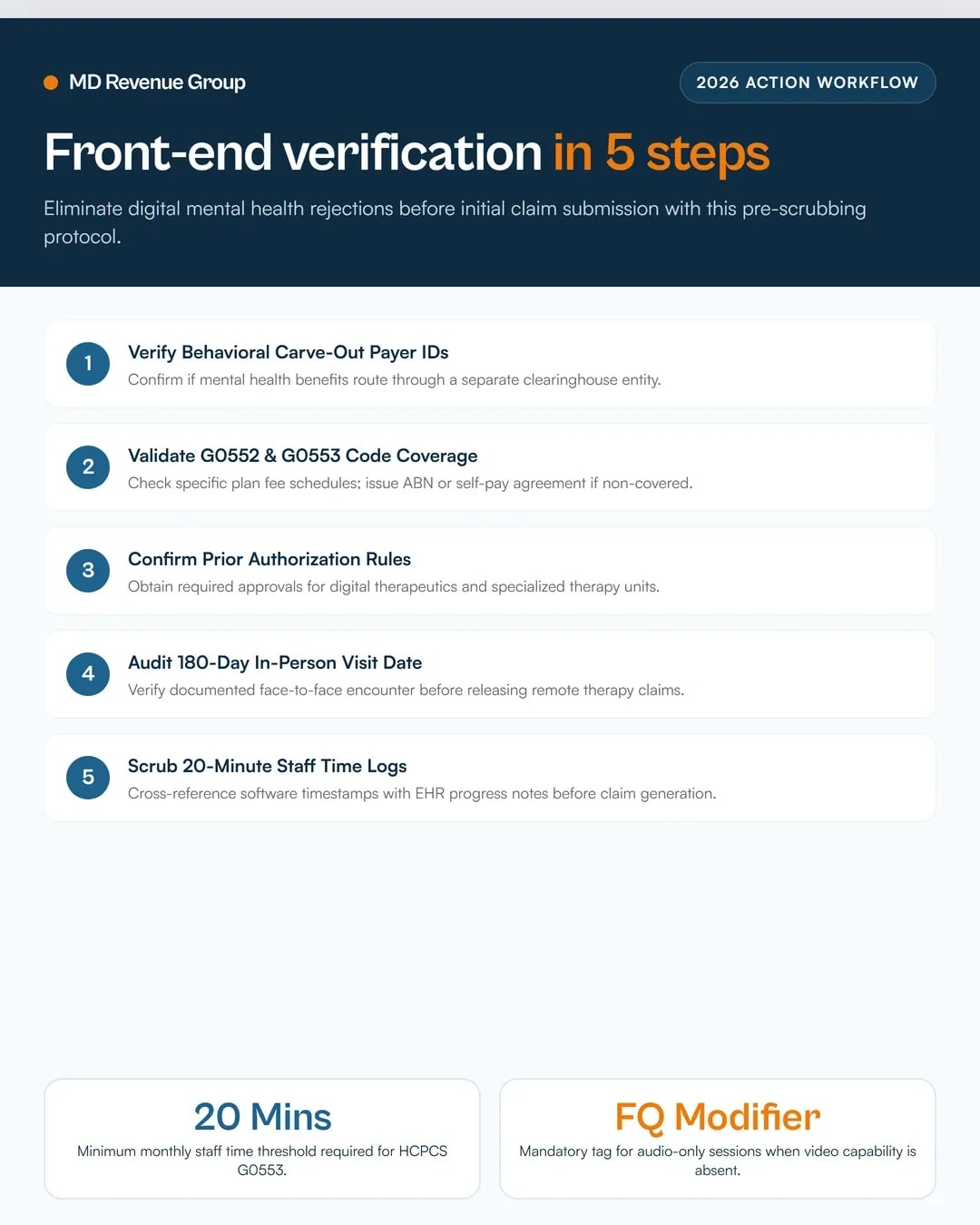
Preventing denials for digital behavioral health services starts before the clinician issues the software prescription. Implement this 5-step front-office protocol:
[Step 1: Payer Identification] ──> [Step 2: Carve-Out Routing] ──> [Step 3: PA Verification]
                                                                        │
[Step 5: Time-Log Scrubbing] <── [Step 4: In-Person Check] <───────────┘- Verify Carve-Out Payer Entities: Confirm whether the patient's mental health benefits are managed by the primary medical insurer or a third-party behavioral health organization. Obtain the exact payer ID for electronic claims.
- Confirm Code-Level Coverage: Validate if the specific health plan reimburses HCPCS codes G0552 and G0553. If non-covered, issue an Advance Beneficiary Notice (ABN) for Medicare or a self-pay agreement for commercial patients.
- Secure Prior Authorization: Check authorization requirements for digital therapeutics and specialized psychotherapy codes. AMA research reveals prior auth failure causes 28% of preventable denials.
- Audit In-Person Recency: Search the electronic health record (EHR) for a qualifying face-to-face visit date within the preceding 180 days before releasing telehealth or DMHT orders.
- Pre-Scrub Monthly Time Logs: Match software-generated activity timestamps with clinician progress notes prior to claim generation. Ensure non-face-to-face staff time hits the 20-minute threshold.
Practices managing multi-state practice footprints can rely on our specialized New York behavioral health practices team to execute automated real-time eligibility checks across all commercial and Medicaid plans.
Decision Matrix: Comparing 2026 Digital Behavioral Health Codes
Selecting the wrong code structure leads to rapid payer downcoding or immediate denial. Use this reference matrix to match clinical services with compliant billing codes.
Code / Code Set | Primary Service Description | 2026 Time Requirement | Eligible Billing Providers | Key Documentation Trigger |
|---|---|---|---|---|
HCPCS G0552 | DMHT initial setup & patient onboarding | One-time setup | MD, DO, NP, PA, LCSW, LMFT, LPC | Prescribed FDA device ID & onboarding note |
HCPCS G0553 | DMHT clinical staff monthly management | 20 mins / calendar month | MD, DO, NP, PA (supervised staff) | Monthly data review log & patient contact |
HCPCS G0554 | DMHT additional monthly management | +20 mins / calendar month | MD, DO, NP, PA (supervised staff) | Cumulative time log exceeding 40 minutes |
CPT 99484 | General Behavioral Health Integration | 20 mins / calendar month | MD, DO, NP, PA, LCSW, LMFT, LPC | Standardized rating scale (PHQ-9 / GAD-7) |
CPT 99492 | CoCM initial care management | 70 mins / first month | MD, DO, NP, PA (with Psych Consultant) | Psychiatric consultant recommendations in note |
CPT 90834 | Individual Psychotherapy | 38 to 52 minutes | MD, DO, LCSW, LMFT, LPC, Clinical Psych | Exact start and stop times documented |
Audit Readiness and Literal Documentation Examples
MAC auditors and commercial special investigation units (SIUs) request full clinical notes for G0553, 99484, and telehealth claims. Vague statements such as "patient monitored on digital app" lead to immediate fee recoupment.
1. DMHT Monthly Management Documentation (G0553)
Your progress note must include exact clinical time, specific software metrics reviewed, and clinician interventions:
"Reviewed 30-day dashboard analytics for FDA-cleared DMHT device (ID: #DMH-8825). Patient completed 18 of 20 assigned cognitive modules (90% compliance). PHQ-9 score decreased from 14 (moderate) to 9 (mild). Conducted 12-minute phone consultation with patient regarding module 4 skill application. Total non-face-to-face clinical staff time: 22 minutes. Adjusted digital module progression for upcoming month."
2. Audio-Only Telehealth Justification (Modifier FQ)
When billing audio-only psychotherapy, document why video was unavailable:
"Session conducted via audio-only telephone technology due to patient lacking broadband internet access at rural residence. Patient confirmed inability to establish video connection. Audio-only format deemed clinically appropriate to maintain continuity of care. Total session time: 45 minutes (10:15 AM - 11:00 AM). Modifier FQ appended."
To protect your clinical notes against strict payer audits, review our comprehensive guide on 42 CFR Part 2 consent rules to maintain strict substance use record compliance while securing payment.
When to Outsource Behavioral Health Billing Operations
Managing digital health additions alongside traditional psychotherapy billing places an immense administrative burden on internal office staff. When denial rates rise above 5%, practice revenue declines rapidly.
Consider outsourcing your revenue cycle if your practice experiences any of these operational bottlenecks:
- Billing staff spends more than 15 hours per week chasing prior authorizations.
- Claim rejections stem from unverified behavioral health carve-out insurance IDs.
- AR days exceed 40 days due to delayed DMHT time-log processing.
- Clinicians fail to track the mandatory 6-month in-person telehealth visits.
Partnering with an expert end-to-end revenue cycle management partner eliminates billing backlog, enforces automated claim scrubbing, and ensures every digital health code gets paid.
When expanding your clinical team or enrolling new therapists with Medicare, our dedicated provider credentialing services team speeds up payer approvals to eliminate billing delays.
Frequently Asked Questions
What FDA-cleared digital therapeutics qualify for G0552 and G0553 reimbursement in 2026?
Devices must hold formal FDA 510(k) clearance or De Novo classification under 21 CFR § 882.5803 or related medical software regulations for conditions like depression, anxiety, PTSD, ADHD, or SUD. General wellness apps do not qualify.
Can Licensed Clinical Social Workers (LCSWs) and LMFTs bill G0552 and G0553 under Medicare?
Yes. Under current CMS guidelines, qualified non-physician behavioral health practitioners enrolled in Medicare can prescribe, supervise, and bill DMHT codes within their authorized state scope of practice.
What happens if a patient does not use the digital therapeutic app during a calendar month?
If the patient fails to log any activity or does not meet minimum active use thresholds, you cannot bill G0553 for that month. You must hold the claim until clinical staff conducts qualifying monitoring time during an active usage month.
How does CMS verify the 6-month in-person telehealth rule?
MAC auditors cross-reference claim history for your National Provider Identifier (NPI) or group Tax ID Number (TIN). If no face-to-face claim (CPT 90791, 90834, or E/M) exists within 180 days prior to the telehealth DOS, auditors flag the claim for recoupment unless an explicit exemption is documented.
Optimize Your Behavioral Health Revenue Cycle Today
Struggling with digital mental health rejections, carve-out denials, or prior authorization delays? Request a free revenue audit with MD Revenue Group to find hidden leakage and fix your billing operations.
Recover your denied claims in dollars.
Send us 50 of your recent denied claims. Our certified AAPC/AHIMA billing team will identify every recoverable dollar within 48 hours.