
APCM, BHI, and CoCM in 2026: Choosing the Right Behavioral-Health Revenue Workflow
Compare APCM, BHI, and CoCM codes for 2026. Learn rules for G0568-G0570 add-ons, care manager math, and billing services for mental health providers.
APCM, BHI, and CoCM in 2026: Choosing the Right Behavioral-Health Revenue Workflow
Finding reliable billing services for mental health providers requires navigating CMS updates to Advanced Primary Care Management (APCM), Behavioral Health Integration (BHI), and the Collaborative Care Model (CoCM). In the CY 2026 Medicare Physician Fee Schedule Final Rule, CMS established new HCPCS add-on codes (G0568, G0569, and G0570) that allow practices to bill behavioral health integration alongside APCM base codes (G0556, G0557, and G0558) in the same calendar month.
Choosing the right care coordination model determines whether your practice captures full reimbursement or absorbs uncompensated clinical staff time. Practices must align billing practitioners, verify patient complexity thresholds, and document required service elements to maintain compliance across Medicare Fee-For-Service and commercial payers.
Key Takeaways
- CMS introduced three optional HCPCS add-on codes in 2026 (G0568 for initial CoCM, G0569 for subsequent CoCM, and G0570 for General BHI) that layer directly onto APCM base codes G0556–G0558.
- The same billing practitioner under the same TIN must submit both the APCM base code and the behavioral health add-on code in the same calendar month to avoid automated claim edits.
- APCM replaces minute-by-minute time tracking with 13 required service elements, whereas traditional standalone BHI (CPT 99484) requires at least 20 minutes of documented clinical staff time.
- As of January 1, 2026, CMS discontinued HCPCS G0512 for RHCs and FQHCs, requiring safety-net clinics to report standard CoCM CPT codes 99492–99494 instead.
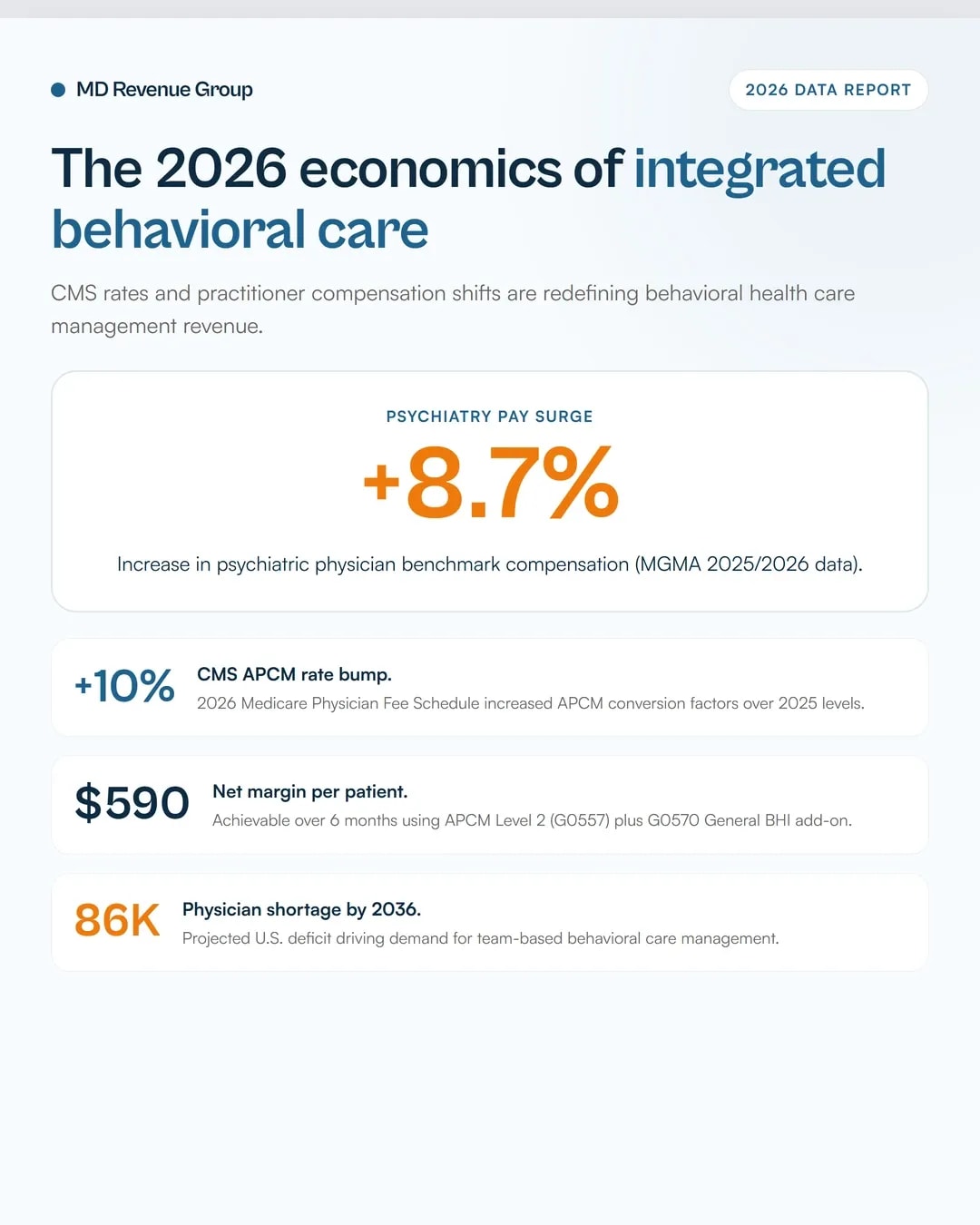
- Psychiatric physician compensation grew 8.7% in 2025/2026 benchmarks, making efficient care manager delegation essential for practice profitability.
How 2026 APCM Base Codes Work with Behavioral Health Add-Ons
Advanced Primary Care Management replaces the traditional minute-tracking requirements of Chronic Care Management with a bundled, monthly activity standard. Practices report one of three base codes per patient per calendar month based on clinical and social complexity:
Every uncredentialed provider costs $32,000/mo in unbilled encounters.
We audit your active payer applications to pinpoint where commercial plans and MACs have stalled your providers.
Audit My Enrollment Pipeline →- HCPCS G0556 (APCM Level 1): Patients with 1 or no chronic conditions, paying approximately $15–$16 PMPM.
- HCPCS G0557 (APCM Level 2): Patients with 2 or more chronic conditions, paying approximately $54 PMPM.
- HCPCS G0558 (APCM Level 3): Patients with 2 or more chronic conditions who are also Qualified Medicare Beneficiaries (QMB), paying approximately $67–$117 PMPM depending on locality.
Instead of tracking every 20-minute block of care coordination, APCM requires your practice to maintain capability across 13 core service elements. These include 24/7 access to care teams, population health management, structured risk stratification, patient-centered care planning, and medication reconciliation.
2026 APCM + BH Add-On Structure |
|---|
Base APCM Code (G0556, G0557, or G0558)<br>Billed 1x per calendar month by Billing Practitioner |
| v
Optional Behavioral Health Add-On (Billed in Same Month)<br>- G0568: Initial CoCM Add-On<br>- G0569: Subsequent CoCM Add-On<br>- G0570: General BHI Add-On |
|---|
Prior to 2026, billing monthly care management alongside behavioral health integration created severe claim edit conflicts. Under the CY 2026 Medicare Physician Fee Schedule Final Rule, CMS established G0568, G0569, and G0570 to permit dual billing.
To review how foundational integration codes evolved, explore our analysis of behavioral health integration billing patterns.
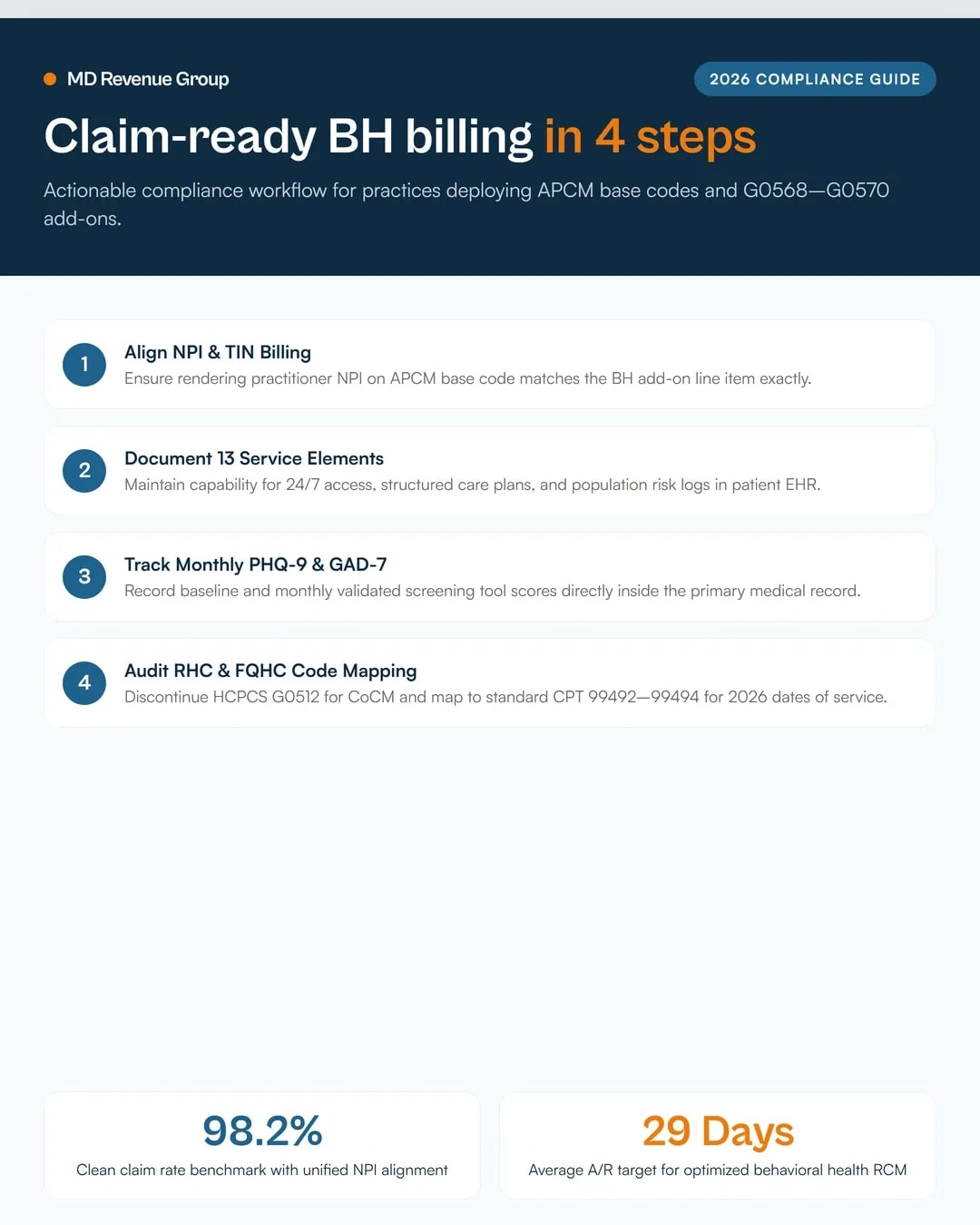
The critical compliance rule is alignment. The physician, nurse practitioner, or physician assistant who bills the APCM base code must be the exact practitioner listed on the behavioral health add-on line item. Submitting the add-on under a different rendering NPI or a separate group TIN triggers instant claim rejections.
Comparing BHI, CoCM, and APCM Add-On Workflows
Choosing between General BHI, Collaborative Care, and APCM add-on workflows depends on your staffing model and patient acuity.
General BHI (CPT 99484) serves patients with mild-to-moderate behavioral conditions. It requires 20 minutes of clinical staff time per month under general supervision. A consulting psychiatrist is not required, making it accessible for smaller outpatient clinics.
Collaborative Care (CPT 99492–99494) targets moderate-to-severe psychiatric conditions using a structured team model. It requires a dedicated behavioral health care manager (such as an LCSW or LPC) and a consulting psychiatrist who reviews patient registries weekly.
Practices evaluating bundled primary care management can also compare these services against our overview of G2211 APCM billing for 2026.
Feature | General BHI (CPT 99484) | CoCM (CPT 99492–99494) | APCM BH Add-Ons (G0568–G0570) |
|---|---|---|---|
Primary Clinical Focus | Mild-to-moderate mental health | Moderate-to-severe psychiatric conditions | Integrated BH within APCM bundle |
Required Staffing | Clinical staff (RN, MA, LPN) | Care Manager + Consulting Psychiatrist | Matches underlying model (BHI or CoCM) |
Time Threshold | Minimum 20 minutes/month | 70 mins initial (99492), 60 mins sub (99493) | Activity-based capability |
Psychiatric Oversight | Not required | Mandatory weekly registry review | Required for G0568/G0569; optional for G0570 |
2026 National Average | ~$57 PMPM | ~$155 initial / ~$128 subsequent | Base APCM rate + add-on allowance |
For safety-net providers operating as Rural Health Clinics (RHCs) or Federally Qualified Health Centers (FQHCs), CMS updated billing mechanics on January 1, 2026. CMS discontinued bundled code HCPCS G0512 for CoCM services, requiring these clinics to report individual CPT codes 99492, 99493, and 99494 to receive payment under the All-Inclusive Rate (AIR) or Prospective Payment System (PPS).
2026 Reimbursement Rates and Proprietary Revenue Calculation
Understanding the financial return of each workflow requires calculating labor overhead against net collection.
In the CY 2026 PFS Final Rule, CMS increased APCM conversion values by approximately 10% over 2025 levels. Meanwhile, Medical Group Management Association (MGMA) 2025/2026 benchmark data indicates that psychiatric physician compensation increased 8.7% due to sustained national demand, while primary care compensation grew 2.23%.
To illustrate the financial differences, consider a 200-patient behavioral health cohort managed under two competing models over a 6-month period:
Model A: Traditional CoCM Standalone (CPT 99492 Initial / CPT 99493 Subsequent)
Month 1 Initial (200 pts @ $155):                           $31,000Months 2-6 Subsequent (200 pts @ $128 x 5 months):         $128,000
Total Gross Revenue (6 Months):                               $159,000
Care Manager Staffing Costs (Full-time LCSW @ $45/hr including benefits):
70 mins/pt Month 1 = 233.3 hrs =                             $10,50060 mins/pt Months 2-6 = 200 hrs/mo x 5 = 1,000 hrs =         $45,000
Psychiatric Consultant Retainer ($200/hr x 4 hrs/wk x 26 wks): $20,800
Total Direct Labor Overhead:                                   $76,300
Net Margin Model A:                                            $82,700 ($413.50/pt)
Model B: APCM Level 2 (G0557) + General BHI Add-On (G0570)
Monthly APCM Base G0557 (200 pts @ $54/mo x 6 months):       $64,800Monthly BH Add-On G0570 (200 pts @ $57/mo x 6 months):        $68,400
Total Gross Revenue (6 Months):                               $133,200
Staffing Costs (Clinical RN/LCSW 20 mins/pt = 66.6 hrs/mo @ $38/hr x 6): $15,185
Psychiatric Consultant Oversight:                                   $0
Total Direct Labor Overhead:                                   $15,185
Net Margin Model B:                                           $118,015 ($590.07/pt)
Model B yields $35,315 higher net margin for mild-to-moderate cohorts because it eliminates the high fixed overhead of weekly psychiatric consulting sessions required under full CoCM.
To optimize overall billing operations across clinical specialties, review our comprehensive revenue cycle management services.
Documentation Standards and Literal Note Examples
Auditors inspect integrated behavioral health claims for unified clinical documentation. A common denial trigger is maintaining care manager tracking notes in a silo separate from the primary EHR encounter.
Every patient medical record enrolled in APCM with behavioral health add-ons must contain five specific compliance elements:
- Validated Screening Tool Scores: Documented PHQ-9 or GAD-7 baseline and monthly progress scores.
- Documented Patient Consent: Explicit verbal or written consent for care coordination and cost-sharing responsibility.
- Continuous Registry Tracking: Active tracking of clinical status, contact dates, and medication adherence notes.
- Physician Supervision Log: Dated confirmation of care plan review by the billing practitioner.
- Reconciliation of Service Elements: Proof that care team members provided or maintained availability for all 13 core APCM elements during the billing cycle.
Literal EHR Documentation Example
Below is the required note structure for an APCM Level 2 patient receiving General BHI Add-On (G0570) care management:
[PATIENT CARE MANAGEMENT NOTE - 2026-08-27]
PATIENT: Jane Doe | DOB: 05/14/1958 | ID: Medicare #1EG4-TE7-MA29
PROGRAM: APCM Level 2 (HCPCS G0557) + General BHI Add-On (HCPCS G0570)
BILLING PRACTITIONER: Dr. Robert Vance, MD (NPI: 1982730491)
CLINICAL METRICS & SCREENING:
PHQ-9 Depression Score: 12 (Moderate) - Down from baseline 16 (Moderately Severe on 2026-07-12).GAD-7 Anxiety Score: 9 (Mild) - Unchanged from prior review.Chronic Conditions Tracked: Major Depressive Disorder (F33.1), Essential Hypertension (I10).
CARE COORDINATION ACTIVITIES (Month of August 2026):
2026-08-10: 15-minute phone contact by Sarah Jenkins, RN. Reviewed medication adherence (Sertraline 50mg daily). Patient reported mild insomnia; educated on sleep hygiene.2026-08-22: 10-minute care coordination with outpatient psychotherapy clinic regarding treatment goals.24/7 Access Availability: Confirmed patient has active access to practice call portal.
BILLING PRACTITIONER REVIEW:
I have reviewed the care plan and registry metrics for Jane Doe. Patient demonstrates clinical response to current pharmacotherapy and behavioral care plan. Plan of care approved without modification.
Signed: Robert Vance, MD (2026-08-27 14:15 EST)
Payer-Specific Rules and MAC Variations
Medicare Administrative Contractors (MACs) apply specific claim edits to behavioral health integration.
Commercial payers such as Horizon Blue Cross Blue Shield and Aetna often cover CPT 99484 and CoCM codes 99492–99494, but their adoption of 2026 APCM HCPCS codes (G0556–G0558) varies. Commercial policies frequently require pre-authorization or specific secondary modifier placement before approving bundled care management.
For specialized guidance on psychiatric claim coding and credentialing, see our dedicated psychiatric billing services department.
Practices operating across state boundaries must track regional MAC rules. In New York, National Government Services (NGS Medicare) enforces strict medical necessity checks on repeated CoCM submissions past month 6.
If your group operates in the Northeast, consult our state-specific guide to medical billing in New York for local coverage determinations.
Real-World Practice Scenario: A 4-Provider New York Behavioral Health Group
Consider Hudson Valley Behavioral Health, a 4-provider group practice in Westchester County, New York, comprising two psychiatrists and two licensed clinical social workers (LCSWs).
In late 2025, the practice suffered a 14% initial claim denial rate on mental health claims due to unaligned billing NPIs and missing time logs on CPT 99484. Their care managers were spending 45 minutes per patient on routine check-ins but failed to bill consistently because staff lacked a clear protocol for tracking minute thresholds.
Hudson Valley Behavioral Health - 2026 Workflow Transition
| 2025 Legacy Workflow | 2026 Optimized APCM + BHI Model |
| --- | --- |
| Unbilled staff time (180+ hrs/mo)<br>14% initial denial rate<br>Split NPI billing errors<br>$14,200/mo uncollected revenue | Standardized APCM G0557 + G0570<br>Clean claim rate improved to 98.2%<br>Unified TIN/Rendering Practitioner<br>$26,400/mo added net collection |
In January 2026, the practice restructured its revenue cycle workflow:
- Patient Stratification: They screened their 650 active Medicare patients. 240 patients met criteria for APCM Level 2 (G0557) due to co-occurring depression and chronic medical conditions.
- Add-On Integration: For 140 of those patients receiving active care coordination for depression, they added HCPCS G0570 (General BHI Add-On).
- NPI Alignment: They established EHR claim rules requiring the rendering physician NPI on G0557 to match the line-item NPI on G0570.
- Billing Outsourcing: They partnered with specialized billing specialists to handle clearinghouse edits and monthly MAC revalidation checks.
Within 90 days, Hudson Valley Behavioral Health increased monthly collections by $26,400 while reducing A/R days from 46 to 29.
To explore dedicated support for outpatient mental health practices, view our mental health billing services overview.
How to Select the Right Billing Workflow for Your Practice
Selecting between APCM add-ons, standalone BHI, and CoCM requires analyzing three operational factors:
- Staffing Infrastructure: If you lack a consulting psychiatrist willing to log weekly registry reviews, do not attempt CoCM (99492–99494). Implement General BHI (99484) or APCM G0570 instead.
- EHR Capabilities: Ensure your EHR can auto-populate 13 APCM service elements into a downloadable audit log before submitting G0556–G0558.
- Payer Mix: Verify commercial contract fee schedules. If your top 3 commercial payers do not recognize HCPCS G0570, bill traditional CPT 99484 for commercial patients while reserving APCM add-ons for Medicare Fee-For-Service claims.
Decision Flowchart for 2026 BH Billing
                                       |
                                       v
                     Does patient have 2+ chronic conditions?
                               /               \
                             YES                NO
                             /                    \
   Is practice enrolled in APCM (G0557)?     Bill Standalone CPT 99484
            /                      \           (20+ mins staff time)
          YES                       NO
          /                          \
Bill G0557 + BH Add-On        Bill Standalone CoCM
(G0568, G0569, or G0570)     (99492/99493 if psychiatrist on team)
Optimize Your Behavioral Health Revenue Cycle Today
Managing complex care coordination codes like APCM, BHI, and CoCM requires specialized billing expertise. MD Revenue Group audits your current claims, identifies uncollected care management revenue, and stops preventable denials.
Struggling with complex behavioral health care management claims? We audit RCM workflows and find your revenue leaks. Request a free audit today.
Unfreeze your credentialing pipeline.
Enter your practice details. We will audit your CAQH profiles and payer enrollments to get your providers billing immediately.