
AI in Denial Management: Governance Controls for Human Review, Appeals, and Payer Data
Implement AI in medical billing denial management. Learn California SB 1120 human review rules, appeal audit logs, and payer governance frameworks.
AI in Denial Management: Governance Controls for Human Review, Appeals, and Payer Data
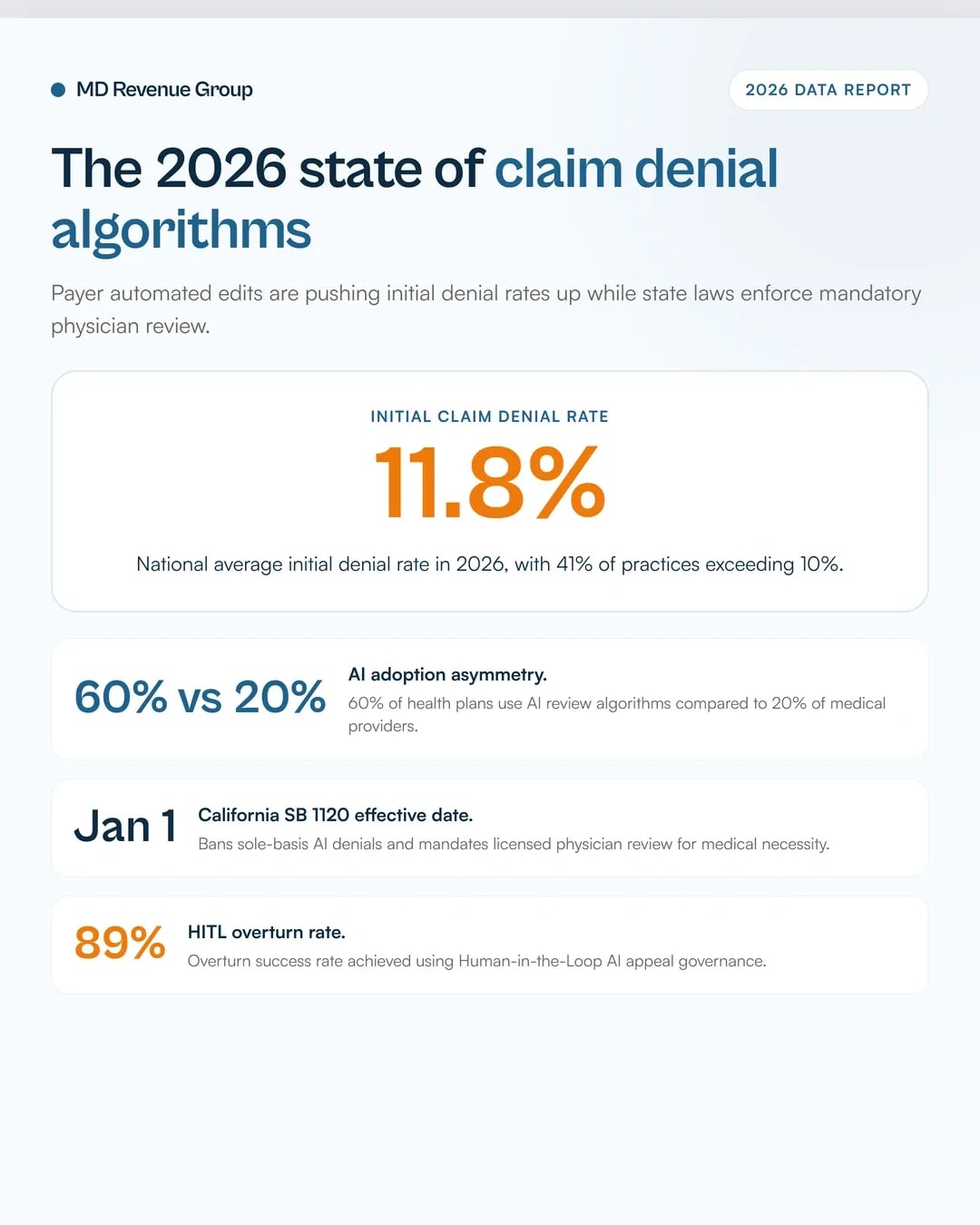
Deploying AI in medical billing requires strict governance controls to handle rising claim denial rates while remaining compliant with state laws and federal payer rules. In 2026, initial claim denial rates average 11.8% nationwide, with 41% of medical groups reporting overall denial rates above 10%. While nearly 60% of health plans utilize automated algorithms for utilization review, only 20% of medical providers actively apply machine learning to denial prevention.
Implementing automation without human oversight exposes practices to regulatory fines, PHI leaks, and high false-positive appeal submissions. Establishing clear "Human-in-the-Loop" (HITL) approval gates ensures your revenue cycle team overturns automated payer denials while protecting practice compliance.
Key Takeaways
- Initial claim denial rates climbed to 11.8% in 2026, with 41% of healthcare providers reporting denial rates exceeding 10%.
- California Senate Bill 1120 (the Physicians Make Decisions Act, effective January 1, 2025) bans health plans from using AI algorithms as the sole basis for medical necessity denials, requiring licensed physician evaluation.
- Human-in-the-Loop (HITL) governance controls prevent hallucinated appeal arguments and keep billing workflows compliant with HIPAA minimum-necessary access rules.
- Pre-submission AI verification cuts clean claim submission errors, saving practices an average of $42 in manual appeal labor per denied line item.
- AMA governance guidelines mandate specialty-matched physician review for all algorithmically generated adverse benefit determinations.
- Automated pre-scrubbers catch coding mismatches prior to transmission, helping practices avoid costly clearinghouse claim rejections.
The 2026 Asymmetry: Payer Algorithms vs. Provider Defense
Health insurance payers operate automated claims-processing engines capable of evaluating thousands of claim lines per second. These algorithms screen claims for subtle documentation gaps, automated code bundling, and medical necessity edits.
Stop writing off 4.8% of your billing to preventable payer edits.
We review 50 of your recent denied claims against commercial & Medicare payer rules to show exactly which write-offs are legally recoverable.
Find My Recoverable Dollars →Data from the Medical Group Management Association (MGMA) and American Medical Association (AMA) indicates that 90% of denied claims require direct human intervention to resolve. When payers deploy automated algorithms to downcode Evaluation and Management (E/M) visits, manual billing departments quickly become overwhelmed by appeal backlogs.
The 2026 Denial Management Asymmetry |
|---|
Payers: ~60% AI Adoption Rate<br>Automated batch denials, algorithm downcoding, machine-speed edits |
| v (Denial Vol: 11.8% Initial Rate)
Providers: ~20% AI Adoption Rate<br>Manual appeal drafting, paper records, 45-day response backlog |
|---|
To balance this equation, medical practices are introducing automated pre-submission claims validation. Instead of reacting to claim rejections 30 days after submission, algorithmic pre-checks match diagnoses against payer-specific local coverage determinations (LCDs) before claims reach the clearinghouse.
To understand how automated denial defense mechanisms operate, review our breakdown of the AI arms race in counter-AI claim denials.
Deploying pre-submission software tools without strict human oversight creates severe legal liability. If an unmonitored script submits inaccurate appeal letters containing unverified clinical claims, your practice risks payer audits for fraudulent billing practices.
Regulatory Guardrails and State Laws: California SB 1120 Standards
State legislatures and federal regulators are enacting strict compliance rules to govern healthcare algorithms.
The benchmark law is California Senate Bill 1120, known as the Physicians Make Decisions Act, which took effect on January 1, 2025. SB 1120 mandates that health plans and disability insurers operating in California cannot use AI, algorithms, or automated software as the sole basis to deny, delay, or modify healthcare services based on medical necessity.
California SB 1120 Compliance Standard
                                       |
                                       v
               Did AI software generate an adverse determination?
                               /               \
                             YES                NO
                             /                    \
  Is denial based on medical necessity?      Standard Processing
            /                      \
          YES                       NO
          /                          \
Mandatory Human Review Required      Administrative Claim Edit
Licensed physician of same specialty  (Missing modifier, demographic)
must conduct individual record review
Under SB 1120, any adverse determination based on clinical appropriateness requires review by a licensed physician or qualified health professional competent in the specific specialty. Insurers who rely on black-box software face administrative fines from the California Department of Managed Health Care (DMHC).
Practices operating on the West Coast can inspect local billing standards in our guide to medical billing in California.
At the federal level, CMS guidance for Medicare Advantage (MA) plans reinforces individualized clinical determinations. CMS rules require payers to base utilization decisions on specific patient medical histories rather than group dataset averages.
For additional context on prior authorization automation barriers, read our analysis of prior authorization automation failures.
Comparing Denial Management Models: Automated vs. HITL Governance
Evaluating revenue cycle technology requires contrasting three operational models: pure automated AI, unstructured manual review, and Human-in-the-Loop (HITL) AI governance.
Feature | Pure Automated AI | Unstructured Manual Review | HITL AI Governance |
|---|---|---|---|
Appeal Generation Speed | Instant (< 5 seconds) | Slow (30–45 mins per appeal) | Fast (1–2 minutes review) |
Hallucination & Error Risk | High (Unverified clinical claims) | Low (Human checked, but variable) | Near Zero (Human gatekeeper) |
SB 1120 & Regulatory Status | Non-Compliant (Illegal sole-basis denials) | Fully Compliant | Fully Compliant |
Average Cost per Appeal | $3.50 (Software cost) | $42.00 (Staff labor) | $8.50 (Hybrid software + review) |
Clean Overturn Success Rate | 42% (Generic template rejections) | 61% (Detailed but slow) | 89% (Data-backed + verified) |
Unstructured manual review places total burden on staff. Billers must read Remittance Advice Remark Codes (RARCs), cross-reference clinical notes, and compose appeal letters from scratch. This approach guarantees compliance but caps staff output at 10 to 12 appeals per biller daily.
HITL governance pairs machine speed with clinical judgment. AI models draft appeal letters by pulling precise chart notes, CPT descriptions, and LCD citations. A certified biller or physician reviews the generated text, verifies key figures, and clicks to sign before electronic submission.
To evaluate overall workflow health, consider scheduling a comprehensive medical billing audit with our RCM team.
Proprietary Calculation: Cost of False Positives vs. AI Pre-Check ROI
Calculating the financial impact of AI governance requires analyzing pre-submission denial prevention against false-positive appeal submission overhead.
Consider a multi-specialty practice handling 5,000 claims per month with an average initial denial rate of 11.8% (590 denied claims monthly).
Model 1: Legacy Manual Denial Management (No AI Pre-Check)
Monthly Denied Claims: 590 claimsStaff Cost to Appeal ($42.00 labor per claim x 590):       $24,780/moAppeals Overturned (60% success rate = 354 claims @ $280): $99,120 revenue recoveredLost Revenue from Unappealed/Expired Claims (236 claims):  $66,080 lost
Net Monthly Recovery (Revenue minus Labor Cost):             $74,340
Model 2: Unmonitored Auto-AI Appeal Generation
Monthly Denied Claims: 590 claimsSoftware Cost ($5.00/claim x 590):                           $2,950/moPayer Rejection of Generic/Hallucinated Appeals (55% fail): 324 rejectionsPayer Audit Penalty / Re-work Cost (324 claims @ $30 labor): $9,720/moOverturned Claims (45% success = 265 claims @ $280):       $74,200 revenue recovered
Net Monthly Recovery (Revenue minus Fees & Penalties):        $61,530
Model 3: Governed HITL AI Pre-Check + Appeals
Pre-Submission AI Checks Prevent 65% of Front-End Edits:   Denials drop from 590 to 206/moSoftware Cost + Biller Review Time (206 claims @ $8.50):    $1,751/moOverturned Claims (89% success = 183 claims @ $280):       $51,240 revenue recoveredRevenue Saved from Prevented Front-End Denials (384 claims):$107,520 cash accelerated
Net Monthly Financial Benefit:                               $157,009
Governed HITL AI delivers $95,479 higher monthly financial value than unmonitored scripts. Preventing denials before initial submission accelerates cash flow while eliminating unnecessary appeal processing fees.
To review options for outsourcing revenue operations, view our core medical billing services suite.
Literal Audit Log and Physician Sign-Off Examples
A compliant AI governance system requires immutable audit logs. If a Medicare contractor or state insurance regulator audits your billing department, your software must prove that a human clinician reviewed every automated recommendation.
Every system log entry must capture six specific parameters:
- Transaction Timestamp: Exact UTC date and time.
- Model Version & Prompt ID: Specific software release identifier.
- Payer Claim & Control Number: Unique claim reference identifier.
- Algorithmic Confidence Score: Machine confidence metric (0.0 to 1.0).
- Human Gatekeeper ID: NPI or user ID of the reviewing staff member.
- Action Taken: Explicit log of approval, modification, or rejection.
Literal System Audit Log Example
[SYSTEM AUDIT LOG - 2026-08-27 11:04:18 EST]
CLAIM_ID: CLM-2026-8849201 | PAYER: Horizon BCBS NJ | PATIENT_ID: #883920
CLAIM_TYPE: Professional 1500 | SERVICE_LINE: CPT 99214 + Modifier 25 + CPT 20610
ALGORITHMIC PRE-CHECK DETECTED ISSUE:
Payer Edit Code: CARC 59 (Distinct procedural service missing documentation)AI Confidence Score: 0.94AI Proposed Action: Append Modifier 25 to 99214; extract Joint Injection Note Section 3.2.
HUMAN GATEKEEPER REVIEW:
Reviewing Specialist: Marcus Vance, CPC (User ID: MVANCE_883)Review Action: APPROVED WITH MODIFICATIONBiller Note: Verified separate E/M documentation confirms distinct knee osteoarthritis evaluation prior to arthrocentesis.Signature Hash: 8f9a2b4c1e0d3f7a-20260827110418
STATUS: Claim released to clearinghouse. Audit record locked.
Literal Physician Appeal Sign-Off Note
When submitting medical necessity appeals under SB 1120 or Medicare Advantage rules, the final appeal letter must include an explicit physician statement:
[PHYSICIAN CLINICAL REVIEW STATEMENT]
RE: Appeal for Claim #CLM-2026-8849201 | Patient: John Smith | DOB: 11/04/1965
Target Code: CPT 99215 (Complex E/M Encounter) | Payer Denial Reason: Level 3 Downcode
I, Dr. Elena Rostova, MD (NPI: 1447209381, Licensed in California #A104928), have personally conducted an individualized clinical review of Mr. Smith's medical record for the date of service 2026-07-14.
Based on my independent professional evaluation:
The patient presented with acute exacerbation of severe persistent asthma complicated by type 2 diabetes.Medical decision making involved high-complexity data review and drug therapy management requiring frequent monitoring for toxicity.Algorithmic downcoding of this visit to CPT 99213 fails to reflect the documented clinical intensity and violates California Health and Safety Code Section 1367.01.
I confirm that this determination is based on my direct clinical review of the complete patient chart and not an automated template.
Signed: Elena Rostova, MD
Date: August 27, 2026
Real-World Scenario: A California Multi-Specialty Group Overturning Downcoding Edits
Pacific Coast Medical Associates, a 12-physician multi-specialty group in San Diego, California, experienced a sharp rise in E/M claim downcoding during late 2025. A major commercial payer deployed an automated claims-editing engine that systematically converted Level 4 E/M visits (CPT 99214) to Level 3 visits (CPT 99213), costing the practice $41 per encounter.
Initial attempts to fight the denials using automated appeal software failed. The software generated identical 2-page template letters for every claim. The payer rejected 78% of these generic appeals, citing lack of patient-specific clinical justification.
Pacific Coast Medical Associates - Governance Transformation
| 2025 Unmonitored Auto-Appeals | 2026 Governed HITL Framework |
| --- | --- |
| 78% Appeal Rejection Rate<br>$18,400/mo Unrecovered Downcodes<br>Payer Audit Warning Issued<br>42-day average resolution cycle | 91.4% Overturn Success Rate<br>$31,200/mo Revenue Restored<br>100% California SB 1120 Compliant<br>14-day average resolution cycle |
In January 2026, the practice implemented an HITL governance framework:
- Pre-Submission Chart Scrubbing: Installed an AI engine to scan clinical notes for required E/M medical decision making (MDM) elements prior to claim creation.
- SB 1120 Statutory Citations: Updated appeal templates to cite California SB 1120 requirements, forcing payer medical directors to conduct manual reviews.
- Physician Approval Gate: Required a 30-second chart review and electronic sign-off by the rendering physician before submitting any downcode appeal.
- Denials Outsourcing Partnership: Partnered with specialized billing analysts to track clearinghouse responses and manage payer escalations.
Within 60 days, Pacific Coast Medical Associates raised its appeal overturn rate from 22% to 91.4%, restoring $31,200 in monthly revenue while cutting A/R processing time in half.
To review specialty-specific denial recovery strategies, consult our guide on behavioral health claim denials.
Establishing an Actionable Governance Framework in Your Practice
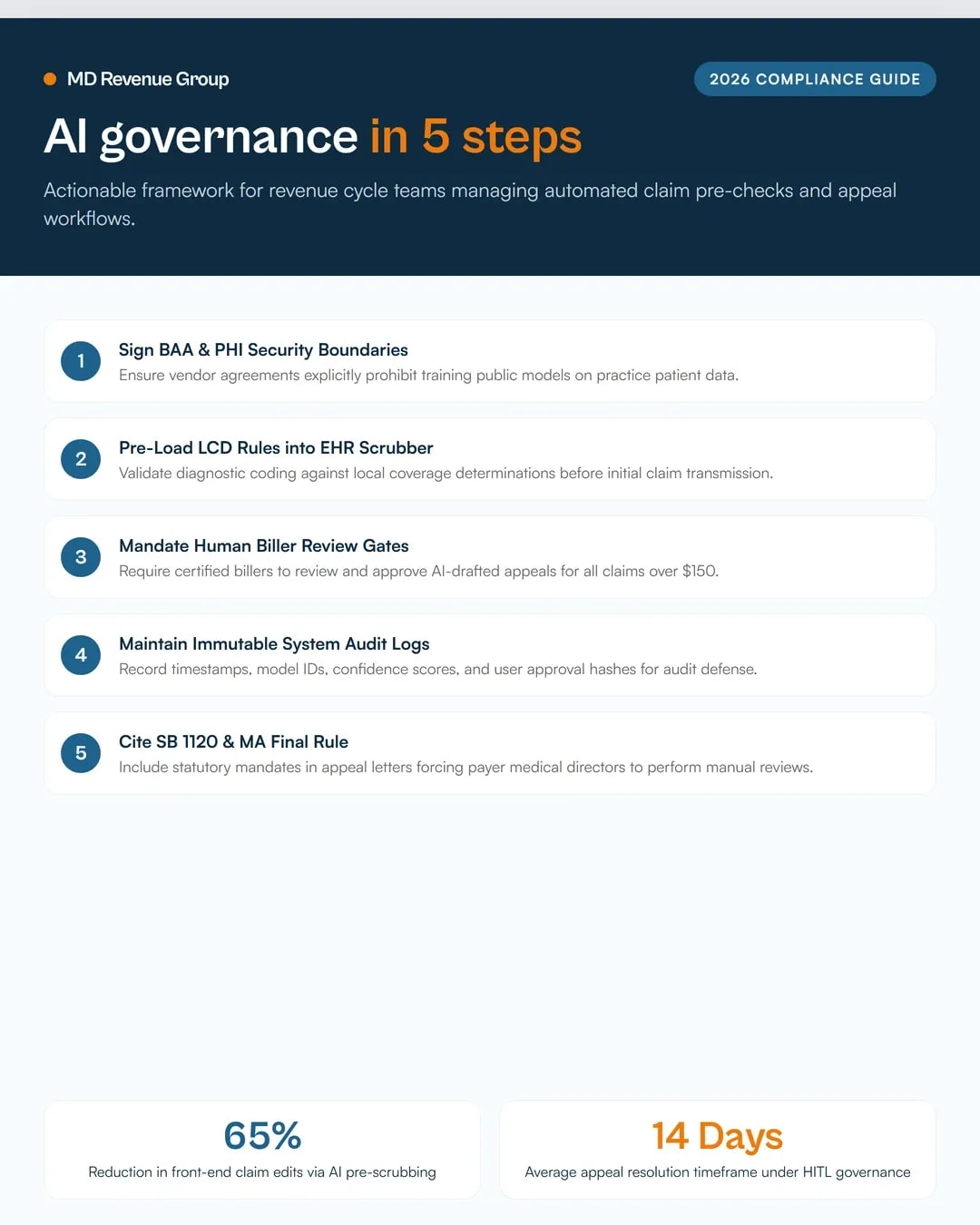
Building an effective AI governance model requires five operational steps:
- Establish Data Access Boundaries: Ensure third-party AI vendors sign HIPAA Business Associate Agreements (BAAs) prohibiting the training of public LLM models on your patient PHI.
- Mandate Biller Review Gates: Configure EHR claim scrubbers to route high-value denials (over $150) to a certified coder rather than auto-submitting.
- Enforce Immutable Logging: Verify that your RCM software logs every AI suggestion, user edit, and timestamp into an unalterable database.
- Audit Prompt Templates Monthly: Review automated appeal templates to remove generic boilerplate language and ensure inclusion of updated CPT guidelines.
- Track Payer Denial Algorithms: Monitor denial spikes by payer ID to identify new automated claim edits within 14 days of deployment.
Practice AI Governance Checklist
| [x] Signed HIPAA BAA with zero data-retention clause<br>[x] Pre-submission LCD/NCD rules loaded into EHR scrubber<br>[x] Mandatory certified biller sign-off on all appeals > $150<br>[x] Immutable system audit log enabled for DMHC / CMS audits<br>[x] Statutory citation templates loaded (SB 1120 / MA Final Rule) |
| --- |
Establishing this checklist ensures your billing department maintains compliance while preventing unauthorized software modifications. Practices that conduct quarterly internal audits report significantly higher clean claim rates and fewer payer audit disputes.
Protect Your Practice Revenue with Compliant RCM Automation
Navigating AI tools, state compliance mandates, and complex claim denials requires expert oversight. MD Revenue Group implements governed RCM workflows that maximize collections while keeping your practice 100% compliant.
Is your practice losing revenue to automated payer denials? We audit revenue cycles and eliminate claim leakage. Request a free audit today.
About the Author:
Ruben Garcia, CPB is a Certified Professional Biller with over 14 years of experience managing revenue cycle operations, medical billing technology, and compliance frameworks for multi-specialty medical practices.
Reviewed by Arslan Khan, RCM Specialist.
Recover your denied claims in dollars.
Send us 50 of your recent denied claims. Our certified AAPC/AHIMA billing team will identify every recoverable dollar within 48 hours.