
The NCCI Q3 edits just went live: are your ESRD claims about to break?
CMS pulled the AX modifier from ESRD add-on billing July 1, 2026. Here's what changed, which revenue codes matter now, and how to avoid CO-97 denials.
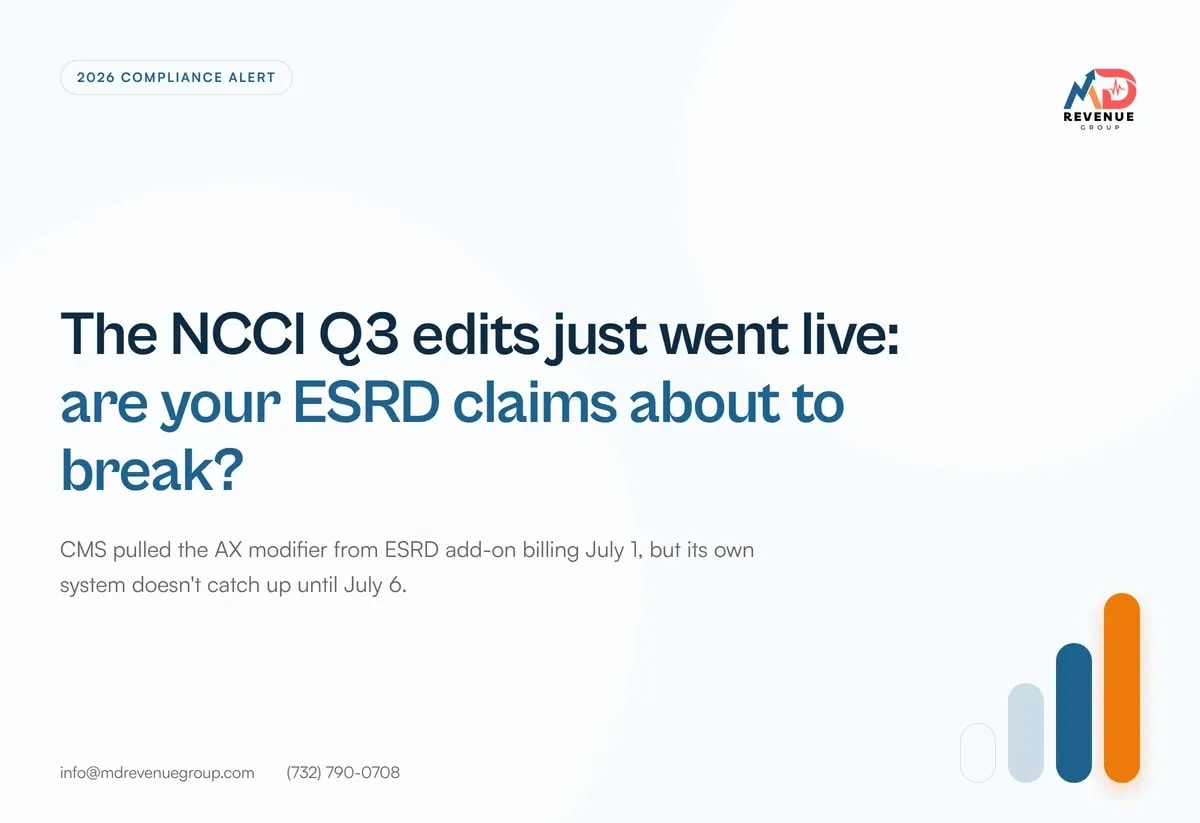
CMS stopped requiring the AX modifier on ESRD add-on payment claims as of July 1, 2026. If your billing team is still attaching AX to TDAPA, TPNIES, or CRA TPNIES claims, stop. CMS now triggers these add-on payments automatically off the HCPCS code plus the matching revenue code: 0636 for TDAPA, 027X for TPNIES, and 0823, 0833, 0843, 0853, or 0889 for CRA TPNIES. This is CR 14354, transmittal R13588CP, and CMS's system implementation date is July 6, 2026, five days after the billing rule itself took effect. That gap is where claims break.
Key takeaways
- CMS removed the AX modifier requirement for ESRD add-on payments effective July 1, 2026. TDAPA, TPNIES, and CRA TPNIES now trigger off HCPCS-plus-revenue-code combinations instead.
- CMS's own system doesn't catch up until July 6, 2026. Claims submitted in that 5-day window are the highest-risk claims your facility will file this quarter.
- Revenue code 0636 drives TDAPA. Revenue code 027X drives TPNIES. CRA TPNIES needs one of five home dialysis equipment codes: 0823, 0833, 0843, 0853, or 0889.
- Billing AX after July 1 doesn't just get ignored. It can trigger CO-97 denials if your scrubber or clearinghouse hasn't updated to the Q3 2026 NCCI AOC edit file.
- This is a template problem, not a training problem. If your ESRD billing templates still hard-code AX, every claim built from them is exposed until someone edits the template.
What changed on July 1, and why
For years, ESRD facilities attached the AX modifier to any claim line that needed a Transitional Drug Add-on Payment Adjustment (TDAPA), the add-on payment for new equipment and supplies (TPNIES), or the capital-related assets version of that same add-on (CRA TPNIES). The modifier told CMS's system to pay the add-on above the ESRD PPS bundled rate.
CMS decided that system no longer needs the modifier to do its job. Under CR 14354 (R13588CP), CMS now identifies add-on-eligible claims by matching the HCPCS code against the active TDAPA or TPNIES list and pairing it with the correct revenue code. Report AX now, and you're not helping the claim. You're adding a data point CMS's system no longer expects.
The ESRD PPS base rate also moved this year: $281.71 for CY 2026, up from $273.82, a 2.2% increase for freestanding facilities (CMS, CY 2026 ESRD PPS Final Rule). That's real money on every dialysis session your facility bills. It's also exactly why a coding error on the add-on side stings more this year than last: you're compounding a payment miss on top of a rate that just went up.
The 5-day gap that's about to cost facilities money
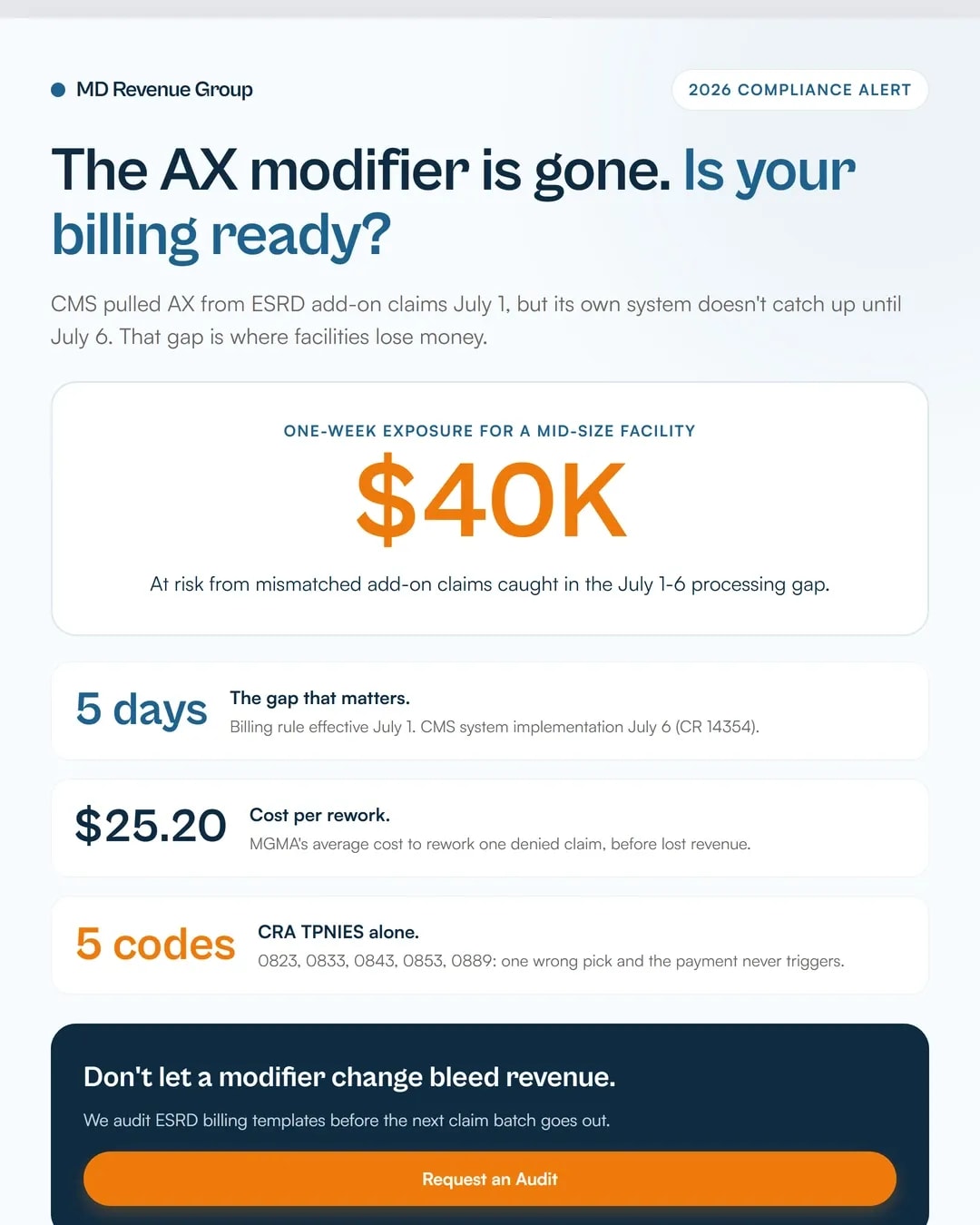
Here's the detail most ESRD billing offices are going to miss: the billing rule took effect July 1, but CMS didn't finish updating its own claims processing system until July 6.
Picture a mid-size dialysis facility running roughly 40 claims a day with TDAPA or TPNIES add-ons in the mix. That's not an unusual volume for a facility managing a active TDAPA drug or a new equipment rollout. If that facility's scrubber is still hard-coded to append AX, and half those claims land in the July 1-6 window with revenue codes that don't line up cleanly with the new logic, you're looking at 100-plus claims sitting in limbo or bouncing back as denials. At an average dialysis treatment reimbursement in the $250-$300 range once add-ons are factored in, that's a $25,000-$40,000 swing in one week, before you count staff hours spent reworking each claim.
MGMA puts the average cost to simply rework one denied claim at $25.20 (MGMA Stat). Multiply that by a batch of 100-plus claims caught in a modifier mismatch, and you're spending real staff time just to get back to zero, on top of whatever revenue sat unpaid while the claims cycled through appeal.
The fix isn't complicated. It's making sure your templates, your scrubber, and your clearinghouse are all working off the same Q3 2026 rules before July 1, not after.
Who this affects
This applies to every Medicare-certified ESRD facility, freestanding or hospital-based, billing TDAPA, TPNIES, or CRA TPNIES add-on payments. If your facility bills dialysis on the standard ESRD PPS bundled rate with no add-on codes in play, this specific change doesn't touch you. But if you've had a new drug, a new piece of equipment, or home dialysis capital equipment on the books anytime in the past 2 years, you almost certainly have AX baked into a billing template somewhere.
Billing services managing multiple ESRD clients face the highest exposure. One outdated template can propagate the same error across every facility using it. If you're a billing service running 5, 10, or 20 ESRD accounts off a shared template library, this is a single afternoon of work now versus weeks of appeals in August.
Why the Q3 file is bigger than one modifier
CMS updates the NCCI Add-On Code (AOC) edit file every quarter, and the ESRD AX modifier removal is one line item inside a broader Q3 2026 release. The AOC file governs which primary codes must accompany which add-on codes across specialties, not just nephrology. Radiology, cardiology, and surgical add-on codes get refreshed the same way, on the same cadence.
That matters for how you treat this update operationally. If your practice bills across multiple specialties and your scrubber vendor only flagged the ESRD change, ask them directly whether the full Q3 AOC file loaded, not just the piece that made the news. A vendor that caught the AX modifier change but missed an unrelated primary-code pairing update elsewhere in your claims mix will still generate denials, just on a different line of your P&L.
The revenue codes you need to map correctly
CMS's new logic is unforgiving about specificity. Get the revenue code wrong and the add-on payment simply doesn't trigger, no error message, no denial to appeal against. It just doesn't pay.
Add-on payment type | Trigger | Revenue code(s) |
|---|---|---|
TDAPA (drug add-on) | HCPCS on active TDAPA list | 0636 |
TPNIES (equipment/supply add-on) | HCPCS on active TPNIES list | 027X |
CRA TPNIES (home dialysis capital equipment) | HCPCS on CRA TPNIES list | 0823 (hemodialysis home), 0833 (peritoneal home), 0843 (CAPD home), 0853 (CCPD home), 0889 (other/ultrafiltration home) |
The CRA TPNIES row is where most billing teams trip. Five separate revenue codes, each tied to a specific home dialysis modality. Bill 0823 for a CAPD claim and the payment won't match, even if the HCPCS code is correct.
Why this triggers CO-97 denials
CO-97 means the payment is bundled into another service already paid. If your scrubber is still appending AX to a claim CMS no longer reads that way, and the revenue code pairing is off, the payer's logic can read the add-on charge as already included in the base ESRD PPS rate, and deny it as a duplicate rather than paying it as a separate add-on.
This is the trap: the denial doesn't tell you "wrong modifier." It tells you the charge is bundled. Billing staff who haven't been briefed on CR 14354 will spend time appealing a claim that was never going to pay, because the real fix is upstream in the revenue code mapping, not in the appeal.
Your 5-step action plan
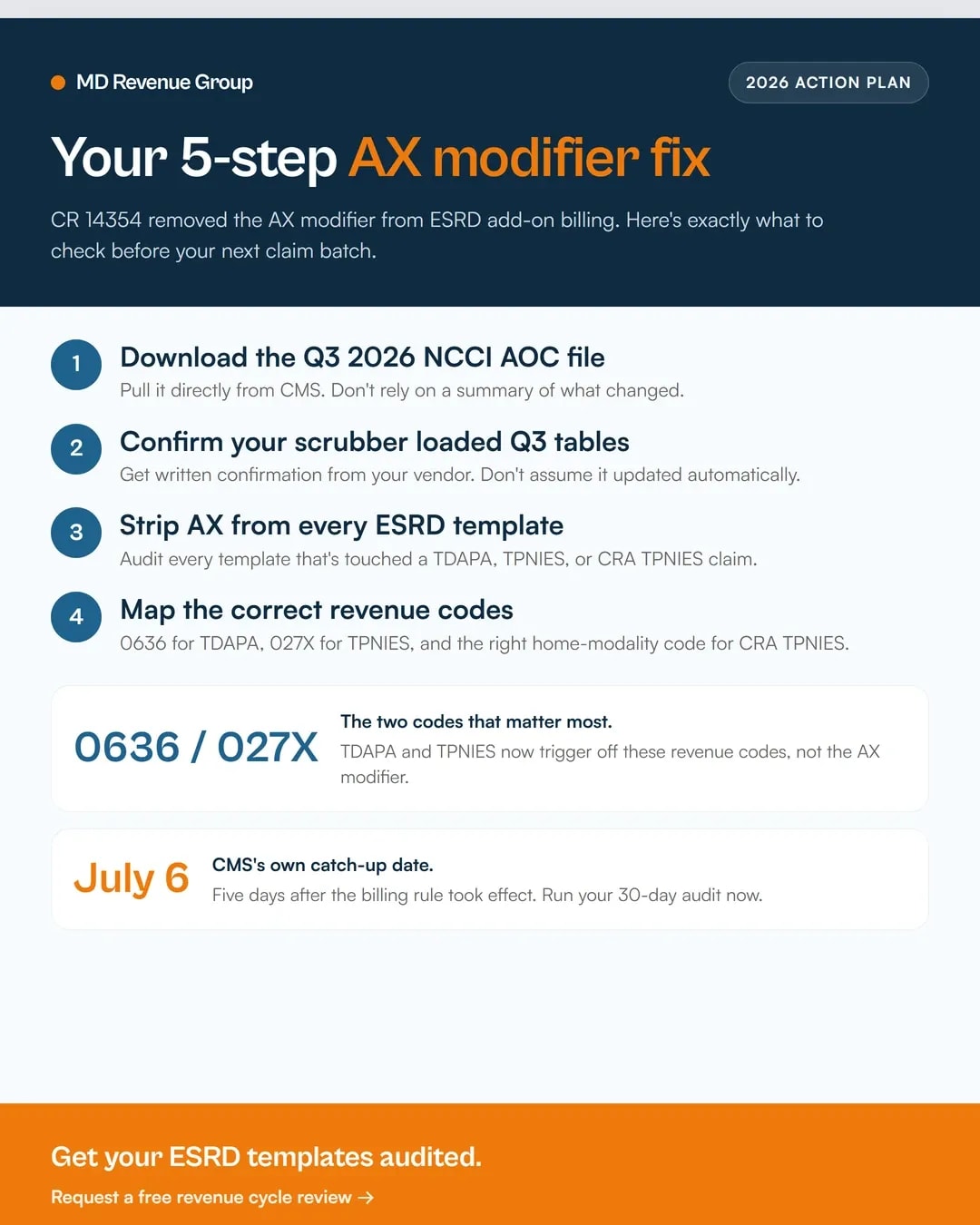
1. Download the Q3 2026 NCCI AOC edit file from CMS. This is the authoritative source for which HCPCS pairings are active this quarter. Don't rely on a summary. Pull the file directly.
2. Confirm your claims scrubber vendor has loaded the Q3 tables. Call them. Don't assume an automatic update happened. Ask for written confirmation of the effective date they applied.
3. Remove the AX modifier from every ESRD billing template. Not just the ones you remember. Audit every template that's touched a TDAPA, TPNIES, or CRA TPNIES claim in the last 12 months.
4. Map the correct revenue codes into your templates: 0636 for TDAPA, 027X for TPNIES, and the correct one of 0823/0833/0843/0853/0889 for CRA TPNIES based on the specific home modality.
5. Run a 30-day pre-implementation audit on every add-on claim before you submit. Pull a sample of claims built under the new templates and manually verify the HCPCS-to-revenue-code pairing before they go out. Catch the mismatch on your side, not the payer's.
What happens if you miss this
Nothing catastrophic on any single claim. That's what makes it dangerous. A missed revenue code pairing doesn't throw a hard error, it just fails to trigger the add-on payment, or it comes back CO-97. Multiply that across every add-on claim your facility files in July, and you've got a quarter with quietly missing revenue that nobody notices until someone runs the numbers in August.
FAQ
Do I need to resubmit claims that already had AX modifier attached before July 1? No. Claims with dates of service before July 1, 2026 follow the old billing rules. The change applies to claims for dates of service on or after July 1, 2026.
What if I bill AX after July 1 by mistake? CMS's guidance is direct: don't report AX on renal dialysis claims for dates of service on or after July 1, 2026 unless specifically instructed otherwise. An accidental AX modifier on a post-July 1 claim risks processing errors, particularly during the July 1-6 gap before CMS's own system fully catches up.
Does this change anything about which drugs or equipment qualify for TDAPA or TPNIES? No. CR 14354 changes how the add-on payment is triggered on the claim, not the underlying eligibility criteria for TDAPA, TPNIES, or CRA TPNIES status.
Nephrology billing has enough moving parts without a modifier change catching your templates off guard. If your ESRD claims are still built on pre-July 1 logic, our nephrology billing team can audit your templates and revenue code mapping before the next batch goes out. Request a free revenue cycle review.
References
- CMS, "AKI & ESRD Billing: Ending the AX Modifier Requirement," MM14354 / Transmittal R13588CP: cms.gov/files/document/mm14354-acute-kidney-injury-esrd-billing-ending-ax-modifier-requirement.pdf
- CMS, "R13588CP" Transmittal, Medicare Regulations & Guidance: cms.gov/medicare/regulations-guidance/transmittals/2026-transmittals/r13588cp
- CMS, "Calendar Year (CY) 2026 End-Stage Renal Disease (ESRD) Prospective Payment System Final Rule": cms.gov/newsroom/fact-sheets/calendar-year-cy-2026-end-stage-renal-disease-esrd-prospective-payment-system-final-rule
- MGMA Stat, "Strategic improvements in your RCM to reduce your practice's claim denials": mgma.com/mgma-stat/strategic-improvements-in-your-rcm-to-reduce-your-practices-claim-denials