
The RCM Cycle in Medical Billing: From Scheduling to Final Payment
The RCM cycle in medical billing runs from the first phone call to the last dollar collected. Follow one $200 visit through every handoff, and see what each delay costs.
The RCM Cycle in Medical Billing: From Scheduling to Final Payment
The RCM cycle in medical billing is the full path a dollar takes from the first phone call to the last payment posted. It starts when a patient books a visit. It ends when the payer and the patient have both paid, or when the balance is written off with a reason on file. Every person who touches the account hands it to the next person, and every handoff can leak money.
Most guides list the stages. This one follows one visit through the whole cycle, day by day, so you can see where the money stalls and what each stall costs. The visit is a sample $200 office visit. The numbers behind each step come from published 2026 data, named as you read. Our revenue cycle management services guide covers the full service in one place, and our revenue cycle management page shows what a full-cycle partner runs for you.
Table of contents
- What the RCM cycle in medical billing actually is
- Follow one $200 visit from scheduling to final payment
- The handoffs: who owns each pass
- Rejection, denial, or underpayment: read the reply right
- Write the note so the claim survives
- The math: what one $200 visit costs on 3 paths
- Where the cycle breaks most
- Your 30-day cycle check
- Frequently asked questions
Key takeaways
- The RCM cycle in medical billing runs from the schedule to the last payment, and medical billing is only the middle slice of it.
- A clean $200 visit closes in about 30 days from first call to last dollar. A denied visit takes 51 days and costs $31.50 to collect. A visit nobody reworks pays $0.
- Registration and eligibility cause about 27% of all denials, the largest single cause, per Change Healthcare data reported by HFMA.
- The targets that matter: clean claim rate 95% or higher, days in A/R 30 to 40, net collection rate 95% or higher, and A/R over 90 days under 10%.
- For a sample practice filing 750 claims a month, denials that are never worked cost about $72,000 a year, plus $9,000 in rework on the ones that are worked.
What the RCM cycle in medical billing actually is
The RCM cycle in medical billing covers every money step for one visit, from the schedule to the last payment. Medical billing is one slice of it. Billing starts after the visit is coded and ends when the payment posts. The cycle starts earlier, at the schedule, and ends later, at the report that shows why claims failed. A practice can run tidy billing and still lose money if scheduling, eligibility, or patient collections fail. Read our medical billing vs revenue cycle management comparison if you have not settled which model fits your practice.
The cycle has 3 phases. The front end runs before the visit. The middle runs during the visit and right after it. The back end runs after the claim goes out. Each phase hands data to the next one. A bad entry in phase 1 shows up as a denial in phase 3, weeks later, when the patient is long gone.
Medical billing | Revenue cycle management | |
|---|---|---|
Starts | Coded encounter | Appointment scheduling |
Ends | Payment posted, statement sent | Reporting and process fixes |
Covers | Claims, posting, statements | Billing plus eligibility, authorization, coding, denials, analytics |
Question it answers | Did the claim go out? | Why do claims fail, and how do we stop it? |
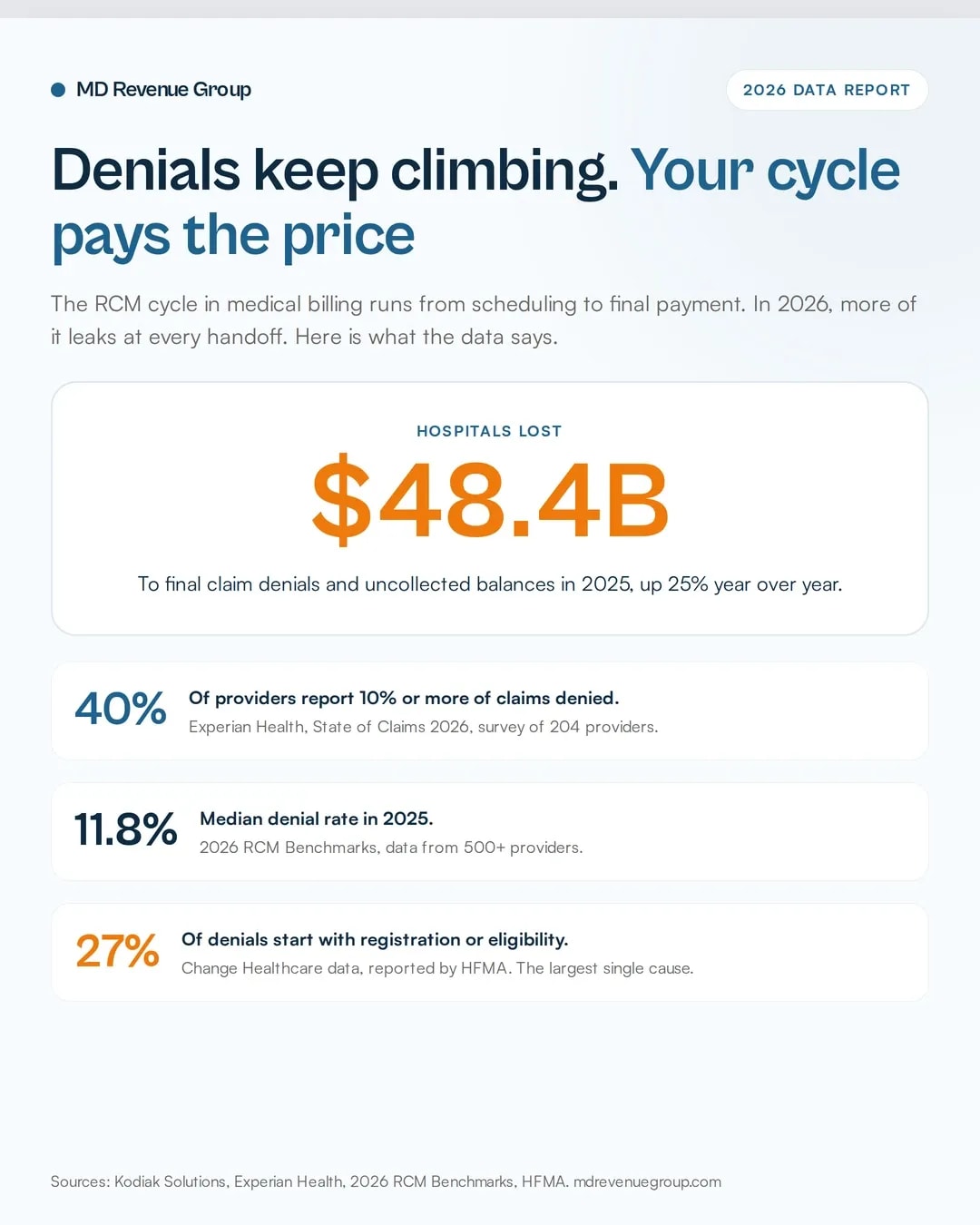
Denials keep climbing, and that is why the full cycle matters more in 2026 than it did 3 years ago. Experian Health's State of Claims 2026 survey found 40% of providers now report 10% or more of claims denied, and 75% say denials are still rising. Kodiak Solutions put the 2025 loss from final denials and uncollected patient balances at $48.4 billion, up 25% in a year. 2026 RCM benchmarks put the median denial rate at 11.8% and median days in A/R at 38.2. The cycle is where that money goes missing, one handoff at a time
Follow one $200 visit from scheduling to final payment
Here is the whole cycle on one visit. A patient calls on a Monday to book a $200 office visit. The dates below are the clean path, the version where every step works. The math section after this one prices the version where a step fails. All dates count from the visit itself, Day 0.
Day -7: Scheduling
the patient calls, the front desk books the visit and captures the legal name, date of birth, insurance card, and reason for the visit
Day -3: Eligibility and prior auth
coverage is verified as active, the copay and remaining deductible are checked, and the auth is secured where the payer requires it
Day 0: Check-in and the visit
the card is checked again at the desk, the $40 copay is collected, and the provider sees the patient and writes the note
Day 1: Charge capture and coding
every service from the visit is recorded, and the coder turns the note into CPT and ICD-10 codes with modifiers where they apply
Day 2: Scrub and submit
the claim passes the payer edits in the scrubber, goes out electronically through the clearinghouse, and the payer acknowledges receipt
Day 21: Payment posting
the payer adjudicates the claim, the remittance arrives, the $160 allowed amount is posted against the contract, and the copay is reconciled
Day 30: Final payment and close
the patient balance is $0, the account closes with $200 collected, and the report logs a clean claim with 30 days in A/R
Day 30 is the close on the clean path. The payer paid $160 after the contract adjustment. The patient paid the $40 copay at check-in. The account closes with $200 collected and $6.50 spent to process it. That is the whole cycle in 37 days from first call to last dollar.
Now look at what happens when one step fails. A missed auth on Day -3 turns into a CO-197 denial on Day 21. The claim comes back, someone reworks it, and the payer takes 30 more days. Same visit, same $200, but the money lands on Day 51 and costs $31.50 to collect. A claim nobody reworks lands never. Our 7 stages guide covers the same cycle from the benchmark angle, with a target for each stage. This guide follows the money instead.
The handoffs: who owns each pass
Six people touch one visit before it closes. The front desk, the provider, the coder, the biller, the payer, and the patient. Each pass needs an owner and a check. When nobody owns a pass, it gets skipped on busy days, and the skip shows up as a denial weeks later.
From | To | What passes | What breaks when it fails |
|---|---|---|---|
Scheduling | Front desk verification | Name, date of birth, insurance card, referral | Wrong member ID becomes a rejection on Day 21 |
Front desk | Provider | Verified coverage, copay, auth number | Missing auth becomes a CO-197 denial |
Provider | Coder | Note with diagnosis and time | Thin note gets downcoded or denied |
Coder | Billing | Coded claim with modifiers | Late charges miss the filing window |
Billing | Payer and posting | Clean claim, then remittance | Unflagged underpayment repeats every month |
The two riskiest passes sit at the ends of the middle phase. The first is the front desk to provider pass. Change Healthcare data reported by HFMA puts registration and eligibility problems at about 27% of all denials, the largest single cause, with authorization problems at another 11.6%. About half of all denials start in the front office. Verify coverage at every visit. January is the danger month. Coverage resets every January, and a plan that paid in December can sit inactive in January.
The second is the coder to billing pass. Charge posting across specialty practices can stretch up to 72 hours, per MGMA data cited by Clarity RCM. A charge that sits 3 days is a charge that can sit 30 days, and a charge that sits 30 days can miss the payer filing window. The fix is a daily habit: every visit reconciled against the schedule before the day ends, every charge posted within 24 hours. Watch DNFB, the discharged-not-final-billed count. A DNFB over 5 days means charges are piling up unbilled. Our 9 fixes guide names the target for each step that stops a denial before it exists.
Rejection, denial, or underpayment: read the reply right
Three replies look alike and mean different things. A rejection means the claim never reached the payer. A denial means the payer got it and said no. An underpayment means the payer said yes and paid less than the contract allows. Mix them up and you appeal a claim that was never filed, or you write off money the contract says is yours.
Reply | What it means | Clock | First move |
|---|---|---|---|
Clearinghouse rejection | The claim failed an edit and never reached the payer | Filing clock still running | Fix it and resend the same day |
Payer denial | The payer adjudicated the claim and said no, with a reason code | Appeal window in the contract, often 60 to 180 days | Classify by root cause, then correct or appeal |
Underpayment | The payer paid less than the contracted rate | Recoupment windows vary by payer | Flag it against the contract the week it lands |
Patient balance | The payer paid its share, the patient owes the rest | Balance ages from the statement date | Send a clear statement with a pay link the same week |
Medicare gives you 1 calendar year from the date of service to file, per 42 CFR 424.44. Commercial payers set their own windows by contract, often 90 to 180 days. A first-level Medicare appeal must be filed within 120 days of the first decision. Put those 3 clocks on the wall above the billing desk. A rejection is the cheapest reply to fix, because the filing clock is still running and the fix takes minutes. A denial that sits 30 days is a denial that gets forgotten. Work every denial inside 5 business days. Our claim denials post prices a 10% denial rate the same way this guide prices one visit.
Write the note so the claim survives
Coding can only bill what the note proves. A thin note gets downcoded or denied for medical necessity, and no coder can fix that after the fact. The note is part of the cycle.
Here is a note that fails. "Knee pain, follow up." That line supports no diagnosis, no time, and no reason for the test that follows it. The payer reads it, finds no medical necessity, and denies the claim. Here is a note that holds. "Right knee pain 6 weeks, failed NSAIDs and physical therapy, exam shows effusion and flexion limited to 90 degrees, MRI ordered to rule out meniscal tear, ICD-10 M25.561." Every code on the claim traces to a line in that note.
Two habits keep notes payable. First, name the diagnosis that supports each service in the note itself. Second, record time when time drives the code. An office visit billed on time needs the total minutes and the minutes spent counseling in the note, or the payer drops it a level. A coder who reads the note, checks the code against the diagnosis, and flags a mismatch before submission saves the $25 rework that a denial costs later. Our charge lag guide prices the lag in days and dollars.
The math: what one $200 visit costs on 3 paths
Run the same $200 visit down 3 paths. Every input ties to a published number, and the practice size is stated up front so you can rerun it on your own numbers. The practice files 750 claims a month at a $200 average claim value. That is $150,000 billed a month, and it collects about $1.5 million a year. Its denial rate runs 8%, the MGMA physician-practice rate. Its clean claim pays in 21 days, inside the 14 to 30 day clean-claim window. A denied claim adds 30 days.
Path | Days to pay | Cost to collect | Dollars back |
|---|---|---|---|
Clean | 21 days | $6.50 | $200 |
Denied once, then paid | 51 days | $31.50 | $200 |
Never worked | Never | $6.50 spent | $0 |
The 3 paths are the same claim on different runs, so do not add them together. Read them as the price of each outcome. The clean path costs $6.50 to process, per MGMA and HFMA figures. The denied path costs $31.50, the $6.50 processing cost plus $25 in rework. The never-worked path costs $6.50 and returns nothing.
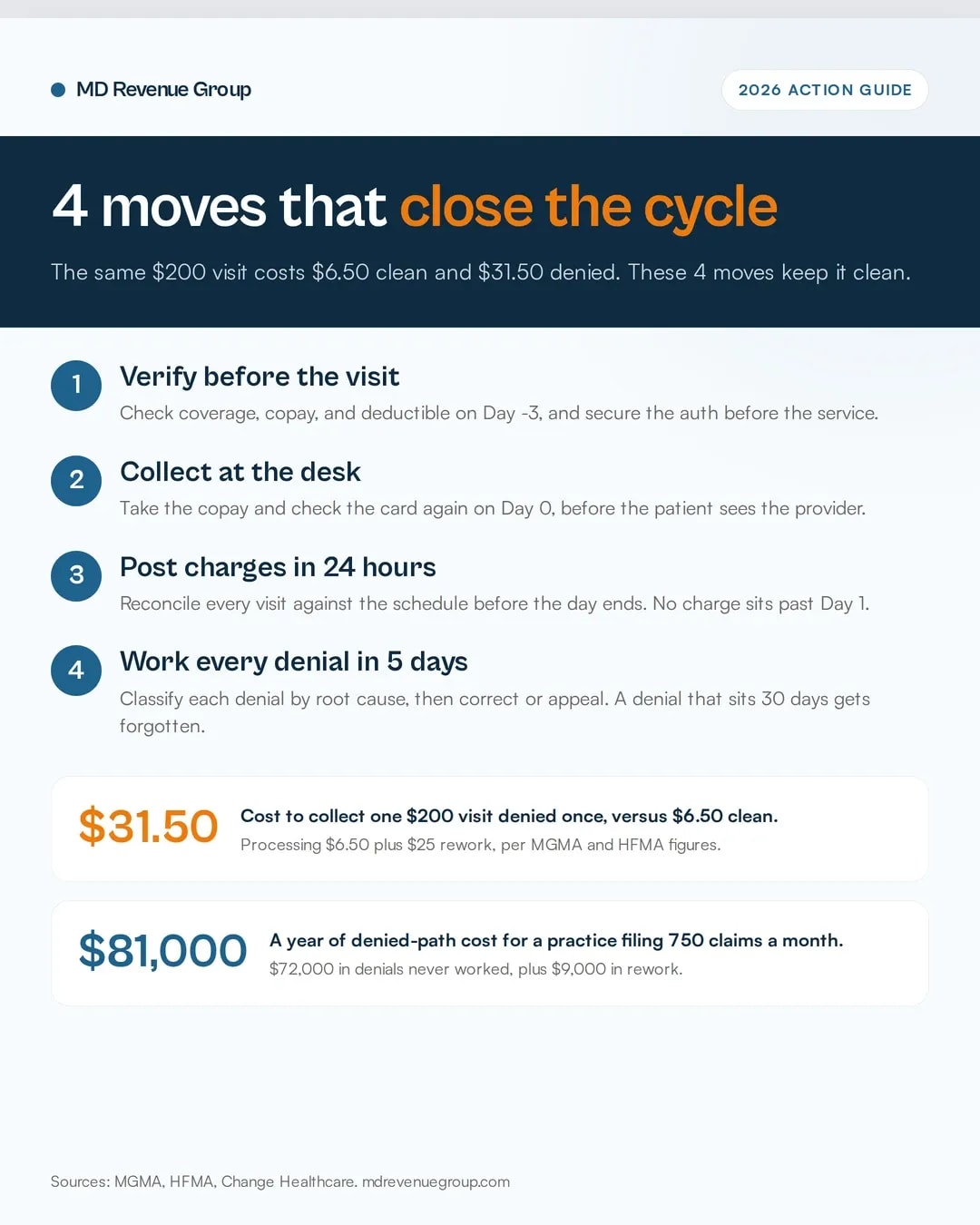
Now scale it to the practice. At 8%, the practice gets 60 denials a month. MGMA puts the share of denied claims that are never reworked at 50% to 65%. Take 50%. Of 60 denials a month, 30 are never reworked. At $200 per claim, that is $6,000 a month, or $72,000 a year, written off by silence. The 30 claims that do get worked cost $25 each in rework, or $750 a month, $9,000 a year in staff cost. The denied path costs this practice $81,000 a year: $72,000 gone plus $9,000 in rework.
The clean processing floor sits under all of it. The practice files 750 claims a month at $6.50 each, so clean processing runs $4,875 a month. That is the floor. Every denial stacks $25 on top of it. One extra point of net collection rate is worth about $15,000 a year on $1.5 million collected. Our clean claim rate benchmark guide gives the 2026 numbers by specialty, so you can check your own rate against the 95% target before you run this math.
Where the cycle breaks most
Four breaks cause most of the damage. Registration and eligibility sit first, at about 27% of denials. Prior auth sits second. The AMA 2024 prior authorization survey, with 1,000 physicians, found practices complete 39 prior auths per physician per week, and physicians and staff spend 13 hours a week on them. KFF analysis of 2025 data found Medicare Advantage insurers denied 12% of standard prior auth requests. CMS-0057-F, the Interoperability and Prior Authorization Final Rule, took effect January 1, 2026. It sets clocks that help: impacted payers must decide expedited requests in 72 hours and standard requests in 7 calendar days.
Third, denials nobody works. Half to 65% of denied claims are never reworked, per MGMA, and the appeal record says the fight is worth it. KFF found that under 1% of denied ACA marketplace claims were appealed in 2024, and 66% of the appeals that were filed got overturned. KFF's January 2026 analysis of CMS data found MA insurers made 52.8 million prior auth determinations in 2024, denied 4.1 million, and only 11.5% were appealed, even though 80.7% of appeals were overturned in whole or in part.
Fourth, patient balances nobody collects. Health systems collect only 31% of patient billings on average, per HFMA and PayZen. The average single-coverage deductible hit $1,886 in 2025, per KFF, and Kodiak data puts patient responsibility at 22.99% of allowed claim amounts in early 2026. More of every bill lands on the patient now. Our days in A/R guide shows how to pull the number and what to do when it runs over 40, and our medical billing process steps post walks the claim path in detail.
A published case shows the same fixes at work. An 8-site federally qualified health center cut days in A/R from 58 to 36, lifted its clean claim rate to 97.4%, and booked a $612,000 annualized net lift, per a vendor-published case study. The results are described as anonymized composites, so read them as direction only. The pattern matches the 4 breaks above in order: front-end fixes first, then a worked denial queue. MD Clarity's KPI guide puts the net collection rate benchmark above 95%, with 97% or higher as excellent, and ADSC's 2026 KPI guide puts the clean claim benchmark at 97% or higher. MedPrecision's 2026 RCM guide adds one honest note: no free primary source publishes a clean claim rate target, so treat the 95% figure as industry guidance. The 2025 CAQH Index, released February 19, 2026, found US healthcare avoided an estimated $258 billion in admin costs in 2024 through electronic transactions, and electronic eligibility verification saves 16 minutes per transaction versus a manual check.
Your 30-day cycle check
Run it in 4 steps. One month is enough to find the leak and prove the fix works.
Measure again on Day 30. Pull the same 4 numbers for the month. Compare them to the before numbers. If the denial rate moved, the fix worked. If it did not move, the leak is a different break, and you run the plan again. A free audit pulls all 4 numbers in 48 hours if you want the before numbers without digging through reports yourself. Medical billing services cover the back-end work in full, and our medical billing guide for small practices covers the setup that fits a 1 to 5 provider office.
Find the handoff that leaks in your cycle
A free audit pulls your last 90 days of claims, names the handoff that costs you the most, and puts a dollar figure on it. It takes 48 hours.
Frequently asked questions
The RCM cycle in medical billing is the full path a dollar takes from scheduling to final payment. It covers eligibility, prior auth, charge capture, coding, claim submission, payment posting, denial management, and patient collections, with reporting at the end.
A clean visit closes in about 30 days from the first call to the last dollar, with the claim itself paying in 14 to 30 days. A denied claim adds about 30 days, so the same visit lands near day 51 instead of day 21.
Medical billing is one slice of the cycle. Billing starts after the visit is coded and ends when the payment posts. The RCM cycle starts earlier, at scheduling, and ends later, at reporting and process fixes.
Registration and eligibility problems cause about 27 percent of denials, the largest single cause, per Change Healthcare data reported by HFMA. Authorization problems cause another 11.6 percent. About half of all denials start in the front office.
The clean claim rate target is 95 percent or higher, with 97 to 98 percent as top-performer range. The denial rate target is under 5 percent for physician practices, against an MGMA rate of 7 to 8 percent. Judge your practice against the MGMA range.
Medicare allows 1 calendar year from the date of service, per 42 CFR 424.44. Commercial payers set their own windows by contract, often 90 to 180 days. A first-level Medicare appeal must be filed within 120 days of the first decision.
Hand it off when verifications get skipped on busy days, charges lag past 72 hours, or more than half of denials are never reworked. Keep it in-house when your denial rate runs under 8 percent, A/R runs under 40 days, and every denial gets worked inside 5 business days.
See your revenue leaks in dollars.
Get a forensic 90-day cash flow audit of your practice. 100% confidential, 48-hour delivery, zero obligation.