
CMS Extends Medicare Home Health and Hospice Enrollment Moratorium 6 More Months
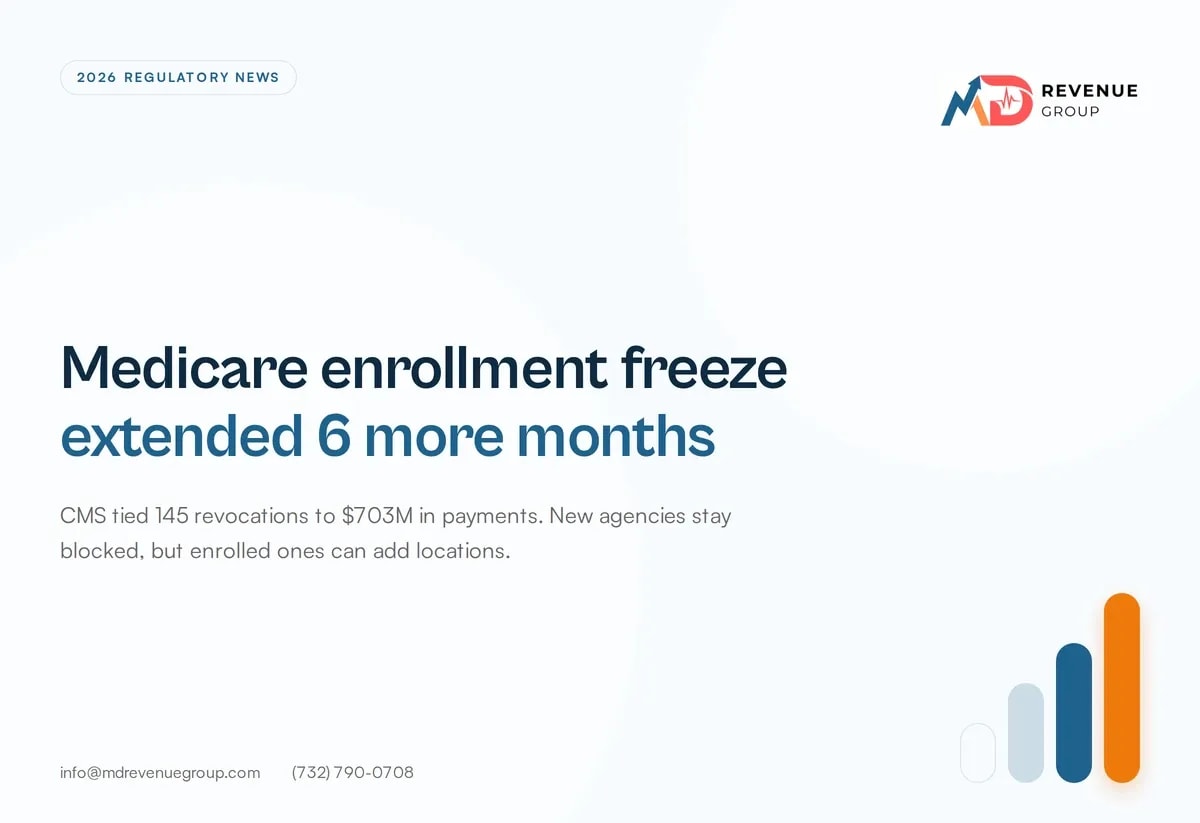
CMS extended the Medicare enrollment freeze for hospices and home health agencies 6 more months, effective Nov 13, 2026. Existing agencies can now add locations.
CMS Extends Medicare Home Health and Hospice Enrollment Moratorium 6 More Months
CMS extended the Medicare enrollment moratorium for hospices and home health agencies for 6 more months, effective November 13, 2026. The freeze started May 13, 2026, and it was set to end this week. It does not end. New Medicare enrollments for hospices and home health agencies stay blocked until about May 13, 2027.
One thing did change. An agency that is already enrolled in Medicare can now add new practice locations under its current enrollment. That door was shut in the May version. It is open now.
If you run a home health or hospice agency, or you planned to open or buy one, this decision sets your next 6 months. The rest of this article gives you the dates, the fraud numbers behind the freeze, the math on what a delay costs, and a checklist for the moves that still work.
Table of contents
- What changed on Nov 13, and what stays frozen
- Why CMS says the freeze has to continue
- The money behind the freeze: what hospice and home health cost Medicare
- What a 6-month delay costs a new agency: the math
- Who gets blocked and who gets through
- The Nov 4 rule behind the freeze
- Your checklist if you planned to open, buy, or expand
- What the freeze does not do
- What happens next
- Frequently asked questions
Key takeaways
- CMS extended the nationwide Medicare enrollment moratorium for hospices and home health agencies for 6 more months, effective November 13, 2026. CMS announced the extension on November 12, 2026.
- New initial Medicare enrollments stay blocked, and certain changes in majority ownership still trigger a new-enrollment application that the freeze blocks.
- Already-enrolled agencies can now add new practice locations and branches under their existing enrollment. That opening is new in this extension.
- CMS tied 145 provider revocations in a 2-day October 2026 California operation to more than $703 million in Medicare and Medicaid payments.
- The freeze sits on top of the November 4, 2026 final rule that made all enrollment revocations retroactive to the date noncompliance began.
What changed on Nov 13, and what stays frozen
CMS announced the extension on November 12, 2026. The CMS press release says the agency will extend its nationwide moratoria on new Medicare enrollments for hospices and home health agencies for an additional 6 months. The CMS moratorium FAQs, revised November 12, 2026, put the effective date at November 13, 2026. The Federal Register notices are scheduled for publication on November 16, 2026.
The original moratoria began May 13, 2026. They were set for 6 months, and CMS has the authority to extend them in 6-month increments. This is the first extension. It runs to about May 13, 2027, and CMS can extend it again if the fraud conditions have not cleared.
The freeze applies nationwide, in all 50 states, the District of Columbia, and the territories. That matches the May version. A bad actor cannot dodge the freeze by filing in another state.
Two things stay blocked. First, initial Medicare enrollment applications for new hospices and new home health agencies. Any application submitted after the moratorium started gets denied. Second, certain changes in majority ownership that require the agency to enroll as a new provider. A buyer who takes majority control of an agency can hit the same wall as a brand-new applicant.
One thing opened up. Under the May moratoria, an enrolled agency could not add a new branch office or practice location. Under the extension, it can. Home Health Care News reported on November 13, 2026 that the extension will allow currently enrolled hospices and home health agencies to add new practice locations within their existing enrollment. CMS drew the line this way on purpose. It is more worried about entirely new operators, with whom it has no track record, than about an enrolled provider adding a location.
Existing enrollments are not touched. The extension does not end any current Medicare enrollment, and it does not stop an enrolled provider from delivering services and billing Medicare. Our Medicare enrollment revocation post covers the separate November 4 rule that changed how CMS can revoke an enrollment, and our revenue cycle management guide covers the full-cycle setup that keeps enrollment, billing, and collections in order.
Why CMS says the freeze has to continue
CMS Administrator Dr. Mehmet Oz said in the announcement, "We've made real progress over the past six months, but fraud in hospice and home health persists and our work isn't finished." He added, "Medicare beneficiaries deserve protection from these bad actors, and American taxpayers need to know the programs they rely on aren't being bled dry by fraudsters."
A CMS spokesperson told Hospice News that the agency "continued to observe rampant fraudulent activity in this space" and that the moratorium "has allowed CMS to halt the influx of new providers into this high-risk category, a key source of fraudulent activity."
The schemes CMS describes in the Federal Register notices are blunt. Patients were enrolled in hospice without their knowledge, or despite not having a terminal illness. Providers billed for care that was unnecessary or never delivered. The home health notice cites kickbacks, stolen patient information, and claims for services that were not provided.
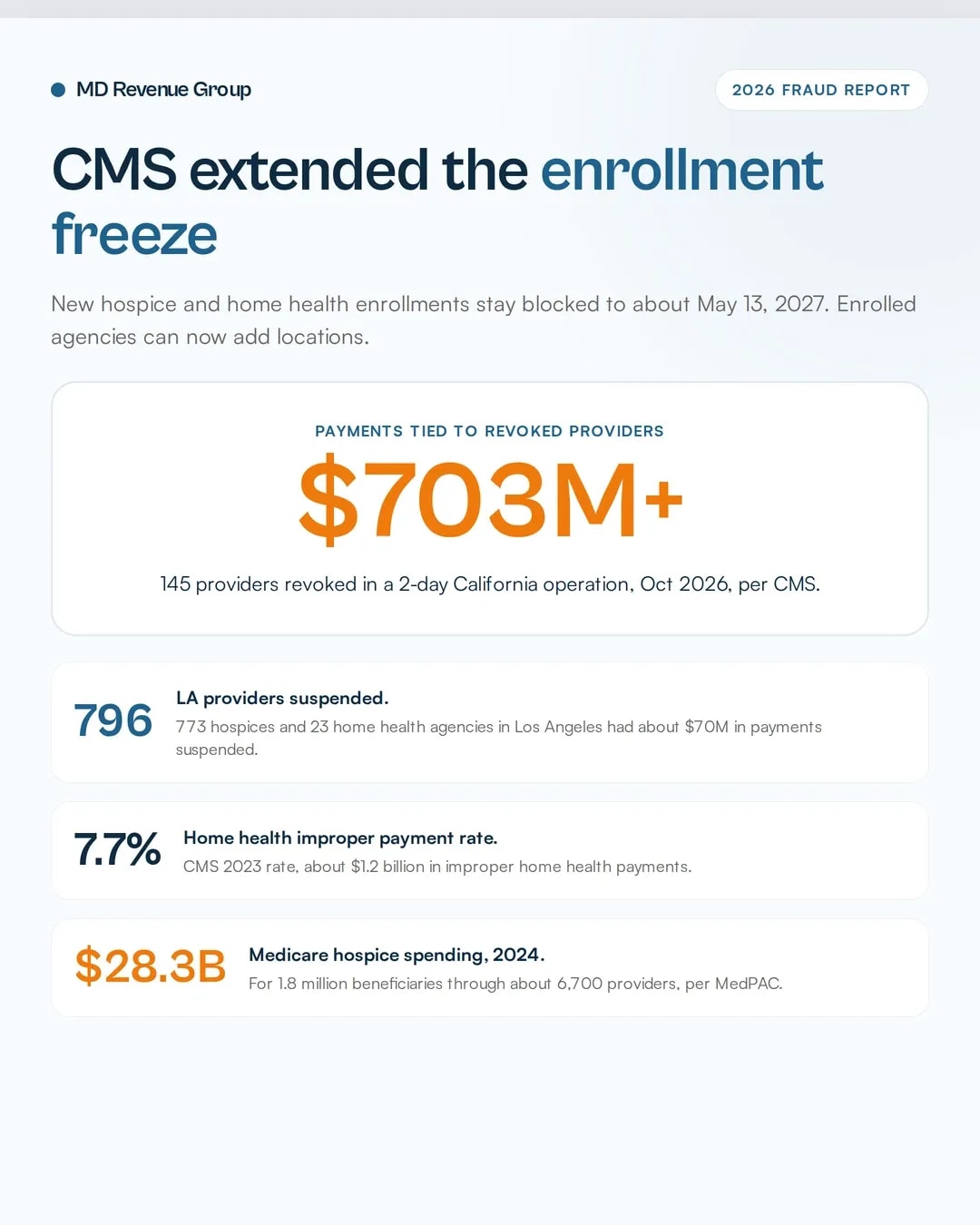
The enforcement numbers back up the language. In October 2026, CMS site visit teams ran a 2-day operation targeting home health agencies and hospices in California. It ended with 145 revocations of providers associated with more than $703 million in Medicare and Medicaid payments, per the CMS press release.
The Los Angeles numbers are older and just as large. At the May 13 announcement, CMS said it had suspended payments to 773 hospices and 23 home health agencies in the Los Angeles area, totaling about $70 million. That is 796 providers in one metro area. A separate April 2026 action suspended 447 hospices and 23 home health organizations in greater Los Angeles, with agents alleging about $600 million in fraud. Keep the two actions apart. They are different operations with different counts.
The OIG audits from 2026 show the same pattern inside ordinary billing, not just in criminal cases. In June 2026, the OIG reported that Medicare could have saved $255.1 million on hospice services for certain new enrollees. Auditors reviewed 100 initial certification periods from fiscal year 2021 and found 45 did not meet Medicare hospice requirements. In 21 cases, the clinical record did not support a terminal illness. In 24 cases, the records failed the eligibility documentation rules.
In July 2026, the OIG reported that Hospice of the Valley - West received at least $8.6 million in Medicare overpayments. Auditors reviewed 100 claims and found 15 did not comply with Medicare requirements. In August 2026, an OIG audit of Deistic Home Health Care found 37 of 100 sampled claims billed incorrectly, mostly for billing and coding errors and missing face-to-face encounter documentation. The OIG work plan post tracks the audits CMS and OIG have lined up, and our improper payments post covers the payment error rates behind the enforcement push.
Two more numbers frame the scale. The HHS OIG put suspected hospice fraud at $198.1 million for fiscal year 2023 alone. And CMS's 2023 improper payment rate for home health claims was 7.7 percent, about $1.2 billion in improper payments.
The money behind the freeze: what hospice and home health cost Medicare
Hospice and home health are big Medicare programs, and that size is part of why CMS guards the door. MedPAC reported that Medicare spent $28.3 billion on hospice in 2024, for more than 1.8 million beneficiaries, through about 6,700 providers. More than half of Medicare decedents used hospice in 2024. The share hit 52.9 percent, a new high.
Home health is smaller but still large. MedPAC's November 5, 2026 presentation puts fee-for-service Medicare home health spending at $16 billion in 2024, for 2.7 million beneficiaries.
The per-day rates explain why long stays pay so well. MedPAC's hospice payment overview lists routine home care at $231 a day for days 1 through 60, and $182 a day from day 61 on. Routine home care covers about 99 percent of hospice days. A patient who stays on service for months bills every single day.
Length of stay splits sharply by ownership. For-profit hospices averaged 120-day stays in 2024, against 71 days at nonprofit hospices, per MedPAC. For-profit hospices posted a 13.7 percent fee-for-service Medicare margin in 2023, while nonprofit hospices posted a margin of negative 1.3 percent.
Private equity ownership adds another wrinkle. A study published November 2, 2026 in Health Affairs found Medicare paid $993 more per hospice encounter after private equity firms bought for-profit hospices, a 5.9 percent rise from a $16,922 baseline. The study compared 191 hospices acquired between 2018 and 2022 with 1,305 matched for-profit hospices that private equity did not buy. The researchers found no rise in physician, nurse, or home health visits that might explain the longer stays.
CMS named 6 states as high-risk markets for hospice and home health fraud: Arizona, California, Georgia, Nevada, Ohio, and Texas. It also runs a pre- and post-claim review demonstration in Florida, Illinois, Oklahoma, Ohio, North Carolina, and Texas. If your agency operates in one of those states, expect site visits and closer claim review. Our medical billing services cover the back-end work that keeps claims clean when scrutiny rises.
What a 6-month delay costs a new agency: the math
The freeze has a dollar value, and you can work it out for your own plan. The numbers below use sample figures, labeled as samples, built from the published MedPAC rates in this article.
Take a sample new hospice that planned to open with 40 patients on routine home care. At $231 a day, that census bills $9,240 a day. Over the 180 days of the extension, that is $1,663,200 in Medicare revenue that cannot start until enrollment opens. One patient on routine home care for 180 days bills $41,580.
Now flip it to the opening the extension created. An already-enrolled agency that adds a branch with 25 patients bills $5,775 a day at the same rate. Over 180 days, that branch bills $1,039,500. That revenue is available now, because the branch rides on the existing enrollment.
Sample agency, routine home care at $231 a day | The number | 180-day value |
|---|---|---|
New hospice, 40 patients, enrollment blocked | $9,240 a day | $1,663,200 deferred |
One patient, 180 days on service | $231 a day | $41,580 deferred |
Enrolled agency adds a branch, 25 patients | $5,775 a day | $1,039,500 now open |
Run the same math on your own planned census and your real wage-adjusted rate. The pattern holds at any size. A new agency waits. An enrolled agency that grows by branch does not. A medical billing audit pulls your last 90 days of claims and shows where your current revenue leaks while you wait.
Who gets blocked and who gets through
Use this table before you sign anything. The moratorium turns on enrollment status, not on how good your care is.
Your situation | Blocked or open | What to do |
|---|---|---|
Opening a brand-new hospice or home health agency | Blocked. New initial enrollments are denied. | Re-plan the launch date and the cash runway. No Medicare revenue until enrollment opens. |
Already enrolled, adding a branch or practice location | Open. New in this extension. | File the location addition under your current enrollment. |
Buying an agency in a change of majority ownership | Blocked if the deal forces a new enrollment application. | Get the enrollment answer in writing before closing. |
Already enrolled, no changes | Open. Existing enrollments continue. | Keep billing as usual and keep enrollment records current. |
If your deal is a change in majority ownership, check the rule before you close. Our credentialing and enrollment post covers how enrollment delays choke revenue, and the same logic applies here at a larger scale.
The Nov 4 rule behind the freeze
The moratorium is one lever. The other lever arrived 8 days earlier. On November 4, 2026, CMS issued the Calendar Year 2027 Home Health Prospective Payment System Final Rule. TechTarget reported on November 6, 2026 that the rule widened CMS's power to deny or revoke Medicare enrollment based on misconduct by a provider's owners or parent companies. Before this rule, CMS could only act on the provider's own violations.
Three parts of that rule matter for any agency owner. First, every revocation is now retroactive to the date noncompliance began. Under the old rules, some revocations took effect 30 days after notice. Now CMS can recoup payments for the whole noncompliant period. An enrollment defect turns into overpayment exposure for every dollar billed while the defect ran.
Second, revocation and denial now reach the people behind the provider. A license suspension or revocation in another state, or a suspension from another federal health care program, can trigger denial or revocation when it involves the provider, its owners, or its managing employees. JD Supra's analysis notes the rule also targets clusters of hospices and home health agencies operating in a small area, and medical directors who oversee a hospice from so far away they cannot realistically do the job.
Third, home health agencies, hospices, and medical equipment suppliers that go through certain changes in majority ownership must re-enroll as new providers and complete a new survey or accreditation. Fail that step and the agency loses its ability to bill or enroll.
The rule also carries a pay bump. Home health agencies get $415 million more next year, a 2.4 percent increase. CMS projects the enforcement changes will save taxpayers $82 million a year. McKnight's reported that CMS received 375 sets of stakeholder comments on the provisions and insisted the new tools will be targeted in scope. Our CMS provider exclusion post covers the exclusion side of the same enforcement push.
Your checklist if you planned to open, buy, or expand
Work this list in order. It takes an afternoon, and it protects the next 6 months.
First, if you planned to open a new agency, re-plan the date and the money. Medicare revenue starts only after enrollment opens, which is about May 13, 2027 at the earliest, and CMS can extend again. Count the months of rent, payroll, and overhead you must carry with no Medicare income. If the math does not work, pause the build-out instead of burning cash.
Second, if you planned to buy an agency, check the ownership question before you close. A change in majority ownership that forces a new enrollment application is blocked by the moratorium. Ask the seller for the enrollment history, the ownership structure, and any pending CMS or state action. Get the enrollment answer in writing from your own counsel, not from the deal documents alone.
Third, if you are already enrolled and want to grow, use the branch route. The extension lets you add practice locations and branches under your current enrollment. File the location addition now, while the door is open. CMS has not said how long the modification will last if the moratorium is extended again.
Fourth, clean up your enrollment record. The November 4 rule made revocations retroactive, so an old reporting gap can cost you months of payments. Check that your owners, managing employees, licenses, practice locations, and addresses are current in PECOS. Report ownership changes and adverse legal actions on time. Our Medicare revalidation post covers the calendar that keeps enrollment current.
Fifth, tighten the billing that draws audits. The OIG findings in this article keep coming back to the same gaps: hospice eligibility documentation, terminal illness support in the clinical record, and the face-to-face encounter. Make sure the record supports the level of care billed, the visit notes match the claim dates, and the per diem level matches the care actually delivered.
Sixth, watch your state. Five states run their own Medicaid hospice enrollment moratoria: Louisiana, Nevada, Ohio, Pennsylvania, and Rhode Island. A federal freeze does not automatically mean a state freeze, and a state freeze does not automatically end when the federal one does. Check both before you plan a launch or a purchase.
What the freeze does not do
Say the limits plainly, because they decide what you can still do. The freeze does not end any existing Medicare enrollment. It does not stop an enrolled provider from delivering care or billing Medicare. It does not apply to Medicaid enrollment directly, though states can impose their own moratoria and 5 have done so for hospice.
It does not cover other provider types. A separate moratorium on DMEPOS suppliers began February 27, 2026. Physicians, hospitals, and other suppliers are not covered by this freeze. And it does not stop CMS from acting against an enrolled provider. Payment suspensions, site visits, fingerprint-based background checks, and revocations all continue during the moratorium. The freeze blocks new entrants. It does not shield anyone already inside.
What happens next
Three dates matter after this announcement. November 16, 2026 is when the Federal Register notices publish. May 13, 2027 is when the extension runs out, unless CMS extends it again in another 6-month increment. And the 6-month clock on the November 4 revocation rule is already running, so expect more revocations tied to owner conduct and retroactive effective dates.
Watch two things in the meantime. First, the outcome of the October California operation and whether CMS runs similar site visit operations in the other high-risk states. Second, whether states add their own Medicaid moratoria or lift the ones they have. CMS said it has seen no evidence that the original freeze materially reduced access to care nationwide or at the state level. Providers in underserved areas dispute that, and access in those markets is the argument to watch if the freeze is extended a second time.
For a home health or hospice operator, the move is simple. If you are enrolled, grow by branch while the door is open. If you planned to open or buy, re-plan around May 2027 and get the enrollment answer in writing before you spend. A free audit pulls your last 90 days of claims and shows where your money leaks. It takes 48 hours.
Planning a home health or hospice move while the freeze runs? Get your billing checked free
The Medicare enrollment moratorium runs to about May 13, 2027. A free audit pulls your last 90 days of claims and shows where your money leaks. It takes 48 hours.
Frequently asked questions
The Medicare enrollment moratorium is a CMS freeze on new Medicare enrollments for hospices and home health agencies. It started May 13, 2026, and CMS extended it for 6 more months, effective November 13, 2026. No new hospice or home health agency can enroll in Medicare while it runs.
The extension runs about 6 months, to about May 13, 2027. CMS has the authority to extend a moratorium in 6-month increments, so it can extend again if fraud conditions have not cleared.
No. Existing Medicare enrollments continue, and enrolled providers keep delivering services and billing Medicare. The extension also lets an enrolled agency add new practice locations and branches under its current enrollment, which the May version did not allow.
No. New initial Medicare enrollment applications for hospices and home health agencies are blocked while the moratorium runs. Any application submitted after May 13, 2026 gets denied.
No. Certain changes in majority ownership require the agency to enroll as a new Medicare provider, and that new enrollment application is blocked by the moratorium. Check the ownership rules and get the enrollment answer in writing before closing a deal.
CMS says fraud in hospice and home health persists. In October 2026, a 2-day California site visit operation ended with 145 provider revocations tied to more than 703 million dollars in Medicare and Medicaid payments. CMS had also suspended payments to 773 hospices and 23 home health agencies in Los Angeles, about 70 million dollars.
The Calendar Year 2027 Home Health Prospective Payment System Final Rule made all enrollment revocations retroactive to the date noncompliance began, added revocation grounds based on owner and parent company conduct, and required re-enrollment after certain majority ownership changes. Home health agencies also get a 2.4 percent pay bump, 415 million dollars, in 2027.
Unfreeze your credentialing pipeline.
Enter your practice details. We will audit your CAQH profiles and payer enrollments to get your providers billing immediately.