A1712: The New NJ Itemized Billing Statement Law Every Practice Must Follow
NJ Bill A1712 requires itemized billing statements within 30 days of discharge. See what's required, the penalties, and how to prepare your practice.
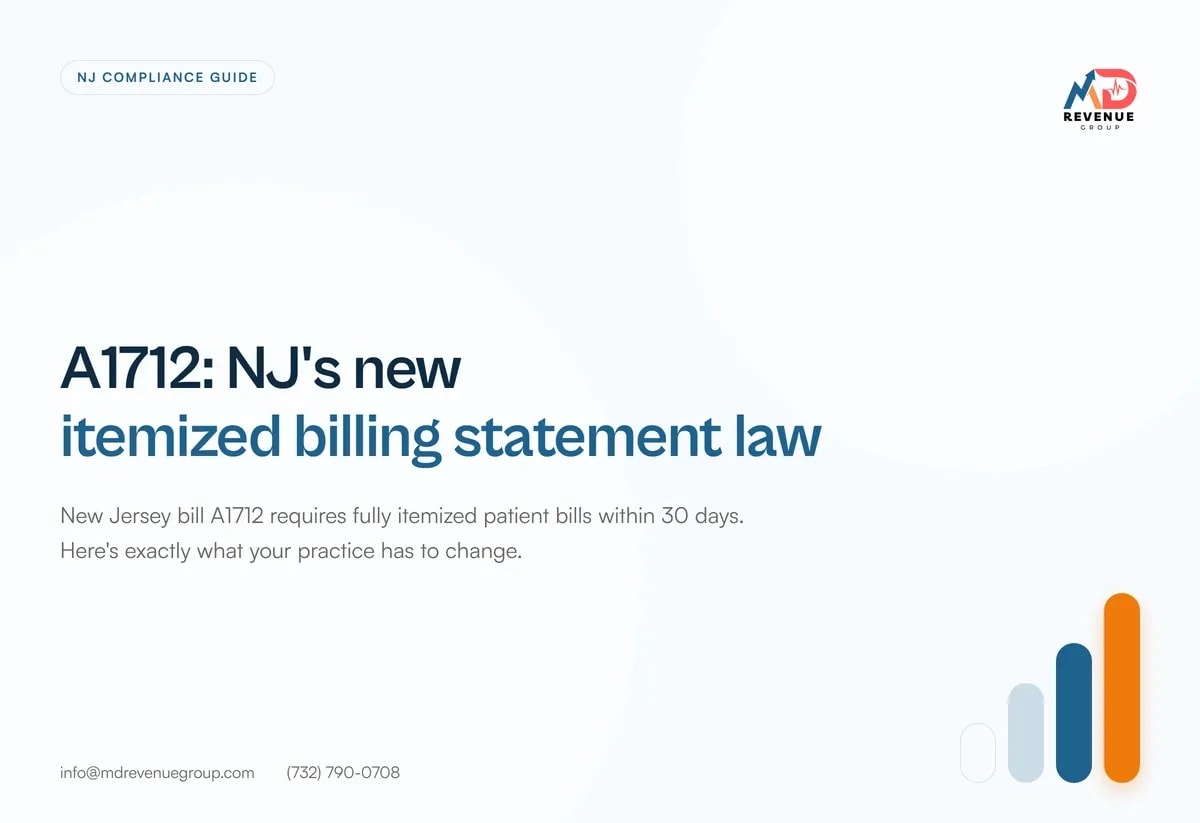
New Jersey Assembly Bill A1712 requires health care providers to send patients a consolidated, itemized statement or bill within 30 days of discharge, or within 7 days of a written request. The statement can't rely on billing codes alone or vague labels like "miscellaneous charges." It has to list each service by date and provider, show unit pricing, name drugs by brand or generic name (not just an NDC code), and mark every line as paid, billed to a payer, or owed by the patient.
A1712 picks up where its predecessor, S2795/A3860, left off in the 2024-2025 session. It was introduced January 13, 2026 and referred to the Assembly Financial Institutions and Insurance Committee. If your NJ practice or facility still generates bills from raw CPT codes and lump-sum totals, this law changes your billing workflow, not just your paperwork.
Key takeaways
- A1712 requires itemized statements within 30 days of discharge or 7 days of a written patient request.
- Bills can't use only billing codes, drug codes, or vague terms like "supply charges."
- Every line must show who's paying it: patient, insurer, or already settled.
- Facilities must answer patient billing questions within 7 business days.
- This is New Jersey's answer to a national pattern: MGMA's January 2026 poll found billing and collections issues rank among the top sources of revenue cycle leakage practices report today (MGMA Stat, Jan 2026).
What A1712 actually requires
The bill's official purpose is to establish "certain medical billing requirements concerning specific nature of charges or expenses." In practice, that means every itemized bill or statement a covered provider sends has to answer three questions clearly: what was done, what it cost, and who owes it.
You can't hide behind a CPT code and a dollar amount anymore. The statement has to describe the service in plain language an ordinary patient can understand. Technical terms are fine, as long as they're defined somewhere on the bill.
This isn't a hospital-only law in spirit, even though the bill text leans on "health care facility" language inherited from S2795. Independent practices billing patients directly for services not covered, denied, or applied to a deductible are the ones most likely to get caught flat-footed, because most EHR-generated superbills were never built for this level of detail.
A1712 is a straight re-introduction of the prior session's S2795/A3860, which cleared committee review in 2025 but didn't reach a full floor vote before the session closed. New Jersey re-files bills like this constantly, and the language rarely changes much between sessions. Treat the requirements below as close to final, not as a rough draft that might get watered down before a vote.
Who has to comply
A1712 applies to health care providers and facilities that bill patients directly, including hospital-based physicians and other providers who can't bill separately from the facility. If your NJ practice sends any patient-facing bill, whether that's a self-pay balance, a copay reconciliation, or a post-EOB statement, this law reaches you.
Multi-specialty groups and ASCs carry the heaviest lift. They typically stack charges from multiple departments onto one statement, which is exactly the format the bill singles out for reform: no more department-level lump sums without unit pricing underneath them. If you run an ambulatory surgery center, check how your ASC revenue cycle management workflow currently bundles facility fees before this becomes a compliance gap.
If your revenue cycle management workflow already itemizes at the CPT and modifier level for internal tracking, you're closer to compliant than you think. Most practices just never surfaced that detail on the patient-facing document.
The itemization rules, line by line
Here's what a compliant statement has to include, based on the bill text and its 2024-2025 companion legislation:
Requirement | What it means for your bill |
|---|---|
Service-level detail | Each service listed by date and rendering provider, not bundled into a daily rate |
Unit pricing | Component-level pricing within each department, not one flat department charge |
No code-only entries | Billing codes must be paired with a plain-language description |
Drug naming | Brand or generic name required; NDC or drug codes alone aren't enough |
Payment status | Each line marked as paid, assigned to a payer, or owed by the patient, with amounts and due dates |
Plain language | Technical medical terms allowed only if defined on the statement |
The plain-language requirement is the one most billing teams underestimate. A statement that's technically accurate but unreadable to a layperson still fails the bill's standard. If a patient can't tell what "99214-25" means without calling your office, the format hasn't done its job.
Facilities also have to build a process for answering billing questions, with a hard 7-business-day response window. That's a workflow requirement, not just a document requirement. Someone on your team owns that clock.
Compare that to what most practices run today: a generic patient statement that lists a date of service, a CPT code, and a balance due, with billing questions routed to a shared inbox nobody checks on a schedule. That gap between the current default and the A1712 standard is exactly where NJ practices are going to lose time scrambling once this becomes enforceable.
How this connects to NJ's other 2025-2026 billing laws
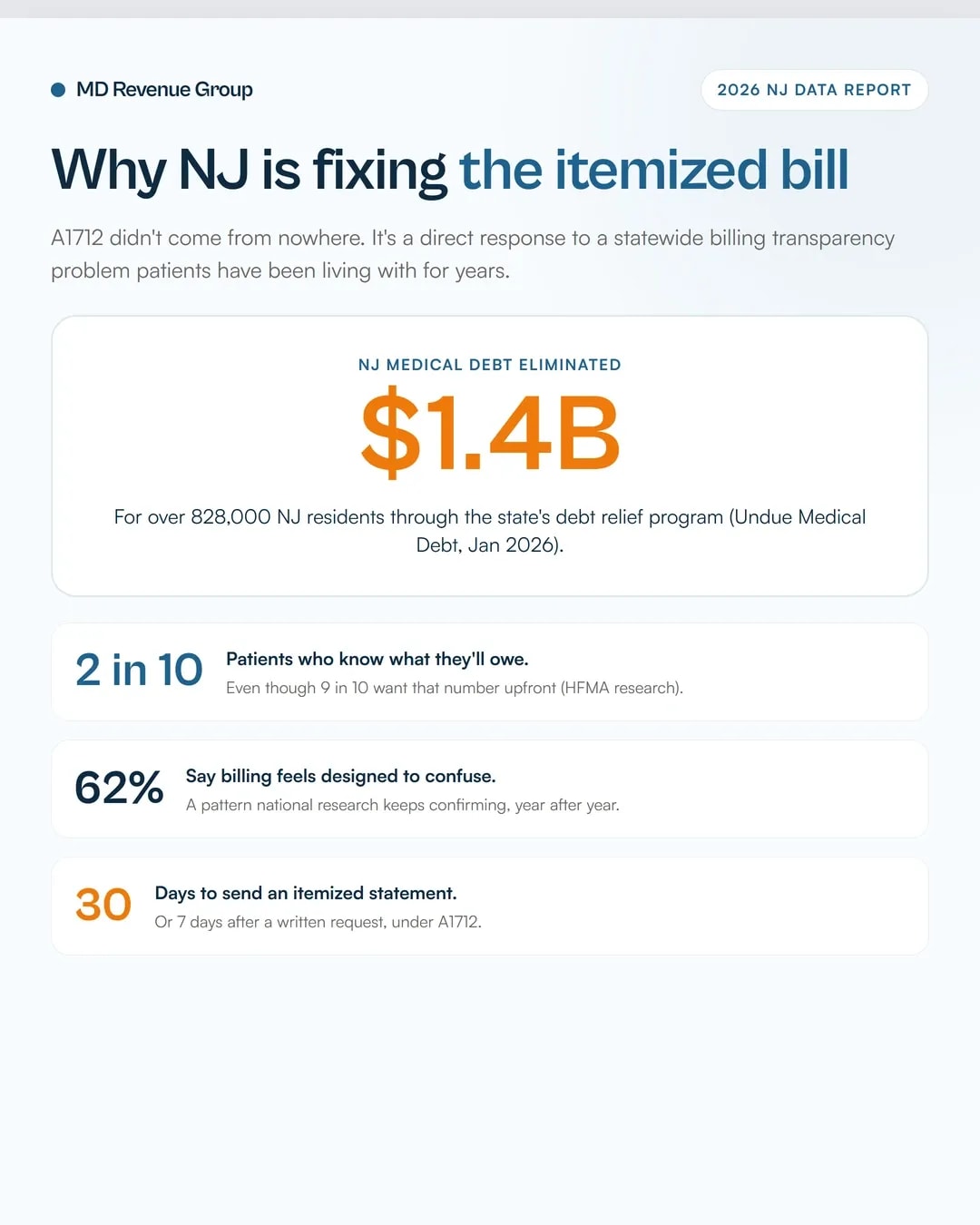
A1712 doesn't exist in isolation. It's the latest piece of a broader New Jersey push on billing transparency and patient debt protection that started with the Louisa Carman Medical Debt Relief Act, effective July 2025. That law caps medical debt interest at 3%, bans most credit reporting on medical debt, and requires a 120-day hold before any collection action starts.
The connection matters operationally. Under Louisa Carman, you can't start the collection clock without a bill the patient can actually understand and dispute. A1712 supplies that bill. If your statements don't meet the itemization standard, any downstream collection activity built on Louisa Carman's timeline is standing on a document that may not hold up.
New Jersey's out-of-network protections add another layer. If your practice handles medical billing audits for out-of-network claims, the itemization requirement gives patients (and their attorneys) a much clearer paper trail to check your numbers against.
Statewide, the stakes are real. New Jersey and Undue Medical Debt have eliminated nearly $1.4B in medical debt for more than 828,000 residents through a series of relief rounds since the program launched, including $86M for over 53,000 residents in the sixth round announced in January 2026 (Undue Medical Debt press release, Jan 2026). Lawmakers aren't writing these bills in a vacuum. They're responding to a documented, statewide billing transparency problem.
What your practice needs to do before this becomes law
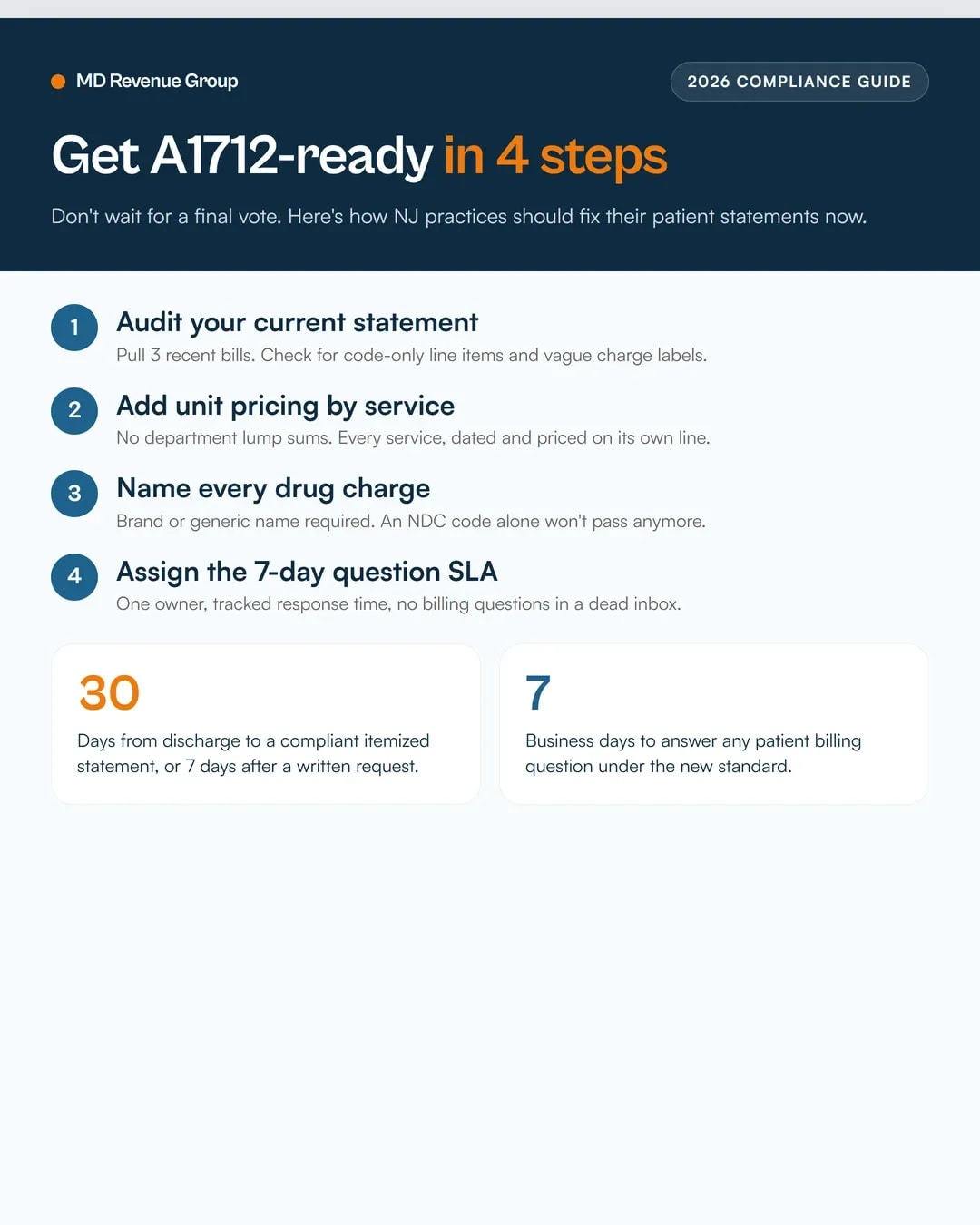
Start with your statement template, not your policy manual. Pull three recent patient statements and check them against the table above. Most practices find the gap immediately: codes with no description, department totals with no unit breakdown, drug charges with no name attached.
Next, map your billing questions workflow. If a patient calls with a billing question today, who owns the response, and how fast does it actually go out? A1712's 7-business-day requirement needs an assigned owner and a tracked SLA, not a "someone will get to it" process. A revenue integrity review can catch the same gaps in your statement data before a patient ever has to call and ask.
Then look at your EHR and billing software's statement generator. Most practices don't build custom statements from scratch, they rely on whatever template their medical billing services platform outputs by default. If that template groups charges by department without unit pricing, that's a configuration problem you can usually fix before it becomes a compliance problem.
Patients aren't shy about escalating when a bill doesn't make sense. National research backs this up: only about 2 in 10 patients say they know what they'll owe after a visit, even though roughly 9 in 10 want that number upfront, and 62% believe the billing process feels deliberately confusing (HFMA/Change Healthcare-Harris Poll research). A1712 is New Jersey's legislative response to that exact frustration, and it's not going away with a committee vote either direction.
What happens if you don't comply
A1712 hasn't reached a final vote yet, so enforcement mechanics (fines, agency oversight, private right of action) will firm up as it moves through committee. What's predictable is the pattern New Jersey has followed with recent billing legislation: unclear or non-itemized statements become evidence in patient complaints, and complaints route to the Division of Consumer Affairs or feed directly into medical debt disputes under Louisa Carman.
The practical risk shows up faster than any statutory penalty. A vague statement invites a billing dispute. A billing dispute delays payment, and delayed self-pay balances are already one of the categories practices flag most often when they're asked where their revenue cycle is leaking (MGMA Stat, Jan 2026). Fixing your itemization now is cheaper than fighting a wave of disputed statements later, regardless of when A1712 gets a final signature.
New Jersey's Consumer Fraud Act gives the Division of Consumer Affairs broad authority over deceptive billing practices already, separate from whatever enforcement language ends up attached to A1712 directly. A statement that hides charges behind unexplained codes is the kind of documentation that turns a routine billing dispute into a consumer protection complaint. Practices that clean up their statement format now aren't just getting ahead of A1712, they're closing off a complaint pathway that already exists under current law.
Get ahead of A1712 before it's mandatory
Waiting for a final vote means retrofitting your billing templates under a deadline instead of on your own timeline. We help NJ practices rebuild patient statement templates for full itemization compliance, ahead of state mandates, not scrambling to catch up to them. Request a free revenue audit and we'll show you exactly where your current statements fall short.