Agentic AI in Revenue Cycle Management: What It Means for Your Practice in 2026
Agentic AI is cutting RCM cost-to-collect by 30-60%. Learn what it actually does, where it beats standard automation, and how to evaluate vendors.
Agentic AI in Revenue Cycle Management: What It Means for Your Practice in 2026
AI revenue cycle management used to mean a script that flagged missing modifiers. That version of AI is already obsolete.
The shift happening right now, in mid-2026, is categorically different. Agentic AI doesn't flag problems and wait for a human to fix them. It identifies a denial, reads the patient's clinical notes, corrects the code, and resubmits the claim "” often the same day, without anyone touching the case. That is a different class of technology, and it's landing inside production billing workflows at health systems across the country right now.
This article breaks down what agentic AI actually is in an RCM context, where it creates measurable returns, what the governance risks are, and the 5 questions you need to ask any vendor before committing.
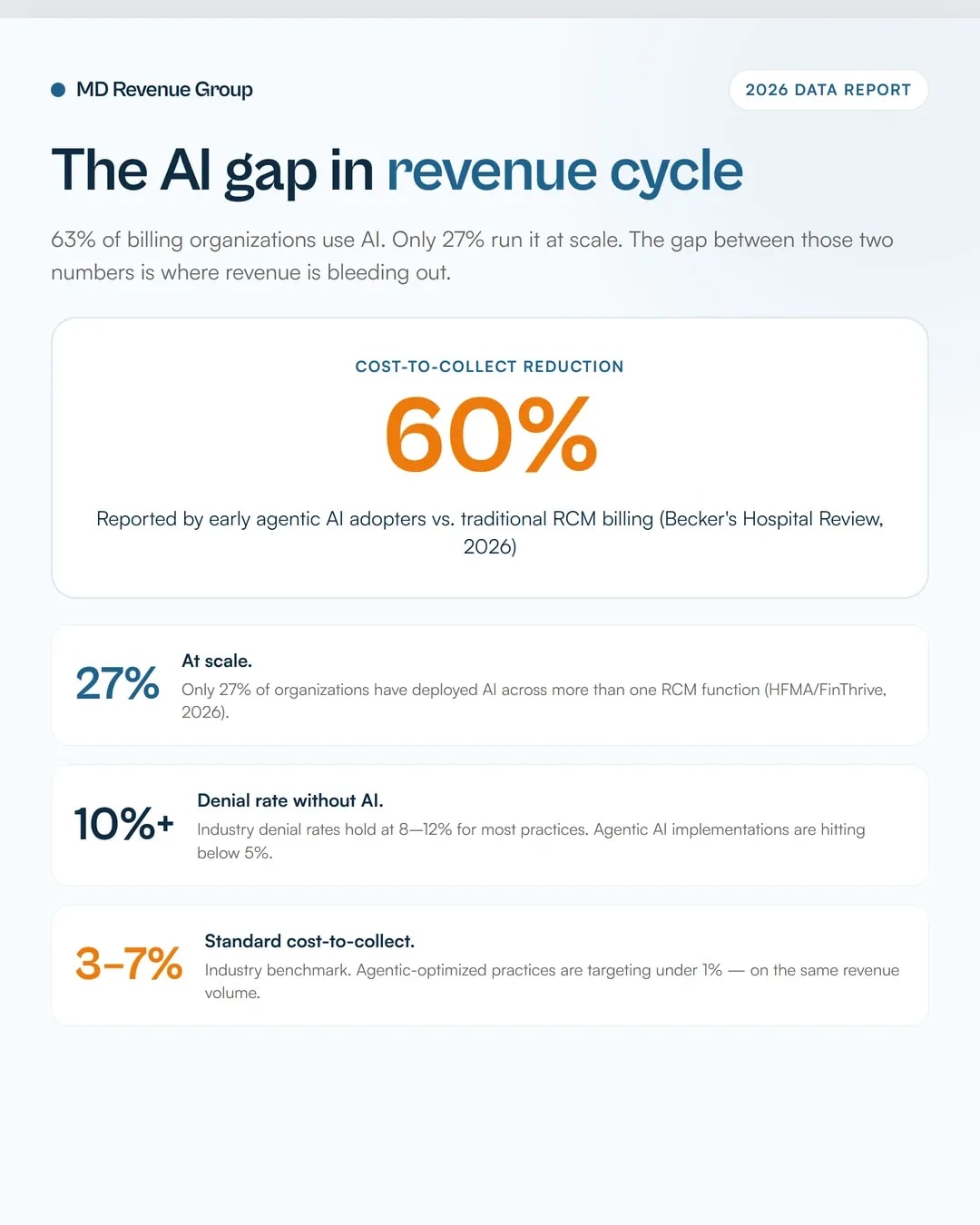
Key numbers: Early adopters are reporting cost-to-collect reductions of 30"“60% (Becker's Hospital Review, 2026). First-pass rates are pushing into the mid-to-high 90s for organizations using end-to-end orchestration. And according to HFMA/FinThrive, 63% of organizations use some form of AI in billing today "” but only 27% have deployed it at scale across more than one function.
Key takeaways
- Agentic AI executes multi-step billing tasks autonomously "” it goes beyond identifying issues to actually resolving them without human prompts.
- Cost-to-collect benchmarks for standard RCM run 3"“7% of net revenue. Agentic AI implementations are targeting under 1%.
- Only 27% of organizations have deployed AI across more than one RCM function, despite 63% using some form of AI (HFMA/FinThrive, 2026).
- First-pass claim acceptance rates are reaching 95%+ in AI-enabled practices vs. the industry standard of 85"“95%.
- Governance "” auditability, human-in-the-loop review, HIPAA compliance "” is where most AI RCM rollouts fail or get cancelled.
What agentic AI actually means in RCM
The word "agentic" has gotten overloaded fast. Every billing software vendor added it to their homepage in early 2026, so it's worth pinning down what it actually means before evaluating anything.
A standard AI tool in RCM is reactive. It looks at a claim, scores a risk, and surfaces a recommendation. A human still has to act on it.
An agentic AI system is autonomous. It has a defined goal "” say, resolving a denial "” and it executes every step required to reach that goal without waiting for instructions at each stage. It can read an EOB, classify the denial reason, pull the patient's chart, check payer policy, update the claim, and resubmit it. The system plans, executes, and adapts in real time.
The architecture usually involves multiple specialized agents working in sequence: one reads and classifies inputs, one checks compliance against payer rules, one executes the task. Tampa General Hospital, which Becker's Hospital Review covered in a June 2026 feature, deployed a multi-agent RCM architecture specifically designed to handle the 40% of claims that require exception handling "” the work that rules-based bots can't touch.
That's the distinction that matters. Most billing tools automate the easy stuff. Agentic AI is built for the messy, exception-heavy work that currently lands on a human's desk.
How it differs from RPA and earlier AI tools
The RCM technology stack has three distinct layers that often get confused:
Technology | What it does | What it can't do |
|---|---|---|
RPA (Robotic Process Automation) | Executes fixed, rule-based tasks (e.g., copy data from EHR to billing system) | Handle exceptions, read unstructured text, adapt to payer rule changes |
Gen AI / ML models | Predict denial risk, suggest codes, draft appeal letters | Act on its own recommendations "” needs a human to execute |
Agentic AI | Independently executes multi-step workflows across systems, handles exceptions, resubmits claims | Operate without governance guardrails "” it needs oversight design |
Your practice almost certainly already has RPA somewhere. It's the workflow that auto-posts ERAs or pre-populates demographic fields. It works until something deviates from the script, then it breaks.
Gen AI tools "” the ones that recommend codes or flag documentation gaps "” have been the dominant category for 2024-2025 adoption. They produce output, but a biller still has to decide what to do with it.
Agentic AI collapses that gap. The recommendation and the execution happen inside the same system. That's what makes it structurally different, and why the ROI figures are in a different range.
Oliver Wyman reported in early 2026 that 20"“40% of health systems have moved to broad or enterprise-wide AI use in their RCM value chain. That number is moving fast. Practices that are still treating "AI in billing" as a future consideration are already behind the adoption curve.
For practices managing revenue cycle management with legacy processes, this shift is both an opportunity and a risk "” depending on whether you adopt with governance or without it.
Where agentic AI creates real ROI
The clearest returns are in 4 specific areas. Not "billing generally" "” these 4 workflows are where the numbers are real and documented.
Prior authorization
Prior auth is the workflow agentic AI was built for. The process involves navigating 30+ payer portals, each with different submission formats and documentation requirements, often for the same procedure. A human doing this serially takes 20"“40 minutes per case. An agentic system maps clinical documentation against payer-specific requirements in seconds, submits across portals, and monitors for status updates.
The prior authorization automation failures that defined 2024 and 2025 were largely failures of RPA, not agentic AI. Rule-based bots couldn't adapt when payers changed form requirements. Agentic systems can read the updated requirements and adjust.
Denial management
Denial rates industry-wide sit at 8"“12% for most practices. Early adopters of agentic denial management are reporting a one-third reduction within 3 months of deployment. Organizations reaching best-in-class are maintaining denial rates below 5% (HFMA/FinThrive benchmark report, 2026).
The mechanism: the agent reads incoming EOBs continuously, classifies denial reasons by root cause (not just CO codes), pulls relevant documentation, drafts the appeal, and routes it for a single-touch review before submission. The human reviewer approves or rejects "” they don't draft.
Our denial management guide covers the manual approach in depth. With agentic AI, the same workflow runs at 10x the volume with a fraction of the staff time.
Eligibility and financial clearance
Real-time eligibility verification sounds basic, but most practices still check it once at scheduling and again at check-in. Agentic systems verify continuously "” at every patient touchpoint "” and surface coverage changes before the visit happens. The MGMA reported in 2026 that eligibility failures remain the single largest source of avoidable denials. Continuous verification eliminates the category almost entirely.
Medical coding and claim scrubbing
Advanced agentic setups are routing fewer than 15% of encounters to human coders for review. The agent handles routine encounters autonomously; complex edge cases get flagged with a pre-filled recommendation, and a coder makes the final call in seconds.
Practices in New Jersey and the surrounding Northeast using medical billing services in New Jersey are seeing these gains applied across multi-specialty groups where coding complexity is high and staffing is tight.
The cost-to-collect math
Here's a calculation no competitor article has published. Run this against your own practice numbers.
Standard RCM cost-to-collect benchmark: 3"“7% of net revenue (industry standard, MGMA 2026).
Best-in-class target with agentic AI: Under 1% of net revenue.
What that means for a $3M annual collections practice:
Scenario | Cost-to-collect % | Annual cost |
|---|---|---|
Industry average | 5% | $150,000 |
Well-run in-house team | 3.5% | $105,000 |
AI-assisted billing partner | 2% | $60,000 |
Full agentic orchestration | <1% | <$30,000 |
The gap between a well-run in-house team at 3.5% and a fully agentic workflow at sub-1% is 3M practice. At 125,000.
That's not counting denial recovery. If your current denial rate sits at 10% and agentic AI brings it to 5%, on 150,000 in previously lost revenue recovered annually "” net new money, not cost savings.
The combined impact (cost reduction + denial recovery) routinely exceeds what most practices pay for billing altogether. Use our revenue integrity tool to model your specific numbers before any vendor conversation.
The governance problem most practices ignore
This is where most AI billing rollouts fail. Quietly.
Agentic AI operates autonomously, which means it makes decisions at a volume and speed that no human can audit claim by claim. Without a governance framework, you have no way to know if the system is systematically making the wrong call on a specific denial category, or if it's creating HIPAA exposure by passing PHI to components that weren't cleared for it.
The governance elements that matter:
Decision boundaries. Every autonomous agent needs explicit rules for when it stops and routes to a human. "When denial code is CO-50 and appeal window is under 48 hours, escalate to senior biller" is a decision boundary. Without these, the system will attempt to resolve cases it's not equipped to handle.
Auditability. You need a log of every action the system took, every document it accessed, and every claim it modified. CMS and OIG audits don't accept "the AI did it" as documentation. Your vendor must produce a per-claim audit trail.
HIPAA compliance by design. PHI touching agentic systems needs to be explicitly scoped. Which components have access? Are those components covered entities or business associates under your BAA? Most practices don't ask this question until something goes wrong.
Human-in-the-loop review layers. The best-performing implementations aren't fully autonomous for high-stakes decisions. They use agents to do the work and humans to approve the output on anything above a defined dollar threshold or complexity level.
The Oliver Wyman 2026 RCM AI survey found that projects lacking these controls were "significantly more likely to face cancellation due to governance and risk concerns." The technology works. The rollout fails when the governance design is skipped.
If your current billing partner "” or any vendor pitching you "” can't produce a governance documentation package, walk away. This is a material compliance risk, not a technical detail.
A medical billing audit before and after AI implementation is the fastest way to verify the governance is actually working, not just documented on paper.
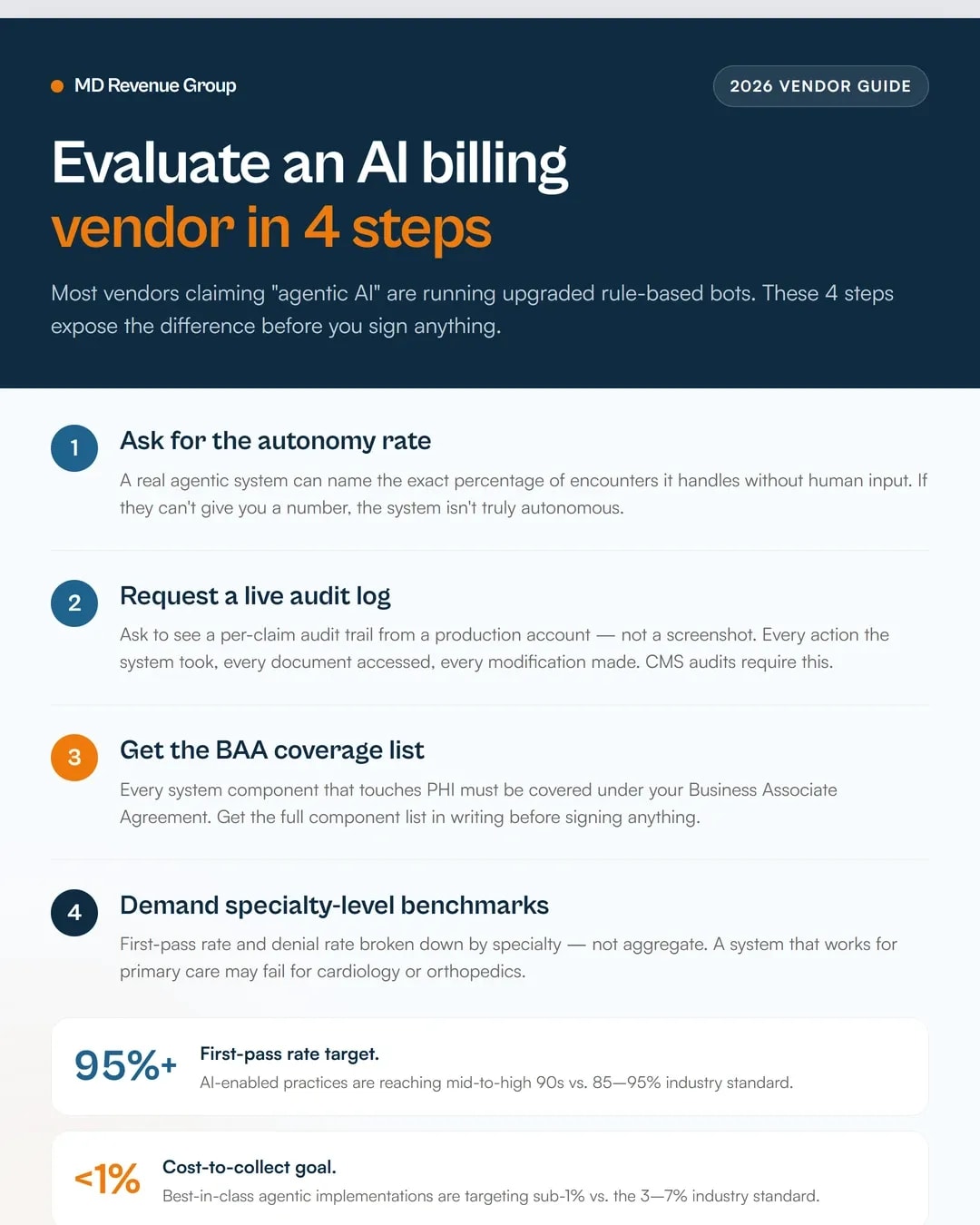
How to evaluate an AI billing vendor: 5 questions
The market is full of vendors who have bolted "AI" and "agentic" onto marketing copy for tools that are still fundamentally rule-based bots. These 5 questions cut through it.
1. What percentage of encounters does your system handle without human intervention, and what's your audit methodology for those cases?
A real agentic system can give you a specific number "” say, 82% fully autonomous, 18% human-reviewed. If they can't quantify it, the system isn't truly agentic.
2. Can you show me a per-claim audit log from a live production environment?
Ask to see an actual log, not a screenshot. If they hesitate, governance is not built in.
3. What are the defined escalation triggers "” the specific conditions that route a case to a human reviewer?
These should be documented and specific. "Complex claims" is not an escalation trigger. "Claims with CO-97 denial code where the procedure is a modifier-dependent service and the appeal window is under 30 days" is.
4. What is your BAA coverage, and which system components have access to PHI?
Every component that touches PHI needs to be covered. Get the list in writing before signing anything.
5. What is your first-pass rate and denial rate in production, by specialty?
Ask for it broken out by specialty. A system that performs well for general practice may perform poorly for high-complexity specialties like cardiology or neurology. If they only give you an aggregate number, push for the specialty breakdown.
Practices in states like New York, Pennsylvania, and Texas operate under different payer mix profiles, so specialty-level data matters especially if your practice sees a high volume of commercial payers.
What small and mid-size practices should do now
Full agentic orchestration requires a data infrastructure investment that most small practices can't build in-house. But that doesn't mean you're locked out.
The practical path for a 2"“10 physician practice in 2026 looks like this:
Step 1: Audit your current denial rate and cost-to-collect. You can't measure a vendor's impact if you don't know your baseline. Run a 90-day look-back on denial reasons, write-off rates, and AR days. If you don't have this data, that's the first problem to fix. Our free revenue audit generates this baseline in 48 hours.
Step 2: Choose a billing partner with documented AI governance, not just AI marketing. For most small practices, the fastest path to agentic AI benefits is through a billing company that has already built and validated the infrastructure. You don't need to build it "” you need a partner who has.
Step 3: Demand outcome benchmarks, not feature lists. First-pass rate, denial rate, cost-to-collect, and AR days. Those 4 numbers tell you more than any demo. Ask for them at 30, 60, and 90 days post-implementation.
Step 4: Establish a governance review cadence. Quarterly reviews of AI decision accuracy, escalation rate, and audit trail completeness. This isn't IT work "” it's a billing compliance function.
Practices across New Jersey, New York, and Connecticut are already seeing these benefits through properly structured billing partnerships. The technology gap between large health systems and independent practices is closing "” but only for practices that move from passive observation to active vendor evaluation now.
FAQ
What is agentic AI in medical billing? Agentic AI in medical billing is software that autonomously executes multi-step billing workflows "” including claim submission, denial management, and prior authorization "” without requiring human prompts at each step. It differs from standard AI tools, which recommend actions but require a human to act on them.
How much can agentic AI reduce cost-to-collect? Early adopter data reported by Becker's Hospital Review in 2026 shows cost-to-collect reductions of 30"“60% for practices using full agentic orchestration across the billing cycle. Industry standard cost-to-collect runs 3"“7% of net revenue; best-in-class implementations are targeting below 1%.
Is agentic AI safe for HIPAA compliance? It can be "” but only with the right governance design. Every system component that handles PHI must be covered under your BAA, decision boundaries must be explicitly documented, and per-claim audit logs must be accessible. Practices should request full governance documentation from any vendor before implementation.
What's the difference between agentic AI and RPA in billing? RPA executes fixed, scripted tasks and breaks when inputs deviate from expected formats. Agentic AI reads unstructured inputs, adapts to payer rule changes, handles exceptions, and executes across multiple systems to complete a goal. RPA automates the predictable; agentic AI handles the unpredictable.
What denial rate should I expect with AI billing? Industry average denial rates run 8"“12%. Practices using agentic AI for denial management are reporting rates below 5%, with a one-third reduction typically visible within 3 months of implementation (HFMA/FinThrive, 2026).
The bottom line
63% of billing organizations are using AI. 27% are using it at scale. The gap between those 2 numbers is where most practices currently sit: running a pilot, watching a demo, or evaluating vendors without a clear framework.
The practices that close that gap in the next 12 months will have cost structures and denial rates that make their current billing overhead look like a historical artifact.
The practices that wait will be competing against them.
Your revenue cycle management doesn't need a pilot program. It needs a production deployment with measurable benchmarks and a governance framework that holds up under audit.
Want to see where your practice stands against these benchmarks? Request a free Revenue Cycle Analysis from MD Revenue Group. We'll run your actual denial rate, cost-to-collect, and first-pass numbers "” and show you the gap between where you are and where agentic AI can take you.