
Hidden Operational Waste: How 'Lean Sigma' Is Finding $5K per Patient in RCM Leakage
Learn how Lean Sigma RCM operational waste audits identify hidden bottlenecks and stop $5K in revenue leakage per patient treatment lifecycle.
Practices lose revenue because of clunky billing processes. The term Lean Sigma RCM operational waste defines the invisible friction, administrative delays, and manual errors that drain clinical profits. When you analyze a patient lifecycle, these small leaks add up to $5,000 in lost collections.
You can find and plug these leaks using manufacturing efficiency principles. We will break down how to map your workflows, calculate your waste, and recover lost cash.
Key Takeaways
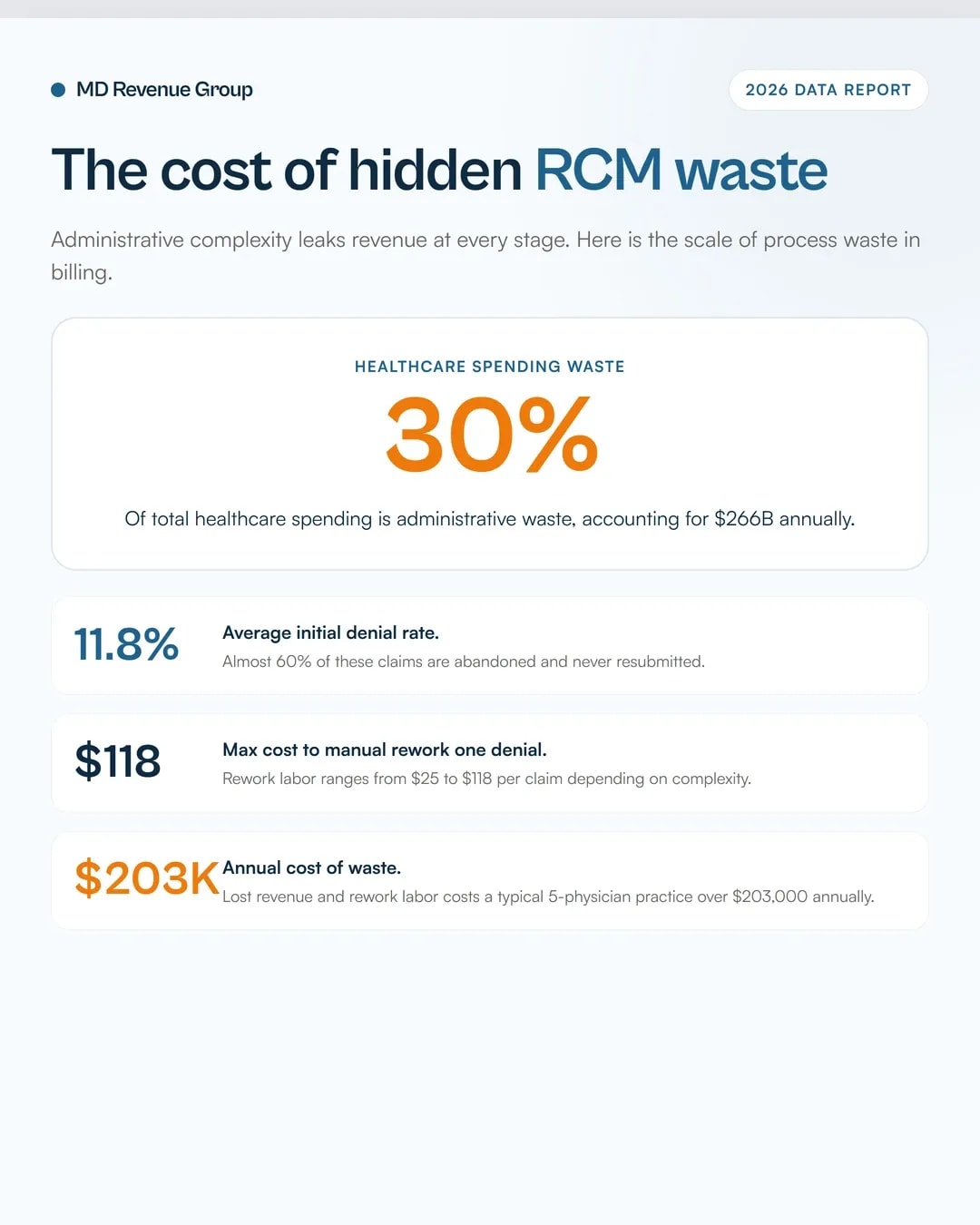
- Administrative Waste Costs: Administrative complexity costs U.S. healthcare $266B annually.
- Rework Tax: Resolving a single denied claim costs 118 in administrative labor.
- Leakage Point: Around 60% of denials are abandoned, leading to permanent revenue loss.
- Lean Action: Applying DMAIC identifies waste in waiting times, motion, and over-processing.
What is Lean Sigma RCM operational waste?
The concept of Lean Sigma originated on factory floors. It aims to eliminate waste and reduce process variation. In a medical office, waste is not scrap metal. Waste is the time your biller spends calling insurance companies. It is the stack of claims waiting for manual correction.
We group these inefficiencies into specific categories. Let's look at the core wastes in billing.
Defects
A defect is any claim sent with incorrect data. This includes transposed insurance numbers, outdated codes, or missing modifiers. Every defect causes a delay. It forces your staff to spend time resubmitting claims instead of filing new ones.
Waiting
Claims sit in systems. They wait for prior authorizations. They wait for provider signatures. This idle time slows your cash flow. If a claim sits for 10 days because a doctor did not sign a chart, your collections drop.
Over-Processing
This happens when staff check the same claim multiple times. If your biller checks eligibility, and your receptionist checks it again, you pay twice for the same task. Redundant reviews do not increase accuracy. They only consume resources.
Motion
Motion represents physical or digital steps. Opening 4 software screens to check one patient record is waste. Logging into multiple payer portals is waste. Every click takes 3 seconds. Over 100 patients daily, that is hours of wasted labor.
Non-Utilized Talent
This occurs when you pay a certified coder to scan papers. If your senior biller spends hours opening mail, you waste their training. You should assign administrative tasks to front-desk staff. Keep your billing experts focused on complex appeals.
Inventory
In a clinic, inventory is outstanding claims. It is the work in progress. A backlog of 500 unsubmitted claims is money sitting on a shelf. It represents cash you cannot spend. You must keep your claims inventory as low as possible.
Managing these leaks requires structured revenue cycle management processes. You must treat billing as a continuous system, not a series of isolated tasks.
How process bottlenecks leak $5K per patient lifecycle
Most managers think revenue loss happens because patients do not pay. The real loss happens because of administrative gaps during care. In specialized medicine, this leakage routinely reaches $5,000 per patient.
Let's look at the numbers. Consider a patient undergoing orthopedic surgery or oncology treatment. The lifecycle spans multiple visits, drug administrations, and scans.
Waste Point | Process Inefficiency | Revenue Leaked |
|---|---|---|
Pre-Authorization | Prior auth obtained but not linked to claim | $1,200 |
Documentation | Physician notes omit exact drug dosage units | $1,800 |
Modifier Coding | Missing modifier 59 on secondary procedures | $850 |
Charge Capture | Unbilled supplies used in the procedure room | $650 |
Underpayments | Payer pays below contract rate; no appeal | $500 |
Total Leakage | Accumulated process waste per patient | $5,000 |
This leakage occurs silently. The biller sees a paid claim and moves on. They do not notice that the payment was 1,200 drug line item was rejected.
A comprehensive medical billing audit reveals these lost items. Most practices find that their software reports clean claims, while their bank accounts show steady losses.
Let's look at a real scenario. A 4-physician cardiology clinic in New Jersey experienced cash flow issues. Their initial denial rate sat at 14%. Their billing software showed a 95% clean claim rate.
We mapped their workflows. The clinic staff spent 22 minutes per patient entering registration details. Because of double-entry in their EHR and practice management system, they transposed insurance IDs on 8% of claims.
This error triggered automated downcoding. The practice lost 112,800.
In device-intensive procedures, staff often fail to document the specific implant barcodes. During one audit, we found 14 cases where the clinic omitted the C1713 modifier. That single omission leaked $4,200 per procedure. The insurance company denied the entire implant cost. The practice absorbed the loss.
Implementing DMAIC: a step-by-step framework for practices
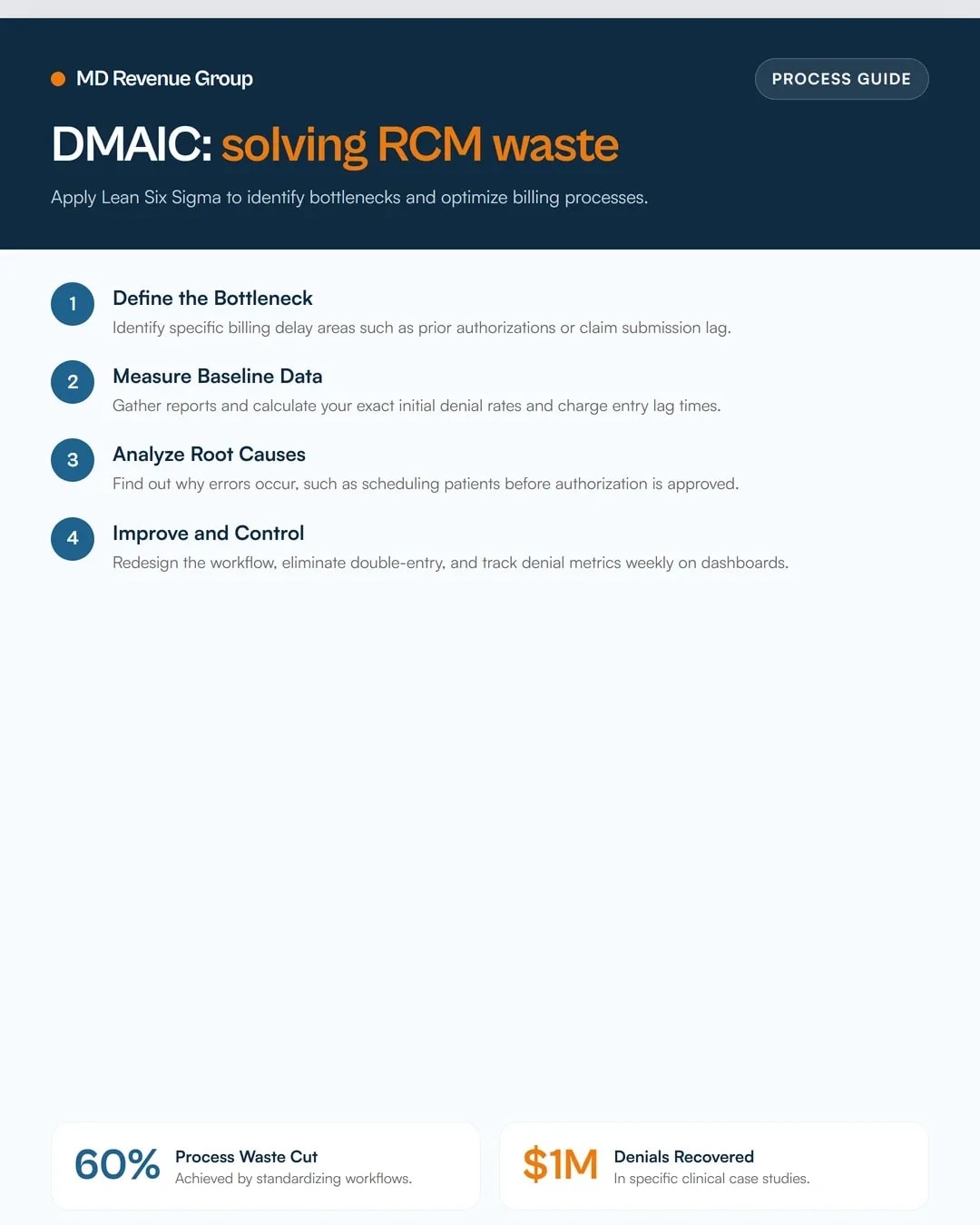
You can fix these issues using the DMAIC framework. This structure provides a path to improve billing metrics.
Define ──> Measure ──> Analyze ──> Improve ──> ControlDefine
Identify the specific billing issue. You might select your prior authorization denial rate. Specify the goal, such as reducing prior auth denials by 50% in 90 days. Write this goal on a whiteboard. Make sure your team agrees on the target.
Measure
Gather baseline data. Do not guess. Check your billing reports. Calculate your exact initial denial rate. Measure the time between patient check-in and claim submission.
If your staff takes 5 days to enter charges, document that delay. You cannot fix what you do not measure.
Analyze
Find the root cause. If claims are denied for missing authorizations, ask why. You might discover that patients get scheduled before the authorization is approved.
Payer requirements change constantly. This is a common source of prior authorization automation failure in modern practices.
We often find that staff do not understand payer rules. For instance, a payer might require prior auth for CPT code 93015 but not for code 93000. If your staff treats both codes the same, denials follow.
Improve
Redesign the process. You could establish a rule. No patient is scheduled for a procedure until the authorization number is saved in the scheduler.
Eliminate the double-entry screens. Introduce a single portal for eligibility verification. This change alone saves hours of manual labor.
Control
Set up monitors. Track your denial rate weekly. Create a dashboard for your staff. If the denial rate rises above 5%, audit the previous week's claims immediately.
You should review your coding patterns monthly. Verify that modifiers are applied correctly. Keep a log of coding corrections to train your team.
For complex workflows, utilizing outsourced medical billing services helps standardize these control steps. External teams often have automated rules engines that prevent errors from escaping.
Lean Sigma checklist for practice managers
This checklist helps identify operational waste in your office. Walk through your billing department and look for these signs.
- [ ] Double-Entry: Staff type patient names, IDs, or codes in more than one system.
- [ ] Payer Portal Hopping: Billers log into multiple websites daily to check eligibility manually.
- [ ] Unsigned Notes: Providers have outstanding charts from 5 or more days ago.
- [ ] Claim Lag: The average time from patient visit to claim submission exceeds 3 days.
- [ ] No Contract Audit: Your contract rates are not loaded into your software to verify payments.
- [ ] Manual Rework: Staff print claims to correct errors with white-out or handwriting.
- [ ] No Batch Processing: Billers process claims one by one instead of in daily batches.
- [ ] Outdated Coding Books: Your team relies on printed coding books from 2024 to verify 2026 codes.
If you check 3 or more boxes, your process has waste. You need to simplify the workflow.
The financial ROI of workflow audits
Process improvements require time. You must train staff and audit files. The financial return justifies this effort.
Let's calculate the Cost of Waste (COW) for a typical practice. We will use benchmarks from industry reports.
According to Purdue University, administrative waste accounts for 30% of total healthcare spending. The Medical Group Management Association (MGMA) reports that reworking a single denied claim costs 118 in labor.
Consider a practice seeing 15,000 patients annually.
If the practice has an 11.8% initial denial rate, they process 1,770 denials.
MGMA data shows that 60% of denials are never resubmitted. This leads to 1,062 abandoned claims.
If the average reimbursement is $150 per claim, the lost revenue is substantial.
Over 3 years, this process waste costs the practice $610,650.
You can find detailed breakdowns of these operational costs in our guide on how much medical billing services cost to compare models.
Annual Rework Labor:    $44,250
Annual Lost Revenue:    $159,300
Total Annual Loss:      $203,550
3-Year Waste Total:     $610,650
Eliminating waste increases profitability. You do not need to see more patients. You just need to collect the money you already earned.
Let's compare this to the cost of doing nothing. If you ignore the bottlenecks, the waste continues. Your staff becomes frustrated by repetitive rework. They burn out and leave.
MGMA reported that replacing a billing specialist costs 9,000 in additional waste. Lean processes protect your cash flow and stabilize your team.
Practices operating in high-volume regions benefit from localized support. Partnering with New Jersey medical billing services ensures compliance with local payers and regulations.
If you want to find your exact leakage points, we can help. Request a process review to identify the bottlenecks in your billing cycle.
Struggling with billing waste? We audit RCM workflows and find the revenue leaks. Request a free audit.